

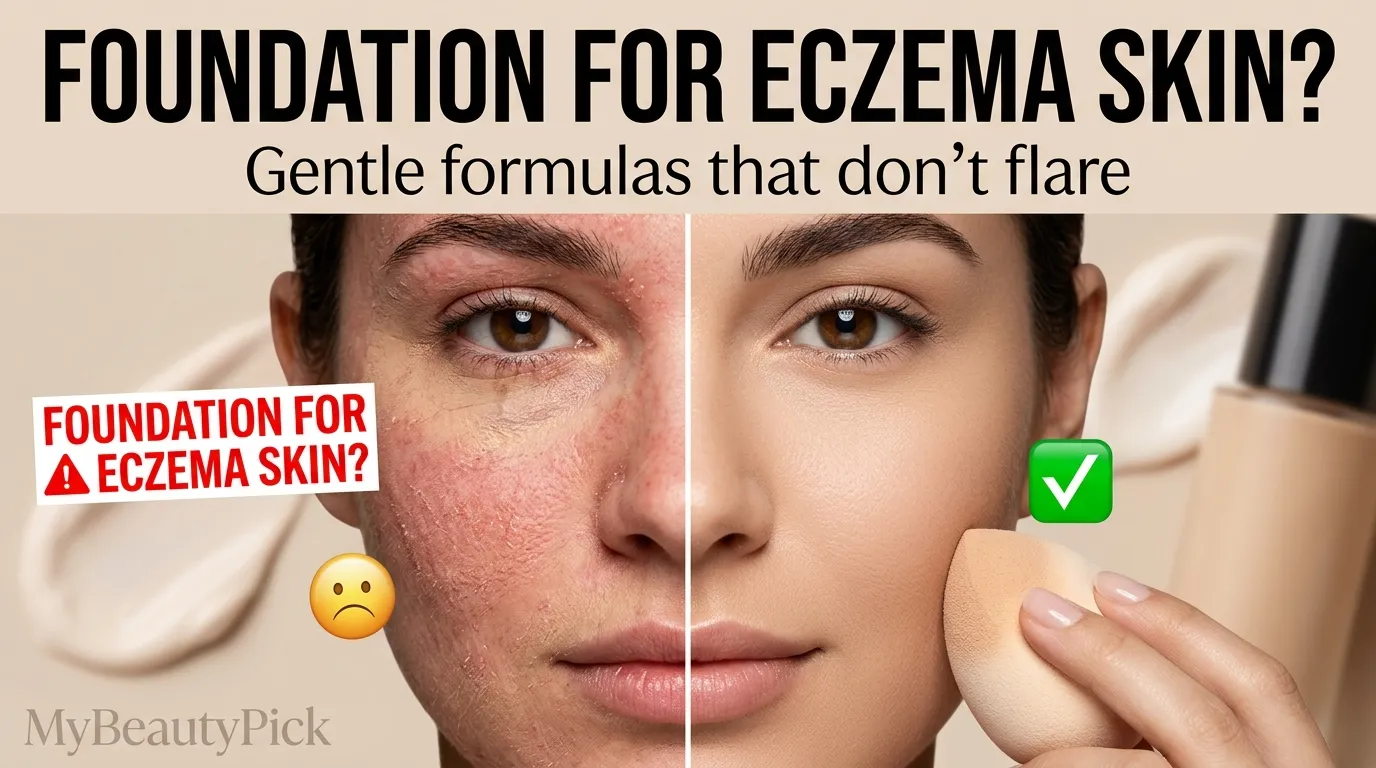
Eczema-prone skin and foundation have a complicated relationship. The right formula can even out redness and flaky patches without sitting in a single dry spot. The wrong one can turn a calm week into a flare by Thursday. After years of prepping clients with atopic dermatitis, seborrheic dermatitis, and perioral dermatitis for weddings and shoots, I have a clear list of what actually works and what looks fine on the shelf but causes trouble on real skin.
This guide covers the best foundation for eczema-prone skin, what separates a safe formula from a risky one, and how the right pick changes depending on whether your dermatitis shows up as dry patches, oily flaking, or bumps around the mouth and nose.
Quick Answer
The best foundation for eczema-prone skin is fragrance-free, alcohol-free, and built around barrier-supporting ingredients like ceramides, hyaluronic acid, and glycerin. Liquid or serum foundations work best for dry, flaky eczema, while lightweight mineral formulas suit oily or bumpy dermatitis. Always patch test for 24 to 48 hours before applying anything to your full face.
What Makes a Foundation Eczema-Safe
Eczema means a compromised skin barrier, so the goal with foundation is not just coverage, it is choosing a formula that will not push that barrier further. I look at two lists with every new client: what the formula avoids, and what it actively contributes to the skin.
| Avoid | Look For |
|---|---|
| Fragrance and essential oils (lavender, citrus, peppermint) | Fragrance-free, hypoallergenic labeling |
| Sulfates and drying alcohols | Glycerin, hyaluronic acid for hydration |
| Formaldehyde-releasing preservatives, parabens | Ceramides, niacinamide for barrier support |
| Propylene glycol in high concentrations | Zinc oxide for calming and sun protection |
| Heavy silicones on perioral dermatitis specifically | National Eczema Association Seal of Acceptance |
None of these ingredients guarantee a reaction or guarantee safety on their own. Eczema is highly individual, and what flares one person’s skin can be completely fine on someone else’s. The table above is a starting filter, not a final answer, which is why patch testing always comes before full application.
The Hero Ingredients Worth Seeking Out
Barrier Support
Ceramides are lipids that help rebuild the skin’s natural barrier. For eczema-prone skin, a foundation with ceramides works with your skin rather than just sitting on top of it.
Hydration
This humectant pulls moisture into the skin and helps a foundation sit smoothly over dry, flaky patches instead of clinging to them and looking patchy by midday.
Calming
Niacinamide helps support the skin barrier and can ease the look of redness, which makes it especially useful for eczema flares that show up as blotchy or inflamed patches.
Mineral Coverage
Zinc oxide offers gentle coverage and broad-spectrum sun protection at the same time, and it tends to sit well on inflamed or reactive skin compared to chemical sunscreen filters.
Best Foundation Type Depends on Where Your Dermatitis Shows Up
This is the part most articles skip, and it is the most useful thing I tell clients. “Eczema” and “dermatitis” cover several different presentations, and the foundation that helps one type can make another worse.
Atopic Eczema: Dry, Flaky Patches on Cheeks or Jawline
Go with a liquid or serum-based foundation with a dewy or natural finish. These formulas pack in humectants and won’t grip onto dry, flaky texture the way a powder will. Apply over a freshly moisturized face for the smoothest result.
Seborrheic Dermatitis: Greasy Patches With Flaking
This one is counterintuitive because the skin can be oily and flaky at the same time. A lightweight, oil-free liquid foundation with buildable coverage works better than a heavy dewy formula, which can sit on top of greasy patches and look heavier than intended.
Perioral Dermatitis: Bumps Around the Mouth or Nose
Skip heavy liquid foundations, silicones, and alcohol-based primers here. A finely milled mineral powder foundation lets the skin breathe and is far less likely to trap bacteria in the affected area. Apply with a clean brush or freshly washed hands, never a sponge that has been sitting out.
If you are not sure which type of dermatitis you are dealing with, treat the area gently rather than guessing. A mineral powder is the safest default across all three presentations while you confirm the diagnosis with a dermatologist.
Foundation Picks Worth Trying
These are formulas that consistently come up among dermatologists and people actually living with eczema and dermatitis. None of them are a guaranteed fit for your skin specifically, so treat this as a shortlist to patch test, not a final answer.
bareMinerals BarePro Liquid Foundation
A lightweight liquid with buildable coverage that layers well over a hydrating moisturizer.
Pros: fragrance-free option, blends easily, won’t grip onto flaking
Cons: shade range can run light on deeper skin tones
Tower 28 SunnyDays Tinted SPF 30
Carries the National Eczema Association Seal of Acceptance and combines sheer coverage with sun protection in one step.
Pros: fragrance-free, dermatologist-developed, doubles as SPF
Cons: sheer coverage won’t fully conceal active redness
Oil-Free Buildable Liquid Foundations
Look for any liquid foundation explicitly labeled oil-free and non-comedogenic in this category, applied in thin layers.
Pros: won’t add grease on top of already-oily patches
Cons: may need a setting powder on the T-zone by midday
Talc-Free Mineral Powder Foundations
Finely milled mineral powders let skin breathe around the nose and mouth where perioral dermatitis tends to flare.
Pros: silicone-free, lower bacteria-trapping risk, gentle application
Cons: less full-coverage than liquid, can settle into deep texture
How to Apply Foundation Without Triggering a Flare
- Patch test first. Apply a small amount to your inner forearm and wait 24 to 48 hours before using it on your face.
- Prep with a fragrance-free moisturizer. Hydrated skin gives foundation something smooth to sit on instead of grabbing onto dry texture.
- Use clean tools. A freshly washed synthetic brush or clean fingertips cause far less irritation than natural-bristle brushes or a sponge that has been sitting in a makeup bag.
- Apply in thin layers. Building coverage gradually looks more natural and reduces the amount of product sitting on inflamed skin at once.
- Remove thoroughly at night. A gentle, fragrance-free cleanser at the end of the day prevents leftover product from sitting on the skin overnight.
Common Mistakes That Make Eczema-Prone Skin Worse
- Skipping the patch test because a product is labeled “natural” or “for sensitive skin.” Those labels are not regulated promises.
- Applying foundation directly over an active, weeping, or broken flare instead of waiting for it to calm down.
- Using a heavy, full-coverage liquid on perioral dermatitis, which traps bacteria and prolongs the bumps.
- Reapplying foundation throughout the day without removing the previous layer first, which builds up irritants.
- Assuming a foundation that worked during a calm season will still be safe during a flare, when skin is far more reactive.
When to Skip Foundation Entirely
If a patch is actively weeping, cracked, or broken, skip makeup on that area until it heals. Covering broken skin increases infection risk and slows healing. See a dermatologist if flares are frequent, severe, or not responding to gentle care, since they can identify your specific triggers and recommend treatment beyond what any foundation can offer.
FAQs
What is the best foundation for eczema-prone skin?
The best foundation for eczema-prone skin is fragrance-free, alcohol-free, and formulated with barrier-supporting ingredients like ceramides, hyaluronic acid, and niacinamide. Liquid or serum formulas suit dry, flaky eczema, while lightweight mineral powders work better for oily or bump-prone dermatitis around the nose and mouth.
Is mineral or liquid foundation better for eczema?
It depends on where your flares show up. Liquid and serum foundations hydrate and blend smoothly over dry, flaky patches typical of atopic eczema. Mineral powders breathe better and carry lower irritation risk for seborrheic or perioral dermatitis, where oiliness or bacteria-trapping is more of a concern.
What ingredients should I avoid in foundation if I have dermatitis?
Avoid fragrance, essential oils, sulfates, drying alcohols, formaldehyde-releasing preservatives, and parabens. If you have perioral dermatitis specifically, also avoid heavy silicones, which can trap bacteria around the mouth and nose and prolong the flare.
Can wearing foundation make eczema worse?
It can, if the formula contains fragrance, harsh preservatives, or alcohol, or if it is applied over an active, broken flare. A gentle, fragrance-free formula applied with clean tools over moisturized skin is far less likely to cause a problem than a heavy, full-coverage product applied carelessly.
Should I see a dermatologist before choosing a foundation for eczema?
If your flares are frequent, severe, or you are not sure which type of dermatitis you have, yes. A dermatologist can identify your specific triggers and recommend a treatment plan, which gives you a much clearer starting point for choosing safe makeup.