

Mineral foundation is the most consistently misunderstood category in makeup. The term appears on everything from talc-heavy pressed powders to genuinely mineral-only loose formulas to liquid foundations that contain mineral pigments alongside a full synthetic base. Understanding what mineral actually means — and what it does not mean — is what separates a formula that genuinely suits sensitive skin from one that uses the word as a marketing badge. This guide covers the best mineral foundations across pressed powder, loose powder, and liquid formats, and explains exactly what to look for and what to avoid.
What to Know Before You Buy
- “Mineral foundation” has no regulatory definition. It ranges from 100% mineral-only formulas (zinc oxide, titanium dioxide, mica, iron oxides) to conventional foundations that simply contain some mineral pigments alongside synthetic binders, fillers, and chemicals.
- Bismuth oxychloride is a common ingredient in many “mineral” pressed powder foundations. It is the most likely cause of breakouts and irritation attributed to mineral formulas — it is not present in true mineral-only products.
- Flashback — the grey-white reflection in flash photography — is the primary concern for tan and medium-deep skin. It comes from titanium dioxide and zinc oxide at high concentrations.
- Liquid mineral foundations suit dry, mature, and sensitive skin far better than loose or pressed powder. They carry the same low-irritation mineral pigments in a hydrating base, with none of the dry powder finish.
- True mineral foundations (loose powder) have a coverage ceiling of medium and cannot be built to full coverage. For deeper coverage with sensitive skin, a liquid mineral formula or a mineral-hybrid liquid is more realistic.
What “Mineral Foundation” Actually Means
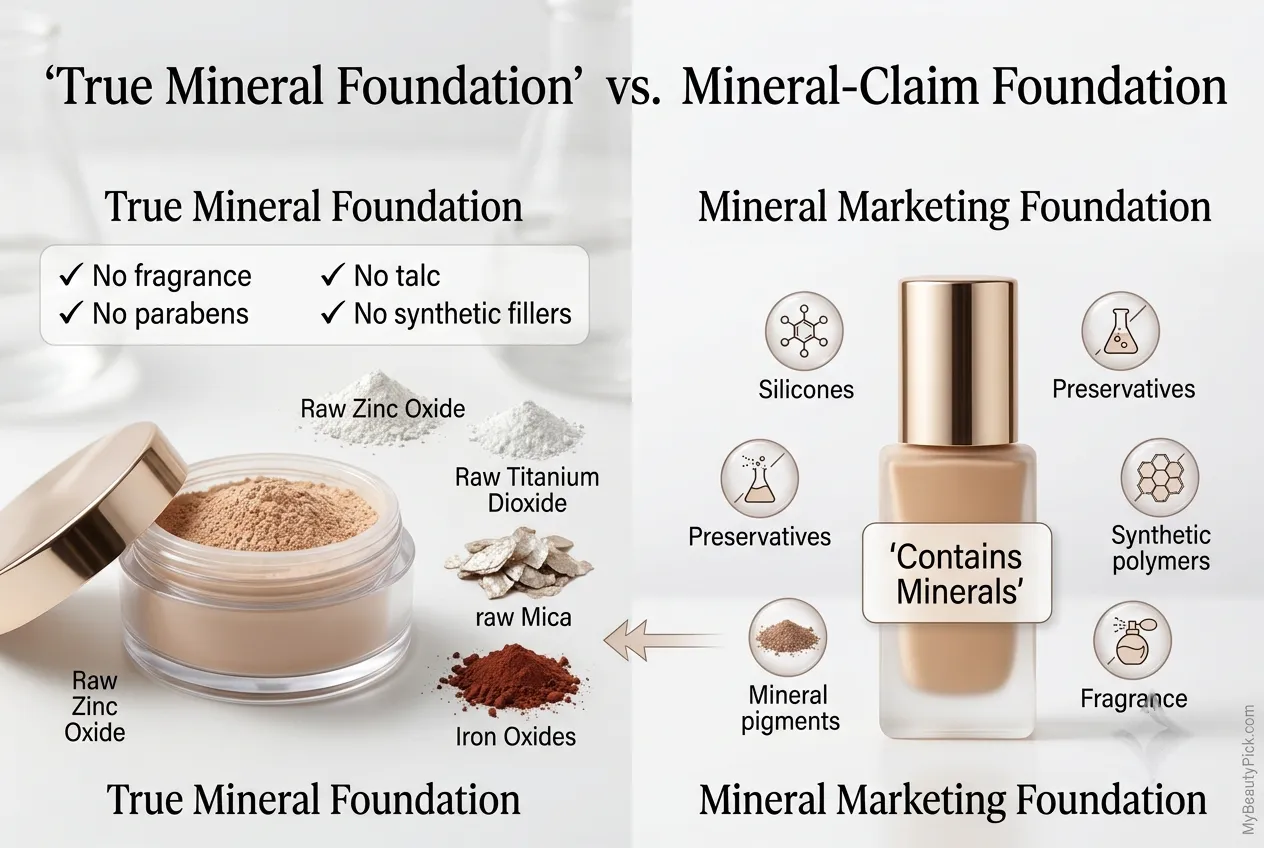
In formulation terms, a 100% mineral foundation contains only inorganic mineral-derived ingredients: zinc oxide, titanium dioxide, mica, and iron oxides, with no synthetic binders, fillers, parabens, fragrance, or liquid carriers. The result is a loose or pressed powder built entirely from particles that exist in the earth. Nothing synthetic, nothing added. This is the original mineral foundation concept, and it is what bareMinerals popularised in the late 1990s.
In marketing terms, “mineral foundation” is applied broadly to any formula containing some mineral-derived ingredients — which now includes almost every foundation on the market, because iron oxides and mica are universal. A conventional liquid foundation with dimethicone, polymers, preservatives, and fragrance can legitimately claim “contains minerals” on packaging if it also lists mica and iron oxides. The claim is accurate but misleading.
The distinction matters because the skin benefits associated with mineral foundation — low irritation, anti-inflammatory zinc oxide, no fragrance, no parabens — only apply to formulas that are genuinely mineral-dominant. A liquid foundation with a synthetic polymer base and a splash of zinc oxide for SPF is not functionally equivalent to a loose mineral powder for sensitive skin.
The Core Ingredients in True Mineral Foundation
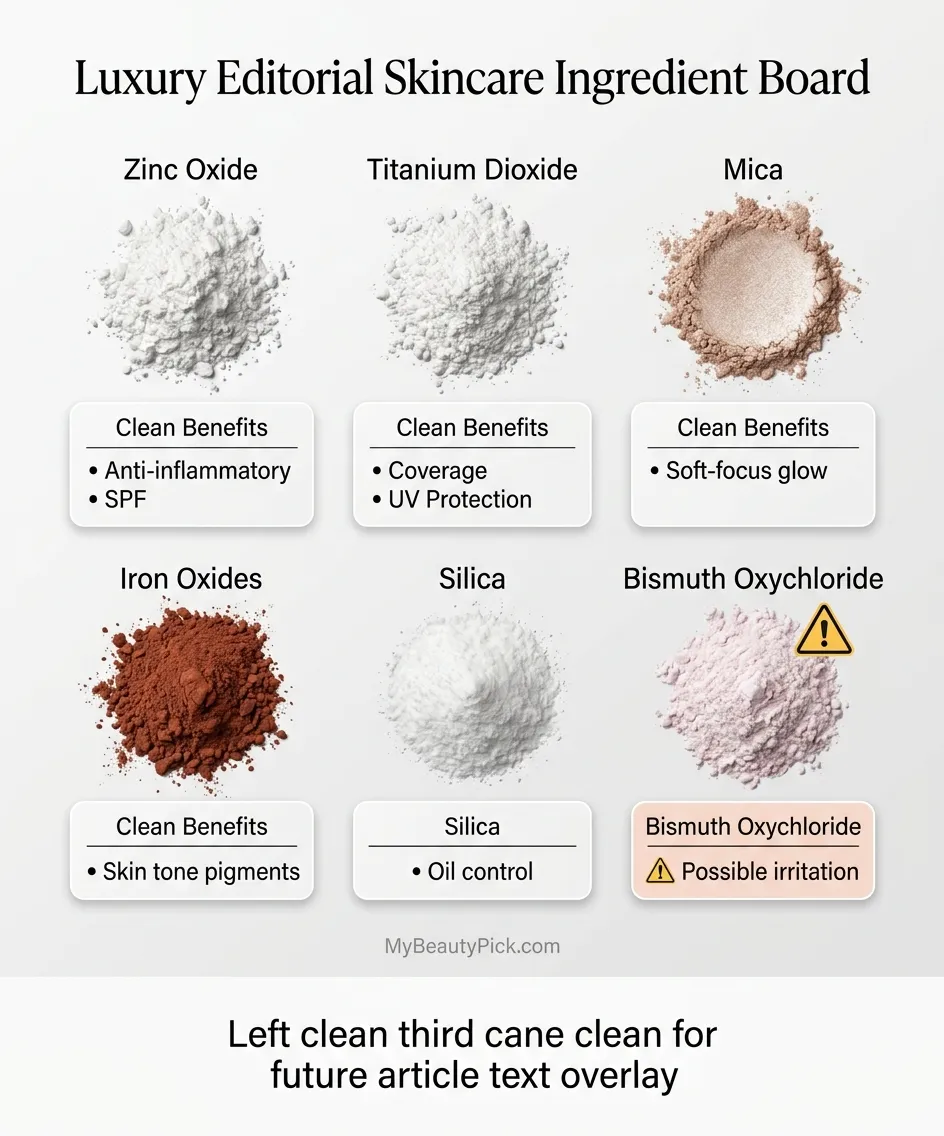
Zinc Oxide
Coverage, SPF, anti-inflammatory
The active component of mineral foundation that provides UV protection and natural anti-inflammatory benefits. Zinc oxide at 15 to 25% gives natural SPF of approximately 15 to 30. It is non-irritating, non-comedogenic, and useful for acne-prone skin because of its mild antibacterial properties. High concentrations cause flashback in photography on deeper skin tones.
Titanium Dioxide
White pigment, opacity, SPF
The primary coverage agent in mineral formulas. It is the white pigment that creates opacity and concealment. Also contributes to SPF alongside zinc oxide. At high concentrations it can leave a white cast on tan and medium-deep skin and is the primary cause of flashback in photos. Finely milled titanium dioxide is less likely to cause visible cast.
Mica
Light diffusion, soft-focus finish
A naturally occurring reflective mineral that creates the soft-focus, skin-smoothing effect mineral foundations are known for. Mica scatters light in multiple directions, which blurs the visible appearance of pores and surface texture without reflecting intensely. It also gives the formula its characteristic luminous, not-quite-matte quality.
Iron Oxides (CI 77491, 77492, 77499)
Skin-tone pigments
The warm-to-deep skin tone colourants present in all mineral formulas. Red, yellow, and black iron oxides are combined to create the full shade range. They react with oxygen and skin oils over time (oxidation), though this is less significant in powder formulas than in liquids because the dry particle format limits iron oxide exposure to skin oils.
Silica
Oil absorption, pore blurring
A mineral-derived powder that absorbs excess sebum and creates a blurring effect over pores. Present in most loose and pressed mineral formulas. Increases the matte quality of the finish and extends wear on oily skin. Also helps the formula feel light and breathable rather than heavy.
Bismuth Oxychloride — Flag This One
Filler in many pressed “mineral” formulas
Bismuth oxychloride is a synthetic compound found in many pressed powder mineral foundations. It gives formulas a pearlescent, skin-smooth quality but is the most common cause of itching, breakouts, and irritation attributed to “mineral” makeup. It is not present in true 100% mineral formulas. If your skin has reacted to a “mineral” foundation, check for bismuth oxychloride before assuming all mineral formulas will cause the same reaction.
Bismuth oxychloride appears in a significant number of “mineral” pressed powder foundations including some well-known lines. It is not a mineral-only ingredient and its presence is the most common reason people experience irritation after switching to what they believe is a gentler mineral formula. A genuinely irritation-free mineral foundation for sensitive skin should have no bismuth oxychloride, no talc, no fragrance, and no parabens. Check the INCI list on the product before purchasing.
Mineral Foundation Formats: Which One Suits Your Skin
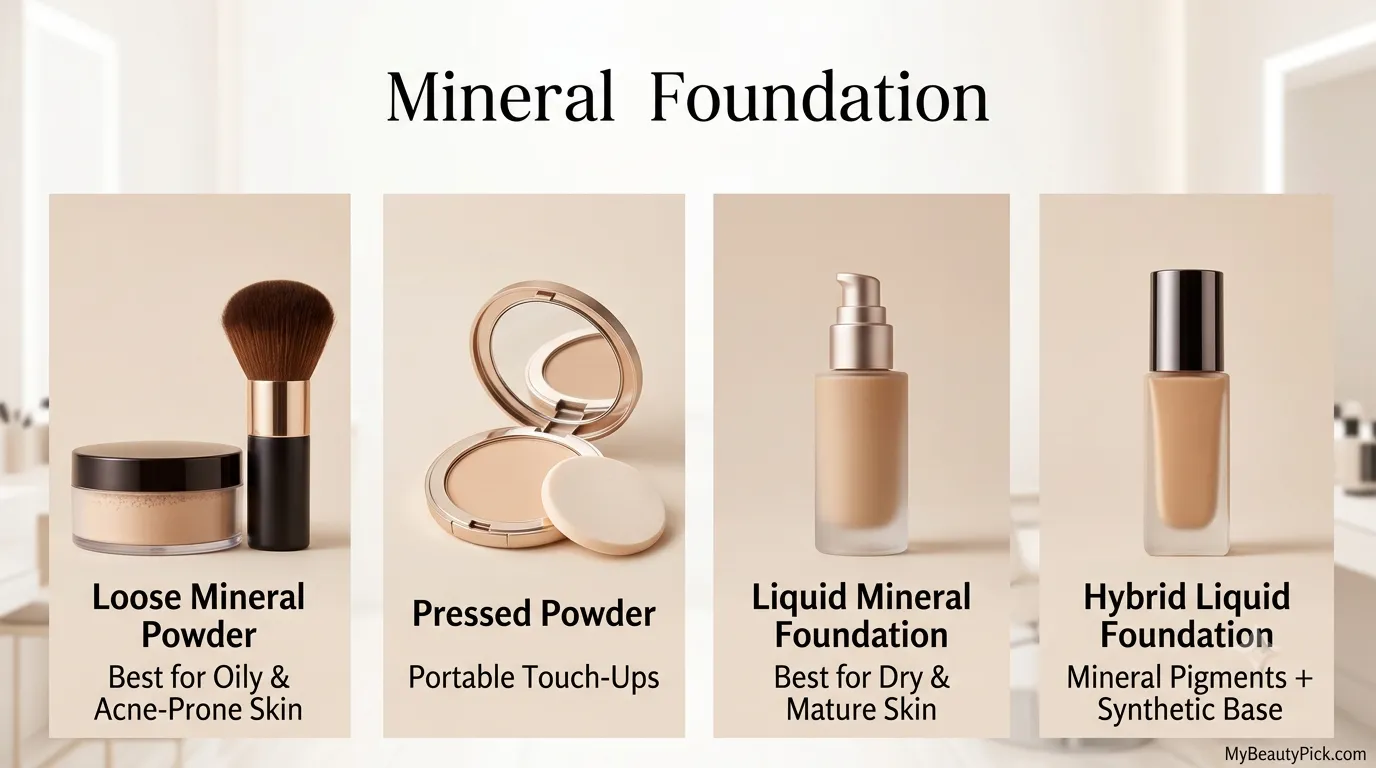
Loose Mineral Powder
The original mineral foundation format. Entirely dry particle formula — no binders, no liquid carrier. Requires a specific buffing technique (swirl, tap, buff) to apply evenly. Gives the lightest, most breathable finish.
Best for: oily, acne-prone, and sensitive skin. Not for dry or dehydrated skin — the powder finish emphasises dryness and fine lines. Coverage ceiling is medium. Application is messier than pressed powder or liquid.
Pressed Mineral Powder
Mineral pigments compressed into a compact with binders to hold the form. More portable and easier to apply than loose powder. Coverage and finish are similar to loose powder but slightly more controlled.
Best for: normal to combination skin, touch-ups throughout the day, layering over liquid foundation. Check for bismuth oxychloride — pressed formulas are more likely to contain it than loose powder formulas.
Liquid Mineral Foundation
Mineral pigments (zinc oxide, titanium dioxide, iron oxides) in a hydrating liquid base. Carries the SPF and low-irritation benefits of mineral pigments with the coverage and application ease of a standard liquid foundation.
Best for: dry, mature, sensitive, and combination-dry skin. Gives more coverage than powder mineral, a more comfortable wear, and none of the mess. The best mineral option for anyone who finds loose powder too light or difficult to apply.
Mineral Hybrid Liquid
A standard liquid or serum foundation that uses mineral pigments alongside synthetic carriers, polymers, and other cosmetic ingredients. Claims “mineral” due to the pigment sourcing but is not functionally a mineral foundation in terms of irritation profile or ingredient simplicity.
Most foundations on the market fall here. The “mineral” claim is technically accurate but does not confer the same skin benefits as a true mineral-dominant formula. Suitable for all skin types but should not be chosen specifically for sensitive skin on the basis of a mineral claim alone.
Flashback: The Mineral Foundation Problem on Tan Skin
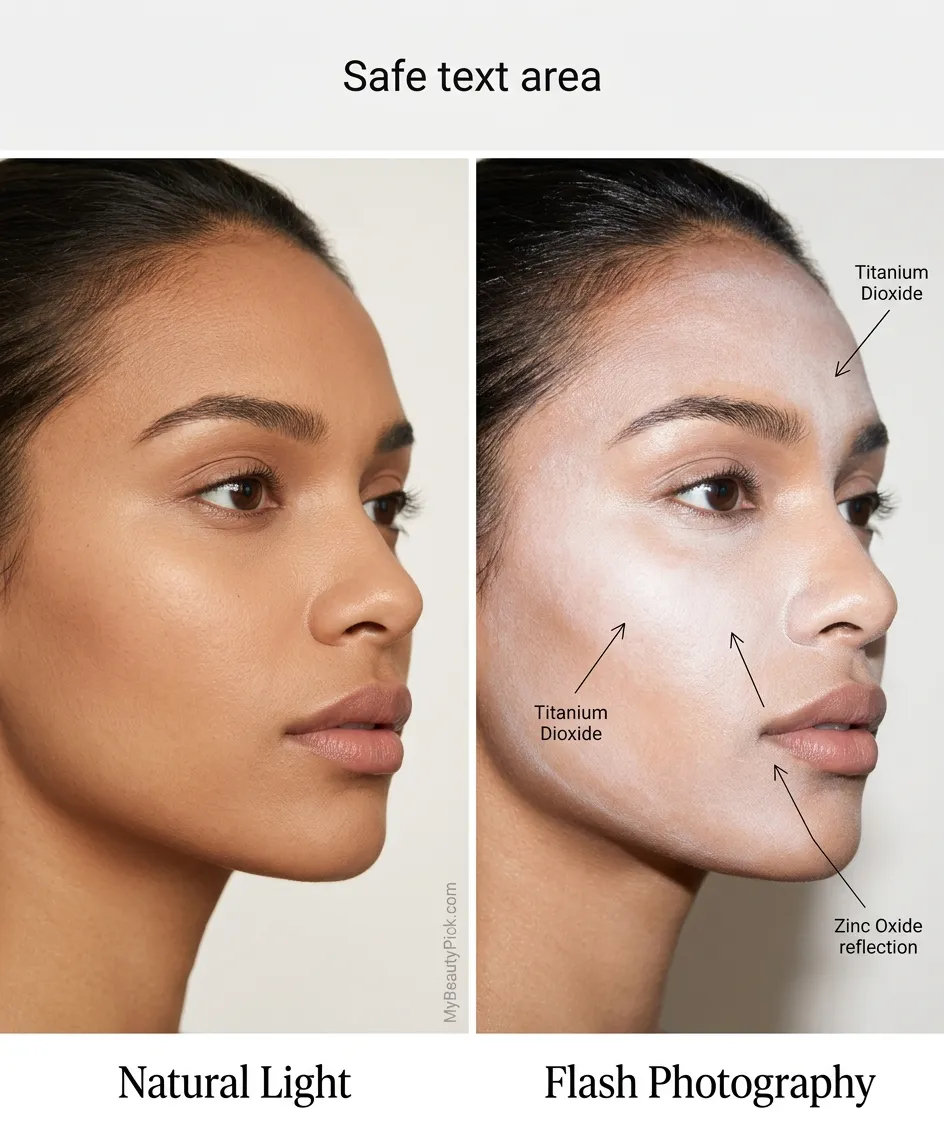
Flashback is the grey-white reflection that appears in flash photography over areas where high-SPF or mineral foundations are applied. It comes from titanium dioxide and zinc oxide — both physically reflective particles that bounce flash light back toward the camera rather than absorbing it. On fair skin, this effect reads as a subtle brightening. On tan and medium-deep skin, the contrast between the foundation’s reflected light and the surrounding skin is sharper, producing a ghostly white zone on the face in photos.
Several factors determine how much flashback a mineral formula produces. Higher zinc oxide percentage increases flashback risk. Titanium dioxide similarly — but coarser, less finely milled particles are worse. Mica adds to reflectivity without the same grey quality. And layering a mineral foundation over an SPF that also contains zinc oxide doubles the reflective particle load on the skin surface, which significantly worsens flashback.
If you want to use mineral foundation but cannot accept flashback risk on tan skin: look for formulas with zinc oxide below 15% and finely milled titanium dioxide, rather than the coarser particle versions. Apply a chemical SPF (no reflective particles) underneath rather than layering two mineral-SPF products. Some brands — like bareMinerals Complexion Rescue and jane iredale’s liquid Mineral Primer — are specifically formulated to reduce flashback in their deeper shade ranges.
The Best Mineral Foundations
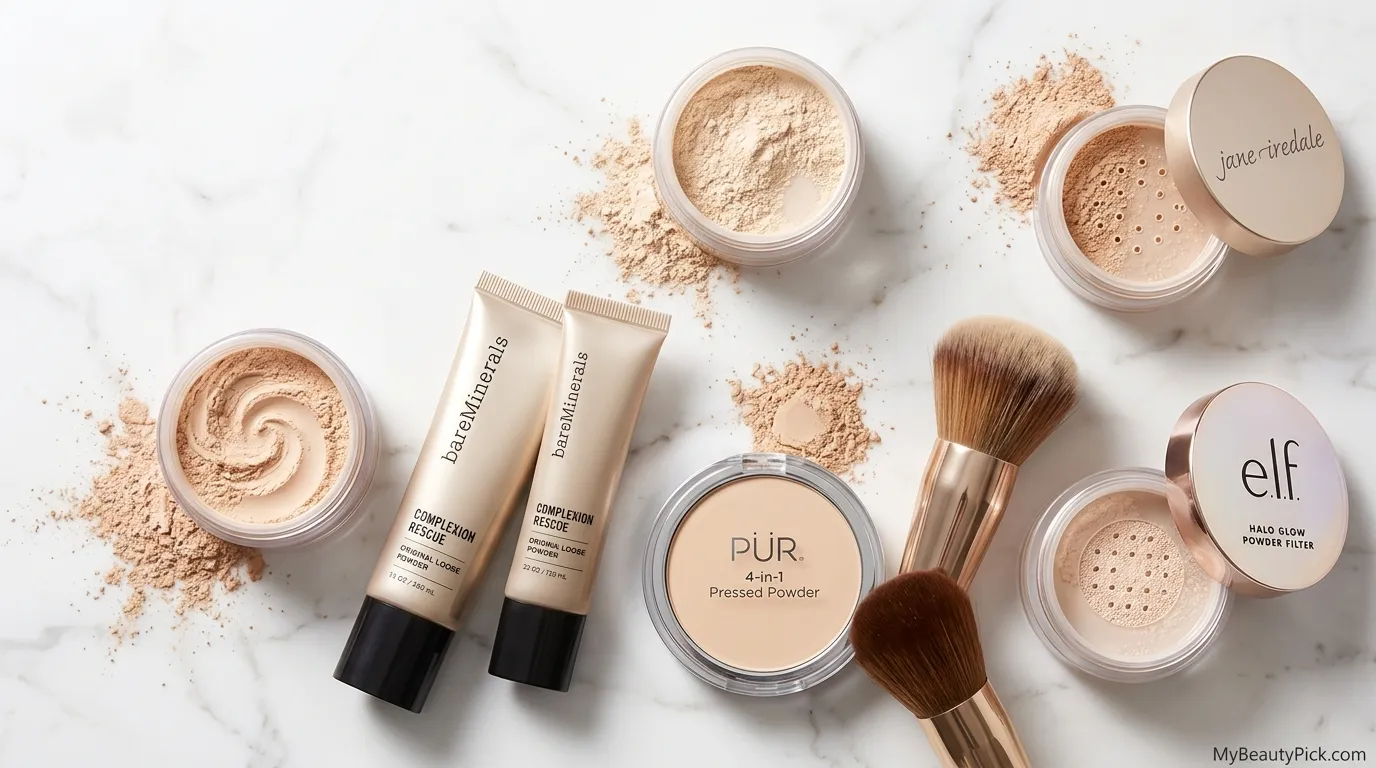
bareMinerals Original is the product that established loose mineral foundation as a mainstream category, and it earns that legacy. The formula is five ingredients: titanium dioxide, zinc oxide, mica, bismuth oxychloride-free (the original formula), and iron oxides. No talc, no parabens, no fragrance, no synthetic binders. It is one of the few formulas that genuinely suits post-procedure skin, active breakouts, and reactive conditions including rosacea — because there is genuinely very little in it to irritate.
Coverage is honestly light to medium. One application produces a skin-evening, pore-softening effect. Multiple buildable layers approach medium but do not reach full coverage for significant PIH or scarring. The application technique — swirl, tap, and buff with a dense kabuki brush — takes practice to master. Too much product creates a cakey, dusty effect. The right amount produces a natural skin-like finish that photographs well and holds comfortably on most skin types.
- Genuinely minimal ingredient list — suitable for reactive and post-procedure skin
- Anti-inflammatory zinc oxide calms redness and active breakouts
- SPF 15 natural sun protection built in
- No bismuth oxychloride in the original formula
- Breathable, lightweight finish — does not feel like wearing product
- 30+ shades including medium-depth tan options
- Coverage ceiling is medium — not for heavy PIH or scarring
- Messy application — loose powder is difficult to use on the go
- Application technique requires practice to avoid dustiness
- Not for dry or mature skin — powder finish emphasises lines
- Some deeper shades have flashback risk in photography
For tan skin: The shade range covers tan to medium-deep reasonably well, with warm and neutral options in the medium range. The flashback risk increases in the deeper shades because titanium dioxide concentration is consistent across the shade range but the contrast against deeper skin is more visible. For tan skin using this in situations involving photography, apply a setting spray to reduce surface particle reflection and check in natural daylight before flash-heavy events.
Complexion Rescue is what loose mineral powder cannot be: a liquid mineral formula built for dry and mature skin. The base is a hydrating gel-cream carrying mineral SPF 30 alongside hyaluronic acid and plant-based actives. The finish is natural and slightly dewy — skin reads as healthy and alive rather than powdery or flat. It applies like a serum-tinted moisturiser and provides the kind of wear comfort that loose powder completely lacks on drier skin types.
Coverage is lighter than standard liquid foundation. It evens tone, reduces redness, and gives a polished finish, but it won’t conceal active blemishes or significant hyperpigmentation in a single layer. Two layers approach medium coverage. For dry sensitive skin that needs more coverage, a targeted concealer over specific problem areas is more effective than building the Complexion Rescue itself.
- Comfortable hydrating wear for dry skin — no powder finish issues
- Mineral SPF 30 without the white cast of a separate SPF product
- Suitable for sensitive, reactive, and post-procedure skin
- One product replaces SPF, moisturiser, and light coverage
- Easy fingertip application — no specialist brush needed
- Only 20+ shades — narrower range, fewer deep options than liquid formulas
- Not for oily skin — dewy finish amplifies shine without setting spray
- Not full coverage — cannot replace concealer for significant PIH
- Darker shades may show flashback in photography
For tan skin: The shade range for tan and medium-deep skin is narrower than the Original loose powder. The medium tan and tan shades (Natural 06, Tan 07, Dusk 08) cover the lighter end of the tan spectrum. The formula’s slightly dewy finish works with tan skin’s natural warmth rather than flattening it. Wear with a light dusting of setting powder on the T-zone only to extend wear without losing the hydrated finish on the cheeks.
PÜR’s pressed mineral powder is among the few pressed formulas that keeps the bismuth oxychloride-free promise while adding a Ceretin Complex of encapsulated retinol, ceramides, and lactic acid for ongoing skin benefit under the coverage. The four-in-one claim covers foundation, concealer, SPF 15, and skin treatment — which is an overstatement, but the formula does function as both a standalone foundation and a reliable touch-up compact over liquid foundation through the day.
Coverage is genuinely medium in a single layer, which is above average for a pressed mineral powder. The soft-focus finish blurs surface texture without the dusty, flat quality of some mineral compacts. It is cruelty-free and vegan, talc-free, paraben-free, and formulated without the irritants commonly found in mass-market pressed powders. The shade range covers medium to deep more generously than most mineral compact lines.
- No bismuth oxychloride, talc, or parabens
- Encapsulated retinol and ceramides — rare in a pressed powder
- Medium coverage stronger than most mineral compacts
- Works as standalone foundation or touch-up compact over liquid
- Vegan and cruelty-free
- More portable than loose powder with comparable coverage
- Not for dry skin — powder finish is still a powder finish
- Retinol concentration in a powder is too low for significant skin treatment
- Narrower shade range than liquid foundations
- SPF 15 is insufficient for extended outdoor sun protection
- Flashback risk in deeper shades in photography
For tan skin: The tan-to-medium-deep shade range is better than most pressed mineral compacts, with warm and neutral undertone options from the MG4 through MG8 range. The natural soft-focus finish reads well on tan skin in regular lighting. For flash photography, check the shade under direct flash before an event — the titanium dioxide content can produce visible flashback in medium-deep shades. Layering a setting spray over the powder at the end of the application reduces particle reflectivity on the surface.
jane iredale positions itself as “The Skincare Makeup” and the Amazing Base earns that description more consistently than most mineral lines. The formula is dermatologist- and allergy-tested, free from bismuth oxychloride, talc, and fragrance, and specifically recommended by dermatologists for patients with rosacea, contact dermatitis, and post-laser skin. Coverage for a loose powder formula is genuinely above average — the titanium dioxide concentration is higher than in bareMinerals Original, which increases coverage and SPF (rated at 20) while also increasing flashback risk in deep shades.
The shade range is narrow at 12 shades — jane iredale’s limitation across most of its powder line. For tan and medium-deep skin, the Warm Sienna, Caramel, and Warm Brown shades are the most used options, with limited undertone variety within the tan range.
- Specifically formulated for rosacea and reactive skin
- Higher coverage for a loose powder format
- SPF 20 — stronger protection than most mineral foundations
- No bismuth oxychloride, no talc, no fragrance
- Dermatologist and allergy tested
- Long track record for post-procedure use
- Only 12 shades — significant limitation for tan and deep skin
- Higher titanium dioxide means increased flashback risk on deeper skin
- Prestige pricing at ~$54
- Narrow shade range limits undertone matching for tan skin
- Not for dry or mature skin
For tan skin: The narrow shade range is the main obstacle. Warm Sienna suits light tan skin; Caramel covers medium tan with a warm undertone; Warm Brown reaches into deeper tan tones. None cover medium-deep or deep skin adequately. For tan skin with rosacea or significant reactive skin concerns, this is still one of the most effective mineral options available — but shade matching will be more of a compromise than with liquid formulas.
This is the accessible entry point into mineral-style pressed powders. e.l.f. is fully vegan and cruelty-free, and the Halo Glow Powder is a mineral-hybrid formula — mineral pigments in a binder system — rather than a pure mineral product. The distinction matters: this does not carry the same low-irritation profile as a true mineral foundation and should not be the first choice for rosacea or highly reactive skin. For normal to combination skin wanting a pore-blurring, luminous finishing powder at a drugstore price, it performs reliably.
The shade range at eight is very limited, making it most useful as a finishing layer over a matched liquid foundation rather than a standalone. Used that way, the slight shade mismatch is less visible because the coverage is so sheer.
- Most accessible price in any mineral-style pressed powder
- Blurs pores and surface texture effectively for a powder
- Vegan and cruelty-free brand-wide
- Works well as finishing layer over liquid foundation
- Light enough not to cause caking when used correctly
- Only 8 shades — limited for tan and deep skin
- Not a true mineral formula — not specifically low-irritation
- Sheer coverage only — cannot stand alone for coverage needs
- Not for very oily skin as a standalone
For tan skin: Shade 5 Tan and shade 6 Rich are the options. Shade 5 works for light-to-medium tan skin as a finishing powder over a matched liquid foundation. Shade 6 covers medium-tan reasonably. Neither shade adequately covers medium-deep or deeper skin tones. The soft glow finish adds a warmth and dimension to tan skin that makes it a useful finishing tool even when used over a different foundation entirely.
Mineral Foundation Formats Compared
| Product | Format | Coverage | Best Skin Type | Flashback Risk | Tan Skin Range |
|---|---|---|---|---|---|
| bareMinerals Original | Loose powder | Light–medium | Oily, acne, sensitive | Moderate in deeper shades | Good — 30+ shades |
| bareMinerals Complexion Rescue | Liquid gel-cream | Light–medium | Dry, combo-dry, mature, sensitive | Low with correct shade | Limited — 20+ shades |
| PÜR Minerals 4-in-1 | Pressed powder | Medium | Normal, combo, oily | Moderate in deeper shades | Moderate — some tan options |
| jane iredale Amazing Base | Loose powder | Medium (strong for format) | Rosacea, reactive, sensitive | Higher — elevated TiO₂ | Poor — 12 shades only |
| e.l.f. Halo Glow Powder | Pressed hybrid | Sheer–light | Normal, combo as finishing layer | Low | Limited — 8 shades |
How to Apply Loose Mineral Powder Foundation Correctly
Loose mineral powder is the most technique-dependent foundation format. Apply it correctly and it produces a natural, breathable coverage that feels like nothing. Apply it wrong and it sits on top of skin in visible patches and falls into lines. Most complaints about mineral foundation — dustiness, patchiness, a grey cast — come from incorrect application rather than a formula problem.
Moisturise and allow full absorption — especially important for mineral powder
Dry skin, dehydrated skin, and unabsorbed skincare all cause loose mineral powder to cling unevenly. The powder needs a smooth, hydrated surface to buff evenly across. Apply a light moisturiser, allow five to eight minutes of full absorption, and blot any surface excess with a tissue before applying powder.
Use a dense, dome-shaped kabuki brush — not a fluffy powder brush
A fluffy brush deposits powder loosely and unevenly. A dense, dome-shaped kabuki brush (flat-top or full dome) presses the mineral particles into the skin rather than laying them on top. This produces fuller coverage and prevents the “floating on top of skin” look that gives mineral foundation its patchy reputation when applied incorrectly.
Swirl, tap, then buff — in that order
Swirl the kabuki brush into the powder jar to load the bristles. Tap the brush against the back of your hand or the edge of the jar to remove excess powder — this is the step most people skip and the main cause of powdery patchiness. Then buff the loaded brush across the skin in small circular motions, working from the centre of the face outward. The tapping step removes excess that would otherwise sit on top of the skin rather than blend in.
Build coverage in layers — one thin layer at a time
One light layer of mineral powder, fully buffed. Assess coverage. If more is needed, repeat the swirl-tap-buff with a very lightly loaded brush. Two or three thin layers, fully buffed between each, produce better coverage than one heavy application. Never press a heavily loaded brush directly into the skin — the result is uneven deposit and the grey, dusty quality mineral foundations are criticised for.
Finish with a setting spray to reduce flashback and settle the powder
A fine mist of setting spray from 25 to 30 centimetres melds the mineral particles together and reduces surface reflectivity, which decreases flashback risk in photography. It also transitions the powder finish from dry to slightly more skin-like, particularly useful on tan skin where a flat dry finish can look grey in some lighting.
Frequently Asked Questions
What is the best mineral foundation for sensitive skin?
bareMinerals Original Loose Powder Foundation and jane iredale Amazing Base are the two most consistent mineral foundations for genuinely sensitive skin. Both are free of bismuth oxychloride, talc, fragrance, and parabens — the four most common irritants in pressed powder foundations. For dry or combination-dry sensitive skin, bareMinerals Complexion Rescue (liquid) is a better option because it carries mineral SPF and low-irritation mineral pigments in a hydrating liquid base rather than a dry powder format that can emphasise sensitivity-related dryness.
What is the best mineral pressed powder foundation?
PÜR Minerals 4-in-1 Pressed Mineral Powder delivers the strongest coverage for a pressed mineral compact, along with a skincare active complex (encapsulated retinol, ceramides, lactic acid), and a bismuth oxychloride-free, talc-free formula. It is the most capable pressed mineral option for normal to combination skin that wants medium coverage in a portable format. For sensitive skin specifically, bareMinerals Original remains the more conservative and skin-safe choice.
Does mineral foundation cause breakouts?
Genuine 100% mineral foundation formulas (zinc oxide, titanium dioxide, mica, iron oxides only) are among the least comedogenic foundations available. Zinc oxide has mild antibacterial and anti-inflammatory properties that can actually reduce breakout frequency on acne-prone skin. The most common cause of breakouts attributed to “mineral” foundations is bismuth oxychloride — a synthetic compound present in many pressed powder mineral formulas that is a known pore irritant. If a “mineral” foundation is causing breakouts, check for bismuth oxychloride on the ingredient list before assuming the category is unsuitable for your skin.
Can mineral foundation be used on oily skin?
Loose mineral powder is one of the best foundation options for oily skin. The dry powder format absorbs excess sebum naturally throughout wear, silica controls shine, and zinc oxide reduces the excess oil production that aggravates acne. There is no water or silicone carrier to mix with sebum and break down. The limitation is coverage — loose mineral powder reaches medium coverage at most, which may not be sufficient for significant PIH or scarring common on oily-breakout-prone skin. Set the T-zone lightly and carry the compact for touch-ups rather than adding powder on top of sebum mid-day.
Why does mineral foundation look grey or cause flashback on tan skin?
The grey appearance and flashback in photography come from titanium dioxide and zinc oxide — physically reflective white particles that bounce light back rather than absorbing it. On fair skin, this reads as a subtle brightening. On tan and medium-deep skin, the contrast between the reflected white light and the deeper surrounding skin is sharper, producing a white or grey zone in flash photography. To reduce flashback: choose finely milled formulas with zinc oxide below 15%, avoid layering multiple SPF products (which doubles the reflective particle load), finish with a setting spray, and test in flash photography before important events.
Is mineral foundation the same as natural or clean foundation?
No. “Mineral,” “natural,” and “clean” are three different claims with different meanings and different levels of regulation. Mineral refers to the pigment source. Natural means ingredients derived from natural sources. Clean is a marketing term without regulatory definition, used variably across brands. A mineral foundation is not automatically natural (it may contain synthetic binders or preservatives) and is not automatically clean by any consistent standard. A genuinely 100% mineral formula with no synthetic additions is the most specific and verifiable of the three claims, which is why it matters more than the other two for sensitive skin.