

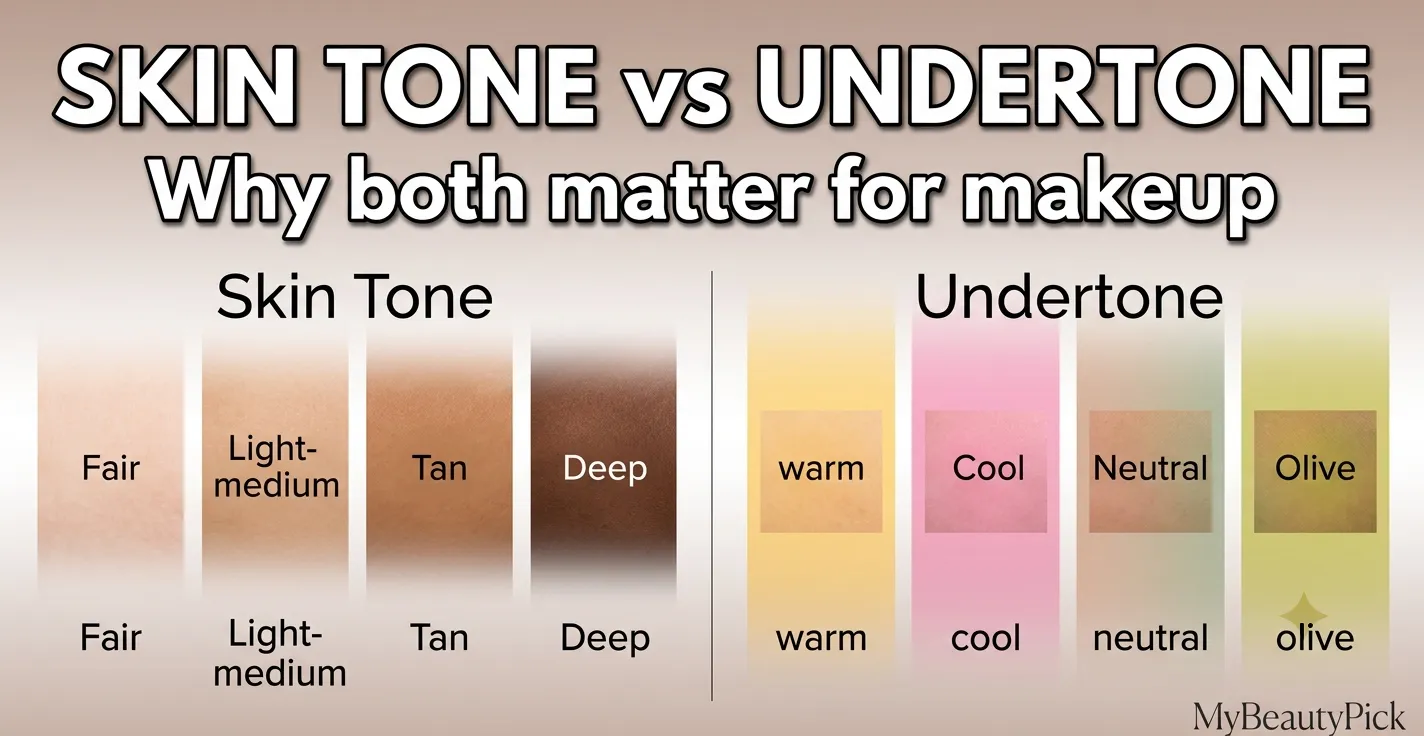
Skin tone is the surface color of your complexion, driven by melanin and grouped into fair, light, medium, tan, or deep. Undertone is the fixed hue beneath the skin, classified as warm, cool, neutral, or olive. Skin tone shifts with sun exposure; undertone never does. Foundation, blush, and lipstick only look natural when both are matched together, not separately.
I have shade-matched faces across every depth and undertone combination you can think of, and the single most common complaint I hear at the counter is some version of “this looked fine in the bottle and wrong on my face.” Almost every time, the client matched their skin tone and ignored their undertone, or matched their undertone and picked the wrong depth. They are not the same thing, and treating them as one decision is exactly why foundation drawers fill up with bottles that get used twice and abandoned.
Key Takeaway
Skin tone tells you how light or deep to go. Undertone tells you how warm, cool, neutral, or olive that depth needs to lean. You need both numbers to land on the right shade, the same way you need both a size and a fit to buy jeans that actually work.
What Is Skin Tone?
Skin tone is the color you see when you look in the mirror with no makeup on. It comes down to melanin, the pigment your skin produces, and how much of it your body makes. Most foundation lines sort skin tone into broad bands: fair, light, medium, tan, and deep, sometimes split further into ten or more numbered shades within a single line.
Skin tone is not fixed. A week in the sun, a self-tanner, or even a change in season can shift it a shade or two lighter or darker. This is exactly why I tell clients to recheck their foundation match at the start of summer and again in late fall. The bottle that matched in March can sit half a shade off by August.
What Is Undertone?
Undertone is the hue working underneath your skin’s surface color, and it does not move when your skin tone does. There are four working categories I use chairside:
- Warm: golden, peachy, or yellow cast beneath the skin
- Cool: pink, red, or blue cast beneath the skin
- Neutral: a balanced mix of warm and cool, with no hue dominating
- Olive: a green-gold cast common on medium to deep complexions, often mistaken for plain warm or plain neutral
Olive gets shortchanged in most beauty content, and it is the undertone I correct foundation purchases for most often. A true olive complexion needs a base with a touch of green-gray balancing the gold, not a standard warm shade and not a standard neutral. Reach for a straight warm or straight neutral on olive skin and it tends to sit too yellow or too flat.
| Factor | Skin Tone | Undertone |
|---|---|---|
| What it measures | Surface color, light to deep | Hue beneath the surface |
| Cause | Melanin production | Blood vessels and pigment composition |
| Does it change? | Yes, with sun, season, self-tanner | No, stays constant for life |
| Common categories | Fair, light, medium, tan, deep | Warm, cool, neutral, olive |
| Main makeup use | Sets the depth of your shade | Sets the color family of your shade |
Why Both Matter Together for Makeup
Here is what most guides skip. Two people can share the exact same skin tone and need completely different foundations because their undertones differ, and two people can share the exact same undertone and need completely different foundations because their skin tone differs. Depth and hue are independent variables. You have to solve for both at once.
Picture two clients with medium skin tone sitting in my chair back to back. One has a cool undertone and needs a rosy-beige base; the wrong gold-leaning medium shade turns her sallow and tired-looking by midday. The other has a warm undertone and needs a honey or golden-beige base; a cool-leaning medium shade leaves her looking flat and slightly gray, like the color is sitting on top of the skin instead of in it. Same tone, opposite result, because undertone was the variable nobody checked.
Expert Tip
When a foundation “disappears” into the jawline but the face still looks off in photos, the depth is right and the undertone is wrong. When the foundation sits visibly on top of the skin no matter how well you blend, the undertone might be close but the depth is off. Learning to tell these two problems apart will save you more returns than any single test.
How to Find Your Skin Tone
- Cleanse your face and let it sit bare for ten minutes with no products on it.
- Stand in natural daylight, not overhead indoor lighting, which flattens and distorts color.
- Compare your bare jawline to a fair, medium, and deep reference swatch if you have one, or to the back of your hand in the same light.
- Note whether your tone looks closer to ivory and porcelain, beige and golden, caramel and honey, or espresso and deep mahogany. These rough bands map to fair, light, medium, and deep on most shade charts.
How to Determine Your Undertone
No single test is foolproof on its own. I always run at least two before I trust a result, especially on deeper or olive complexions where surface pigment can mask the underlying hue.
The Vein Test
Look at the veins on the inside of your wrist in natural light. Blue or purple veins point to a cool undertone. Green or olive-green veins point to warm or olive. Veins that look like a blend of both, or are genuinely hard to call, suggest neutral.
The Jewelry Test
Hold gold and silver jewelry against your jawline or wrist in daylight. Skin that lights up next to gold usually leans warm. Skin that looks brighter and cleaner next to silver usually leans cool. If both look equally good, that is a strong neutral signal.
The White Fabric Test
Hold a plain white cloth or paper against your bare face. If your skin reads noticeably pink or rosy against it, you are likely cool. If it reads more golden or yellow, you are likely warm. Minimal shift either way points to neutral.
Where These Tests Fail
The vein test struggles on deep skin, where veins can be hard to read regardless of undertone, and it struggles on very fair skin, where veins read blue almost universally. Lighting temperature, recent sun exposure, and even skin thickness can throw off all three tests. Treat them as a starting point, then confirm with an actual foundation swatch on the jawline, not the hand or the inner arm, which run a different undertone than the face.
Foundation Matching by Tone and Undertone
| Tone + Undertone | Look for shades labeled | Avoid |
|---|---|---|
| Fair, cool | Porcelain, ivory, rose | Golden or honey-leaning fair shades |
| Fair, warm | Ivory-beige, vanilla, warm fair | Pink or rose-leaning fair shades |
| Medium, neutral | Natural, sand, buff | Strongly rosy or strongly golden medium shades |
| Medium to tan, olive | Olive, golden-green, neutral-olive | Standard warm shades; they often read too yellow |
| Deep, warm | Caramel, honey, amber | Cool deep shades; they can read ashy |
| Deep, cool | Espresso, mahogany, deep rose | Warm deep shades; they can read orange |
Watch for Oxidation
Many liquid foundations shift darker and warmer fifteen to thirty minutes after application as the formula reacts with your skin’s natural oils. A shade that looks perfect at the counter can read a shade too deep and too orange by the time you leave the store. Always swatch, wait, walk around, and check again in daylight before you commit. If you run warm naturally, size down half a shade to account for oxidation.
Common Mistakes When Matching Foundation
- Testing on the hand or inner arm. These areas run a different undertone than your face. Always swatch along the jawline and blend into the neck.
- Relying on one test alone. The vein test, jewelry test, and fabric test can each be thrown off by lighting or skin thickness. Cross-check at least two.
- Shopping under fluorescent store lighting. Step outside or near a window before you decide. Indoor lighting can make a cool shade look neutral or a warm shade look muted.
- Ignoring oxidation. Buying the shade that looks right in the first sixty seconds, before the formula has had time to settle and shift.
- Assuming neutral means “anything works.” True neutral undertones still skew slightly warm or slightly cool in most people. A fully balanced fifty-fifty undertone is rare.
- Treating olive as a shade of warm. Olive needs its own green-balanced formulas. Standard warm shades on olive skin tend to oxidize yellow.
Beyond Foundation: Undertone in Blush, Lipstick, and Eyeshadow
Warm Undertone
Coral, peach, and brick blush; terracotta and warm red lipstick; gold, copper, and bronze eyeshadow tend to read most natural.
Cool Undertone
Rosy pink and berry blush; blue-red and mauve lipstick; silver, plum, and cool taupe eyeshadow tend to read most natural.
Neutral Undertone
Most blush and lipstick families work, though true neutrals often look best slightly desaturated rather than at full saturation in either direction.
Olive Undertone
Brick, rust, and warm rose blush; brownish-red and muted berry lipstick; gold-bronze and olive-green eyeshadow tend to flatter without clashing against the green cast in the skin.
This is the part most foundation-focused guides skip entirely. Undertone does not stop mattering once your base is on. A cool blush on a warm undertone can look bruised instead of flushed. A warm lipstick on a cool undertone can look muddy instead of rich. The same logic that picks your foundation should drive the rest of the face.
Frequently Asked Questions
Can your undertone change over time?
No. Undertone stays constant from birth. What changes is skin tone, the surface color, which shifts with sun exposure, season, and self-tanning. If a foundation that used to match no longer does, the depth has likely changed, not the undertone.
What if my undertone tests give different answers?
That usually points to a neutral or olive undertone. When vein color, jewelry, and fabric tests do not agree clearly, skip the categorization and go straight to swatching neutral and olive-leaning foundation shades on your jawline in daylight.
Is olive the same as warm undertone?
No. Olive carries a green-gold cast that standard warm formulas do not account for. Foundations built for warm undertones often oxidize too yellow on olive skin. Look for shades specifically labeled olive or neutral-olive.
Why does my foundation look different in photos than in the mirror?
Camera flash and phone cameras tend to exaggerate undertone mismatches that natural light hides. If foundation looks fine in person but off in photos, the undertone match is usually slightly loose, even if the depth is correct.
Should I match foundation to my neck or my face?
Match to your jawline and blend down into the neck. The face and neck are usually close enough in tone that this gives the most natural transition, while the hand or inner arm can be a full undertone off.