

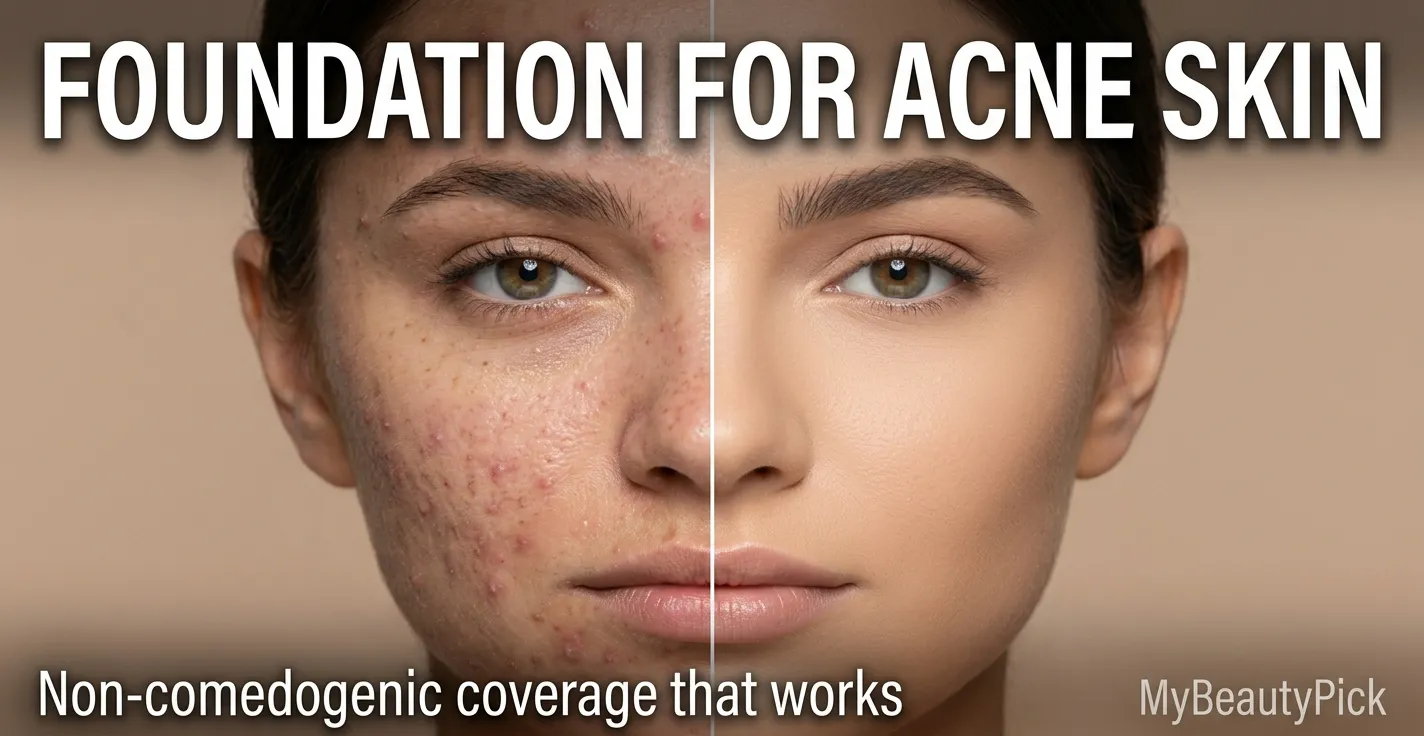
Finding the best foundation for acne-prone skin is less about brand name and more about formula. The wrong ingredients — heavy oils, pore-clogging waxes, synthetic fragrances — can turn a daily makeup routine into a breakout trigger. The right one does the opposite: it covers blemishes without aggravating them and can even actively support clearer skin.
The key concept to understand is non-comedogenic — a term you’ll see on almost every foundation marketed toward breakout-prone skin. It means the formula is designed to avoid ingredients known to block pores and stimulate comedones (the technical name for blackheads, whiteheads, and clogged pores). It is a brand claim rather than a regulated certification, which means reading the actual ingredient list still matters — but it’s a reliable starting filter.
In this guide, we’ve broken down our top non-comedogenic foundation picks by coverage level — from barely-there skin tints to full-coverage formulas strong enough to camouflage cystic acne and post-inflammatory hyperpigmentation. Whether you’re managing a single hormonal breakout or persistent adult acne, there’s a formula for you.
“The best foundation for acne-prone skin acts as an extension of skincare — it soothes, shields, and supports the skin barrier while providing breathable coverage.”— Dermatologist guidance on acne-safe formulas
What Actually Makes a Foundation Safe for Breakout-Prone Skin?
Not all foundations labeled “non-comedogenic” are created equal. When makeup formulas contain occlusive oils, heavy waxes, or irritating chemicals, they can worsen acne by trapping sebum, bacteria, and dead skin cells against the skin surface. The result is inflamed pores, new breakouts, and prolonged healing time for existing ones.
Board-certified dermatologists point to a few non-negotiables when choosing a foundation for breakout-prone skin. First: the formula should be oil-free — meaning the base is water or silicone rather than a plant or mineral oil. Second: it should list no known comedogenic ingredients in the top half of the ingredient list, where concentration is highest. Third: it should be fragrance-free, since synthetic and natural fragrances alike can trigger inflammatory responses in sensitised skin.
Dermatologist Note: Board-certified dermatologist Dr. Azadeh Shirazi explains that comedogenic foundation formulas are typically heavier and contain “petroleum, mineral oil, lanolin, coconut oil, avocado oil, and waxy emollients like myristyl myristate.” Avoiding these in the top half of any foundation ingredient list is your first line of defence against formula-triggered breakouts.
Ingredients to Look For — and Avoid
Below is a practical at-a-glance guide to the ingredients that help acne-prone skin and the ones that reliably cause problems. When you’re evaluating a new foundation, scan the ingredient list against these two columns before purchasing.
✓ Seek These Out
- Salicylic acid (0.5–2%) — exfoliates inside pores while worn; ideal for active breakouts
- Niacinamide — anti-inflammatory, pore-minimising, brightens hyperpigmentation
- Hyaluronic acid — deep hydration with no added oil; prevents dehydration that makes skin overcompensate with excess sebum
- Zinc oxide — mineral SPF ingredient that also calms inflammation and redness
- Kaolin / silica — oil-absorbing mineral ingredients that keep oily skin matte without drying
- Aloe vera / ceramides — barrier support and active soothing for inflamed skin
- Titanium dioxide — mineral sun filter; non-irritating and fungal-acne safe
✕ Check and Avoid
- Coconut oil, lanolin, cocoa butter — highly comedogenic; common in cream and stick formulas
- Petrolatum / mineral oil — heavy occlusives that can trap bacteria and debris
- Isopropyl myristate / myristyl myristate — among the most common hidden breakout triggers in foundation
- Sodium lauryl sulfate — strips and disrupts the skin barrier, worsening inflammation
- Synthetic fragrances and dyes — even small concentrations irritate sensitised skin
- Heavy silicones at high concentration — low amounts are generally fine; first-listed silicones may suffocate oily skin
Formula Types: Ranked for Acne-Prone Skin
The texture and base of a foundation matters as much as the individual ingredients. Here’s how common formula types stack up for acne-prone and breakout-prone skin:
| Formula Type | Safety Level | Why |
|---|---|---|
| Water-based liquid | ✓ Best | Lightweight, breathable, won’t trap sebum |
| Gel / skin tint | ✓ Best | Ultra-sheer, non-occlusive; ideal for mild breakouts |
| Mineral / loose powder | ✓ Best | Oil-absorbing, naturally non-comedogenic minerals |
| Silicone-based liquid | ⚠ Depends | Check silicone type and concentration; low amounts generally fine |
| Buildable stick | ⚠ Depends | Waxy base — verify no comedogenic waxes before use |
| Oil-based / dense cream | ✕ Avoid | Heavy occlusives; consistently clogs pores on acne-prone skin |
How to Choose the Right Coverage Level
Coverage level is one of the most common axes people use to choose a foundation — and one of the most misunderstood when it comes to acne. The widespread belief is that heavier coverage means more breakouts. That’s not accurate. The formula causes breakouts; the coverage level does not. A non-comedogenic, oil-free full-coverage foundation is no more likely to cause acne than a sheer tint.
What coverage level does affect is texture, finish, and how effectively it camouflages different types of blemishes. Here’s how the four major tiers map to common acne-prone skin needs:
| Coverage Level | What It Does | Best For | Common Formulas |
|---|---|---|---|
| Sheer / Skin Tint | Evens tone, lets skin show through | Mild redness, minor texture | Gel tint, serum foundation |
| Medium Buildable | Covers most blemishes with a natural finish | Active breakouts, daily wear | Water-based liquid, powder |
| Full Coverage | Camouflages active acne, scarring, and PIH | Severe acne, special occasions | Concentrated liquid, cushion |
| Powder Foundation | Oil absorption, sets base, matte finish | Very oily skin, humid climates | Loose, pressed, compact powder |
Our recommendation for most acne-prone skin types: start with a medium buildable coverage liquid or powder foundation, then use a targeted non-comedogenic concealer on individual spots. This gives you the most flexibility — build where you need it, stay light everywhere else — and avoids the cakey, mask-like finish that comes from applying full coverage all over.
Pro Technique: Instead of applying a thick layer of foundation all over, try spot coverage: apply a sheer-to-medium base across the entire face, then add a second thin layer or dab of concealer directly on active blemishes. The result looks more natural, wears longer, and puts far less product on healthy skin.
Best Sheer & Light Coverage Foundations for Acne-Prone Skin
Ideal for mild redness, minor texture, and days when you want your skin to look like skin — just on its best day. These formulas are the lightest on the skin and the lowest-risk for breakouts.
Neutrogena Hydro Boost Hydrating Tint Best Overall · Sheer
“A water-gel formula that hydrates while it evens your tone — with none of the heaviness.”
- Key ingredients: Hyaluronic acid, glycerin, oil-free water-gel base
- Coverage & finish: Sheer, buildable to light — natural dewy finish
- Shade range: 10 shades (limited on deeper tones)
- Best for: Mild redness, combination skin, hydration-focused routines
- Price tier: Drugstore
Why it’s acne-safe: Water-gel base with zero oils, non-comedogenic formula, and fragrance-free — one of the cleanest sheer options available at any price point.
Watch out for: The limited shade range won’t cover deeper active spots or darker hyperpigmentation. Pair with a non-comedogenic concealer for targeted coverage.
Glossier Skin Tint Best Skin Tint
“Ultra-breathable with a real ‘your skin but better’ effect — perfect for minimal-makeup days.”
- Key ingredients: Water-based, non-comedogenic formula; no heavy silicones
- Coverage & finish: True sheer — redness-evening only; satin finish
- Shade range: 40 shades with diverse undertones
- Best for: Minimal coverage days, combination to oily skin
- Price tier: Mid-range
Watch out for: Won’t cover active blemishes on its own — this formula evens tone, it doesn’t conceal spots. Always pair with a non-comedogenic concealer over breakouts.
IT Cosmetics Your Skin But Better CC+ Cream SPF 50+ Best Skincare Hybrid · Sheer
“A foundation that functions like skincare: blurs, hydrates, and protects in one step.”
- Key ingredients: Hyaluronic acid, aloe vera, micro-fine pearl powder, SPF 50+
- Coverage & finish: Light-to-medium buildable; natural blurring finish
- Shade range: 15 shades
- Best for: Combination to dry-acne skin; sensitive skin that also needs daily SPF
- Price tier: Mid-range
Why it’s acne-safe: Aloe vera and hyaluronic acid keep the formula hydrating without oils. SPF 50+ in a non-comedogenic base prevents UV-induced darkening of post-inflammatory marks.
Best Medium Coverage Foundations for Acne-Prone Skin
The sweet spot for most people with breakout-prone skin. Medium buildable coverage conceals active blemishes and redness without the heavy, mask-like feel of full coverage — and it’s versatile enough to layer where needed.
Clinique Acne Solutions Liquid Makeup Editor’s Pick · Best Overall
“Treats breakouts while you wear it — a dermatologist favourite that earns its reputation.”
- Key ingredients: 0.5% salicylic acid, glycerin, laminaria saccharina extract (redness reduction), caffeine
- Coverage & finish: Medium buildable; soft natural matte — blurs pores without caking
- Shade range: 24 shades across light to deep skin tones
- Best for: Oily, acne-prone, and combination skin with active breakouts
- Price tier: Mid-range
Why it’s acne-safe: The 0.5% salicylic acid unclogs pores throughout wear, glycerin keeps skin balanced, and the entirely oil-free, non-comedogenic base won’t contribute to new breakouts.
Watch out for: Salicylic acid can be drying when layered with additional SA spot treatments or strong retinoids. If your skincare routine already contains these actives, adjust to avoid over-exfoliation.
Neutrogena SkinClearing Liquid Makeup Best Drugstore · Medium
“The gold standard drugstore pick — oil-free, pore-clearing, and built to last 10 hours.”
- Key ingredients: Salicylic acid, oil-free base; no fragrances
- Coverage & finish: Medium buildable; creamy texture, streak-free matte
- Wear time: Up to 10 hours without significant fading or oxidation
- Best for: Budget-conscious shoppers; everyday coverage with active acne treatment benefits
- Price tier: Drugstore
Why dermatologists recommend it: Consistently cited in dermatology practices as a first-line makeup recommendation for acne patients. Proven non-comedogenic formula with decades of clinical use.
Maybelline Fit Me Matte + Poreless Liquid Foundation Best Budget · Medium
“A beloved drugstore classic — oil-absorbing clay formula that controls shine all day.”
- Key ingredients: Clay, non-comedogenic base; fragrance-free, allergy-tested
- Coverage & finish: Medium; natural matte — never chalky
- Shade range: 40 shades — one of the broadest drugstore ranges
- Best for: Very oily skin; everyday wear; extreme budget
- Price tier: Drugstore
Rare Beauty Liquid Touch Foundation Best Lightweight Feel · Medium
“Medium-to-full coverage that feels like you’re wearing almost nothing — a remarkable formula.”
- Key ingredients: Non-comedogenic, oil-free; water-first formula
- Coverage & finish: Medium buildable to full; luminous natural finish
- Shade range: 48 shades — excellent depth and undertone variety
- Best for: Combination skin; those who want natural coverage without a mask feel
- Price tier: Mid-range
Why it stands out: The featherweight texture and best-in-class shade range make this a top pick for acne-prone skin also dealing with uneven tone or post-breakout discolouration.
Best Full Coverage Foundation for Acne-Prone Skin
Full coverage foundation for acne-prone skin is not the enemy — bad formula is. The picks below are non-comedogenic and oil-free despite their high pigment load, making them genuinely safe for daily wear even on reactive skin.
Anastasia Beverly Hills Impeccable Blurring Second-Skin Matte Foundation Best Full Coverage Overall
“Full coverage that somehow feels breathable — the hardest combination to achieve, and ABH nailed it.”
- Key ingredients: Breathable matte formula; non-comedogenic; no heavy occlusives
- Coverage & finish: Full; airbrushed matte — buildable in thin layers without caking
- Wear time: Long-wearing; transfer-resistant once set
- Best for: Hard-to-camouflage blemishes; events and occasions; matte finish preference
- Price tier: High-end
What sets it apart: Most full-coverage formulas either feel suffocating or oxidise on oily skin. This one maintains a breathable, fresh finish throughout wear — a genuine differentiator for acne-prone skin that needs serious coverage.
Dermablend Continuous Correction CC Cream SPF 50 Best for PIH + Acne Scarring
“Covers everything — active acne, deep scarring, hyperpigmentation — while staying dermatologist-tested and non-comedogenic.”
- Key ingredients: Clear SPF 50 (avoids white cast), bixa orellana seed extract, titanium dioxide, hyaluronic acid
- Coverage & finish: Full; concentrate formula — a little goes very far
- Shade range: 30 shades with strong deeper-tone support and clear SPF
- Best for: Severe acne with PIH; deeper skin tones needing SPF without white cast
- Price tier: Mid-range
SPF advantage: Clear SPF 50 is critical for acne-prone skin with PIH — UV exposure directly darkens post-inflammatory marks. This formula protects and covers simultaneously.
Watch out for: Thick concentrate texture can feel heavy if over-applied. Use a very small amount — a pea-sized dot covers significantly more than expected — and build gradually.
Oxygenetix Oxygenating Foundation Best for Sensitive + Severe Acne
“Designed for the most reactive acne-prone skin — breathable enough to wear after laser or chemical peel procedures.”
- Key ingredients: Aloe vera base, ceravitae (synthetic oxygen carrier); no heavy occlusives; non-comedogenic
- Coverage & finish: Full; natural skin-like finish
- Best for: Severe or cystic acne; post-procedure skin; highly sensitised skin types
- Dermatologist use: Frequently recommended post-laser and post-peel as the only foundation suitable during healing
- Price tier: High-end
Best Powder Foundation for Acne-Prone Skin
The best powder foundation for acne-prone skin offers something liquid formulas can’t match: built-in oil absorption. Silica, kaolin, and mineral powders actively absorb sebum throughout wear, keeping oily and breakout-prone skin matte without adding any pore-clogging ingredients.
Why Powder Often Wins for Oily, Acne-Prone Skin: Most liquid foundations rely on mattifying agents that absorb oil after it reaches the surface. Powder foundations contain those same oil-absorbing minerals within the formula, creating a natural barrier. They also tend to have simpler ingredient lists — fewer potential irritants — and are more easily removed at day’s end.
bareMinerals Original Loose Powder Foundation SPF 15 Best Powder Overall · Editor’s Choice
“Five ingredients. Thirty years of dermatologist trust. The original acne-safe powder foundation — still unmatched.”
- Key ingredients: Mica, bismuth oxychloride, titanium dioxide, zinc oxide, iron oxides — nothing else
- Coverage & finish: Buildable sheer to full; natural skin finish
- Safety profile: Fungal acne safe, cruelty-free, allergen-free, fragrance-free
- Best for: Fungal acne, sensitive skin, minimalist ingredient preferences
- Price tier: Mid-range
Why it’s special: With only 5 ingredients — all minerals — this is as close to a guaranteed non-comedogenic formula as exists. Zinc oxide and titanium dioxide provide SPF 15 while also calming active inflammation.
Tarte Amazonian Clay 16-Hour Loose Powder Foundation Best for Very Oily Skin · Powder
“Dermatologist-recommended for extreme oil control — kaolin clay absorbs sebum for a full 16 hours.”
- Key ingredients: Kaolin clay (oil absorption), ruby powder (nourishing), tourmaline (brightening), vitamin E
- Coverage & finish: Full; stays matte through heat and humidity
- Wear time: 16 hours; transfer-resistant; performs in humid climates
- Best for: Very oily skin; hot and humid conditions; long days without touch-ups
- Price tier: Mid-range
Why dermatologists recommend it: Kaolin clay actively draws out impurities from pores throughout the day, functioning as both a foundation and a mild daily pore-clearing treatment.
Maybelline Fit Me Matte + Poreless Powder Best Budget · Powder
“Heatproof, sweatproof, transfer-resistant — the budget powder that punches well above its price point.”
- Coverage & finish: Medium; matte; naturally pore-blurring
- Best for: Budget shoppers; oily to combination skin; everyday matte finish
- Price tier: Drugstore
Fenty Beauty Pro Filtr Soft Matte Powder Foundation Best for Deeper Skin Tones · Powder
“The gold standard for shade inclusivity in powder — 50 shades across the full spectrum, non-comedogenic.”
- Key ingredients: Soft matte powder formula; oil-controlling silica; non-comedogenic
- Coverage & finish: Medium-to-full buildable; velvety soft matte
- Shade range: 50 shades — industry-leading depth and undertone diversity
- Best for: Deeper skin tones; shade-inclusive coverage; matte powder preference
- Price tier: High-end
Drugstore vs. High-End: Does Price Matter for Acne-Prone Skin?
The short answer: not as much as formula. Non-comedogenic performance is not correlated with price. Neutrogena SkinClearing — a $14 foundation — routinely outperforms luxury options on the core metric that matters for acne-prone skin: not clogging pores.
What higher price points do offer is a broader shade range, more refined finishes, and increasingly skin-care-forward hybrid formulas. They are not inherently safer for acne-prone skin — they are simply more likely to invest in premium active ingredients like niacinamide, ceramides, and high-quality mineral SPFs alongside their pigments.
| Drugstore ($8–$20) | High-End ($35–$75+) | |
|---|---|---|
| Non-comedogenic safety | Equally achievable — verify label | Equally achievable — verify label |
| Key advantage | Accessibility; simpler, lighter formulas | Broader shade range; skincare hybrids |
| Acne-fighting actives | Salicylic acid (Neutrogena); clay (Maybelline) | Niacinamide, ceramides, mineral SPF hybrids |
| Shade depth | Adequate (20–40 shades typical) | Often broader, more undertone variety |
| Top picks | Neutrogena SkinClearing, Maybelline Fit Me | Clinique Acne Solutions, Rare Beauty Liquid Touch |
How to Apply Foundation on Acne-Prone Skin (Without Making It Worse)
The right formula is only half the equation. Application technique directly affects how foundation interacts with active breakouts. Here’s a step-by-step approach built from dermatologist guidance on acne-safe makeup application.
- Moisturise First — Always. Apply a lightweight, non-comedogenic moisturiser and let it fully absorb for 5–10 minutes before foundation. Do not skip this step, even on oily skin. Dehydrated skin clings to foundation, emphasises texture, and causes uneven coverage. Use ceramides or hyaluronic acid-based formulas.
- Prime Only If Necessary. Many acne-prone skin types skip primer entirely to reduce product layers. If you do use primer, choose a non-comedogenic, silicone-free option and apply a thin layer only. Avoid pore-filling primers — they often contain heavy silicones that can cause breakouts over time.
- Apply in Thin Layers. Use a damp beauty sponge or clean synthetic brush. Start with a sheer layer across the whole face and build coverage only in areas that need it. Never apply a thick all-over layer in one pass — it increases cake risk, traps heat against the skin, and deposits unnecessary product on clear areas.
- Spot Conceal After the Base Layer. Apply a small amount of non-comedogenic concealer directly on active blemishes after the base layer — not before. Use a clean fingertip or small dense brush; press gently rather than dragging. This gives precise coverage without a heavy all-over look.
- Set Strategically (Oily Skin Only). Press a thin layer of translucent mineral powder through the T-zone for oil control. Pat, don’t swipe — rolling a brush or sponge across an active or sore blemish increases irritation and displaces product. Avoid over-powdering dry areas, which can dehydrate and trigger rebound oil production.
- Remove Thoroughly at Day’s End. Double-cleanse every evening: first, an oil-free micellar water or gentle cleansing balm to lift foundation from pores, then a gentle foaming cleanser to clear any remaining residue. Sleeping in foundation — even non-comedogenic formulas — is one of the most reliably documented causes of formula-triggered breakouts. Eight hours of occlusion means eight hours of direct pore exposure.
Application Tip: For sore or active blemishes, use a dense synthetic brush or clean fingertip to press foundation onto the spot rather than rolling a sponge over it. Rolling across an inflamed blemish increases irritation and displaces coverage exactly where you need it most.
Special Considerations for Specific Acne Types
Not all acne-prone skin is the same. Here are targeted recommendations for three underserved skin concerns that standard foundation guides consistently overlook.
For Fungal Acne (Malassezia)
Standard non-comedogenic does not mean fungal acne safe — these are entirely different conditions with different triggers. Malassezia (the yeast responsible for fungal acne) feeds on certain fatty acids found in many cosmetic formulas, including some non-comedogenic ones. Use SkinSort’s FA-safe filter to verify any new foundation before purchasing. Top fungal acne safe options: bareMinerals Original Loose Powder Foundation, Maybelline SuperStay Lumi-Matte, and Romand Nu Zero Cushion.
For Deeper Skin Tones with Post-Inflammatory Hyperpigmentation (PIH)
PIH from acne darkens with UV exposure, making SPF in your foundation non-optional for this skin type. Prioritise formulas with clear SPF rather than physical-filter SPF that causes white cast — Dermablend’s Continuous Correction CC Cream SPF 50 is a standout. Niacinamide in the formula offers a double benefit: anti-inflammatory action on active skin and brightening of existing PIH marks over time.
For Sensitive + Acne-Prone Skin
Fragrance-free is non-negotiable for this skin type — even “natural” fragrances like essential oils can trigger inflammatory responses in sensitised skin. Additionally, prioritise hypoallergenic and allergy-tested claims, choose mineral SPF (zinc oxide or titanium dioxide) over chemical UV filters, and consider ceramide-based primers for barrier support before applying foundation.
Frequently Asked Questions
Can I wear foundation if I have active acne?
Yes — the right formula won’t worsen active acne, and some will actively help it. Choose a non-comedogenic, oil-free formula and remove it thoroughly at day’s end. Foundations containing salicylic acid (such as Clinique Acne Solutions and Neutrogena SkinClearing) can gently clear pores while worn, making them a genuine skincare benefit rather than just a cosmetic cover. The variable that matters most is removal: leaving any foundation on overnight is a reliable breakout trigger regardless of formula.
What does non-comedogenic actually mean?
Non-comedogenic means the product is formulated to avoid ingredients known to block pores and trigger comedones — the technical term for blackheads, whiteheads, and clogged pores. Critically, it is a brand claim rather than a regulated certification. No independent body certifies products as non-comedogenic, which means checking the actual ingredient list against known comedogenic ingredients still matters. The label is a useful starting point, not a guarantee.
Is powder or liquid foundation better for acne-prone skin?
Both can work well — the choice depends on your specific skin type. Powder foundations are ideal for very oily or breakout-prone skin because they actively absorb sebum throughout wear without adding moisture or product layers. Liquid foundations offer more buildable, flexible coverage and are better suited to combination or dry-acne skin types. If you’re unsure, start with a medium-coverage liquid and use a mineral powder to set on oily zones only.
What ingredients should I avoid in foundation if I have acne?
The main offenders are coconut oil, lanolin, petrolatum, isopropyl myristate, myristyl myristate, sodium lauryl sulfate, heavy synthetic fragrances, and occlusive waxes. These can block pores and exacerbate breakouts even in small concentrations. Isopropyl myristate and myristyl myristate are worth searching specifically — they appear in many foundations without being labelled as oils, and they’re among the most reliably documented comedogenic ingredients in cosmetic chemistry.
Does salicylic acid in foundation actually help acne?
Yes — at concentrations of 0.5–2%, salicylic acid is a beta-hydroxy acid that exfoliates inside pores, dissolves excess sebum, and reduces the buildup that leads to blocked pores. Worn daily in a foundation, it provides a meaningful cumulative benefit. The main caveat: it can be drying when layered with other acne actives like retinoids or additional SA products. If your skincare routine already contains salicylic acid, a foundation without it may be the better choice to avoid over-exfoliation.
Can full coverage foundation cause more breakouts?
Coverage level alone does not cause breakouts — the formula does. A non-comedogenic, oil-free full coverage foundation is no more likely to trigger acne than a sheer tint. The breakout risk associated with heavy coverage comes from the formula types typically used to achieve it: dense oil-based creams, heavy waxes, and occlusive silicones. Choose a full-coverage formula that is explicitly oil-free and non-comedogenic and you lose none of the coverage with none of the breakout risk.
What’s the best drugstore foundation for acne-prone skin?
Neutrogena SkinClearing Liquid Makeup is our top drugstore recommendation, consistently cited by dermatologists as a reliable acne-safe choice. It’s oil-free, contains salicylic acid for active pore clearing, and provides medium buildable coverage with up to 10 hours of wear. Maybelline Fit Me Matte + Poreless is the best drugstore powder option — its clay-based formula absorbs oil effectively at a fraction of the cost of high-end alternatives.
How do I properly remove foundation when I have acne?
Double-cleanse every evening. First, use an oil-free micellar water or gentle cleansing balm to dissolve and lift foundation — this step breaks down the makeup at the pore level. Follow immediately with a gentle, non-comedogenic foaming cleanser to clear any remaining residue. Never use makeup wipes alone — they rarely remove foundation fully and can drag irritating ingredients across active blemishes. And never sleep in your foundation: even the most acne-safe formula can trigger breakouts under eight hours of continuous occlusion.
Our Verdict: The Right Formula Changes Everything
The best foundation for acne-prone skin is not about brand, price, or even coverage level. It’s about formula. A non-comedogenic, oil-free base with the right active ingredients — salicylic acid, niacinamide, kaolin, zinc oxide — can cover breakouts while actively working to prevent them. A formula with the wrong ingredients will undo your skincare no matter how carefully it’s applied.
Our top picks by coverage tier:
- Sheer: Neutrogena Hydro Boost Hydrating Tint — water-gel base, zero oils, reliable non-comedogenic formula at drugstore price.
- Medium: Clinique Acne Solutions Liquid Makeup — salicylic acid, glycerin, 24 shades; the closest thing to a universal recommendation for breakout-prone skin.
- Full Coverage: Dermablend Continuous Correction CC Cream SPF 50 — covers everything, protects against PIH-darkening UV, available in 30 shades with clear SPF.
- Powder: bareMinerals Original Loose Powder Foundation — five mineral ingredients, three decades of dermatologist trust, fungal acne safe.
Whichever formula you choose, patch test on your jaw before full application, introduce it alone so you can isolate any reaction, and remove it thoroughly every evening. The foundation won’t cause breakouts. Leaving it on will.