

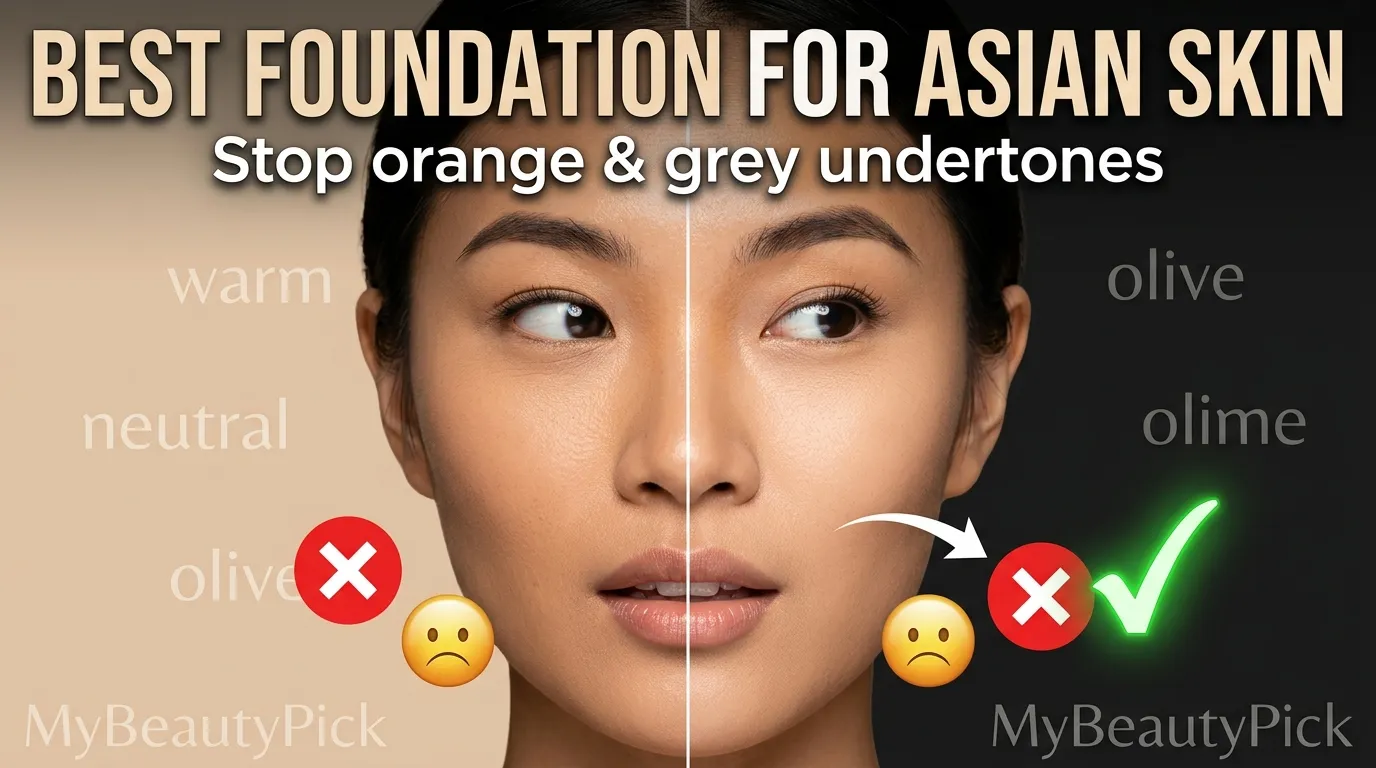
If you have Asian skin, you already know the frustration. You find a foundation that looks right in the bottle, apply it carefully, and within an hour it’s either turned a shade too orange, gone grey and ashen, or started sliding off in the heat and humidity. The beauty industry spent decades designing foundations for European skin — specifically for pink-to-neutral undertones — and the mismatch shows.
Asian skin is not a single thing. It spans dozens of countries, hundreds of ethnic backgrounds, and an enormous range of skin tones from porcelain-fair to deep caramel. What most Asian skin types share — though not all — is a yellow, golden, or olive base undertone that sits badly against foundations formulated with pink or red pigment bias. The result is the two most common foundation complaints among Asian users: the orange cast (too much red pigment meeting yellow skin) and the grey or ashen finish (pink-based foundation pulling cool against warm undertones).
Add a second layer of complexity — Asian skin, particularly in humid East and Southeast Asian climates, skews significantly oilier than the Western averages most foundation formulas are designed around — and the challenge compounds. The best foundation for Asian skin must handle undertone correctly, survive humidity, control oil through a long day, and ideally not oxidise into a different shade by afternoon.
In this guide, we break down everything that matters: how Asian undertones actually work, what to look for in a formula, and the best picks by skin type — with dedicated sections for oily skin and K-beauty and J-beauty formulas that were engineered precisely for this market.
“It’s presumptuous to assume all Asians have a yellow or warm skin tone. Asian complexions can carry warm yellow, neutral olive, and even cool pink undertones — especially at fairer depths. The goal is matching the undertone you actually have, not the undertone assumed for you.”
— Kenneth Soh, Celebrity Makeup Artist (clients: Kerry Washington, Phoebe Dynevor)
Understanding Asian Skin Undertones: The Complete Guide
The single biggest mistake in Asian foundation shopping is choosing based on skin tone (how light or dark your skin is) without understanding undertone (the underlying hue that determines which foundation shades will actually blend into your skin). Getting this wrong is why foundations look “off” even when the depth match seems right.
The Three Undertone Categories in Asian Skin
| Undertone | What It Looks Like | Vein Colour Test | Common in | Foundation Shades to Seek |
|---|---|---|---|---|
| Warm (Yellow / Golden) | Skin has a yellow, golden, or peachy warmth on the surface; bronzes easily in sun | Veins appear green | East Asian, Southeast Asian, South Asian skin at medium-to-deep depths | Shades labelled “warm,” “golden,” “honey,” “sand,” “beige” — avoid pink or red-biased shades |
| Neutral (Olive / Balanced) | Mix of warm and cool; skin appears neither distinctly yellow nor pink; may have a slight grey or olive cast | Veins appear blue-green | Common across many Asian skin types, particularly those with olive or sallow undertones | Neutral or “olive” labelled shades; avoid strongly pink or strongly yellow foundations |
| Cool (Pink / Rose) | Skin has pink, rosy, or occasionally bluish hues; common in very fair Asian skin tones | Veins appear blue or purple | Fair East Asian skin; Korean and Japanese fair complexions; mixed Asian heritage | Shades with pink or rose bias; neutral foundations; avoid strongly yellow-orange bases |
Celebrity makeup artist Daniel Martin, global director of artistry for Tatcha, emphasises a technique most people skip: shade-matching from the neck up, not from the wrist or hand. “Your neck and face should be the same tone. If you prefer a warmer face, make sure you balance the neck as well so you’re not two-toned.” This matters especially for Asian skin because hands and arms often carry more sun exposure — and therefore more warmth — than the face.
Why Most Foundation Formulas Get Asian Undertones Wrong
The practical problem is this: the majority of Western foundation formulas are built around a pink-to-neutral pigment base, designed for European skin that tends to carry pink, beige, or peachy undertones. When a pink-biased foundation meets yellow-undertoned Asian skin, one of three things happens:
- Grey or ashen cast — the pink and yellow pigments conflict, pulling the skin colour toward a flat, dull grey that reads as unnatural and mask-like
- Orange cast — when the foundation leans red/warm trying to compensate for yellow skin, it overshoots into orange territory, particularly visible at the jawline
- Washed out or chalky finish — foundations formulated for fair European skin often contain white pigments that read as chalky or bleached against yellow-toned Asian complexions
The solution is either choosing foundations specifically formulated with yellow-warm pigment bias (K-beauty and J-beauty brands excel here), or using Western brands with comprehensive shade ranges that explicitly label undertone — and selecting shades marked “warm,” “golden,” or “olive” rather than the default “neutral” shades, which often have a pink bias.
Makeup Artist Tip — Swatch on Your Jawline, in Natural Light: Kenneth Soh recommends getting foundation samples in both a warm-toned and a cool-toned shade in your depth range, wearing each on separate days, and photographing yourself in natural daylight. “The right shade will disappear into your skin without leaving any noticeable lines at the jawline. The wrong one will show — often as a line of orange or grey at the edge.” Photos in natural daylight reveal mismatches that artificial lighting hides.
The Oxidation Problem: Why Your Foundation Looks Different by Noon
Oxidation is a specific and common complaint among Asian foundation users — particularly those with oily skin. It occurs when the iron oxide pigments in a foundation react with oxygen, sebum, and sweat over time, causing the foundation to shift to a darker, warmer, or more orange tone over the course of a wear day. A shade that looks perfect at 8am can look visibly orange by 1pm.
Oily skin accelerates oxidation significantly because sebum creates the chemical environment in which pigment shift happens fastest. Asian skin in humid climates compounds the issue further. To minimise oxidation:
- Choose foundations with anti-oxidation technology — this is a genuine formulation investment, most common in K-beauty foundations (VDL’s Lumilayer Pigment system is one of the most documented examples)
- Use an oil-control primer before application to reduce the sebum that drives oxidation
- Set with a translucent mineral setting powder — the powder layer creates a physical barrier that slows pigment-sebum contact
- Choose one shade lighter than your perfect match if oxidation has been a consistent problem — the slight shift will land you closer to your natural tone by midday
What to Look for in the Best Foundation for Asian Skin
Beyond undertone, four additional criteria separate foundations that genuinely work for Asian skin from those that only look good in the bottle.
1. Shade Range Depth and Undertone Labelling
A shade range with 40 shades means nothing if they are all pink-based. Look for brands that explicitly label undertone in shade names or descriptions — terms like “warm,” “golden,” “N” (neutral), “W” (warm), “O” (olive), or “Y” (yellow). MAC Studio Fix, Fenty Beauty, and NARS all provide undertone coding in their shade systems. Most Korean and Japanese foundations are formulated with yellow-warm undertone as the default, which aligns better with the majority of Asian skin types at the outset.
2. Formula Texture for the Climate
Much of Asia operates in high-humidity, high-temperature conditions for significant parts of the year. Foundations designed for cooler, drier Western climates frequently fail in these conditions — melting off, oxidising, or caking as they break down. Look for:
- Water-resistant or sweat-resistant formulas — explicitly tested against humidity
- Long-wear designations of 16–24 hours — a genuine wear test rather than a marketing estimate
- Transfer-resistant finishes — particularly relevant in cultures where physical contact (masks, scarves, hugging) is common
3. Finish Type Matched to Skin Type
| Skin Type | Best Finish | Avoid | Key Ingredients to Seek |
|---|---|---|---|
| Oily / combination-oily | Matte or natural-matte; oil-controlling | Dewy, luminous, or cream finishes — they intensify oiliness | Silica, kaolin, niacinamide, salicylic acid (for acne-prone) |
| Dry | Dewy, satin, or luminous; hydrating formula | Powder-heavy or matte formulas — they emphasise dry patches | Hyaluronic acid, glycerin, ceramides, squalane |
| Combination | Natural or satin finish; buildable | Extreme matte or extreme dewy — neither performs well across T-zone + cheeks | Hyaluronic acid + silica balance; niacinamide |
| Normal | Any — personal preference applies | No specific avoidances | Antioxidants, SPF, skincare hybrids |
4. SPF and PA Rating
Asian skin — particularly East and Southeast Asian skin — tends toward higher rates of post-inflammatory hyperpigmentation (PIH), where sun exposure causes dark spots left by acne, breakouts, or minor trauma to deepen and persist. Daily SPF in foundation is not optional for most Asian skin types. Look for foundations with SPF 30 or higher and a PA+++ or PA++++ rating — the PA system used in Korean and Japanese cosmetics specifically measures UVA protection, which is the primary driver of pigmentation. Western SPF ratings (SPF 30, 50) measure UVB only.
Best Foundation for Asian Skin: Our Top Picks
Every pick below is assessed against the criteria above: yellow-warm or neutral undertone availability, proven wear performance, appropriate finish for Asian climate conditions, and formulas that don’t oxidise into orange or grey. We’ve included both Western brands with exceptional Asian undertone ranges and K-beauty and J-beauty formulas built specifically for this market.
MAC Studio Fix Fluid SPF 15 Foundation Best Overall · All Skin Types · Asian Undertones
“The makeup artist’s most-trusted foundation for Asian skin — a 60+ shade range with explicit warm and olive undertone options that actually match.”
- Key ingredients: SPF 15 (chemical), oil-absorbing polymers, water-resistant formula; oil-free
- Coverage & finish: Medium buildable to full; natural matte — blurs pores without looking flat
- Shade range: 60+ shades with W (warm), N (neutral), NW (neutral-warm), NC (neutral-cool), and C (cool) coding across every depth
- Best for: All Asian skin types; particularly oily and combination; warm-to-neutral undertones at every depth
- Undertone coding: NW20–NW35 covers the majority of warm-undertoned East and Southeast Asian skin tones at light-to-medium depths; NC shades address neutral-cool Asian complexions
- Price tier: Mid-range
Why it works for Asian skin: MAC pioneered undertone shade coding and still executes it more comprehensively than almost any competitor. The W and NW designations explicitly indicate warm-yellow bias, cutting directly through the guesswork that sends many Asian shoppers to the wrong shade. The oil-absorbing formula performs reliably in humid conditions, and the buildable medium-to-full coverage handles uneven tone and PIH scarring — common Asian skin concerns — without caking.
Watch out for: SPF 15 is the minimum recommended level — layer a separate SPF underneath for adequate Asian skin UV protection. The quick-set formula requires fast blending; use a damp sponge and work in sections.
NARS Natural Radiant Longwear Foundation Best for Warm + Neutral Undertones · Luminous Finish
“Antioxidant-rich with 30 shades, half in golden-yellow undertones — a rare Western foundation genuinely designed for warm Asian complexions.”
- Key ingredients: Antioxidant complex, hyaluronic acid, long-wear polymers; oil-free
- Coverage & finish: Medium buildable; natural radiant (luminous, not glittery) — skin looks alive rather than matte-flat
- Shade range: 30 shades — notably, approximately half carry golden-yellow undertones suited to warm Asian skin
- Best for: Normal to combination Asian skin; warm-to-golden undertones; those wanting a natural glow finish
- Price tier: High-end
Why it works for Asian skin: The antioxidant formula actively combats the environmental oxidative stress that contributes to PIH — a meaningful benefit for Asian skin types prone to dark spot formation. The warm-undertone shade emphasis in the range reflects a genuine effort to serve Asian complexions within a Western brand framework, and the natural radiant finish avoids the matte flatness that can read as dull against yellow-toned skin.
Watch out for: The luminous finish adds moisture-feel to the skin — on very oily Asian skin or in high-humidity climates, this may intensify shine by midday. Set with a translucent mineral powder over oily zones.
Orce Cosmetics Skin Foundation Best Built-for-Asian Skin · Specialist Brand
“One of the only Western foundations formulated specifically with Asian undertones — six shades covering light ivory to deep caramel, each with Asian complexion data at the core.”
- Key ingredients: Skincare-forward formula; buildable pigment system
- Coverage & finish: Medium buildable; natural finish
- Shade range: 6 shades — specifically formulated with different Asian undertones from light ivory to deep caramel
- Best for: Asian skin seeking Western brands that treat their undertones as the primary consideration, not an afterthought
- Price tier: Mid-range to high-end
Why it’s different: Most Western beauty brands — and even many K-beauty and J-beauty brands — design foundation shade ranges for fair-to-light Asian complexions and leave medium-to-deep Asian skin undertones underserved. Orce was specifically created to fill this gap in mainstream American and European beauty, with Asian complexion data driving the shade development from the ground up rather than being retrofitted after the fact.
Rare Beauty Liquid Touch Weightless Foundation Best for Warm Undertones · Wide Shade Range
“48 shades with detailed undertone descriptions — and a featherlight formula that won’t slide off in the heat.”
- Key ingredients: Non-comedogenic, oil-free, water-first formula
- Coverage & finish: Medium buildable; luminous natural finish
- Shade range: 48 shades — detailed undertone descriptions including warm and neutral options across all depths
- Best for: Combination to oily Asian skin; warm-to-neutral undertones; those wanting a natural glow without heaviness
- Price tier: Mid-range
Why Asian skin users rate it highly: The weightless, water-first formula performs considerably better in humid and warm conditions than heavier liquid foundations. The 48-shade range with transparent undertone guidance gives warm-undertoned Asian shoppers genuine options across all depths — a rarity in Western brands at this price point.
Best Asian Foundation for Oily Skin
Oily skin is significantly more prevalent in Asian populations than in Western ones — a combination of genetic, hormonal, and climate factors means that many Asian beauty brands design specifically for high-sebum output as a default. The criteria for the best Asian foundation for oily skin are more demanding than standard oil-control: the formula must control shine in high humidity, resist oxidation (which sebum accelerates), hold its shade for 12+ hours, and still deliver coverage that doesn’t cake as oil breaks it down.
The Three Pillars of Oily-Skin Foundation Performance: Finish type (matte is the strongest oil controller, natural-matte is the most wearable compromise), ingredient profile (silica, kaolin, and niacinamide genuinely absorb and regulate sebum), and shade stability (anti-oxidation technology prevents the colour shift that sebum drives). A foundation that fails any of these three will disappoint on Asian oily skin regardless of how good it performs in other categories.
Estée Lauder Double Wear Stay-in-Place Foundation Best Asian Foundation for Oily Skin · Overall
“The gold standard for oily Asian skin — 24-hour matte wear, genuine humidity resistance, and warm-yellow shade options that don’t oxidise orange.”
- Key ingredients: Long-wear oil-free polymers, silica (oil absorption), skin-strengthening actives in the updated formula; dermatologist-tested
- Coverage & finish: Medium-to-full buildable; matte — transfer-resistant and sweat-resistant
- Shade range: 55+ shades including 1W2 Sand and 2W2 Rattan — warm-yellow undertone options consistently cited by Asian users as accurate matches
- Wear time: 24 hours; tested against sweat, humidity, and long days
- Best for: Oily and combination-oily Asian skin; humid climate wear; warm-to-neutral undertones at light-to-medium depths
- Price tier: High-end
Why it leads for Asian oily skin: The Double Wear’s reputation among Asian beauty communities is built on genuine performance data: it is consistently the top-rated Western foundation for oily Asian skin across Reddit’s r/AsianBeauty, Baidu beauty communities, and Singaporean and Malaysian beauty forums. Its warm-yellow shade options (particularly 1W2 Sand for light-medium warm Asian tones) are among the few Western shades that don’t pull orange or grey on yellow-undertoned skin. The updated formula strengthens the skin barrier while maintaining the same sweat- and humidity-proof performance.
Watch out for: The quick-dry formula requires fast, decisive blending — work one section at a time with a damp sponge. Once it sets, it does not blend easily. Beginners may prefer a slower-setting formula while they develop technique.
VDL Perfect Lasting Foundation Best K-Beauty Foundation for Oily Asian Skin · Oxidation-Resistant
“The K-beauty formula engineered specifically against oxidation — Lumilayer Pigment technology keeps the shade stable for the full wear day, even in heat and humidity.”
- Key ingredients: Proprietary Lumilayer Pigment (anti-oxidation), air pore powder, flat cover pigment technology; long-wear moisture-maintaining formula
- Coverage & finish: Medium buildable; natural matte — velvety, non-flat
- Best for: Oily and combination-oily Asian skin; those with oxidation as their primary foundation complaint; humid climates
- Price tier: Mid-range
Why it addresses the oxidation problem directly: VDL is one of the few brands to invest in proprietary pigment technology specifically to prevent shade shift. The Lumilayer Pigment system creates a protective coating around iron oxide particles that slows their reaction with oxygen and sebum — the chemical process that drives oxidation. For oily Asian skin in humid climates where standard foundations routinely shift by lunchtime, this is a meaningful technological advancement rather than a marketing claim. The air pore powder simultaneously absorbs oil to keep the finish matte throughout wear.
Etude Double Lasting Foundation SPF 35 PA++ Best Budget K-Beauty · Oily Asian Skin
“Dermatologist-tested, long-lasting, and genuinely oil-controlling — K-beauty performance at an accessible price point, with yellow-warm shades built in from the start.”
- Key ingredients: Oil-controlling polymers; SPF 35 PA++; long-wear agents; fragrance options available (check labels for fragrance-free version if sensitive)
- Coverage & finish: Medium-to-full; long-lasting semi-matte finish
- Best for: Oily Asian skin on a budget; those wanting SPF + oil control in a single formula; K-beauty beginners
- Price tier: Drugstore to low mid-range
Why it works: Etude, as a mainstream Korean brand, formulates with Korean and Asian skin as the primary market. This means the default shade range carries yellow-warm undertones rather than treating them as an add-on, and the formula is calibrated for the sebum levels and humidity conditions of the Korean climate — which transfers well to most of Asia.
Touch in Sol Pretty Filter Perfect Finish Foundation Best for Combination-Oily Asian Skin · Natural Matte
“Oil control without the flatness — a natural-matte K-beauty formula that controls shine without making skin look like a mask.”
- Key ingredients: Lotus extract, gardenia, water lily (calming and antioxidant); lightweight serum-feel formula; paraben-free
- Coverage & finish: Medium buildable; natural matte — skin-like rather than powdery or flat
- Best for: Combination-oily Asian skin; those who want oil control without a heavy matte finish; humid climates; sensitive skin crossover
- Price tier: Mid-range
Why it’s popular for combination Asian skin: The full matte finish that performs best on very oily skin can look flat and artificial on combination Asian skin where only the T-zone is truly oily. Touch in Sol’s natural matte finish provides the oil control where it’s needed without the “painted-on” effect that extreme matte formulas create across drier cheek and eye areas.
Maybelline Fit Me Matte + Poreless Foundation Best Drugstore · Oily Asian Skin · All Markets
“The most accessible oil-controlling foundation with a shade range that includes warm-yellow options — a dependable everyday pick for budget-conscious oily Asian skin.”
- Key ingredients: Clay (oil-absorbing), non-comedogenic; fragrance-free, allergy-tested
- Coverage & finish: Medium; natural matte; pore-blurring
- Shade range: 40 shades including warm options; wide market availability across Asia and internationally
- Best for: Budget shoppers; oily to combination Asian skin; everyday wear; first foundation purchase
- Price tier: Drugstore
Why it works across Asian markets: Maybelline is one of the most widely distributed beauty brands in Asia and has calibrated the Fit Me shade range with Asian markets in mind in several regional launches. The clay-based formula genuinely absorbs oil without the drying effect that some mattifying formulas create, and the price point makes it low-risk for first-time shoppers still learning their undertone.
K-Beauty and J-Beauty Foundations: Why They Often Work Best for Asian Skin
Korean and Japanese beauty brands design foundations with Asian skin as the primary — not secondary — market. The practical implications of this are significant:
- Yellow-warm undertones are the default, not an add-on to a pink-biased core range
- Formulas are tested in Asian climate conditions — heat, humidity, and high sebum environments are factored into wear tests
- Skincare-foundation integration is more advanced — active ingredients like niacinamide, centella asiatica, fermented rice, and hyaluronic acid are formulated at meaningful concentrations alongside coverage pigments
- Cushion foundation format, invented in Korea, is uniquely well-suited to Asian oily skin: the sponge delivery system deposits a thin, even layer of formula that’s harder to over-apply than a liquid pump or tube
Best Cushion Foundation for Asian Skin
HERA Black Cushion Foundation Best K-Beauty Cushion · Premium
“Winning the Olive Young Awards in Korea is the beauty equivalent of a Michelin star — HERA’s cushion earns it for good reason.”
- Key ingredients: Hyaluronic acid, pearl extract, damask rose water, pink plankton; humidity-resistant formula
- Coverage & finish: Medium-to-full; semi-matte to satin — skin-like and breathable
- Wear time: Up to 44 hours (brand claim); sweat- and humidity-resistant
- Best for: All Asian skin types; particularly oily and combination; humid climate; those wanting skincare-foundation hybrid benefits
- Price tier: High-end
Why it’s a standout: Cushion foundations deliver formula in thinner, more controlled layers than liquid foundations, making over-application — the primary cause of cakey, heavy coverage — much harder. HERA’s formula adds meaningful skincare actives (hyaluronic acid, pearl extract, rose water) that support skin over a long wear day rather than just sitting on top of it. The anti-ageing and hydration properties are a genuine secondary benefit for Asian skin types prone to dehydration under long-wear coverage.
TirTir Mask Fit Red Cushion Foundation Best K-Beauty Cushion · Value + Performance
“72-hour wear claim, semi-matte finish, and a loyal following across oily Asian skin communities — the K-beauty cushion that punched its way into the mainstream.”
- Key ingredients: Long-wear agents; semi-matte formula
- Coverage & finish: Medium-to-full; semi-matte — smudge-proof, transfer-resistant
- Wear time: 72-hour claim; verified long-wear on oily skin by independent testers
- Best for: Oily Asian skin; long wear days; those who want a cushion with matte-leaning performance
- Price tier: Mid-range
Watch out for: Some users report oxidation. If this occurs, go one shade lighter than your match — the formula will shift slightly warmer over time, and starting slightly cooler lands you at the right shade by midday. Samples are available before committing to the full compact.
Shiseido Synchro Skin Self-Refreshing Foundation SPF 30 Best J-Beauty Foundation · Asian Skin All Types
“Shiseido’s self-refreshing technology actively responds to skin movement, oil, and humidity — a genuinely innovative formula for Asian skin’s real wear conditions.”
- Key ingredients: SkinSync Technology (elastic-polymer that responds to facial movement and humidity), SPF 30; oil-free
- Coverage & finish: Medium buildable; natural finish — adapts between matte and dewy based on skin’s needs
- Shade range: 40 shades; warm and neutral options across all depths
- Wear time: 24 hours; humidity-resistant; tested against creasing caused by facial movement
- Best for: All Asian skin types; active lifestyles; humid climates; those who want a foundation that moves with the skin naturally
- Price tier: High-end
Why J-beauty innovation matters here: Shiseido invests more in skin-movement and climate-adaptive foundation technology than almost any other brand globally — a direct response to the demands of the Japanese and broader Asian market. The elastic-polymer SkinSync technology means the formula stretches and flexes with facial expressions rather than creasing at expression lines, and it actively regulates its behaviour in response to humidity — becoming more oil-controlling in wet conditions and more hydrating in dry ones.
Clio Kill Cover Founwear Cushion XP SPF 50+ PA+++ Best for Full Coverage + Asian Oily Skin
“Full coverage in cushion format — rare, effective, and built specifically for Asian oily skin’s coverage demands.”
- Key ingredients: High-pigment formula; SPF 50+ PA+++; long-wear agents; oil-controlling formula
- Coverage & finish: Full; semi-matte to natural finish — exceptional for its coverage level
- Shade range: Yellow-warm shades as default; olive and neutral options available
- Best for: Oily Asian skin needing full coverage; PIH scarring; acne coverage; long wear days in humid climates
- Price tier: Mid-range
Why it’s unique: Most cushion foundations max out at medium-to-full buildable coverage — the cushion delivery system is not traditionally suited to high-density formulas. Clio engineered around this limitation to create a full-coverage cushion that maintains the format’s lightness and natural finish, making it one of the only full-coverage options in the category that doesn’t feel heavy or mask-like on Asian oily skin.
Asian Skin Shade Matching: A Practical Step-by-Step Guide
Shade matching for Asian skin requires a more deliberate process than picking what looks closest on a swatch card. Here’s the framework makeup artists use.
- Identify your undertone first, not your depth. Check the veins on the inside of your wrist in natural light: green veins indicate warm (yellow/golden) undertones; blue/purple veins indicate cool (pink/rose) undertones; blue-green veins indicate neutral (olive) undertones. This determines which foundaton column you should be shopping in — not your skin’s lightness or darkness.
- Select shades labelled for your undertone, at three depths. Choose one that matches your skin exactly, one shade lighter, and one shade darker. Do not swatch on your hand or wrist — these areas carry different undertones and sun exposure than your face.
- Swatch on your jawline, in three vertical stripes. Apply each shade as a stripe running from cheekbone to jaw, side by side. The correct shade disappears — it blends seamlessly into both your face and your neck without a visible line at either edge.
- Assess in natural daylight, not store lighting. Artificial lighting (particularly the warm lighting used in most beauty stores) makes undertone matching extremely difficult. Step outside or take a photo in daylight after swatching.
- Wear the top candidate for two hours before deciding. For oily Asian skin prone to oxidation, the shade that’s perfect at application may shift by two hours. If your skin oxidises, the shade that looks one step lighter than perfect at application will be your match by midday.
- Buy samples before full sizes whenever possible. Most Korean brands (and an increasing number of Western brands) offer samples. This is the only reliable way to test for oxidation and all-day wear performance without committing to a full-size product.
On Neutral Shades in Western Brands: When a Western foundation range labels a shade “neutral,” it almost always means neutral for European skin — which carries pink-to-beige undertones. For warm-undertoned Asian skin, the “neutral” shade in most Western ranges will pull slightly pink or grey. Always test; never assume a neutral label is undertone-neutral for your specific complexion.
Shade Codes That Work for Common Asian Undertones
| Brand | Shade Codes for Warm Yellow Asian Undertones | Shade Codes for Neutral/Olive Asian Undertones |
|---|---|---|
| MAC Studio Fix | NW13, NW15, NW20, NW25, NW30, NW35 (light to medium) | N4, N5, N6 (neutral, slightly warm) |
| Estée Lauder Double Wear | 1W2 Sand, 2W2 Rattan, 2W1 Dawn (light-to-medium warm) | 2N1 Desert Beige, 2N2 Buff (neutral light-medium) |
| NARS Sheer Glow / Natural Radiant | Deauville, Syracuse, Barcelona (medium warm-golden) | Mont Blanc, Gobi (neutral light-medium) |
| Fenty Beauty Pro Filtr | 130W, 150W, 230W, 235W (warm undertone coding) | 130N, 150N, 230N (neutral coding) |
How to Apply Foundation on Asian Skin for All-Day Wear
Technique matters as much as formula selection, particularly for oily Asian skin in humid conditions. These steps are built around maximising wear time and preventing the two most common Asian foundation failures: midday shine breakthrough and afternoon oxidation.
- Start with skincare, not primer. Apply a lightweight, non-comedogenic moisturiser and allow it to fully absorb — 5 to 10 minutes. For oily skin, use a gel or water-based moisturiser rather than cream. Properly hydrated skin produces less reactive sebum, which slows both shine breakthrough and oxidation.
- Use an oil-control primer on the T-zone. Apply a silicone-free, oil-absorbing primer specifically to the T-zone and any other areas of peak oiliness. This creates a physical layer between skin and foundation that slows sebum migration into the formula — the primary cause of both shine and oxidation. Wait 60 seconds for it to fully set before applying foundation.
- Apply foundation in thin, fast layers. For long-wear formulas (which set quickly), use a damp beauty sponge and work one section at a time — forehead, each cheek, nose, and chin separately. Press the sponge rather than dragging. A thin first layer sets cleaner, blends more naturally, and is less likely to lift when a second layer is added.
- Build coverage only where needed. Apply a second thin layer directly over blemishes, PIH scarring, or areas of stronger redness. Using full coverage across the entire face increases cakey risk and product load — keep the base layer sheer and concentrate coverage strategically.
- Set with a translucent mineral powder — especially on oily zones. Press a translucent mineral powder onto the T-zone using a fluffy brush or sponge immediately after foundation. This setting step creates a physical barrier that slows oil breakthrough and significantly reduces oxidation speed. Do not over-powder dry zones — cheeks and eye area need minimal to no setting powder.
- Use a setting spray to lock the finish and reduce chalkiness. A fine mist of setting spray after powder application melds layers together, reduces the flat or chalky effect that powder can create on Asian skin, and adds an additional layer of humidity protection. Look for water-based, alcohol-free formulas for sensitive or reactive skin.
- Blot, don’t powder, for mid-day touch-ups. Use blotting papers or a blotting film on oily areas before any touch-up. Applying more powder over oil-saturated foundation creates cakiness. Blotting first removes excess sebum, allowing a light dusting of powder to reset the base without buildup.
Frequently Asked Questions
What is the best foundation for Asian skin?
For most Asian skin types, MAC Studio Fix Fluid is the most consistently recommended option due to its explicit undertone coding system (NW, NC, W, N), 60+ shade range, oil-controlling formula, and proven humid-climate performance. For K-beauty enthusiasts, the Estée Lauder Double Wear offers 24-hour matte performance in verified warm-yellow Asian undertone shades, while VDL Perfect Lasting Foundation addresses oxidation specifically with its Lumilayer Pigment technology. The best pick depends on your undertone, skin type, and climate — this guide breaks all three down.
Do all Asian people have yellow undertones?
No — and this is one of the most common and damaging assumptions in Asian foundation shopping. While warm yellow, golden, and olive undertones are prevalent across many Asian ethnic groups, cool-to-neutral undertones are common in fair East Asian skin (particularly Korean and Japanese complexions) and in many South Asian skin types. The most reliable approach is undertone identification via the wrist vein test and jawline swatching — do not assume your undertone based on ethnicity alone.
Why does my foundation look orange on Asian skin?
An orange cast typically means one of two things: the foundation shade is too warm or too pink for your undertone (red pigment meeting yellow skin produces orange), or the foundation is oxidising on your skin. To diagnose: if it looks wrong immediately after application, it’s a shade mismatch — go cooler or more neutral. If it looks right at first but shifts to orange over a few hours, it’s oxidation driven by sebum reacting with the formula’s iron oxide pigments. Choose one shade lighter than your match, use oil-control primer, and look for anti-oxidation technology in the formula.
What foundation is best for Asian oily skin in a humid climate?
The Estée Lauder Double Wear is the most widely trusted option for oily Asian skin in humid climates — its 24-hour, sweat- and humidity-resistant formula with warm-yellow shade options is specifically validated in the conditions most Asian oily-skin users face. For K-beauty alternatives, VDL Perfect Lasting Foundation adds anti-oxidation technology that prevents the shade shift that humidity and sebum cause. Setting with a translucent mineral powder and a setting spray after application extends performance in extreme conditions.
Are K-beauty foundations better for Asian skin?
K-beauty foundations are often better calibrated for Asian skin because they are designed with Asian skin as the primary market. This means yellow-warm undertones are the default rather than an afterthought, formulas are tested in Korean and Asian climate conditions, and skincare actives are integrated at meaningful concentrations. However, Western brands with strong undertone coding systems (MAC, NARS, Fenty, Estée Lauder) offer comparable performance for the right skin type. The ideal approach is choosing based on undertone match and formula performance, not brand geography.
What is a cushion foundation and is it good for Asian skin?
Cushion foundation is a Korean-invented format where liquid foundation is saturated into a sponge cushion inside a compact and applied using a separate applicator sponge by pressing rather than spreading. The format is particularly well-suited to Asian oily skin for three reasons: the press-apply technique deposits thin, controlled layers that are harder to over-apply than liquid foundations; it cools the skin on application (reducing redness and flushing); and the compact format makes midday touch-ups extremely easy. Look for semi-matte formulas for oily skin (HERA Black Cushion, TirTir Mask Fit Red Cushion) and dewy formulas for dry or normal Asian skin.
How do I know if I have warm or cool Asian undertones?
The most reliable methods: look at the veins on the inside of your wrist in natural light (green veins indicate warm undertones; blue or purple veins indicate cool; blue-green indicates neutral). Then hold a white piece of paper against your bare skin — if your skin looks more yellow or golden next to the white, you’re warm; if it looks more pink or rosy, you’re cool; if it’s hard to tell, you’re neutral. When in doubt, Kenneth Soh’s recommendation is to start with a neutral-toned foundation and use contouring and concealing techniques to adjust rather than over-committing to a strongly warm or cool shade before you’ve tested it.
Does Asian skin need SPF in foundation?
Yes — particularly for Asian skin prone to post-inflammatory hyperpigmentation (PIH). Asian skin types, particularly East and Southeast Asian, develop PIH dark spots more readily than many Western skin types, and UV exposure is the primary driver of their darkening and persistence. Look for foundations with SPF 30 or higher for daily protection, and prioritise PA+++ or PA++++ ratings (found on Korean and Japanese products) which specifically measure UVA protection — the UV wavelength primarily responsible for pigmentation. Note that foundation SPF alone is not sufficient for outdoor or extended sun exposure; it should be supplemented with a dedicated sunscreen underneath.
The Right Formula Exists — You Just Have to Know What to Look For
The best foundation for Asian skin is not the one with the most shades or the most expensive formula. It’s the one that correctly matches your specific undertone, performs in your climate conditions, and stays stable on your skin type across a full wear day. Asian skin is as diverse as any other category — the warm-yellow assumption is a shortcut, not a solution.
Start with undertone identification. Test on your jawline in natural light. If you have oily skin, prioritise oil-control and anti-oxidation technology. And don’t overlook K-beauty and J-beauty formulas built specifically for you — they often solve problems that Western brands don’t even know exist.
Our top picks by need:
- Best overall for Asian skin: MAC Studio Fix Fluid — undertone-coded, 60+ shades, proven matte performance in warm and humid conditions.
- Best for oily Asian skin: Estée Lauder Double Wear — 24-hour humidity-resistant wear with warm-yellow shade options that don’t oxidise orange.
- Best for oxidation prevention: VDL Perfect Lasting Foundation — Lumilayer Pigment technology specifically engineered to stop shade shift.
- Best K-beauty cushion: HERA Black Cushion Foundation — award-winning Korean formula with skincare actives, humidity resistance, and natural-matte finish.
- Best J-beauty: Shiseido Synchro Skin Self-Refreshing Foundation — climate-adaptive technology that responds to humidity and facial movement in real time.
- Best budget: Maybelline Fit Me Matte + Poreless — accessible oil control with warm-shade options, widely available across Asian markets.