

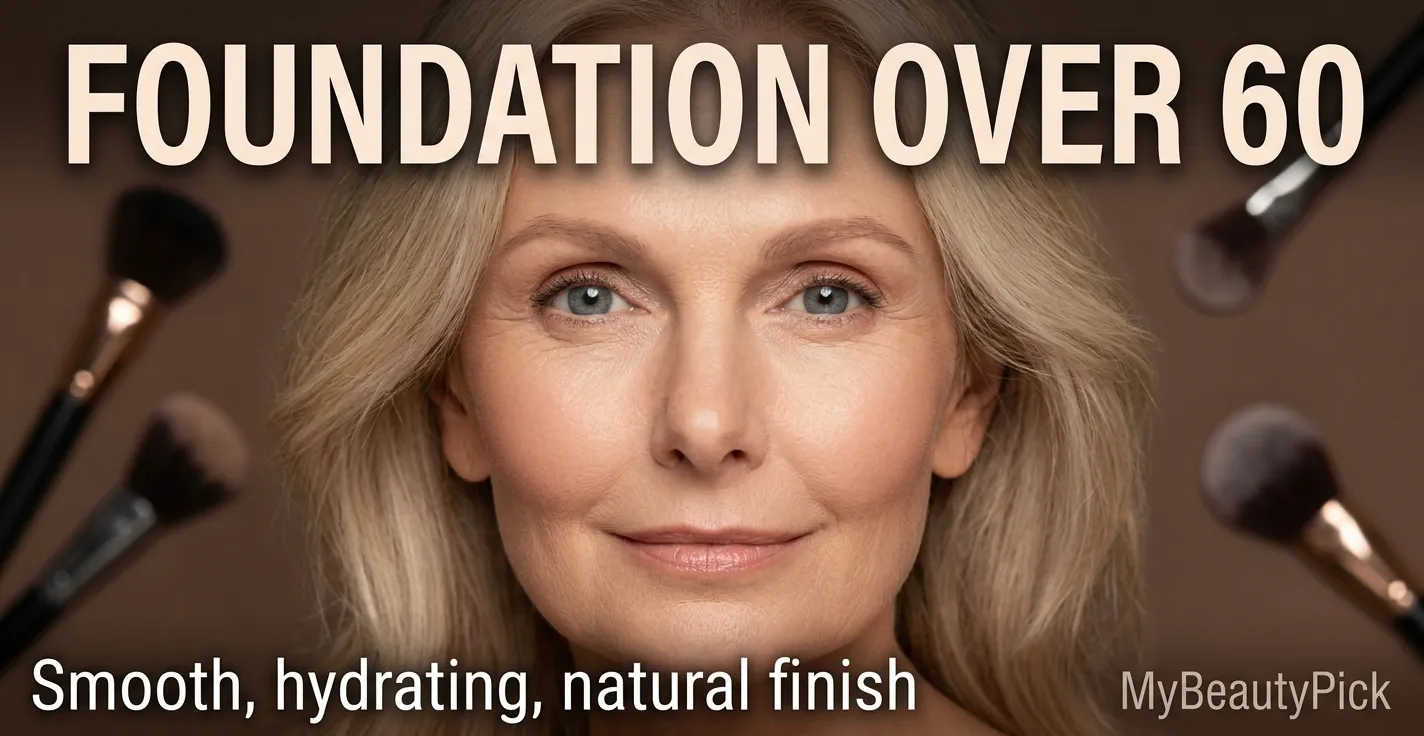
After two decades of doing makeup on faces of every age, the most common complaint I hear from clients over 60 is some version of the same thing: “my foundation used to work and now it just sits wrong.” It is not the application that changed. It is the skin. The best foundation for women over 60 is a hydrating, buildable formula with a dewy or satin finish that uses light-diffusing pigments rather than heavy coverage to soften the look of fine lines. Mattifying, full-coverage formulas that worked beautifully at 40 tend to grab onto dry texture and settle into creases on skin that has lost collagen, sebum, and elasticity. Below I am going to walk through exactly what changed, what to look for instead, and which specific dewy and powder formulas hold up in real wear, not just on the back of your hand in a department store.
Key Takeaway
Skin over 60 produces less oil and loses collagen, which means thick, mattifying foundation clings to texture and ages the face. The foundations that actually work are hydrating first, light to medium in coverage, and finished with a dewy or satin glow rather than a flat matte. Warmer undertones generally read better than cool ones as skin turns more sallow with age.
Why Foundation Behaves Differently on Skin Over 60

I started noticing this shift in clients somewhere in their late 50s, and it is almost always the same pattern. A foundation that wore beautifully for years suddenly starts looking dry by mid-morning, or it pools along the nasolabial folds and under the eyes no matter how carefully it is blended. That is not a user error. It is a change in what the skin is actually doing underneath the makeup.
Sebum and ceramide production both decline with age, and ceramides are what hold moisture in the skin’s outer layer. Less ceramide means the skin surface dries out faster, and any foundation sitting on top of that dry surface is going to look chalky or patchy within a few hours, regardless of how good the formula is. At the same time, collagen loss thins the skin and makes texture, pores, and fine lines more visible than they were a decade earlier. A heavier, fuller coverage foundation does not hide that texture. It sits inside it, which is exactly why a foundation that gave flawless coverage at 45 can look cakey and aging at 65.
Cell turnover also slows down, so flaky patches around the nose, chin, and forehead show up more often and take longer to resolve on their own. Powder-heavy or long-wear, transfer-resistant formulas are usually the worst match here, because the same silicone-based grip technology that keeps them from budging all day is what makes them cling to dry patches and look uneven.
What Actually Works: The Five Things to Look For
None of this means coverage is off the table or that mature skin needs to go bare. It means the type of coverage matters more than the amount. After fitting hundreds of clients in this age range, here is what consistently performs well regardless of brand or price point.
Hydration Built Into the Base
Hyaluronic acid, glycerin, squalane, and ceramides should be part of the formula itself, not just marketing language. These ingredients keep the product from drying down into fine lines over the course of the day.
Light to Medium, Buildable Coverage
Sheer-to-medium formulas that can be layered only where needed, like around the nose or over redness, look far more natural than a foundation applied at full opacity across the whole face.
Dewy, Luminous, or Satin Finish
Matte finishes absorb light and draw attention to texture. Dewy and luminous finishes reflect light, which softens the look of lines instead of spotlighting them. This is the single biggest finish-related mistake I see mature clients make.
Light-Diffusing or Blurring Particles
Finely milled pigments or soft-focus technology blur the appearance of fine lines and wrinkles without adding heavy coverage on top of them. This is what separates a foundation that looks airbrushed from one that looks like a mask.
A Slightly Warmer Undertone
Skin tends to look more sallow with age. Most of my clients over 60 end up shifting a shade warmer than their younger shade match to keep the complexion looking alive rather than flat or gray.
When I am shade-matching a client over 60, I test on the jawline in natural daylight, never under store lighting, and I always test one shade warmer than what looks correct in the mirror. Skin oxidizes slightly over the first twenty minutes after application, and mature skin in particular tends to pull the shade warmer once it settles.
Best Dewy Foundation for Mature Skin

Dewy finish is the most frequently requested formula type in my chair for clients over 60, and it earns that reputation honestly. It adds back the radiance that drier, less elastic skin naturally loses, without requiring extra product or extra steps.
Giorgio Armani Luminous Silk Foundation
Why it works: The Micro-fil technology in this formula blends into the skin rather than sitting on top of it, giving an airbrushed quality that still reads as skin, not makeup. It is one of the most consistently requested foundations among my clients in this age group for that exact reason.
Who it is best for: Normal to dry skin that wants a natural, lit-from-within finish with enough coverage to even out tone.
Who should avoid it: Very oily skin types, since the dewy finish can read as shine by midday without a setting powder on the T-zone.
Strengths
- Blends seamlessly with fingers or a damp sponge
- Builds without looking heavy
- Wide shade range with accurate undertones
Limitations
- No SPF included
- Premium price point
- Needs powder touch-up on oily areas by afternoon
Ilia Super Serum Skin Tint
Why it works: This functions more like a tinted serum than a traditional foundation. Squalane, niacinamide, and hyaluronic acid are built into the base, so the product is actively hydrating the skin while it sits, rather than just sitting there.
Who it is best for: Clients who want the lightest possible hand and rely on concealer for spot coverage rather than full-face foundation.
Who should avoid it: Anyone wanting to cover noticeable redness, hyperpigmentation, or uneven tone, since coverage here is genuinely sheer even when layered.
Strengths
- Built-in SPF 30
- Feels like skincare on the face
- Clean ingredient formulation
Limitations
- Will not hide visible discoloration
- Limited shade depth at the extremes
Yves Saint Laurent Touche Eclat All-In-One Glow Foundation
Why it works: The water-based formula sits between a tinted moisturizer and a true foundation, which means it never has the opportunity to dry down into a heavy, set layer the way oil or silicone-based formulas can.
Who it is best for: Dry to normal skin types who want visible radiance without a department-store level price tag every single time they repurchase.
Who should avoid it: Combination to oily skin in humid climates, since the water base can break down faster in heat.
Jones Road What The Foundation
Why it works: The oil-infused, balm-like texture actually absorbs into the skin rather than resting on top as a separate film, which is exactly what prevents the settling-into-lines problem so many mature clients struggle with.
Who it is best for: Dry, dehydrated skin that wants visible glow and does not mind applying with fingers for better control.
Who should avoid it: Oily skin types, since the oil content can shift and travel by the afternoon without careful powder placement.
L’Oreal Paris Age Perfect Radiant Serum Foundation
Why it works: This brings the serum-foundation hybrid concept to an accessible price point, combining vitamin B3 and a hydrating base with genuinely high SPF, which matters more for mature skin than most people realize given the cumulative sun damage most of us are already carrying.
Who it is best for: Clients who want department-store performance without department-store pricing, and anyone who wants sun protection built into one step.
Who should avoid it: Very deep or very fair skin tones, since the drugstore shade range still skews toward the middle of the spectrum.
Best Powder Foundation for Mature Skin Over 60

Powder gets an unfair reputation in my industry when it comes to mature skin. The assumption is that it always drags into texture and emphasizes dryness, and that assumption is correct for traditional, heavily mattifying powders. It is not correct for the newer generation of finely milled, hydrating powder formulas, which can actually work very well for clients who want a fast, low-maintenance application or who deal with oil in the T-zone alongside dryness on the cheeks, which is more common after 60 than people expect.
The features that separate a powder that works from one that does not are the same ones that matter in liquid formulas: hydrating ingredients like hyaluronic acid or glycerin built into the powder itself, a satin or luminous finish instead of a flat matte, and light-diffusing particles that soften texture rather than sitting flatly across it.
Giorgio Armani Luminous Silk Glow Powder
Why it works: This extends the reputation of the brand’s liquid formula into powder form, with the same emphasis on blendability and adjustable coverage that does not read as heavy even when built up.
Who it is best for: Anyone who already loves the liquid version and wants a quick touch-up option, or normal to dry skin wanting a soft glow finish from powder.
Who should avoid it: Very oily skin needing strong mattification, since this leans radiant rather than matte by design.
BareMinerals Original Foundation SPF 15
Why it works: Being a loose mineral powder rather than pressed, this blends into texture more naturally than a compact powder can, since there is no binder forcing it to sit as a uniform flat layer.
Who it is best for: Clients with sensitive or reactive skin, since the minimal ingredient list reduces irritation risk.
Who should avoid it: Very dry skin without proper moisturizing prep underneath, since any loose mineral powder will grab onto unprepped dry patches.
Laura Mercier Real Flawless Luminous Perfecting Pressed Powder
Why it works: This is the powder I reach for most often on clients who run oily in the T-zone but dry on the cheeks, a combination that becomes increasingly common after 60. It controls shine in the center of the face without flattening or dehydrating the cheeks.
Who it is best for: Combination mature skin that needs targeted shine control rather than all-over mattification.
Who should avoid it: Skin that is uniformly dry across the whole face, where a cream or liquid formula will perform better than any powder.
Clinique Almost Powder Makeup SPF 18
Why it works: This deliberately does not try for full opacity. The light-handed approach holds up better across a full day on mature skin than a heavier powder, because there is simply less product available to settle into lines as the hours pass.
Who it is best for: Clients who want the absolute lowest-maintenance option and do not need to cover significant discoloration.
Who should avoid it: Anyone with visible redness, melasma, or noticeable dark spots, since coverage here will not be enough on its own.
Laura Geller Baked Balance-N-Brighten Color Correcting Foundation
Why it works: The baking process creates a finer, more blendable texture than standard pressed powder, and the color-correcting pigments address sallowness directly, which is one of the most common concerns I hear from clients in this exact age bracket.
Who it is best for: Clients dealing with sallow or uneven undertones who want correction and coverage in a single step.
Who should avoid it: Very fair or very deep skin tones, since the shade range is strongest in the middle of the spectrum.
Common Mistake
Setting an already-dewy liquid foundation with a heavy layer of mattifying powder across the entire face cancels out the radiance you just built and brings back the exact texture-emphasizing problem you were trying to avoid. If you need to control shine, powder only the T-zone and leave the rest of the face alone.
Best Foundation for Women Over 60 by Skin Concern
Not every complexion over 60 has the same priority, so matching the product to your specific concern works better than starting from a generic best-of list.
| Skin Concern | Best Foundation Type | Recommended Picks |
|---|---|---|
| Dryness and dehydration | Oil or balm-based formula, hyaluronic acid built into base | Jones Road What The Foundation, Ilia Super Serum Skin Tint |
| Visible fine lines and texture | Light-diffusing or blurring technology | Armani Luminous Silk, L’Oreal Age Perfect Serum Foundation |
| Sun protection priority | Built-in SPF rather than layered separately | Ilia Super Serum Skin Tint, L’Oreal Age Perfect, BareMinerals, Clinique Almost Powder |
| Combination skin, oily T-zone | Targeted shine control powder | Laura Mercier Real Flawless Pressed Powder |
| Sallow or uneven undertone | Color-correcting formula | Laura Geller Baked Balance-N-Brighten |
| Budget-conscious | Hydrating drugstore liquid or powder | Neutrogena Healthy Skin Liquid Makeup, Laura Geller Baked Powder |
Application Mistakes That Age Mature Skin

Even the right foundation will look wrong if it goes on the way it did twenty years ago. These are the mistakes I correct most often in my chair.
FAQs: Foundation for Mature Skin Over 60
What finish is best for foundation on skin over 60?
A dewy, luminous, or satin finish works best for most skin over 60, since these finishes reflect light and soften the look of fine lines. Flat matte finishes absorb light instead, which draws more attention to texture and creasing, especially on drier mature skin.
Is powder foundation bad for mature skin?
Powder foundation is not inherently bad for mature skin, but traditional, heavily mattifying powders can cling to dry texture and look patchy. Finely milled, hydrating powders with a satin or luminous finish, like Laura Mercier Real Flawless or Armani Luminous Silk Glow Powder, can work very well, particularly for combination skin.
Should foundation shade get warmer or cooler with age?
Most clients over 60 need to shift slightly warmer than their previous shade match, since skin tends to look more sallow with age. A foundation that reads as the correct shade in a mirror under store lighting often needs to be one shade warmer once tested in natural daylight.
How much foundation should women over 60 apply?
Less than most people assume. A thin, buildable layer applied only where needed, with concealer used for specific spots, looks more natural than a single heavy, full-coverage application across the entire face.
Does foundation with SPF replace sunscreen for mature skin?
Foundation with SPF should not fully replace a dedicated sunscreen underneath, since most people do not apply enough foundation to reach the SPF level listed on the label. It is a helpful addition on top of sunscreen, not a substitute for it.
The Bottom Line
The best foundation for women over 60 is not about finding more coverage. It is about finding a formula that behaves like skincare first and makeup second. Hydrating ingredients, a dewy or satin finish, buildable rather than full coverage, and light-diffusing technology are what consistently separate the foundations that work on mature skin from the ones that just sit on top of it. Whether that ends up being a twelve dollar drugstore liquid or a department-store cushion compact, the formula and finish matter far more than the price tag, and the right shade tested in daylight will always outperform the most expensive product matched under bad lighting.