

It is late summer and the foundation you have been using since April no longer matches. Your skin is deeper, richer, and the formula now sits a full shade too light against your jawline. Or it is January, and the shade that carried you through summer looks muddy and too warm on skin that has faded back toward its base tone. For people with tan complexions, seasonal foundation mismatch is not occasional — it is predictable. What most people do not know is exactly why it happens, and how to get ahead of it.
Undertone vs. Skin Tone — Understanding the Difference
What Is Undertone?
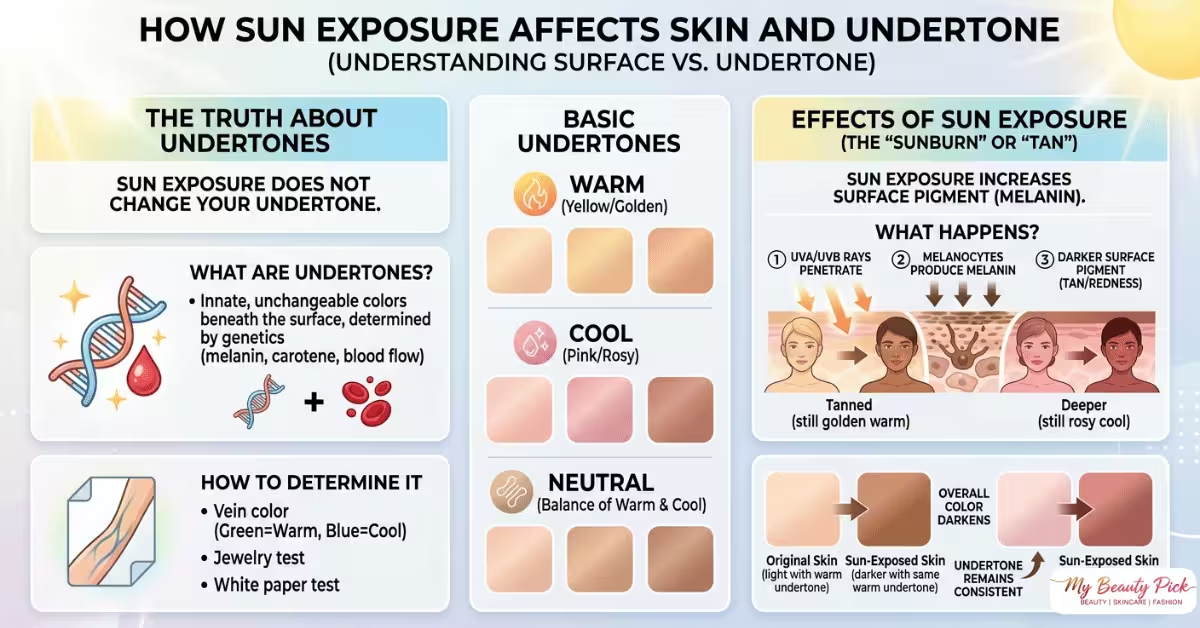
Undertone is the subtle hue that exists beneath the surface of your skin. It is determined by the ratio of melanin, haemoglobin, and carotene in your skin tissue — and it does not change. Regardless of how much sun you get, how your health fluctuates, or how your complexion shifts across seasons, your undertone remains warm, cool, or neutral throughout your life. This is why identifying your undertone is a one-time investment. Once you know it, every product decision becomes faster and more accurate.
What Is Overtone?
Overtone refers to the visible surface tone of your skin — its current depth and colour as seen by others. This is the part that changes. Sun exposure, seasonal light patterns, health, hydration levels, and ageing all affect your overtone. When your foundation no longer matches, the issue is almost always an overtone shift, not an undertone change. The foundation’s undertone direction is still right for your skin — what has changed is the depth.
Why People Confuse Them
The confusion is understandable because both variables show up in the same place — your face. When a foundation looks wrong, it is hard to know at a glance whether the undertone is off or the depth has shifted. The practical test: if your foundation looks ashy or pink, the undertone is wrong. If it looks too light or too dark but the general hue is right, the depth has changed. These require different solutions.
| Undertone | Overtone (Surface Tone) |
| Fixed throughout life | Changes with seasons, sun, health |
| Warm, cool, or neutral | Light, medium, deep — and in-between |
| Affects which foundation direction to choose | Affects which shade number or depth to choose |
| Does not change with self-tanner or sun | Changes directly with UV exposure |
How UV Exposure Changes Skin Colour
UVA vs. UVB Radiation
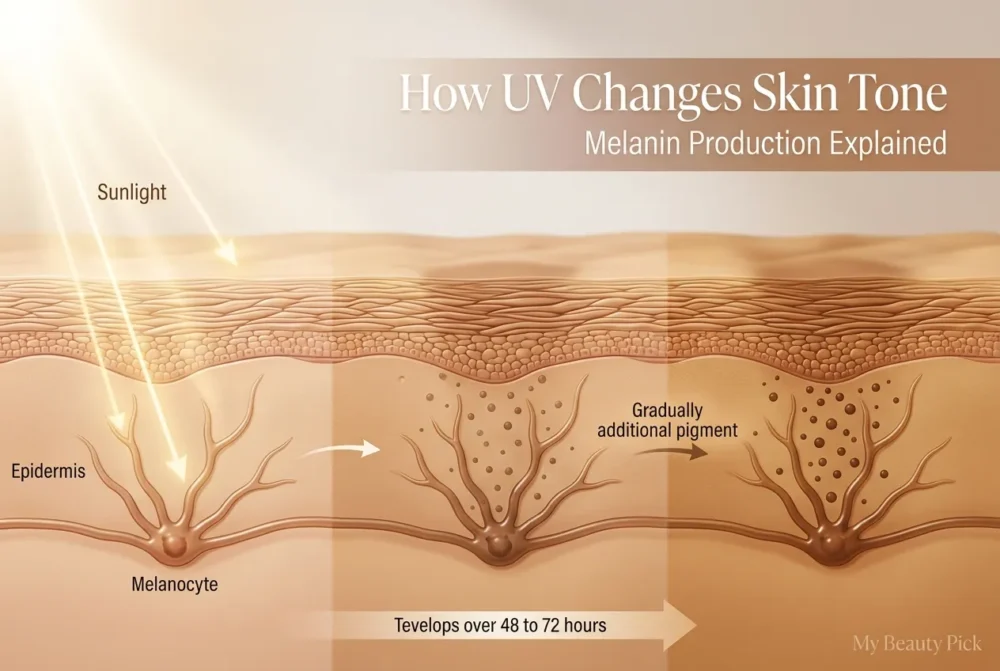
UVA rays penetrate deep into the dermis and oxidise existing melanin, causing an immediate but temporary darkening effect. UVB rays act on the epidermis and stimulate new melanin production — the slower process that creates a lasting tan. Most sun exposure involves both wavelengths, meaning skin darkens in two distinct ways simultaneously: a rapid surface shift and a deeper, longer-lasting pigment increase. This combination is why summer tanning can be noticeable within days and persist for months.
The Tanning Response
UV exposure triggers melanocytes to increase melanin production as a protective response. This new melanin is transported to surrounding skin cells and creates the visual deepening we call a tan. The process is not instantaneous — full melanin expression from a single UV exposure can take 48 to 72 hours to become fully visible. This is why a day in the sun produces a more dramatic effect when you see it two days later.
Why Tan Skin Tans Differently Than Fair Skin
Tan skin has more active melanocytes and a higher baseline melanin density. This means the tanning response is faster, more uniform, and more sustained. Where fair skin might burn before tanning, tan skin typically activates its melanin response almost immediately upon UV exposure. The result is a deeper, more even shift in surface tone — which translates directly into foundation shades needing to go deeper or be replaced seasonally.
Why Your Foundation Shade Changes During Summer
Increased Melanin Concentration
As melanin production ramps up through repeated UV exposure, the skin’s surface pigmentation deepens. A foundation matched in early spring will visually lighten relative to your complexion by July, making the formula appear too light on the face and creating a mismatched line at the jaw and neck. This is the most straightforward cause of summer shade mismatch — your foundation stayed the same, your skin got deeper.
Golden-Olive Shifts
For tan skin with warm or olive undertones, sun exposure does not just deepen the complexion — it intensifies its warmth. The golden quality in warm tan skin becomes more pronounced through the summer months. A foundation that was a well-balanced match in spring may start to appear slightly ashy or cool against a more intensely golden summer complexion, even if the depth was correct. The undertone itself has not changed, but the saturation of the skin’s warmth has increased, creating a visible contrast with a less-warm formula.
Changes in Hemoglobin Visibility
Haemoglobin contributes to the red and pink tones in skin. In summer, increased circulation and heat can bring more haemoglobin closer to the skin’s surface, adding a subtle flush that alters the complexion’s overall tone. For cool-undertoned tan skin, this can make the skin appear more vibrantly cool or rosy than in winter months, shifting which foundation shade reads as correct.
Surface Dehydration Effects
Sun exposure dehydrates the skin’s surface layers. When skin is dehydrated, foundations can appear drier, more powdery, and lighter than they do on well-hydrated skin. This is a separate visual effect from the melanin shift but compounds the seasonal mismatch — skin looks both deeper and drier simultaneously, and a formula matched in spring lacks the coverage depth and finish quality to look correct in summer conditions.
How to Diagnose Your Seasonal Shade Shift
The Neck Comparison Method
Apply your current foundation to your face in your usual way, then step into natural daylight and look at where your jaw meets your neck. The neck receives significantly less sun exposure than the face, so it shifts less dramatically through the seasons. If your face looks deeper than your neck, your foundation is now too light. If your face and neck match, you are still in the right shade range.
The White Shirt Test
Hold a plain white cotton shirt or towel against your bare face in natural daylight. Look at whether your skin reads yellow-golden, pink-rosy, or balanced. This resets your undertone awareness and helps you confirm that any shift you are seeing is a depth change rather than an undertone drift. If the result looks the same as it always has, you only need to adjust depth. If it looks different, check that your assessment conditions are consistent — lighting, skin hydration, and time of day all affect the result.
Photograph Comparison Technique
Take a photo in the same natural-light spot, at the same time of day, once in May and once in August. Place them side by side. Skin tone differences between seasons are often subtle enough to feel gradual but are clearly visible in a direct photographic comparison. This gives you an objective record of how much your complexion shifts and helps you anticipate how far your foundation shade needs to move.
Building a Seasonal Foundation Wardrobe
Why One Foundation Shade Is Rarely Enough
For people with fair to light skin, seasonal shifts are often small enough that a single foundation works year-round or requires only minor adjustment. For tan complexions, the range of shift is simply greater. A typical warm tan complexion can move through two to three full shade steps between winter and peak summer. Trying to make one shade cover that range — either by going too light in winter or too dark in summer — always results in a visible mismatch somewhere in the cycle.
The Two-Shade Strategy
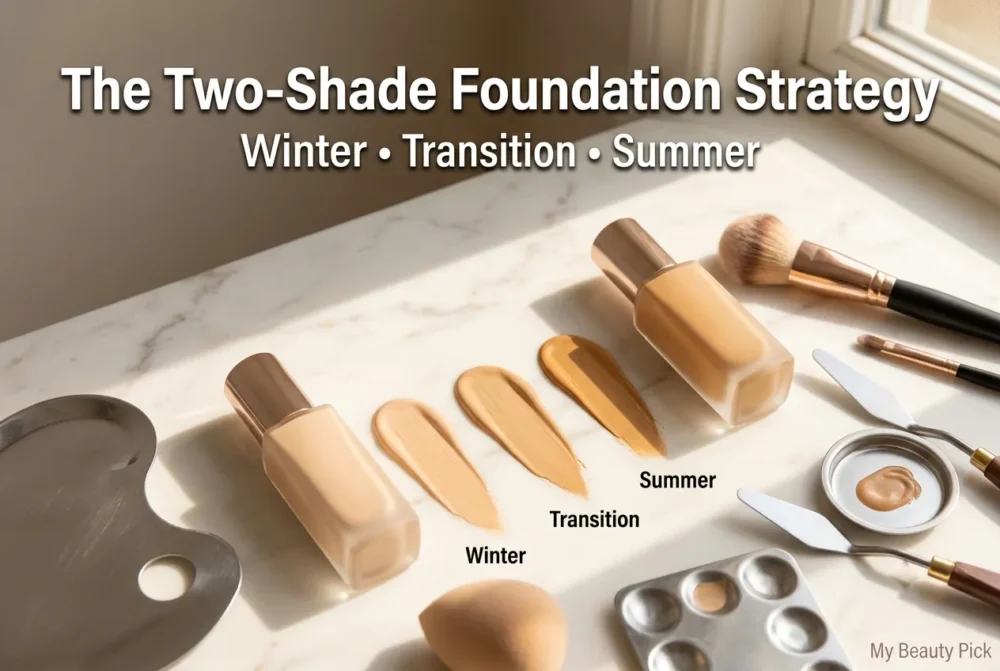
The most practical approach is maintaining two foundations: a winter shade matched to your lighter, faded complexion and a summer shade matched to your deepest seasonal tone. These become your anchor points. Everything in between is handled by mixing.
| Shade | When to Use | How to Identify It |
| Winter shade | November through February | Matches your neck in December natural daylight |
| Summer shade | July through September | Matches your neck after 6 weeks of summer sun exposure |
| Transition blend | March–June and October | Mix of winter and summer in varying ratios as you tan or fade |
Mixing Foundation Shades for Tan Skin

Shade Mixing Ratios
During transition seasons — spring and autumn — mixing your two anchor shades in varying ratios tracks the gradual shift of your complexion without requiring additional product purchases. Start with a 3:1 ratio of winter to summer shade in early spring, shift to 1:1 at the height of the transition, and move to 1:3 as summer deepens. Reverse the process coming into autumn.
Adjusting Depth Without Changing Undertone
When mixing for depth adjustment, stay within the same undertone family. Mixing a warm tan shade with a cool tan shade to hit a middle depth creates a muddy, grey-brown result that does not read as natural on either skin type. Both shades in your mixing pair should share the same undertone direction — the only variable changing between them is the depth number.
Common Mixing Mistakes
The most common error is mixing on the hand and then immediately applying without blending fully. Incomplete mixing creates streaks across the face where one shade dominates. Always mix the two foundations thoroughly — either on a clean palette, the back of your hand with 20 seconds of active blending, or directly in a small container if you use the same mix daily. Consistency in the ratio matters; if the blend is different each day, the match will be inconsistent.
Products That Transition Well Between Seasons
Buildable Coverage Formulas
Sheer-to-medium buildable foundations are easier to adapt across seasons than full-coverage formulas. Applied lightly, they show more of the skin’s natural tone beneath — which reads differently at each depth. This means a single formula can look credible across a wider range of complexion depths simply by varying the amount applied, reducing the gap that mixing needs to bridge.
Shade Adjusting Drops
Self-tan drops added to foundation are a now well-established technique for pushing a lighter shade deeper without buying a second foundation. They are most effective when the drop formula is undertone-matched to your skin — a neutral or warm drop in a warm tan shade, rather than a generic DHA drop that tends to pull orange on already-warm complexions. Start with one drop per pump of foundation and increase from there. Test the blend on the jawline and give it 10 minutes to develop before committing.
When to Replace Instead of Mix
Mixing works across a reasonable two-to-three shade range. Beyond that, a new shade is the more practical and accurate solution. If your complexion has shifted to the point where your summer shade no longer matches and your winter shade looks dramatically too light, you have moved outside your mixing range. This is especially common after an extended holiday or a particularly sun-intensive summer. Match fresh on your jawline in natural daylight and start the shade identification process again from scratch.
Seasonal Foundation Checklist
| Match your foundation in natural daylight, never in artificial store lighting or indoor light |
| Always match on the jawline and check against the neck — not on the wrist or back of the hand |
| Re-test your shade at the beginning of every new season — at minimum twice per year |
| Keep a winter shade and a summer shade as anchor points; mix in transition months |
| Mix only within the same undertone family — changing depth, not warmth direction |
| Use shade-adjusting drops to extend an existing formula rather than purchasing a new one unnecessarily |
| If the complexion shift is more than three shades, match fresh rather than mixing |
Download the Seasonal Shade Mixing Guide and build a foundation wardrobe that works year-round.