

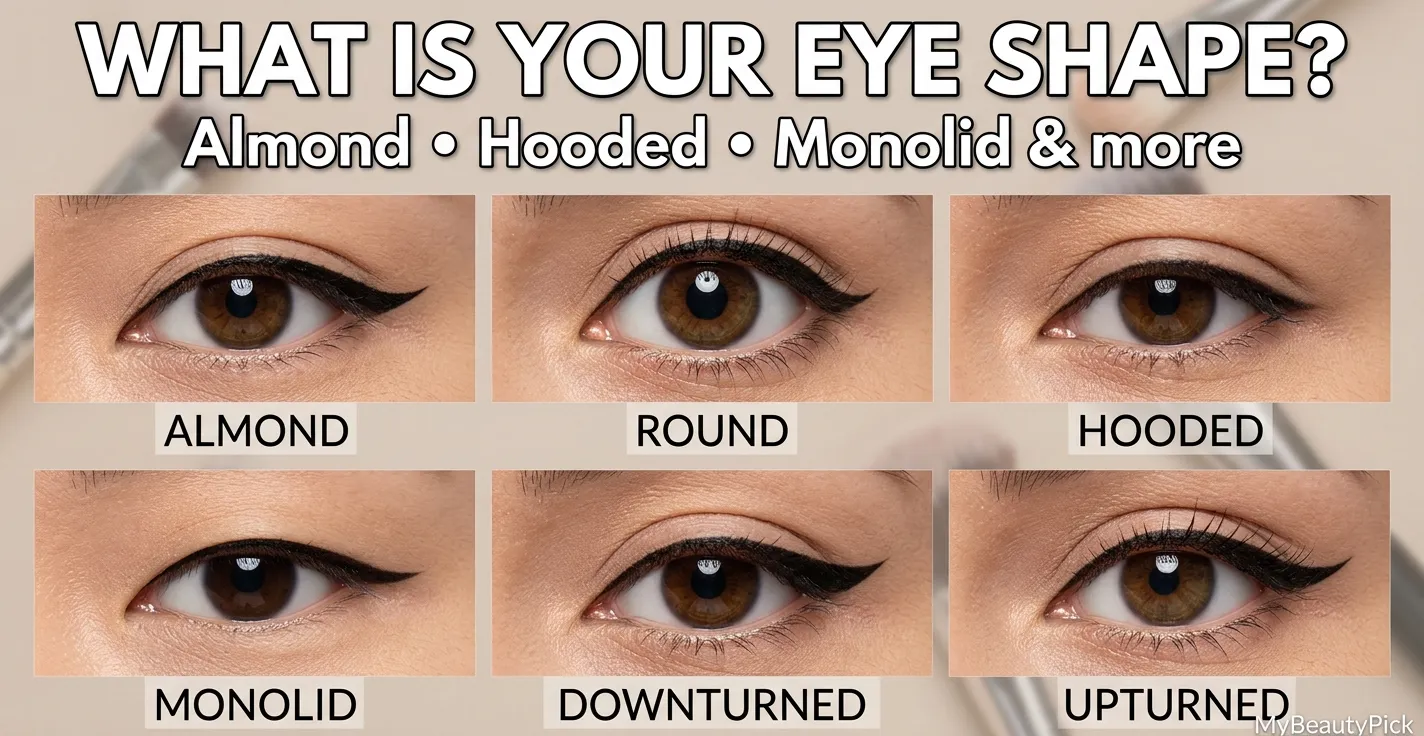
If you have ever drawn the exact same winged liner two days in a row and gotten two completely different results, your eye shape is the reason, not your hand. After two decades of doing makeup on every face shape that walks through a chair, I can tell you eye shape decides more about how your makeup behaves than any product you buy.
Here is the short answer: identify your eye shape by checking three things in a mirror under natural light. How much lid shows when your eyes are open, which direction your outer corners point, and how much white shows around your iris. Those three checks alone sort almost everyone into almond, round, hooded, monolid, downturned, or upturned.
Key Takeaway
- Eye shape is determined by lid visibility, crease depth, and corner direction, not eye color or size
- Most people are a combination of two shapes, like hooded and downturned
- Knowing your shape changes where you place liner, shadow, and lash extensions, not just what colors you wear
- The most reliable test takes under two minutes and needs only a mirror and daylight
How to Actually Test Your Eye Shape (Mirror Method)
Skip the phone filters and the AI eye shape quizzes. They guess based on averages, not your actual bone structure. Do this instead.
Step 1: Get the right light
Stand facing a window with daylight coming at your face, not from behind you. Overhead bathroom lighting flattens your lid and hides your crease, which is the single biggest reason people misidentify their own eye shape.
Step 2: Check your lid visibility
Look straight ahead with a relaxed brow, no lifting, no squinting. Can you see your eyelid skin between your lash line and your brow bone?
- No visible lid space at all, flat from lash line to brow: monolid
- A sliver of lid shows but a fold of skin covers most of it: hooded
- A clear, defined lid and crease show: move to step 3
Step 3: Check your outer corner direction
Draw an imaginary horizontal line across your eye from inner corner to outer corner. Where does the outer corner sit relative to that line?
- Outer corner sits higher than the inner corner: upturned
- Outer corner sits lower than the inner corner: downturned
- Outer corner sits roughly level: move to step 4
Step 4: Check the white of your eye
Look directly ahead in the mirror without straining.
- White (sclera) is visible above and below your iris all the way around: round
- White is mostly hidden by your upper and lower lid, eye looks elongated and slightly tapered: almond
Photograph yourself instead of trusting the mirror alone
Mirrors flip your face and your brain compensates for asymmetry without you noticing. Take a straight-on phone photo with your face relaxed and your chin level, then look at the photo instead of your reflection. I have had clients swear they had hooded eyes for years and then see clearly in a photo that they actually had a low brow bone pushing the skin down, which is a different fix entirely.
The Six Eye Shapes, in Detail
Almost nobody is a textbook example of one shape. You are looking for your dominant traits, then your secondary traits. Here is what each shape actually looks like and what it means for your makeup.
Almond Eyes
How to spot it: Lid and crease both visible, iris slightly covered top and bottom, outer corners level or with a soft lift.
Why it works for liner: The visible crease gives you a natural shelf to wing liner out from, so almost any liner shape sits well.
Who has it: The most common shape, and often blended with upturned or downturned at the corners.
Mistake to avoid: Over-winging the liner so far past the natural corner that it drags the eye downward instead of lifting it.
Round Eyes
How to spot it: White visible above and below the iris, eye looks as tall as it is wide.
Why it works for shadow: Round eyes read youthful and open, but heavy shadow all the way around can make them look smaller, not bigger.
Who has it: Common in eyes with a higher brow bone and less hooding.
Mistake to avoid: Thick liner on the lower lash line. It closes the eye down instead of opening it.
Hooded Eyes
How to spot it: A fold of skin sits over the crease, hiding most or all of the lid when eyes are open.
Why it matters: Shadow placed where you can see it in the mirror, eyes closed, often disappears completely once your eyes are open.
Who has it: Can be genetic from birth, or develop gradually with age as skin loses elasticity above the crease.
Mistake to avoid: Building a smoky eye with the eyes closed only. Always check the look with eyes open and looking straight ahead before finishing.
Monolid Eyes
How to spot it: No visible crease line at all, the lid is flat and smooth from lash line to brow.
Why it matters: There is no natural shelf to follow, so liner and shadow placement is based on the lash line and outer corner, not a crease that does not exist.
Who has it: Most common in East Asian eye shapes, though it appears across all ethnicities.
Mistake to avoid: Copying a crease-based eyeshadow tutorial line for line. The placement guides are different, not lesser.
Downturned Eyes
How to spot it: Outer corners sit lower than the inner corners, giving a slight droop at the outer edge.
Why it matters: A standard wing that follows the natural downward angle of the lower lash line will exaggerate the droop instead of softening it.
Who has it: Can appear at any age, and becomes more pronounced with the natural skin laxity that comes with aging.
Mistake to avoid: Skipping a lift technique on the liner. A small upward angle at the outer third makes a real visible difference here.
Upturned Eyes
How to spot it: Outer corners sit higher than the inner corners, giving a natural feline lift.
Why it matters: This shape already has built-in lift, so most winged liner shapes and cat-eye looks come together with very little effort.
Who has it: Less common on its own, often paired with almond traits.
Mistake to avoid: Adding too much extra wing length. It can tip the look from lifted into severe.
Quick Comparison Table
| Eye Shape | Lid/Crease | Outer Corner | White Visible | Best Liner Approach |
|---|---|---|---|---|
| Almond | Visible crease and lid | Level or slight lift | Minimal top and bottom | Follow the natural crease line |
| Round | Visible crease and lid | Level | Visible all around iris | Thin liner, avoid full lower lid |
| Hooded | Crease hidden by skin fold | Level or downturned | Minimal | Check with eyes open, not closed |
| Monolid | No visible crease | Level | Minimal | Lash-line based, no crease guide |
| Downturned | Visible crease and lid | Lower than inner corner | Moderate | Angle liner up slightly at outer third |
| Upturned | Visible crease and lid | Higher than inner corner | Minimal | Keep wing short, shape is already lifted |
You Are Probably a Combination, Not One Shape
This is the part most eye shape guides skip entirely, and it is the part that actually matters for your makeup routine. Eye shapes are not six separate boxes. The lid/crease check and the corner check are independent tests, which means you can be hooded and downturned, or monolid and upturned, or round and almond depending on which eye you are checking.
In the chair, I see hooded-downturned combinations constantly, especially after age 40, because the same loss of skin elasticity that creates hooding also tends to pull the outer corner down. If that is your combination, you need both the open-eye check from the hooded section and the corner lift from the downturned section, applied together.
Common Misdiagnosis to Watch For
People with a low or flat brow bone often mistake the shadow it casts for hooding. True hooding is a skin fold that covers the lid. A low brow bone changes the angle of light on the eye area but does not necessarily hide your crease the same way. The photo test from earlier will show you the difference clearly, a mirror often will not.
Mistakes People Make When Identifying Their Eye Shape
- Testing with a lifted brow. Raising your eyebrows opens up hooded lids artificially and gives you a false reading.
- Testing under downlighting. Light from above casts shadows that mimic a deeper crease than you actually have.
- Only checking one eye. Most faces are slightly asymmetrical. Check both eyes, the dominant shape usually shows on both but the degree can differ.
- Confusing eye size with eye shape. Small eyes can be almond, round, or hooded. Size and shape are separate traits.
- Relying only on an AI eye shape quiz. These tools average pixel patterns and frequently mislabel hooded eyes as almond because the algorithm cannot always detect a subtle skin fold.
FAQ
Can your eye shape change over time?
Yes. Skin around the eyes loses collagen and elasticity with age, which is why hooding and downturning often become more noticeable in your 40s and beyond even if your eyes looked almond or round in your 20s. Sun exposure and sleep position can also influence the rate of change.
Can I have a different eye shape on each side of my face?
You can have a different degree of the same general traits on each side, since most faces are not perfectly symmetrical. A true difference in category, like almond on one eye and monolid on the other, is uncommon but not impossible.
Do eye shape AI quizzes actually work?
They can give you a rough starting point, but they tend to misread hooded eyes as almond and struggle with combination shapes since they are trained on averaged, idealized examples rather than your specific bone structure and skin behavior.
What is the difference between hooded eyes and deep-set eyes?
Hooded eyes have a skin fold that physically covers the crease. Deep-set eyes sit further back in the socket under a prominent brow bone, which creates shadow but does not necessarily hide the crease the way hooding does. You can have both at once.
Does eye shape affect what eyeliner style suits me?
Yes, significantly. A liner shape that lifts upturned eyes can drag downturned eyes further down, and a full lower lid line that defines almond eyes can make round eyes look smaller. The shape itself is the deciding factor, not the trend you saw online.