

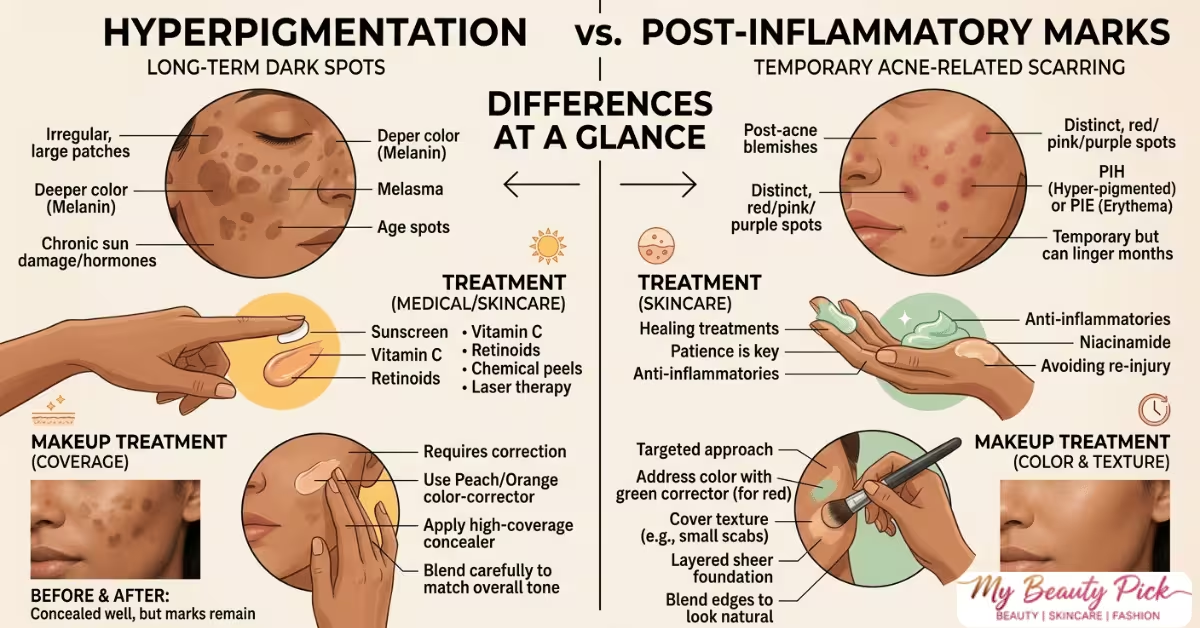
If you have ever watched a concealer settle into a dark spot and make it look more obvious than before you started, you already know there is something more going on than just shade selection. Dark marks on tan skin are not a single category. They come from different causes, develop differently, and need to be treated differently — both in skincare and in makeup. Applying the same product and technique to every mark on your face is the most common reason the coverage fails.
This guide separates hyperpigmentation from post-inflammatory hyperpigmentation, explains how each type looks and behaves on tan complexions, and gives you a specific makeup approach for each one.
What Is Hyperpigmentation?
Melanin Overproduction Explained
Hyperpigmentation occurs when melanocytes — the cells responsible for producing skin pigment — become overactive and produce excess melanin in a localised area. This excess melanin deposits in the upper layers of the skin and appears as a patch or spot darker than the surrounding complexion. The underlying skin structure is unchanged; only the pigment level in that area is elevated.
Major Triggers
UV exposure is the most consistent trigger. Sun stimulates melanin production across all skin types, but existing areas of elevated pigmentation respond more intensely, making them darker with each exposure. Hormonal fluctuations — particularly those associated with pregnancy, oral contraceptives, and perimenopausal shifts — can activate hyperpigmentation that was previously dormant. Certain medications, including some antibiotics and anti-seizure drugs, increase photosensitivity and accelerate pigmentation. Physical trauma to the skin surface — including aggressive scrubbing, chemical exfoliation taken too far, or laser procedures not calibrated for deeper skin tones — can also trigger localised overproduction.
Melasma as a Special Category
Melasma is a hormonally driven subtype of hyperpigmentation with a distinct pattern. It appears as larger, symmetrical patches — most commonly across the cheeks, forehead, upper lip, and chin. Unlike spot hyperpigmentation, melasma tends to be blotchy and diffuse rather than sharply defined. It is significantly more common in tan and deeper complexions, and it is one of the most stubborn pigmentation conditions to treat because it has both hormonal and UV components. Concealing melasma requires a different approach than concealing a single dark spot.
How Hyperpigmentation Appears on Tan Skin
On tan complexions, hyperpigmentation tends to appear in deeper brown tones — ranging from warm medium brown to very dark brown, sometimes with a greyish undertone in longer-standing marks. The contrast against the surrounding skin is usually high, making the marks clearly visible. Marks that are recent tend to be brighter and more saturated in colour; older, longer-standing marks can take on a flatter, greyer quality as the melanin settles deeper into the skin layers.
What Is Post-Inflammatory Hyperpigmentation (PIH)?
Causes of PIH
Post-inflammatory hyperpigmentation is a response to skin injury or inflammation. When the skin experiences trauma — from acne, eczema, a cut, a burn, an insect bite, or even aggressive extractions — the inflammatory process triggers excess melanin production in the affected area. This melanin accumulates as the inflammation resolves, leaving behind a flat discolouration at the site of the original injury. PIH is not the injury itself; it is the skin’s pigmented response after the injury has healed.
Why Fitzpatrick IV–VI Skin Experiences More PIH
The degree of PIH response is closely linked to baseline melanin activity. In skin with higher melanin concentration — Fitzpatrick Types IV through VI — the melanocytes are more reactive and produce a stronger pigment response to inflammatory signals. This means the same acne breakout that leaves minimal discolouration on fair skin can produce a dark, persistent mark on tan or deep skin. PIH is not a sign of abnormal skin — it is simply a more active melanin response in a skin type that already has high melanin activity.
Red Stage vs. Brown Stage
PIH goes through two visible stages. The red or pink stage is the initial inflammatory phase — the skin is still responding, the melanin response has not fully developed, and the mark has a reddish or purplish cast. On tan skin, this stage can appear more purple-brown than the pink it shows on lighter complexions. The brown stage follows as inflammation fully resolves and excess melanin deposits in the epidermis. By this point the mark is a flat, defined discolouration without texture or elevation. Understanding which stage a mark is in changes how you conceal it.
Acne and PIH Connection
Acne is the most common source of PIH on the face. Every breakout — even those that do not come to a head and are never touched — creates an inflammatory response beneath the surface. On tan skin, this inflammatory response almost always produces some degree of post-inflammatory discolouration. The marks from a single moderate breakout can take four to twelve months to fully fade without targeted treatment, and sun exposure during that window will deepen them further.
Hyperpigmentation vs. PIH — Visual Comparison Guide
| Characteristic | Hyperpigmentation | Post-Inflammatory Hyperpigmentation (PIH) |
| Colour on tan skin | Medium to dark brown, sometimes grey-brown on older marks | Red-purple early stage; flat brown to dark brown in later stage |
| Shape | Diffuse patches; irregular borders; often larger areas | Corresponds to the original injury — usually circular or spot-shaped |
| Edge definition | Often blurry or gradient at the edges | Relatively defined — matches the shape of the original inflammation |
| Location patterns | Symmetrical; cheeks, forehead, upper lip (melasma); or UV-exposed areas | Anywhere acne or injury occurred — cheeks, chin, forehead most common |
| Duration | Months to years; persistent without treatment | Months to a year or more depending on depth and sun exposure |
| Texture | Flat — no raised or recessed texture | Flat — but may sit in or over a pore or acne scar |
How Makeup Should Treat Hyperpigmentation
Coverage Requirements
True hyperpigmentation — particularly melasma — requires either medium-to-full buildable coverage or a colour-correcting layer beneath your foundation. The pigment is dense and does not fade visually through sheer coverage. Attempting to cover melasma with a light formula and calling it done typically results in the mark being visible through the coverage, particularly in bright light.
Peach and Orange Correctors
Colour correction works by applying the opposite hue to the discolouration on the colour wheel, neutralising it before coverage goes on top. For brown hyperpigmentation on tan skin, peach and orange correctors are the most effective. Peach works for lighter tan complexions where the pigmentation is medium brown. Orange is more effective for deeper tan skin where the hyperpigmentation is very dark brown. The corrector is applied specifically to the darkened area in a thin layer, then set lightly before foundation is applied on top. The corrector should not be visible in the final result — it simply neutralises the depth of the mark so that a more moderate coverage foundation can do the rest.
Layering Technique
Apply corrector first with a small brush or fingertip, pressing — not rubbing — it into the pigmented area. Set with a micro-dusting of translucent powder. Apply foundation over the face in the usual way. Follow with a concealer in your skin shade over the corrected area if additional coverage is needed. Setting finally with a light pressed powder prevents the layers from moving or creasing throughout the day.
Importance of SPF
SPF is not optional when dealing with hyperpigmentation. UV exposure is both the primary cause and the primary driver of worsening. Any area of hyperpigmentation that receives UV exposure will deepen. This means that even well-concealed marks need protection beneath the makeup — an SPF 30–50 applied as part of your morning skincare routine before any makeup products go on.
How Makeup Should Treat PIH Marks
Red PIH Correction
For PIH marks in their early red or purple stage on tan skin, green corrector is not the right choice — it is formulated for the pink-red flush of lighter complexions. On tan skin, early-stage PIH has a purple-brown cast. A yellow or light peach corrector neutralises this more accurately, evening out the tone without pulling the area too warm or too light.
Brown PIH Concealing
In the later brown stage, PIH is approached similarly to hyperpigmentation — a peach or orange corrector beneath, then foundation, then a skin-tone concealer on top. The key difference is that PIH marks are often smaller and more sharply defined than hyperpigmentation patches, which means precise application with a small flat concealer brush is more effective than blending with a sponge, which can pull coverage away from the target area.
Avoiding Heavy Coverage
Heavy coverage concealer applied directly onto a PIH mark without correction beneath tends to look patchy and cakey. The mark’s colour shows through full-coverage product when the coverage is built too high in a single layer. Two or three thin corrected layers produce a more invisible, natural-looking result than one thick layer of concealer applied in the hope that enough product will hide the colour.
Colour Corrector Selection by Skin Depth
| Skin Depth | For Brown/Hyperpigmentation | For Red/Early PIH |
| Light tan (Fitzpatrick III) | Peach corrector — pastel, medium saturation | Yellow-peach corrector |
| Golden tan (Fitzpatrick IV warm) | Medium peach to light orange | Golden yellow corrector |
| Deep tan (Fitzpatrick IV–V) | True orange corrector — fully saturated | Deep peach to light orange |
| Deep brown (Fitzpatrick V) | Deep orange or rust corrector | Orange-peach with warm undertone |
Common Makeup Mistakes That Make Dark Marks More Visible
Too-Light Concealer
The most widespread mistake. A concealer lighter than the surrounding skin does not conceal a dark mark — it creates a bright circle that draws more attention than the mark itself. Concealer should match the skin tone exactly, or sit within a half-shade of it. The correction layer underneath does the work of neutralising the mark’s colour. The concealer’s job is simply to match the surrounding skin and unify the finish.
Over-Correcting
Applying too much colour corrector — or using a corrector that is too highly pigmented — can push the corrected area into a visibly orange or warm cast that shows through the foundation. Corrector should be applied in a thin, targeted layer and blended at the edges so there is no visible line between corrected and uncorrected skin. Less is more.
Skipping Skin Prep
Dry, unhydrated skin makes dark marks more visible because the skin’s surface texture is uneven. A good moisturiser applied before makeup allows foundation and concealer to sit flat and evenly, rather than catching on dry patches and highlighting the texture at the edges of marks. Niacinamide-containing serums applied consistently also help reduce the contrast of PIH and hyperpigmentation over time, making the makeup’s job progressively easier.
Excess Powder
Heavy powder set over a layered concealing technique compresses the product and can crack or cake over the area, drawing more attention than leaving it lightly set. Always use the minimum amount of powder needed to set the coverage — ideally applied with a clean puff in a pressing motion rather than a brush sweep, which disturbs the layers beneath.
Skincare and Makeup Combined Strategy
Niacinamide
Niacinamide (Vitamin B3) is one of the most well-supported ingredients for reducing visible hyperpigmentation and PIH. It works by inhibiting the transfer of melanin from melanocytes to the surrounding skin cells, gradually reducing the pigment concentration in affected areas. Applied consistently at concentrations of 5 to 10%, results typically become visible within 8 to 12 weeks. It is compatible with most other active ingredients and suitable for daily use.
Azelaic Acid
Azelaic acid works through a slightly different mechanism — it directly inhibits tyrosinase, the enzyme required for melanin production, and has additional anti-inflammatory properties that help reduce the PIH response in the first place. It is available over the counter at lower concentrations and by prescription at higher concentrations. It is particularly useful for acne-prone tan skin because it addresses both the breakouts that cause PIH and the pigmentation they leave behind.
Sunscreen Importance
No amount of skincare or makeup correction is effective if UV exposure is allowed to continue deepening the marks. SPF is the single most impactful step in a pigmentation management routine — more than any active ingredient. Apply SPF 30–50 every morning regardless of weather or indoor activity, as UVA radiation passes through windows and contributes to pigmentation deepening even on overcast days.
Realistic Timelines
Hyperpigmentation and PIH take time to fade even with consistent, correct treatment. Most dermatologists recommend giving any skincare routine at least 3 months before assessing results, and 6 months as the point at which significant improvement should be visible. Deep, long-standing marks may require 12 months or longer. Consistency and sun protection are more important than the specific active ingredients used.
Quick Identification Checklist
| If the mark looks like this… | It is likely… | Approach with… |
| Diffuse patches, symmetrical, blurry edges, cheeks and forehead | Melasma (hormonal hyperpigmentation) | Orange corrector, full-coverage foundation, strict SPF |
| Brown patch, UV-exposed area, irregular but defined | Solar hyperpigmentation | Peach/orange corrector based on depth, medium-to-full coverage |
| Purple-brown spot, recent, sits where a breakout was | PIH — early red stage | Yellow-peach corrector, light foundation layer over top |
| Flat dark brown spot, weeks to months old, well-defined | PIH — brown stage | Orange corrector, skin-tone concealer over foundation |
Use our Corrector Shade Selector Tool to find the right correction colour for your skin tone and mark type.