

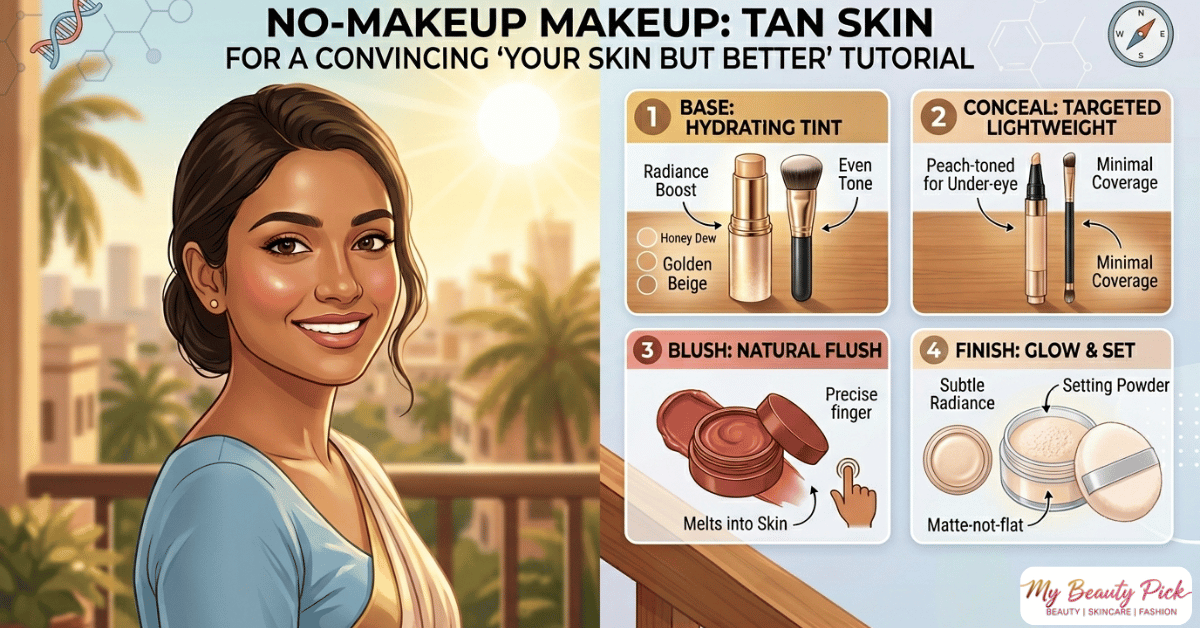
The no-makeup makeup look is one of the most technically demanding looks in beauty — not because the steps are complicated, but because every product has to earn its place without being visible. On tan skin, this requires a specific set of choices. The wrong “natural” product creates a grey cast, a chalky finish, or a warmth mismatch that reads as obviously made-up. Done right, the result is skin that looks impossibly good — healthy, even, glowing — with no visible product in sight.
What “No-Makeup Makeup” Actually Means on Tan Skin
The goal is not minimal product. It is invisible product. The distinction matters because achieving skin that looks naturally flawless without looking made up often requires more steps and more precision than a full-coverage look — the difference is that every product is working to enhance the skin’s own qualities rather than cover them or add colour. Skin with more melanin has inherent advantages here: its warmth, depth, and natural luminosity are exactly what this look celebrates. The challenge is choosing products that support those qualities rather than flattening or cooling them.
Where fair-skin no-makeup looks focus on sheerness and pink undertones, tan skin no-makeup looks need warmth, light-absorbing coverage, and finishing products that add glow rather than shimmer. The approach below is built specifically around that.
The Complete Product Edit
Everything you need, chosen for tan skin specifically
The base layer determines finish. A hydrating, non-silicone primer on tan skin creates a moist surface that lets skin-tints move naturally rather than sitting on top. Avoid mattifying primers for this look — they suppress the skin’s natural radiance, which is the whole point here.
Full-coverage foundation is the wrong tool for this look — it immediately reads as makeup. A skin tint gives enough evening to unify the complexion while letting texture, pores, and natural depth show through. On tan skin, choose one with a golden or warm-neutral base, not pink or beige.
Used only where needed — under eyes and over any visible discolouration. Serum-formula concealers are the best fit for this look because they blend into the skin rather than sitting on top of it. A half-shade lighter than your skin tone, in the same undertone family, creates a natural brightening without obvious coverage.
Well-groomed brows are the structural element that makes a no-makeup look read as intentional rather than undone. For tan skin, avoid cool-ash brow products — they create a disconnection from the skin’s warmth. A warm taupe or soft brown that is one shade lighter than your natural brow hair is the correct starting point.
Powder blush is too obviously applied for this look — the visible product on the face surface immediately reads as makeup. Cream blush blends into the skin and reads as a natural flush. On tan skin, terracotta and warm peach are the most natural-looking flush colours because they complement the skin’s own warmth rather than adding an artificial pink note.
Black mascara immediately registers as a makeup choice. Dark brown mascara — particularly on warm-undertone tan skin — reads as naturally defined lashes rather than a visible product. Apply one coat and wiggle the wand at the roots. That is enough for this look.
The most important lip product choice in this look. For tan skin, the correct nude is never beige or pale pink — those drain warmth from the face. Your actual nude is a warm, slightly deeper version of your natural lip colour: a warm rose, terracotta-nude, or brown-rose depending on your specific depth and undertone.
Shimmer products applied on top of the skin look obviously applied. For this look, glow comes from within the base: one drop of liquid highlighter or a few drops of facial oil mixed into the skin tint before application. On tan skin, gold-toned highlighters complement the melanin-rich warmth. White or icy highlighters create an ashy, disconnected glow.
Step-by-Step Tutorial
8 steps — complete in 12 minutes
Apply your regular moisturiser and allow it to absorb fully — a minimum of three minutes. This is not optional for this look. A dehydrated skin surface makes even the most skin-like tint look patchy and emphasises texture. If you have dry patches, apply a thin layer of facial oil to those areas specifically and press in with fingertips. For the under-eye area, apply eye cream and allow it to set before any makeup goes near it.
On the back of your hand, place one pump of your skin tint and add one drop of liquid highlighter or two drops of facial oil. Mix thoroughly with a fingertip or spatula until the texture is uniform. This distributes glow evenly through the base rather than applying it as a visible product on top of the skin. The result looks like naturally radiant skin, not highlighted skin. Apply this mixture to your face using your fingers or a damp beauty sponge, pressing and patting rather than dragging.
Resist the impulse to apply concealer everywhere — it immediately pushes the look toward full makeup. Use your serum concealer under the eyes only if the discolouration is visible through the skin tint, and over any PIH or dark spots that are distracting. Apply with a fingertip using a tapping motion, blending the edges into the skin tint beneath. For the under-eye area on tan skin specifically: if the shadow has a purple-brown cast, apply a thin touch of peach corrector first, set it with the lightest dusting of powder, then your concealer on top.
Powder anywhere on the face that is not the under-eye or blemish-concealed area will immediately flatten the skin-tint’s natural finish and make the look appear powdered and obviously made up. Use a small puff with a very light dusting of a warm-tinted translucent powder — or banana powder for warm-undertone tan skin — only under the eyes and over any concealed spots. Press gently and sweep away the excess with a clean fluffy brush.
Dot your cream blush directly onto the apples of the cheeks — smile, place the product at the fullest point, then blend upward toward the temple using your ring finger in circular motions. The warmth of your finger melts the product into the skin rather than sitting on top of it. For tan skin, apply a slightly more generous amount than you think you need — the simultaneous contrast effect means the colour will read lighter on your skin than it appears on your fingertip. Build slowly, stepping back to check from a distance.
For this look, the brows should be groomed, not drawn. Brush upward and through with a spoolie to give them shape and lift. If there are sparse areas, use a hair-stroke pencil in a warm taupe or soft brown — one stroke at a time, following the direction of natural hair growth, only in the genuinely sparse areas. Finish with a clear or tinted brow gel to set the shape. The goal is to look like someone whose brows are simply well-kept, not someone wearing brow makeup.
Dark brown mascara is the correct choice for this look on tan skin. Wiggle the wand at the roots of the upper lashes and draw upward to the tips. One coat. Do not build. If after drying you feel the lashes need more presence, a second coat applied only to the outer half of the lash line adds definition without an obviously mascaraed appearance. Skip mascara on the lower lashes — it immediately reads as a makeup choice and pulls the eye away from the skin focus of the look.
For tan skin, the correct no-makeup lip is warmer and slightly deeper than most “nude” products suggest. A tinted lip balm in warm rose, warm terracotta-nude, or a sheer lip gloss over a warm-brown liner in your lip shade creates the effect of enhanced natural colour. If using a liner and gloss combination: line the lip and blend the liner inward with a fingertip so there is no visible liner edge, then apply gloss to the centre only. The contrast between the lined outer lip and the glossy centre creates natural-looking fullness without obvious product.
Products to Avoid for This Look on Tan Skin
What Breaks the “No-Makeup” EffectPowder foundation — reads as coverage immediately, even in photos. Full-coverage concealer applied broadly. Black mascara — instantly registers as visible product. Pink or cool-beige lip colours — drain warmth from tan skin and look artificial. Powder highlighter applied on top of the skin — reads as sparkle, not glow. White or ivory setting powder — creates a visible grey or ashy cast on tan skin in any lighting.
Making It Last — Wear and Touch-Up
The skin tint and cream product combination used in this look is less robust than a full powder-set foundation routine, which is the trade-off for the skin-like finish. To maximise wear time, finish the routine with two light mists of a hydrating setting spray held at arm’s length. This binds the water-based products together and extends the finish. At midday, blot any shine with a blotting paper, tap a very small amount of cream blush back onto the cheeks if needed, and refresh the lip product. Avoid powder touch-ups — a single application of powder at midday over a skin-tint base creates a patchy, inconsistent finish that is harder to correct than the original shine.
Quick Reference Checklist
- Moisturiser fully absorbed before any base product goes on
- SPF applied as a separate skincare step, not mixed into base
- Glow mixed into skin tint before application — not applied on top
- Concealer used only where genuinely necessary, not all over
- Powder set only under eyes and over concealed spots
- Cream blush in terracotta or warm peach — applied with fingers
- Brown mascara, one coat, upper lashes only
- Warm-toned nude lip, not cool beige or pale pink
- Setting spray as the final step — no additional powder touch-ups