

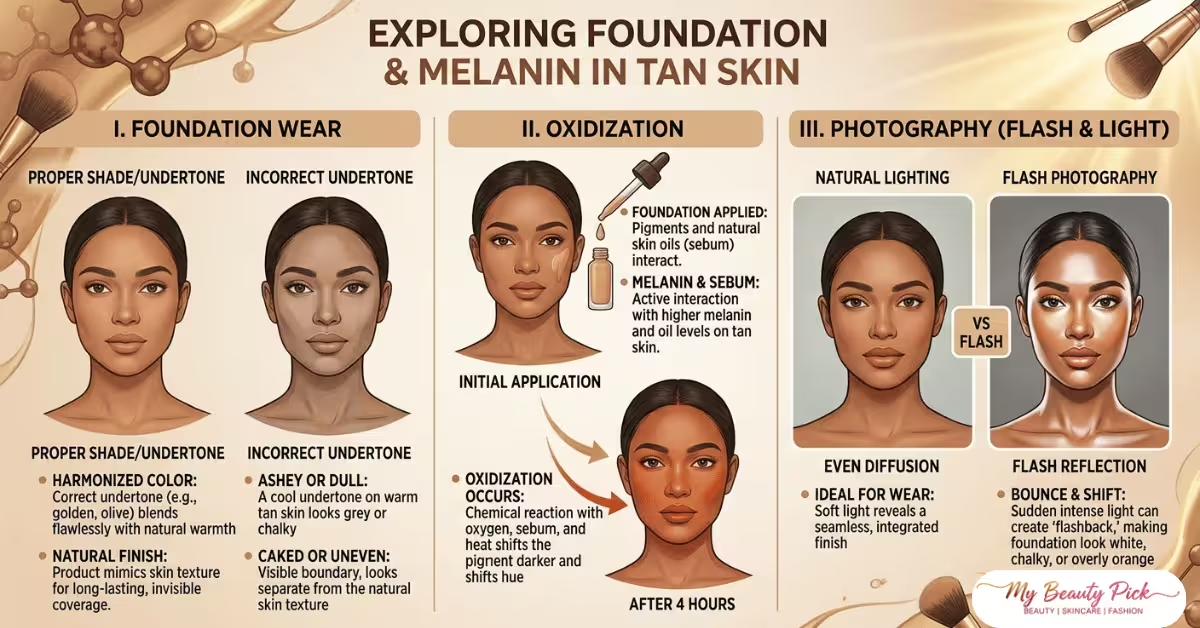
You spend twenty minutes at the beauty counter finding a foundation that matches. You apply it carefully, step outside, and catch your reflection at noon — and your face is two shades darker and visibly orange. This is one of the most common complaints from people with tan and medium-deep complexions, and almost every case traces back to the same root cause: foundation oxidation.
Oxidation is not a shade mistake. It is a chemical process. The foundation looked right when you applied it. The problem is what happened after. Understanding why this occurs — and why it occurs more dramatically on tan skin — is the starting point for fixing it permanently.
Understanding Melanin and Why It Matters for Foundation Performance
What Is Melanin?
Melanin is the pigment responsible for skin, hair, and eye colour. It is produced by cells called melanocytes in the basal layer of the epidermis. Beyond colour, melanin plays a protective role — it absorbs UV radiation and converts it into heat, shielding deeper skin layers from damage. Skin with more melanin is inherently better protected from UV exposure, which is why darker complexions burn less easily.
For makeup purposes, what matters is how melanin concentration affects the skin’s surface chemistry and how it interacts with pigments in cosmetic formulas.
Eumelanin vs. Pheomelanin
There are two primary types of melanin in human skin. Eumelanin produces brown and black tones. Pheomelanin produces yellow, red, and pink tones. Most people have both, but the ratio determines the overall complexion character. Tan skin typically has a higher concentration of eumelanin, which creates the warm, golden-to-chestnut depth that defines this range of complexions. This concentration also affects how pigment-heavy products — like foundations — sit and react on the skin surface.
Melanin Density Across Fitzpatrick Skin Types
Tan skin spans Fitzpatrick Types III through V. Type III describes light-to-medium skin that tans easily and rarely burns. Type IV covers olive and medium-brown tones. Type V includes deeper caramel and warm brown complexions. Two people who both describe themselves as having tan skin can sit at very different points on this scale — meaning the same foundation may behave differently on each of them even if the shade label is identical. Melanin distribution is not uniform, and it affects both how foundation pigments are absorbed and how oxidation manifests visually.
| Fitzpatrick Type | Typical Description | Oxidation Visibility |
| III | Light tan, golden beige, tans easily | Moderate — orange cast appears within 60 minutes |
| IV | Olive, honey, medium brown | High — orange or bronze shift is clearly visible by midday |
| V | Caramel, chestnut, deep warm brown | Very high — shift amplified by pigment depth in formula |
Foundation Oxidation on Tan Skin Explained
What Foundation Oxidation Actually Means
Oxidation in foundation refers to a chemical reaction between the pigments in the formula and external factors — primarily oxygen, skin oils, and pH. This reaction changes the way pigments reflect light, causing the shade to shift. The result is almost always a warmer, darker, more orange or bronze finish compared to what the foundation looked like immediately after application.
This is meaningfully different from choosing the wrong shade. A mismatched shade looks wrong immediately. Oxidation looks correct at first and changes over time — typically becoming visible between 20 and 60 minutes after application. That timing window is the diagnostic key.
Why Foundation Turns Orange on Tan Skin
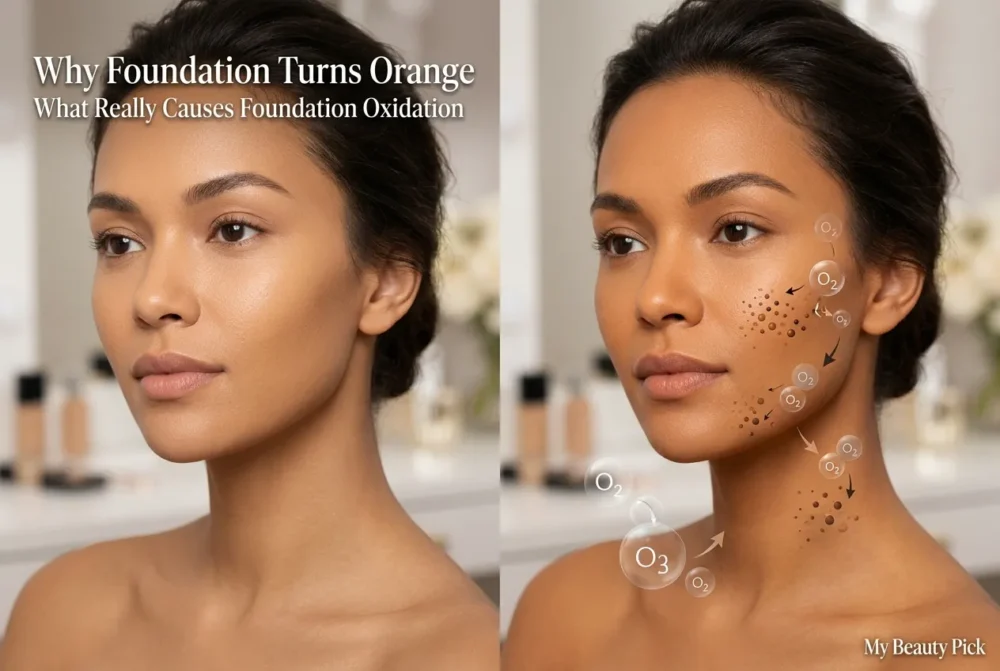
The central cause is iron oxide pigments. Iron oxides are used in almost every foundation to create warm, tan, and brown shades. They are chemically reactive by nature. When exposed to oxygen, skin sebum, and shifts in surface pH, iron oxide compounds deepen and drift warm — producing that orange or bronze shift. The shades formulated for tan skin require a higher concentration of iron oxides to achieve the right depth, which means a higher starting level of reactive pigments. More reactive pigment equals more visible oxidation.
The Role of Titanium Dioxide
Titanium dioxide is a white mineral pigment used in foundations to adjust opacity and coverage, and in mineral SPF formulas as a UV filter. On lighter skin tones, its brightening effect is often desirable. On tan and deeper complexions, titanium dioxide creates a different problem — it sits on top of the skin as a white-reflective layer, which on higher-melanin skin reads as a grey or ashy cast rather than a natural finish. This is separate from oxidation but compounds the overall mismatch problem, particularly in formulas that combine titanium dioxide with reactive iron oxides.
Skin pH and Sebum Interaction
Healthy skin sits at a mildly acidic pH of around 4.5 to 5.5. Many foundations are formulated at a neutral to slightly alkaline pH. When these two meet at the skin surface, the contact can destabilize the binding compounds that hold pigments in place, accelerating their drift. Sebum compounds this further — it breaks down the emulsifier system in the foundation over time, allowing pigments to migrate and react more freely. In humid climates and on oilier skin types, this process runs significantly faster.
Common Ingredients Most Associated with Oxidation
| Ingredient | Role | Oxidation Risk |
| Iron oxides (CI 77491, 77492, 77499) | Primary pigmentation in tan and warm shades | High — core cause of orange shift |
| Triglycerides and plant oils | Emollients for texture | Moderate — feed sebum breakdown of the formula |
| Isopropyl myristate | Spreadability agent | Moderate — softens the formula film, increasing reactivity |
| Talc (in powder foundations) | Oil absorption and setting | Low alone, higher when combined with reactive pigments |
| Expert Insight: From a cosmetic chemistry perspective, oxidation is not a defect — it is an expected interaction between chemically active pigment compounds and the biological environment of skin. The industry standard is to formulate foundations that are stable at the point of application, not across a full day of wear. That gap is where tan skin is most often let down. |
Why Melanin-Rich Skin Experiences Different Foundation Wear Patterns
Barrier Function in Melanin-Rich Skin
Skin with higher melanin density tends to have a more robust and compact stratum corneum — the outermost skin layer. This affects how quickly products are absorbed and how foundation sits on the surface versus bonding with it. Foundations on higher-melanin skin often stay more surface-active throughout the day, which means their pigments remain more exposed to environmental oxidation factors rather than being stabilised by skin absorption.
Sebum Production Differences
Research consistently shows that skin with higher melanin concentration tends to produce more sebum than lighter skin types. The sebaceous glands are both more numerous and more active in Fitzpatrick IV–V skin. Since sebum is one of the primary drivers of foundation oxidation, this baseline difference in oil production means tan and deeper skin starts the day at a higher oxidation risk — before climate, activity, or product formula even come into play.
How Oil Changes Foundation Structure Throughout the Day
Within the first two hours of wear, sebum begins working its way through the foundation film. It softens the binding agents that hold iron oxide pigments in suspension. Once those binders are compromised, pigments migrate freely across the surface and react with oxygen. The result looks like shine or greasiness at first, but the underlying cause is pigment destabilisation. This is why blotting — which removes surface oil without disturbing the formula — works better than powder touch-ups, which simply trap the oil beneath an additional layer.
Common Breakdown Zones
Oxidation does not happen evenly across the face. It concentrates where sebum production is highest. The nose, upper lip, forehead, and chin — the classic T-zone — are where color shift appears first and most intensely. Cheeks come next, followed by the jawline. If you are photographed a few hours into wear, the face-to-neck contrast in these zones is typically where the mismatch is most obvious.
Oxidation vs. Wear Breakdown — How to Tell the Difference
| Sign | Oxidation | General Wear Breakdown |
| When it appears | 20–60 minutes after application | 4–8 hours after application |
| Where it starts | T-zone and oily zones first | Folds, creases, high-movement areas |
| What it looks like | Color shifts orange, darker, or ashy | Fades, patches, reveals skin beneath |
| Cause | Chemical pigment reaction | Physical friction and moisture loss |
| Fix | Formula change, shade adjustment, skin prep | Setting spray, powder, midday touch-up |
How Foundation Looks Different Under Indoor Lighting, Daylight, and Camera Flash
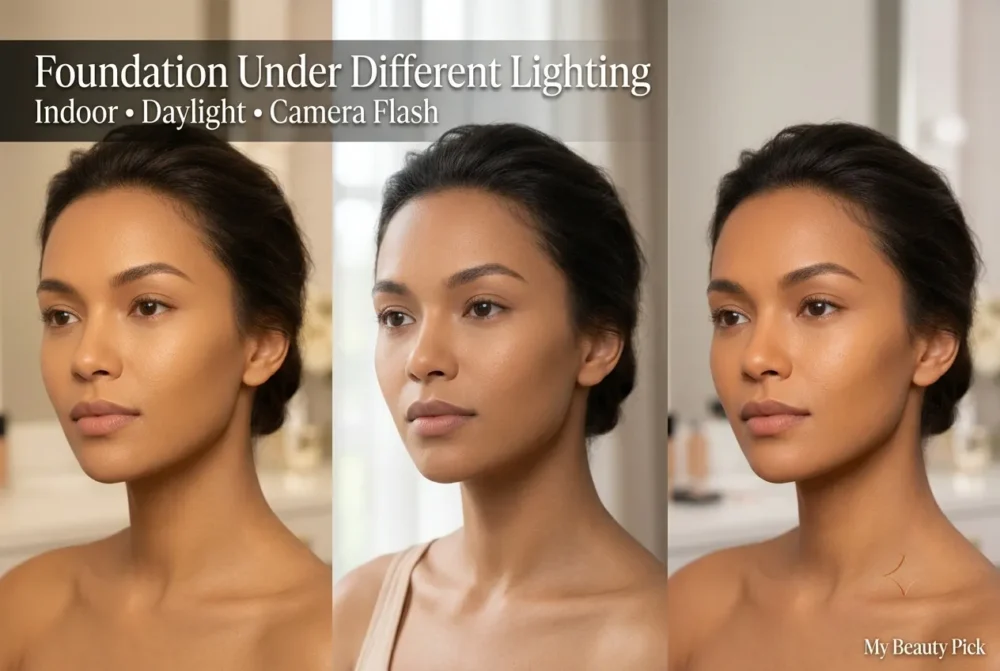
Why Foundation Appears Correct Indoors but Wrong Outside
Fluorescent and incandescent lighting mutes the difference between warm and cool tones. In this environment, an oxidizing foundation can appear to match your skin. Step outside into natural daylight and the full spectrum of light reveals the actual colour of both your skin and your foundation — including any orange or ashy shift that has developed since application. Always test foundation in natural daylight before committing to a shade.
Understanding Flashback in Photography
Camera flash emits a burst of white light that reflects off the skin’s surface. Certain ingredients — particularly titanium dioxide and zinc oxide — are highly reflective under this type of light. They bounce the flash back at the camera, appearing as a bright, whitish cast in photos even when the skin looks completely normal to the naked eye. On tan skin, this contrast between the bright reflected cast and the darker melanin-rich complexion is stark and unflattering.
The Titanium Dioxide Problem
Titanium dioxide causes flashback because of its refractive index — a measure of how strongly it bends and reflects light. It is particularly problematic in foundations that double as SPF, where titanium dioxide is present in high concentrations as a UV filter. For events, professional photography, or any situation where flash photography will be used, formulas with chemical SPF filters are significantly less likely to create white-cast flashback on tan and deeper complexions.
SPF Foundations and Photography
This does not mean avoiding SPF. It means separating your UV protection from your base makeup. Applying a chemical SPF moisturiser before foundation — and using a foundation without added mineral SPF — gives you sun protection without the reflective ingredients that cause flashback. Your SPF is doing its job beneath the foundation, not on top of it.
Wedding, Event, and Professional Photography Considerations
For any occasion involving a photographer, test your full makeup routine under flash conditions at least one week before the event. Use a phone camera with flash enabled to check for any white cast or colour mismatch. Do this test at the time of day when the event will occur, in similar lighting conditions, so you are evaluating your actual wear performance rather than a best-case scenario.
Titanium Dioxide White Cast on Brown Skin and the Science Behind It
How Light Reflects from Higher-Melanin Skin
Higher-melanin skin absorbs more light than it reflects. This is what creates depth and richness in tan and deeper complexions. When a highly reflective ingredient like titanium dioxide is layered on top of this naturally light-absorbing surface, the contrast is immediate and visible. The skin beneath is absorbing light; the titanium dioxide layer on top is bouncing it back. The result is an ashy or chalky appearance that makes the complexion look flat and washed out.
Why Mineral SPF Creates Ashiness
Mineral sunscreens — those using titanium dioxide or zinc oxide as active ingredients — sit on top of the skin rather than absorbing into it. This physical placement means the reflective white particles are always visible at the surface, regardless of how well they are blended in. The issue intensifies on tan and deeper skin because the contrast between the white mineral particles and the darker skin beneath is simply greater. Tinted mineral formulas reduce but rarely eliminate this contrast.
Titanium Dioxide vs. Zinc Oxide
Both are reflective, but they behave slightly differently. Zinc oxide particles tend to be available in a broader range of sizes, including ultra-fine formulations that are somewhat less visible on skin. Titanium dioxide, even in nano-particle form, tends to create a more pronounced white cast on tan and deeper complexions. If a mineral formula is necessary for your routine, zinc oxide-dominant formulas with tinted pigmentation are typically a better starting point for tan skin than titanium dioxide-heavy options.
Modern Pigment Technologies That Reduce Flashback
Some newer foundation and SPF formulas use surface-treated mineral particles — coated with silicones or other agents — that reduce their reflectivity without changing their UV-filtering function. Iron oxide-tinted mineral formulas also counter the white cast by adding complementary warm pigments. These are worth seeking out if you prefer mineral formulas, but they require careful testing on your specific undertone since the tinting may not match all tan skin variations.
Ingredient List Analysis for Melanin-Rich Complexions
Iron Oxides and Their Importance
When iron oxides appear near the top of a foundation ingredient list — particularly CI 77491 (red iron oxide), CI 77492 (yellow iron oxide), and CI 77499 (black iron oxide) — they are present in significant concentrations. For tan skin shades, all three are typically present to build depth. The ratio matters: a formula heavy in red iron oxide relative to yellow and black will push the shade toward orange even before oxidation occurs.
Chemical SPF vs. Mineral SPF
| SPF Type | Active Ingredients | Flashback Risk | Best For Tan Skin |
| Chemical | Avobenzone, octinoxate, homosalate | Low | Yes — absorbs into skin, no white cast |
| Mineral | Titanium dioxide, zinc oxide | High | Only if tinted and iron oxide-corrected |
| Hybrid | Mix of chemical and mineral filters | Moderate | Test on your specific tone before committing |
Ingredients That Help Prevent Oxidation
Dimethicone and cyclomethicone create a semi-occlusive film over iron oxide pigments, slowing their exposure to oxygen and sebum. Isododecane, a lightweight silicone carrier, similarly stabilises pigment suspension. Vitamin E (tocopherol) is an antioxidant that can partially counteract oxidative reactions within the formula. Formulas that include these alongside iron oxide pigments tend to be more wear-stable on tan skin than those that do not.
Undertone-Matched Pigments
For warm golden undertones, look for a higher proportion of yellow iron oxide with balanced red oxide. For olive undertones, a formula with a green pigment offset (sometimes listed as chromium oxide greens, CI 77288) alongside balanced iron oxides prevents the foundation from sitting orange or too warm. For neutral undertones, a balanced warm-to-cool pigment ratio with neither dominant gives the most accurate match. For red undertones common in some South Asian and Latin complexions, slightly more red oxide with a muted yellow base prevents the foundation from reading muddy.
The Best Foundation Testing Protocol for Tan Skin

Why Wrist Swatching Fails
The inside of the wrist is one of the least representative areas of skin on the body for foundation testing. The skin there is thinner, cooler in temperature, less exposed to UV, and produces almost no sebum. A foundation swatch on your wrist will behave entirely differently from the same formula applied to your face. The wrist swatch cannot show you how the formula responds to your skin’s oil production, pH, or actual melanin concentration — and it certainly cannot show you oxidation.
The 4-Hour Oxidation Test
Apply three candidate shades as stripes from jawline to neck. Go about your normal day. At the 4-hour mark, check under natural daylight and photograph with flash. The stripe that has shifted least and still matches your neck is your working shade. The stripe that has turned orange or dark has a higher iron oxide reactivity on your specific skin chemistry. Eliminate it regardless of how good it looked at application.
Step-by-Step Testing Framework
| Step | Action |
| 1 | Select three shades in your approximate depth range — one half-shade lighter, one match, one half-shade deeper |
| 2 | Apply as vertical stripes from jawline down to neck using a clean sponge |
| 3 | Wait at least 4 hours, going about normal activity |
| 4 | Step into natural daylight and assess all three stripes |
| 5 | Photograph under phone flash — eliminate any shade showing white cast or flashback |
| 6 | The stripe that remains closest to your neck and has shifted least is your match |
Common Foundation Matching Mistakes on Tan Skin
Buying Based on Initial Application
The most common and costly mistake. A foundation that looks perfect immediately after application is not proven to be a match. The only proof of a true match is what it looks like after 4 hours of real wear. Any shade chosen on the basis of its initial appearance risks being returned or wasted once oxidation sets in.
Ignoring Undertones
Shade depth and undertone are separate variables. Matching depth while ignoring undertone is the primary reason foundations look orange on tan skin — the depth is right but the warmth-to-cool balance in the formula conflicts with the skin’s natural undertone. Always identify undertone first (vein test, white paper test, jewellery test), then shop within that undertone category.
Assuming One Shade Works Year-Round
Tan skin shifts with sun exposure. A foundation matched in winter will almost certainly look too light by July — and vice versa. A two-shade seasonal wardrobe, or a shade-adjusting drop system, prevents the mismatch that develops when complexion depth changes but the formula does not.
How to Find the Best Foundation for Melanin-Rich Skin
Oxidation-Resistant Formula Features
| Feature | Why It Helps |
| Water-based formula | Fewer oils in the base means less sebum interaction and slower pigment breakdown |
| Matte or long-wear finish | More stable pigment-binding system designed for extended wear |
| Chemical rather than mineral SPF | No white-reflective particles that cause ashiness and flashback |
| Dimethicone-based binders | Creates protective film around iron oxide pigments, slowing oxidation |
| Developed for tan skin tones first | Pigment ratios calibrated to warm-undertone complexions rather than extended from a lighter range |
Key Takeaways
| Melanin itself does not cause oxidation — but higher sebum production and the higher iron oxide concentration in tan shades make oxidation more visible and more rapid on tan complexions. |
| Foundation chemistry interacts differently with melanin-rich skin. Pigment ratios, SPF type, and binder chemistry all affect whether a formula stays stable or shifts. |
| Oil production, undertone mismatch, and SPF ingredients are each independent contributing factors — addressing all three is more effective than addressing any one alone. |
| The 4-hour jawline test in natural daylight is the only reliable way to confirm a shade works on your specific skin chemistry before purchasing. |
Take our Foundation Shade Finder and discover oxidation-resistant foundations matched to tan and melanin-rich skin.