

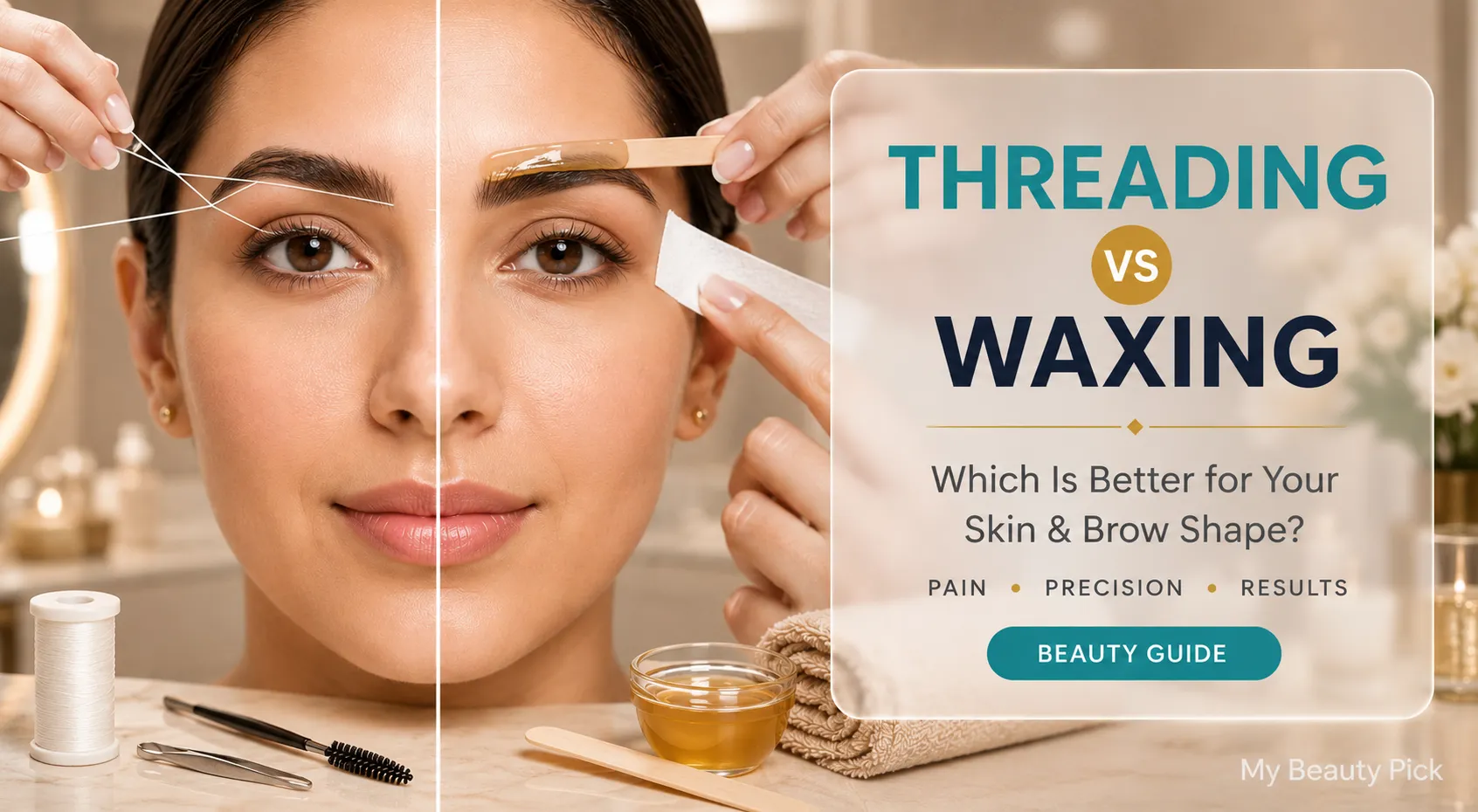
Threading and waxing both remove eyebrow hair at the root and produce lasting results for 3–6 weeks. The method, the precision, the skin interaction, and who should avoid each are meaningfully different. Threading uses a cotton thread manipulated to catch and pull individual hairs. Waxing applies warm wax to the skin, presses a strip on top, and removes hair and a thin layer of skin cells in one motion. Those different mechanisms produce different results for different skin types and different brow shape goals.
- Threading: more precise, safer for sensitive and medication-affected skin, doesn’t contact the skin surface, usually cheaper.
- Waxing: faster, more widely available, better for removing large areas of finer hair quickly.
- On retinoids (tretinoin, retinol): avoid waxing — thread instead.
- Results: similar longevity — 3–6 weeks for both.
- Pain: waxing is sharper and more immediate; threading is more sustained. Most people find waxing more intense overall.
How Each Method Works
Threading
A trained aesthetician uses a cotton thread, doubled and twisted, and rolls it across the skin. The twisted section catches hairs in the loop and pulls them from the follicle as the thread is moved. The thread touches the skin but doesn’t adhere to it or remove skin cells — it only removes the hair that’s caught in the loop. This makes it more precise (individual hairs can be targeted) and gentler on the skin surface.
The sensation is a rolling stinging feeling that’s sustained throughout the process — not a sharp single pull. The skin goes slightly red immediately after threading but this usually settles within 20–30 minutes for most people.
Waxing
Warm wax is applied to the skin in the direction of hair growth, a strip of fabric or paper is pressed over it, and the strip is pulled away quickly in the opposite direction of hair growth. The adhesive bond of the wax to both hair and skin means the top layer of skin cells is removed along with the hair. This is what causes the characteristic post-waxing rawness and temporary skin texture change.
The sensation is a sharp, immediate pulling pain that’s intense but brief. Skin redness and sensitivity after waxing is typically more pronounced and lasts longer than after threading.
Head-to-Head Comparison
| Factor | Threading | Waxing |
|---|---|---|
| Precision | High — individual hairs targeted | Medium — removes hair in the wax area |
| Pain | Sustained sting during process | Sharp, brief pain at strip removal |
| Skin contact | Thread rolls across skin — no adhesion | Wax adheres and removes top skin layer |
| Results longevity | 3–6 weeks | 3–6 weeks |
| Sensitive skin | Generally safer | Risk of skin lifting and irritation |
| On retinoids | Generally safe | Not recommended — risk of skin removal |
| Speed | 5–10 minutes for brows | 3–7 minutes for brows |
| Typical cost | £6–12 | £10–20 |
| Availability | Specialist threading salons | Most beauty salons |
| Regrowth appearance | Fine, tapered tips (from root removal) | Fine, tapered tips (from root removal) |
Which Is Better for Precision Brow Shaping?
Threading gives more precise control over brow shaping. Because the thread can target individual hairs, a skilled threading technician can create clean, defined lines and remove stray hairs while leaving others untouched. Waxing removes all hair in the waxed area, which requires more care to avoid over-removal and can be less precise around the arch definition.
For people who want highly defined, shaped brows with clean edges — particularly important for sharp arches and precise brow tails — threading is typically the better tool. For someone who just wants lower-maintenance brow clean-up without a specific shape goal, either method works.
Who Should Choose Threading
- Anyone using retinoids, AHAs, BHAs, or other skin-thinning skincare products
- Sensitive skin that reacts to waxing with prolonged redness or breakouts
- Anyone wanting very precise brow shaping with clean defined edges
- Those prone to post-waxing skin lifting or scarring
- Darker skin tones where post-inflammatory hyperpigmentation from waxing is a concern
Who Should Choose Waxing
- Anyone who can’t find a skilled threading technician locally
- Those who prefer the brevity of the pain — one sharp pull rather than a sustained sting
- People with a large area of fine hair to remove quickly and efficiently
- Those whose skin responds well and doesn’t show prolonged redness or irritation after waxing
Threading and Waxing on Tan and Darker Skin
Post-waxing hyperpigmentation is a genuine concern on tan and darker skin tones. The trauma of wax adhesion and the skin layer removal can trigger post-inflammatory hyperpigmentation (PIH) — dark spots that persist long after the redness fades. This is particularly common on the brow bone and upper lip area where the skin is delicate.
Threading on tan skin doesn’t carry the same PIH risk because the thread doesn’t adhere to or remove the skin surface. For this reason, threading is the more commonly recommended method for medium-to-deep tan and darker complexions, and is widely used in South Asian and Middle Eastern beauty traditions for exactly this reason.
If you’re using any retinoid product — prescription tretinoin, adapalene, or over-the-counter retinol — do not wax the face without stopping retinoid use for 5–7 days first. Retinoids significantly thin the skin’s surface layers. Waxing on retinoid-thinned skin can remove the top skin layer along with the hair, causing open wounds, rawness, and potential scarring. Threading is the safe alternative for brow maintenance while using retinoids.
Frequently Asked Questions
Is threading or waxing better for eyebrows?
Threading is generally better for precise brow shaping and for sensitive or medication-affected skin. Waxing is faster and more accessible but removes a layer of skin along with the hair. For sensitive skin, retinoid users, or anyone prone to hyperpigmentation from waxing, threading is the safer and more precise choice.
Does threading hurt more than waxing?
Pain is different between the two rather than simply more or less. Waxing causes a sharp, intense but brief pain at strip removal. Threading causes a sustained, lower-intensity stinging sensation throughout the process. Most people who experience both describe waxing as more intensely painful in the moment; threading as more sustained but less sharp overall.
How long do threading and waxing results last?
Both remove hair from the root, so regrowth timelines are similar: 3–6 weeks depending on individual hair growth rate. Most people book appointments every 4–6 weeks. Regrowth from both methods starts fine and tapered because it’s growing from the root rather than a cut surface.
Can you thread or wax if you use retinol?
Threading is generally safe while using retinol. Waxing is not recommended — retinoids thin the skin’s surface layers, and waxing can remove that thinned skin along with the hair, causing wounds and potential scarring. Stop retinoids 5–7 days before any waxing appointment. Threading is the safer alternative for brow maintenance while using retinoid skincare.