

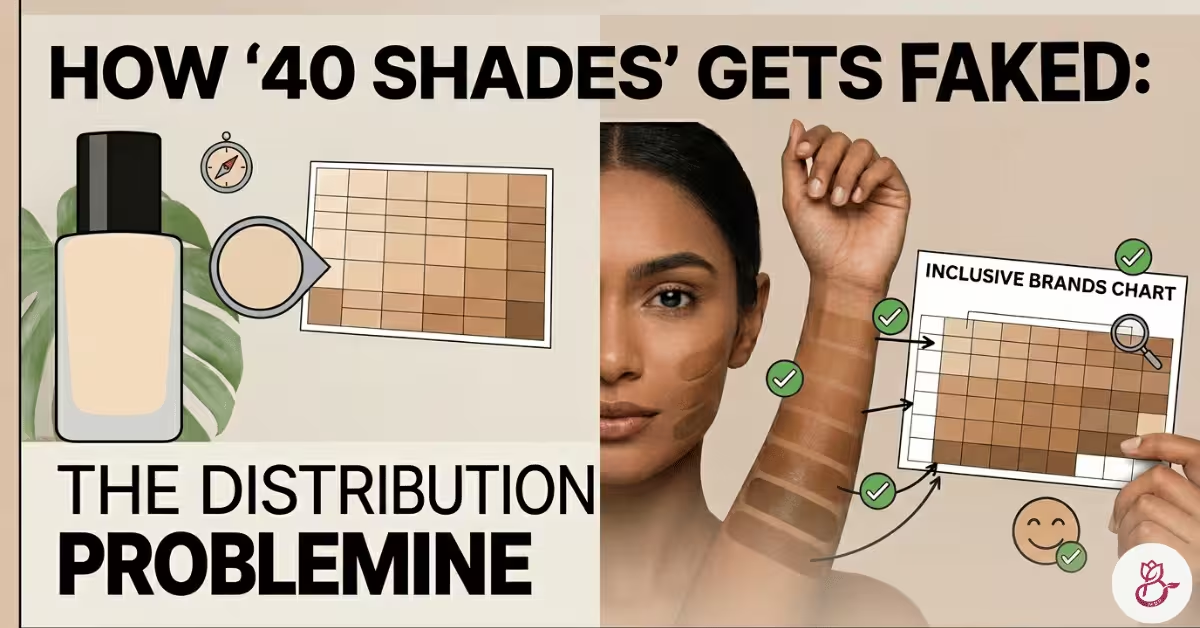
Forty shades sounds inclusive. It is the number Fenty Beauty launched with in 2017 and the benchmark that reshaped how the entire industry talks about foundation ranges. But counting shades is not the same as being inclusive for tan and medium skin, and eight years after that launch, many brands are still padding their shade counts with duplicates at the lighter end while leaving medium and tan buyers with three or four genuine options in the middle.
This article goes through the most widely sold foundation ranges, looks at how many shades they actually allocate to medium through tan depth, and separates the brands that genuinely serve this skin tone range from the ones using shade count as marketing rather than substance.
How “40 Shades” Gets Faked: The Distribution Problem
The issue is not the total number of shades. It is distribution. A foundation range can legitimately have 40 shades and still allocate 22 of them to the fair to light range, 12 to medium and tan, and 6 to deep and rich skin. That is not a 40-shade range for tan skin. That is a light-focused range with a medium and dark extension.
The Test That Matters
Count only the shades that fall within medium to tan depth (Fitzpatrick types III through V). If a brand has 40 total shades but only 8 of them serve medium to tan buyers, the total shade count is not a meaningful number for you.
There is also the undertone duplication trick. Brands sometimes list warm, neutral, and cool versions of the same depth level as separate shades. Three shades called N35, W35, and C35 are not three coverage options. They are one depth with three undertone variants, which is actually good shade engineering, but it should not be counted as three distinct shades when comparing range breadth.
A third pattern is the gap problem: medium shades that jump from light tan to deep tan with nothing in between. Fitzpatrick type IV buyers regularly find that they fall between two shades, both of which look wrong, because the range simply has not been filled in at the depth levels they need.
Foundation Ranges That Actually Deliver for Medium and Tan Skin
Fenty Beauty Pro Filt’r
Genuinely Inclusive
50 shades with strong medium and tan representation. Undertone variety across warm, neutral, and cool at each depth level. Named with numbers rather than misleading descriptors. Medium and tan buyers consistently find matches rather than compromises here.
Fenty’s naming system (100s through 500s by depth, with W/N/C undertone codes) is one of the clearest on the market. The medium to tan range covers shades roughly from 240 through 380, with enough undertone variation at each level that warm-golden, olive, and cooler tan buyers all have real options. The distribution across depth is more even than most competitors, and the formula itself was developed with melanin-rich skin in mind rather than being a light-skin formula extended downward.
NARS Natural Radiant Longwear
Strong Medium and Tan Range
45 shades with particularly good coverage of medium through tan depth. The naming system is less intuitive than Fenty’s but the actual shade distribution is solid and the undertone engineering at medium depth is well done.
NARS covers warm, neutral, and olive undertones across medium and tan depth well. Shades like Syracuse, Macao, Tahoe, and Stromboli sit specifically in the light-to-medium-tan range with clear undertone differentiation. The main weakness is the naming system, which uses geographic place names with no depth or undertone coding, making online shade selection difficult without a swatch guide.
MAC Studio Fix Fluid
Reliable NC and NW System
60+ shades with the NC/NW coding system that, once understood, makes undertone matching straightforward. Strong tan range. Widely available for in-person testing.
MAC’s NC (neutral-cool/warm-neutral) and NW (neutral-warm/pink) system is one of the oldest undertone coding systems in mass-market makeup and still one of the most reliable for tan buyers. The NC30 through NC50 range specifically covers a wide spread of warm and golden tan skin tones. The NW range covers cooler and more pink-based tan tones. The depth increments are small enough that most tan skin buyers find a close or exact match rather than having to blend between shades.
L’Oreal True Match
Drugstore Leader for Tan Skin
45 shades at drugstore price point. The W (warm), N (neutral), C (cool) coding with number depth system makes this one of the most navigable shade ranges at mass-market pricing.
True Match is the strongest mass-market option for tan skin buyers specifically because the shade naming system actually communicates something useful. A shade called 5W tells you depth (5 = medium-tan) and undertone (W = warm) before you have even looked at it on skin. The medium to tan range from shades 4 through 6 across warm and neutral undertones covers South Asian, Latin American, and Middle Eastern tan complexions well for the price point.
Foundation Ranges That Fake Inclusivity for Medium and Tan Skin
The Classic “32 Shades, 22 of Them Light” Pattern
A large number of mid-range and luxury foundation brands expanded their ranges after 2017 by adding shades at the deeper end without addressing the medium and tan gap. This created ranges where buyers with Fitzpatrick type III or IV skin find themselves in between the lightest “medium” shade (which reads light on them) and the darkest “medium” shade (which reads too deep), with nothing that actually hits their undertone at their depth.
| Brand Pattern | What It Looks Like | Impact on Tan Buyers |
|---|---|---|
| Heavy fair/light weighting | 15 shades of ivory to light beige, 8 medium, 6 tan, 5 deep | Tan buyers get fewer options and less undertone variety than fair buyers |
| Undertone gaps at medium depth | Warm and neutral at light depth, neutral only at medium-tan | Warm-undertoned tan buyers have no match and must compromise |
| Large depth jumps | Shade 4 reads light-medium, shade 5 reads deep tan — nothing between | Buyers fall in the gap and end up mixing or choosing the wrong shade |
| Undertone mislabeling | Shades labeled “warm” that have a pink or neutral base on application | Tan buyers with golden or olive undertones cannot rely on the labeling |
Luxury Brands That Still Have the Gap
Gaps Remain Despite High Price Point
Several high-end prestige foundations still allocate the majority of their shade range to light depths. Buyers paying premium prices for medium and tan skin often find fewer options at their depth than drugstore alternatives offer.
This is one of the more frustrating realities of the current foundation market. A foundation priced at significantly more than a drugstore option does not automatically have better tan skin coverage in its shade range. Some luxury ranges added darker shades after 2017 without reformulating the base chemistry for melanin-rich skin, meaning the deeper shades in the range still oxidize or sit grey on tan and brown skin because the formula was built around lighter skin chemistry and then extended downward by deepening the existing iron oxide ratios.
How to Audit a Foundation Range Before Buying
Before purchasing any foundation with a large shade count claim, do this quick audit:
- Count only your depth range. Filter the range to medium through tan shades only and see how many remain.
- Check undertone variety at your depth. If warm, neutral, and cool undertones are not all represented at medium-tan depth, the range is not complete for this skin tone group.
- Look for depth gaps. If two adjacent shades in the medium-tan range look too similar or too different on swatches, there is a gap the brand has not filled.
- Read oxidation reports. For tan skin specifically, check reviews from South Asian, Latin, and Middle Eastern buyers about whether the shade shifts after application. Oxidation at medium-tan depth is a formulation issue, not a shade selection issue.
- Check the undertone system. A brand that does not code undertones in its naming system is harder to navigate online and suggests shade engineering is less systematic.
The Brands Getting Closer: Partial Credit
Improving but Not Complete
Several brands have made genuine progress since 2017 but still have specific gaps at medium-warm and olive undertone depths. The ranges are better than they were but still require compromise for some tan skin buyers.
Brands like Maybelline Fit Me, Charlotte Tilbury Airbrush Flawless, and Giorgio Armani Luminous Silk all have medium and tan shade options that work well for many buyers but still show clear distribution gaps on warm or olive undertone buyers at specific depth levels. Fit Me in particular is strong for neutral and cool-undertoned medium skin but thins out significantly on warm golden and olive options at the tan depth range. Armani Luminous Silk has excellent formula performance on tan skin but fewer shade steps at each undertone compared to what it offers at lighter depths.
What a Genuinely Inclusive Shade Range for Tan Skin Looks Like
Criteria for a Foundation Range That Actually Works for Tan Skin
- At least 10 to 12 distinct shades within medium to tan depth (not counting undertone variants as separate shades)
- Warm, neutral, and olive undertone options at each depth level in the tan range
- Small enough depth increments between shades that buyers do not fall in gaps
- A naming or coding system that communicates depth and undertone without requiring in-person testing
- Formula base chemistry developed for melanin-rich skin — not extended downward from a light-skin formula
- Oxidation-resistant formula at medium to tan shade depths
Bottom Line
Shade count is a marketing number. Distribution is the meaningful one. For medium and tan skin buyers, the question is never how many shades a foundation has in total — it is how many shades it has at your depth, in your undertone, with no gaps.
Fenty Beauty, MAC Studio Fix Fluid, NARS Natural Radiant Longwear, and L’Oreal True Match are the most consistently reliable options for tan skin across undertone variety and depth coverage. Most other brands with large total shade counts have not distributed those shades equitably across depth levels, and medium to tan buyers end up with fewer genuine choices than the total number suggests.
For help navigating shade selection once you have narrowed down a range, our foundation shade guide for tan skin and our breakdown of undertones for tan skin cover the exact matching process.
Related Reading