

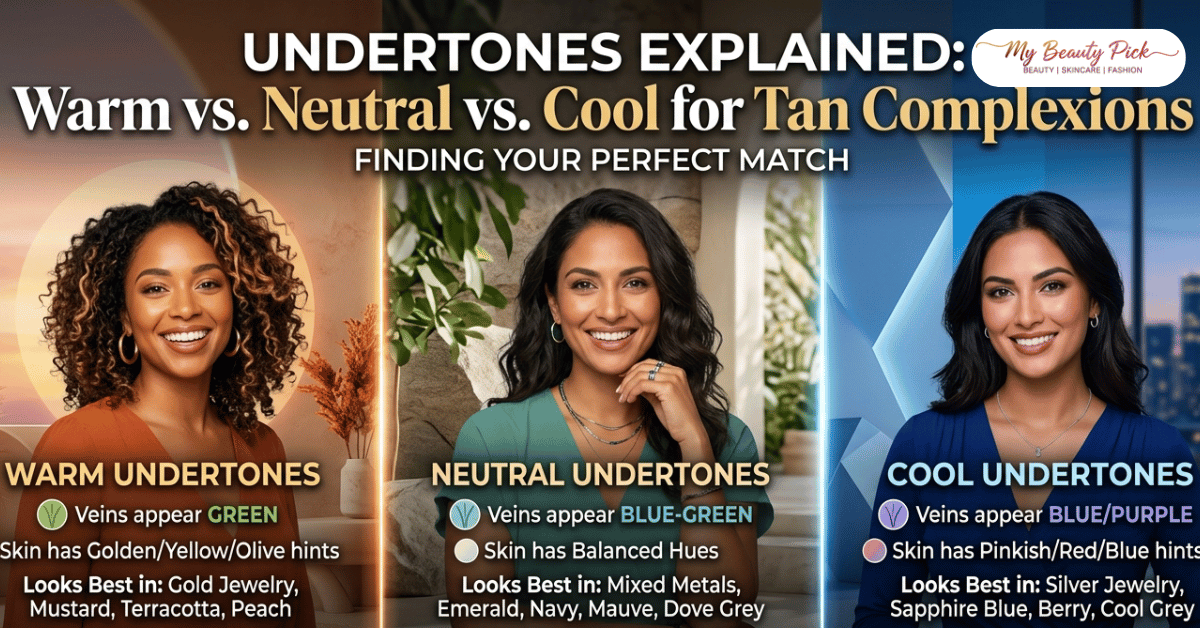
The real reason your foundation looks orange, grey, or just “off” — and how understanding undertones for tan skin changes everything.
The Foundation Problem Nobody Talks About
You pick up what looks like a perfect match at the beauty counter. The shade number seems right. The depth matches your skin. But two hours later, you’re catching a grey or orange tint in the mirror that wasn’t there in the store.
This is one of the most common makeup frustrations for people with tan complexions, and the cause is almost always the same: the shade was matched to surface colour, not undertone.
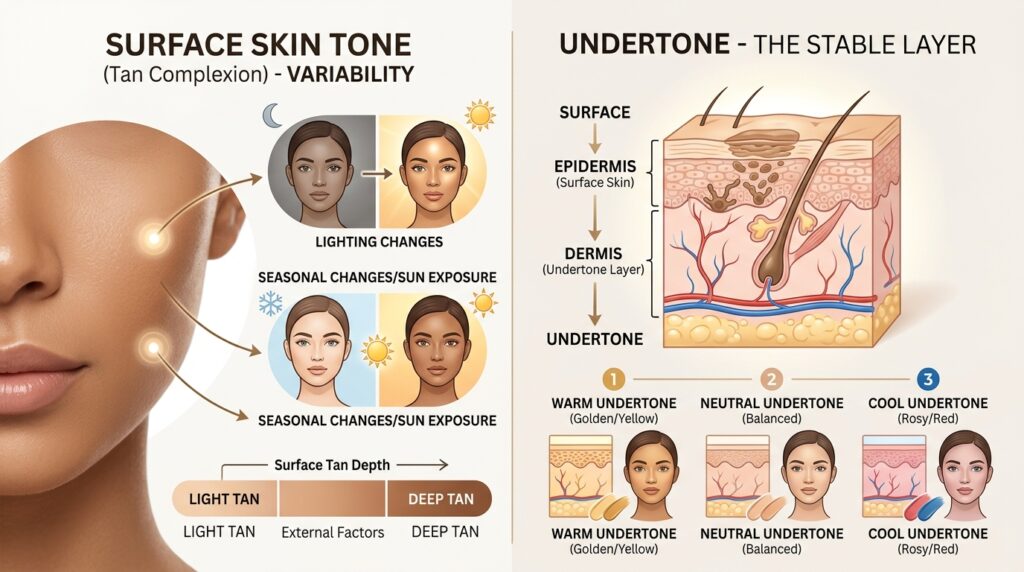
| The short version: Your surface tone is what people see — light, medium, dark. Your undertone is the subtle hue beneath the skin that never changes, regardless of how much sun you get or how your complexion shifts seasonally. Getting your undertone right is the single most important step in makeup selection. |
What Are Skin Undertones?
Skin undertone refers to the underlying hue that exists beneath your visible surface colour. While your surface tone can change — it shifts with sun exposure, seasons, health, and ageing — your undertone stays constant throughout your life.
Undertones fall into three broad categories:
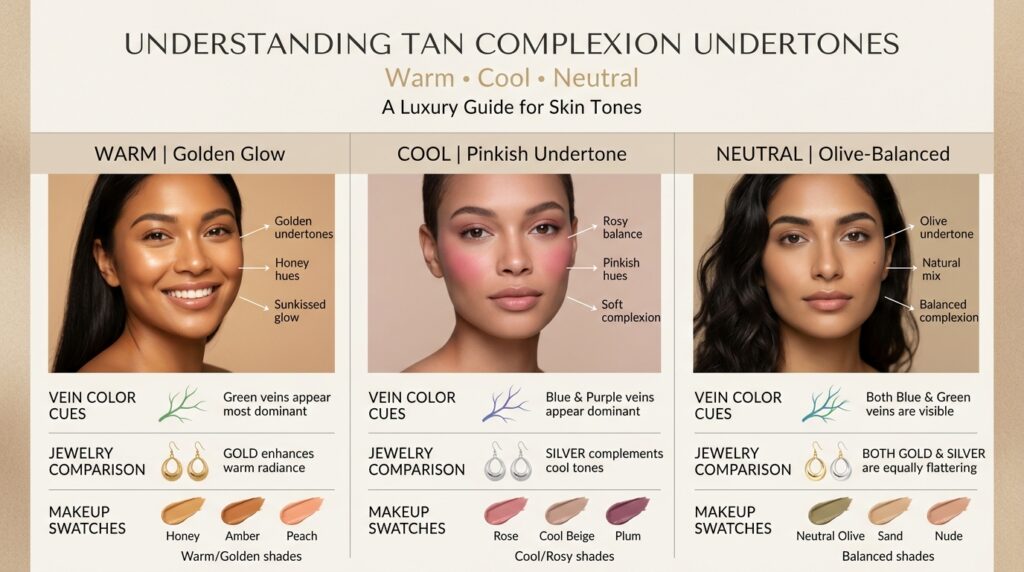
| Warm | Cool | Neutral |
| Yellow, golden, peachy, or bronze undertones. Common in South Asian, Latin American, and Middle Eastern complexions. Tans easily and rarely burns. | Pink, red, or bluish undertones. Skin may flush pink. Common in East/Southeast Asian, Mediterranean, and some Latin complexions. | A balanced mix of warm and cool — neither dominates. Often described as “olive.” Most versatile for makeup matching. |
Understanding this distinction — surface tone vs. undertone — is the foundation of every great makeup match. Many people (and even some beauty counters) skip it entirely, which is why so many foundations end up looking wrong.
Tan Complexions: What You Need to Know
Tan skin sits in a wide range of the Fitzpatrick scale, typically spanning types III through V. This includes:
- Light tan (sun-kissed, golden beige)
- Medium tan (warm beige to honey)
- Deep tan (caramel, chestnut)
- Caramel and warm brown skin tones
Undertone identification is particularly confusing for tan complexions for one key reason: tan skin already carries visible warmth in its surface appearance. This makes it easy to assume all tan skin has warm undertones — which is far from the truth. Tan skin can carry cool, warm, or neutral undertones, and the only way to know for certain is to look past the surface.
Warm Undertones in Tan Skin
How It Looks
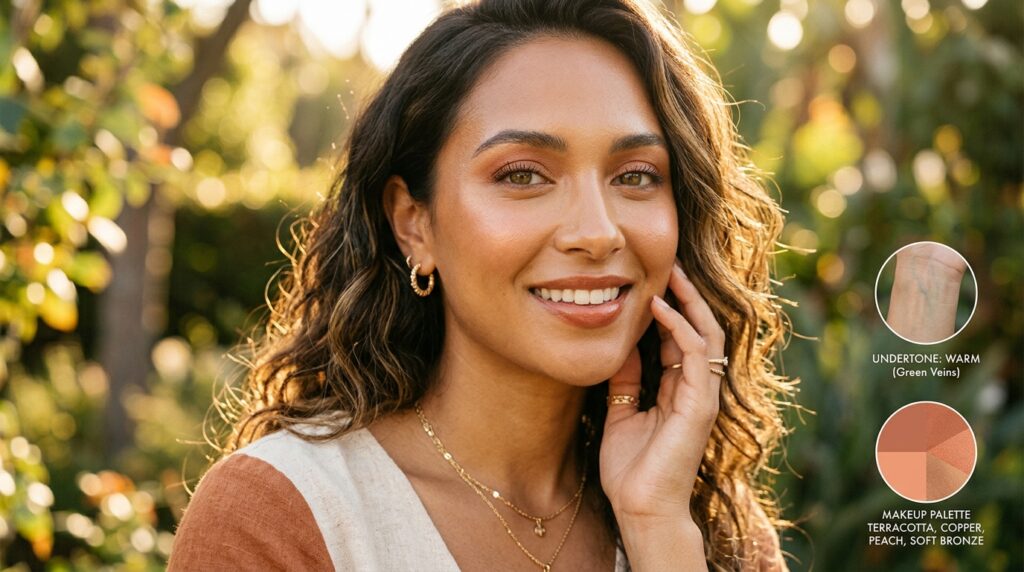
Warm-undertoned tan skin has a golden, peachy, or bronze glow to it. In natural light, it often appears sunlit even without bronzer. Common among South Asian, Latin American, Middle Eastern, and mixed-heritage complexions, warm tan skin tends to tan easily and rarely burns.
The Vein Test
Look at the inside of your wrist in natural daylight. If your veins appear green or olive, you have warm undertones. The green appearance is caused by yellow pigment in the skin filtering the blue-green of the vein.
The Jewellery Test
Gold jewellery — yellow gold, rose gold — will complement your skin and make it glow. Silver or white gold tends to look stark or cold against warm-undertoned tan skin.
Makeup Recommendations — Warm Undertones
| Foundation — Golden or yellow-based shades — Look for: “warm,” “golden,” “caramel,” “honey” — Avoid pink or rosy-toned formulas | Lips & Cheeks — Terracotta, brick, peach, copper reds — Warm coral blushes — Bronzer over cool-toned highlighters |
| Eyes — Browns, golds, coppers, burnt orange — Olive and forest green shadows — Warm bronze liners | Avoid — Ash-toned setting powders — Pink or lilac lip shades — Cool-toned foundations (NC/NW systems) |
Cool Undertones in Tan Skin
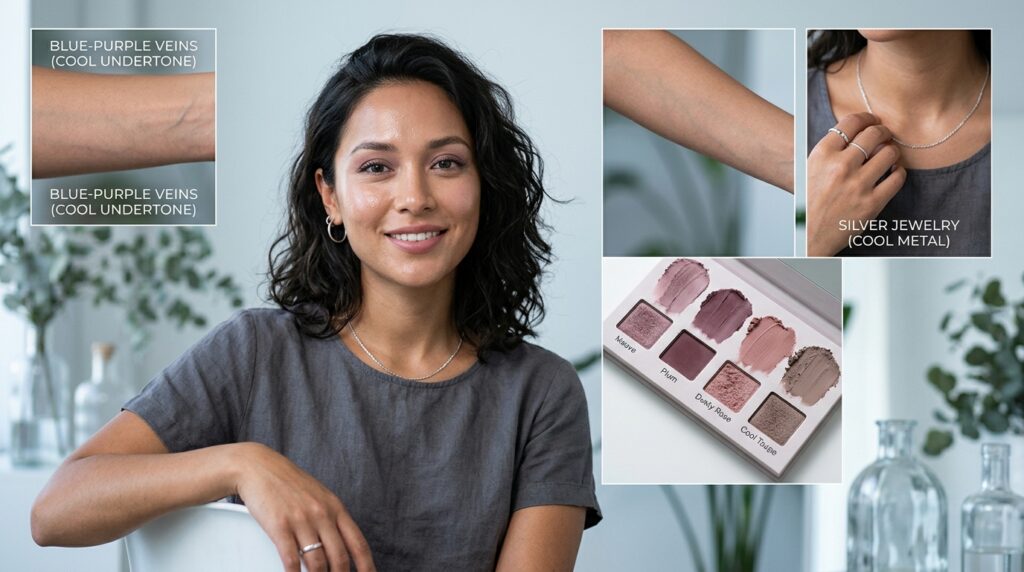
How It Looks
Cool-undertoned tan skin has a subtle pink, rosy, or slightly greyish cast beneath the surface. From a distance, these complexions often look “clean” or porcelain-like despite the tan depth. Common in East Asian, Southeast Asian, some South Asian, Mediterranean, and certain Latin complexions.
One giveaway: cool tan skin can appear slightly ashen when dry, and it tends to flush pink or red rather than bronze when exposed to heat, exercise, or emotion.
Makeup Recommendations — Cool Undertones
| Foundation — Pink, rosy, or neutral-cool bases — Look for: “cool,” “rose,” “sand,” “porcelain” — Avoid orange or yellow-heavy formulas | Lips & Cheeks — Berry, plum, mauve, cool red — Dusty rose or pink blushes — Cool-toned highlighters (champagne, icy pink) |
| Eyes — Mauve, plum, grey, cool taupe — Navy and slate blue liners — Silvery or icy eyeshadow | Avoid — Orange-toned bronzers — Warm brown lipsticks that turn muddy — Heavy golden shimmer products |
Neutral Undertones in Tan Skin
How It Looks
Neutral-undertoned tan skin balances both warm and cool. This is particularly common in people described as having “olive” skin — a greenish-grey neutral undertone common in Mediterranean, Latin, and mixed-heritage complexions. Not all neutral undertones are olive; some are simply balanced without any clear dominant hue.
On the vein test, neutral skin shows veins that are neither clearly green nor clearly blue-purple — they often appear blue-green or teal.
Versatility in Makeup
Neutral undertones are the most forgiving. Both warm and cool makeup shades tend to work, giving you wider latitude in foundation shopping. The worst foundations for neutral tan skin are those at the extreme ends — deeply orange or intensely pink — which will still clash.
| Foundation — True neutral shades — no dominant cast — Look for: “N,” “neutral,” or “olive” — Test in natural light before buying | Versatile Picks — Nude-rosy or nude-brown lips work equally well — Peachy-pink or soft coral blushes — Both gold and silver jewellery look good |
How to Identify Your Undertone: Step-by-Step
- The vein test (most reliable): In natural daylight, look at the veins on the inside of your wrist. Green or olive = warm. Blue or purple = cool. Blue-green or teal = neutral.
- The white paper test: Hold a plain white piece of paper against your bare face in natural light. Yellowish-golden = warm. More pink or rosy = cool. Neither clearly = neutral.
- The sun reaction test: Think about how your skin reacts to sun exposure. Tan easily to golden-bronze = warm. Burn or go pink before tanning = cool. Tan gradually and evenly = neutral.
- The jewellery test: Try on gold then silver jewellery in natural light. Gold glows, silver stark = warm. Silver brightens, gold dull = cool. Both equally good = neutral.
- The colour clothing test: Hold an orange-red fabric then a blue-red fabric against your face. Whichever makes your skin look clearer indicates your undertone family.
Pro tip: Never test foundation or undertone in artificial store lighting. Fluorescent light distorts both cool and warm tones. Always step outside or hold the shade to your neck/jaw in natural daylight.
Common Undertone Mistakes in Tan Skin
| Mistake 1: Matching shade depth only, ignoring undertone Picking a foundation by holding it to your wrist and checking depth is not enough. Two foundations can be identically deep but look completely different on your face if their undertones differ. Always swatch on your jaw in natural light. |
| Mistake 2: Assuming tan skin always has warm undertones This is the most common mistake, and it causes cool-undertoned tan skin to be pushed into yellow-based foundations that sit orange or muddy. Tan skin can be decidedly cool, and those complexions are often misserved at beauty counters. |
| Mistake 3: Conflating “olive” with “warm” Olive is a specific neutral undertone with greenish-grey tones. It is not a warm undertone, and olive skin should not be matched with purely yellow-golden foundations. Olive skin needs foundations with a slight grey-green neutrality, not a purely warm or purely cool base. |
| Mistake 4: Using a setting powder that’s too ashy or too warm Setting powders have undertones too. A translucent powder with ashy tones will grey out warm tan skin. A heavily golden powder will look muddy on cool-undertoned tan skin. Look for truly translucent or undertone-matched pressed powders. |
Foundation Matching Guide for Tan Skin
From a professional makeup artist standpoint, here is how to approach foundation selection for each undertone in tan complexions:
| Undertone | What to Look For | Shade Descriptors | What to Avoid |
| Warm | Yellow or golden base; peachy or bronze-toned | Honey, Golden, Caramel, Tan W, NW (MAC) | Pink or rose-based shades; anything labelled “cool” |
| Cool | Pink or rosy base; no yellow or orange cast | Sand, Buff, Tan C, NC (MAC), shades ending in “C” | Orange, yellow, or golden tones; warm bronzers |
| Neutral | Balanced base with no dominant hue; slight olive works | Tan N, Natural, Olive, Tawny, Neutral Tan | Extreme warm or cool shades; heavy orange tones |
Mixing Shades
If you can’t find a single foundation that matches your undertone and depth, mixing is a valid professional technique. For warm tan skin, blend a golden-toned shade with a neutral. For cool tan skin, mixing a rosy-based shade with a neutral prevents the foundation from looking too pink on the surface.
Always blend the test shade along the jawline — not the back of the hand — and step into natural light before committing.
Frequently Asked Questions
What undertone is most common in tan skin?
Warm undertones are the most frequently seen in tan complexions, particularly among South Asian, Latin American, and Middle Eastern skin types. However, tan skin can carry cool or neutral undertones equally. Assuming all tan skin is warm is one of the most persistent mistakes in beauty — always verify your undertone rather than assuming based on surface tone.
Can tan skin have cool undertones?
Absolutely yes. Cool undertones in tan skin are more common than many people realise, particularly among East and Southeast Asian complexions, some Latin and Mediterranean skin types, and mixed-heritage backgrounds. Cool-undertoned tan skin has a pink, rosy, or slightly ashen quality beneath the surface and tends to flush pink rather than bronze.
Why does my foundation look grey or orange?
A grey cast usually means your foundation has too much cool or ashy undertone for warm-undertoned tan skin. An orange cast means the opposite — you have cool or neutral undertones and the foundation base is too yellow or golden. Both problems are undertone mismatches rather than shade depth issues. Adjusting the undertone — not just going lighter or darker — is the fix.
How do I know my undertone if I have tan skin?
The most reliable method is the vein test: in natural daylight, look at your inner wrist. Green veins = warm undertones, blue or purple veins = cool, blue-green or teal veins = neutral. Pair this with the white paper test and the jewellery test for added confidence. Avoid testing in store or artificial lighting — it distorts results significantly.
What does ‘neutral undertone’ mean for tan skin?
Neutral undertone means neither warm nor cool dominates beneath your skin. For tan complexions, this often manifests as an olive quality — a subtle green-grey cast that is neither pink nor golden. Neutral-undertoned tan skin is the most flexible for makeup matching, with both warm and cool shades tending to work.
Does undertone change with self-tanner or sun exposure?
No. Your undertone is determined by the amount of melanin, haemoglobin, and carotene in your skin — it remains constant regardless of surface colour changes. Self-tanners or sun exposure will alter your surface tone, meaning you may need a deeper or lighter foundation shade, but the undertone of that foundation should always stay the same.
The Bottom Line
Surface shade matching is only half the equation. The other half — undertone — is what separates a foundation that disappears into your skin from one that looks like a mask.
For tan complexions especially, where the surface already carries visible depth and warmth, learning to read undertones is transformative. It changes how you shop, how you mix, and how your finished look lands in every light.
Identify your undertone once, apply it consistently to every product from foundation to blush to lip colour, and foundation mismatches become a thing of the past.