

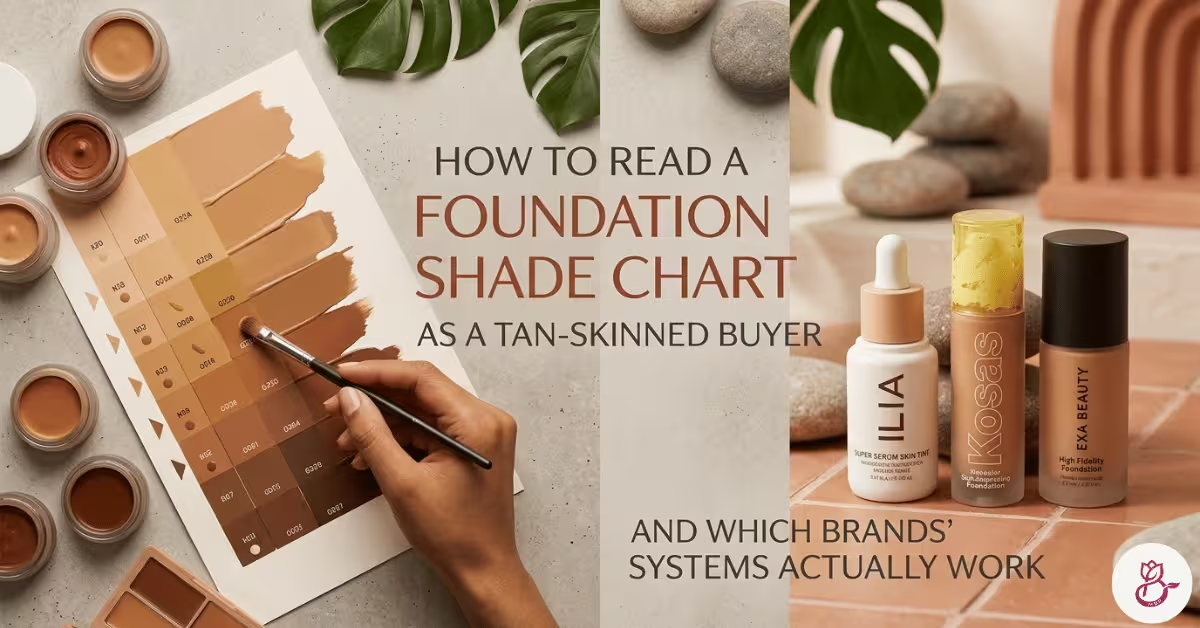
You are a Fitzpatrick type IV. Your skin is warm, golden, tan. You go to a foundation brand’s website and navigate to their shade range. Under “medium” there are ten options, all of which sit somewhere between ivory and light beige. Under “tan” there is one shade. It is called Warm Beige. It does not match your skin.
This is not a shade range problem. It is a language problem. The way beauty brands name and categorize foundation shades was built around a default skin tone that is not yours, and the vocabulary they use to describe the medium and tan range often communicates something completely different depending on whether the person writing the shade names and the person buying the foundation share the same reference point for what “medium” or “tan” means.
This piece is about that gap and why it matters for how tan-skinned buyers navigate the beauty market.
The Default That Is Built Into Beauty Language
Foundation shade naming developed over decades in an industry where the default consumer was assumed to be fair-skinned and European. The descriptors that emerged from that assumption — light, medium, tan, deep, dark — were calibrated to that reference point. “Medium” in that context meant medium relative to fair European skin. It did not mean the actual middle of the full human skin tone spectrum.
“Medium” in beauty naming means medium relative to a fair skin default. It does not mean the midpoint of all human skin tones.
This matters because it means the entire vocabulary of beauty shade naming is offset. What a brand calls “medium” often reads as light to light-medium on tan skin. What they call “tan” often covers only the shallowest end of what Fitzpatrick type III and IV skin actually looks like. The result is that buyers with genuinely tan, golden, or caramel skin navigate shade categories that were not designed with them as the intended user.
Why “Medium Beige” Is Not a Tan Shade
“Medium Beige” is the specific shade name that appears most often in the wrong place in a tan-skin buyer’s experience. It appears in the medium category, it sounds like it should be relevant, and it is almost always several depth levels too light for actual tan skin.
Typical Naming Problem
A brand’s shade range goes: Porcelain, Ivory, Light Beige, Warm Beige, Natural Beige, Medium Beige, Sand, Warm Sand, Golden Beige, Caramel. The first six shades are variations of fair to light. “Medium Beige” sits at position six and reads as light on tan skin. “Caramel” is the tenth shade and the first one genuinely usable for tan buyers — but it is categorized under “tan” with no undertone options beside it.
The issue with “beige” specifically is that it references a color family that is culturally coded as neutral and light. Beige is cream, off-white, sand. Using “medium beige” to describe what is in practice a light foundation shade but placing it in a “medium” category creates a mismatch between where tan buyers look and where the products they can actually use are placed.
The Vocabulary That Signals Where You Belong
There is a reliable pattern in how foundation shade names shift as they move toward tan and deeper depths. The language changes from neutral European color references to geographic place names, food references, and material textures. This shift is not accidental — it reflects a historical assumption about who the “normal” shades were for and who the specialty shades were for.
| Shade Name Type | Where It Appears | What It Signals |
|---|---|---|
| Color + noun (Ivory, Porcelain, Cream, Bisque) | Fair to light range | Direct, neutral, matter-of-fact descriptions designed for easy navigation |
| Adjective + Beige (Warm Beige, Natural Beige, Honey Beige) | Light to light-medium range | Still “normal” range language, beige implying something close to a default |
| Food names (Caramel, Honey, Toffee, Mocha, Espresso) | Medium-tan through deep range | Shift from color language to flavor/texture language — a different register |
| Geographic names (Tahiti, Morocco, Havana, Ibiza) | Medium-tan through deep range | Exotic/travel reference encoding that positions these shades as “other” |
| Material textures (Sienna, Mahogany, Walnut, Chestnut) | Deep range | Wood and earth references that again shift the vocabulary from human skin to material |
When you map foundation shade names across depth levels, the shift in language is consistent enough to function as a visible seam in how the industry thinks about skin tone. The light range uses color vocabulary that implies universality. The medium and tan range uses vocabulary that implies specificity, specialty, or otherness. This is not neutral language choice.
The Depth Labeling Problem: Where “Tan” Starts and Stops
The second language problem is the category label itself. “Tan” as a shade category in beauty naming carries assumptions about which skin tones it refers to. In practice, brands use “tan” to mean different things depending on where their shade range is concentrated.
What “Tan” Actually Covers
In a brand with a heavy fair-skin focus, “tan” often starts at what Fitzpatrick type III considers light-medium. In a brand with a broader range, “tan” may start at type IV. There is no standard. A shade called “tan” in one brand can be three full depth levels lighter than a shade called “tan” in another.
This inconsistency makes cross-brand shade shopping almost impossible for tan-skinned buyers without physical swatching. The category name “tan” cannot be trusted as a consistent reference point because it was never standardized. Each brand defines it relative to their own range distribution, which was itself built around a reference point that may not include your skin.
The Undertone Language Gap
The language problem extends to how undertones are described at tan depth specifically. In the fair range, “warm,” “neutral,” and “cool” are distinct, clearly delineated categories with multiple options in each. In the tan range, undertone language collapses. Many brands offer only “warm” and “neutral” at tan depth, with no cool or olive option. Others label shades as “warm” that have a distinctly neutral or even cool base on application — the label does not reliably describe what is in the bottle.
Real Naming Failure
A shade called “Warm Tan” with a pink-leaning base. A shade called “Natural” that oxidizes orange. A shade called “Golden” that reads neutral-grey in flash photography. The names promise something the formula does not deliver, and tan-skinned buyers absorb the cost of that mismatch in wasted product and failed purchases.
Which Naming Systems Actually Work for Tan Buyers
The foundation ranges that work best for tan-skinned buyers are almost always the ones with coded systems rather than descriptive names. A code communicates information. A name communicates feeling, and the feeling encoded in most foundation shade names was not designed with tan skin as the reference.
| Naming System | How It Works | Useful for Tan Buyers? |
|---|---|---|
| Fenty 100-500 + W/N/C | Number indicates depth, letter indicates undertone family | Yes — depth and undertone both communicated before seeing the shade |
| MAC NC/NW + number | NC = warm-leaning neutral, NW = cool-leaning neutral, number increases with depth | Yes — once the system is learned, navigation is reliable |
| L’Oreal True Match number + W/N/C | Number = depth level, letter = undertone | Yes — one of the clearest systems at drugstore level |
| Geographic place names (NARS, Chanel) | No coding — names are decorative rather than informative | Requires external shade guide or in-person swatching |
| Adjective + material (Warm Sand, Honey Beige, Golden Caramel) | Partially communicates undertone (warm, golden) but not depth precisely | Partial — undertone hint present but depth is ambiguous cross-brand |
What Better Naming Would Look Like
The solution is not more evocative shade names. It is more informative ones. A shade naming system that works for tan-skinned buyers communicates depth numerically or on a consistent scale, communicates undertone with a reliable and consistently applied code, uses the same vocabulary register across the entire range rather than shifting from color language at light depth to food and geography at tan and deep depth, and does not require a visit to a brand counter or a YouTube tutorial to decode.
Some brands have moved in this direction. Most have not. Until the industry standardizes shade naming in a way that treats tan and deep skin as the reference point rather than the extension, buyers with tan skin will continue to spend disproportionate time and money navigating a system that was not built for them.
What This Means Practically for Tan-Skinned Buyers
Until naming conventions improve, the most reliable approach is to ignore shade names entirely and use the brand’s coding system if one exists, or to map the shade number to the total range size to understand where in the distribution the shade actually sits. A shade called “Warm Beige” tells you almost nothing useful. A shade that sits at position 18 of 40 in a range, coded as warm undertone, tells you it is roughly mid-range in depth and warm in undertone — which is actionable.
Our guide on how to find your foundation shade as a tan-skinned buyer covers how to navigate brand shade systems regardless of how confusingly they are named, and our undertone guide for tan skin helps identify which undertone codes to look for once you understand your own undertone family.
Related Reading