

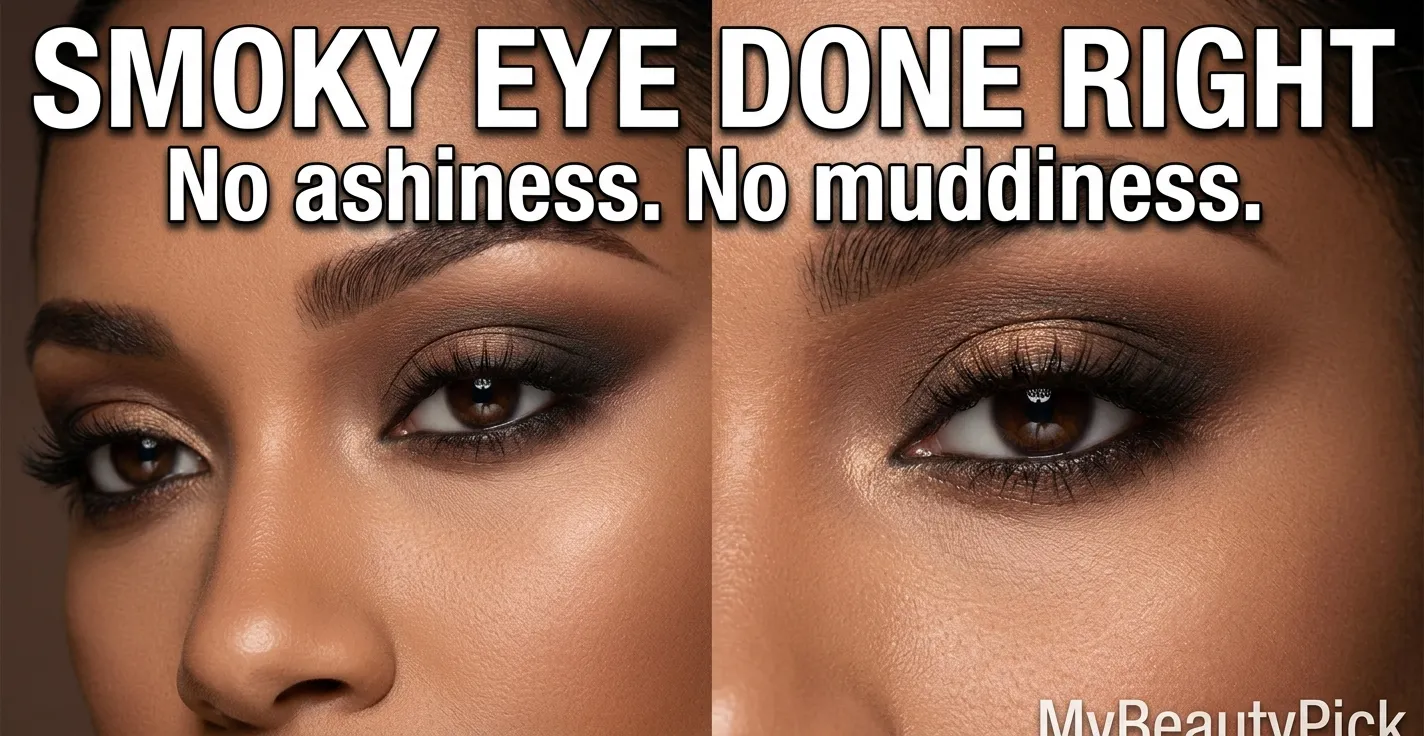
A smoky eye on tan and brown skin has the potential to be one of the most striking eye looks in any makeup repertoire. The depth of melanin-rich skin creates a contrast and richness that makes a well-executed smoky eye look genuinely dramatic — more so than on lighter complexions, where the same eyeshadow shades have less visual contrast to work with.
But smoky eyes on warm tan skin go wrong in two specific ways. They go muddy when the blending technique is wrong. They go ashy when the shade selection is wrong. Both problems have clear causes and clear fixes, and both are preventable once you understand why they happen.
- Smoky eyes on tan skin go ashy when cool-toned shades (grey, charcoal, silver) are used. These have no warmth relationship with warm complexions.
- Smoky eyes go muddy when the same brush is used for multiple shades without cleaning, or when blending is done in circular motions.
- The warm smoky eye palette: copper or bronze shimmer on the lid, warm brown in the crease, espresso or deep walnut at the outer corner.
- Always prime the lid — on tan skin with any oiliness, unprimed eyeshadow creases within hours.
- The mute-lip rule: a smoky eye on tan skin needs a warm nude or matte terracotta lip. Dark eye plus dark lip removes the focal point entirely.
Why Smoky Eyes Go Wrong on Tan and Brown Skin
Most smoky eye tutorials are built around three shades: a light base, a medium grey, and a dark charcoal or black. This system creates a cool-to-dark gradient that reads as shadow and depth on fair and neutral skin tones. The grey creates contrast that looks sophisticated.
On warm tan and brown skin, this same grey-charcoal system fails. Cool grey has no warmth relationship with warm melanin-rich skin. Rather than reading as depth and shadow, it reads as flat, disconnected colour that fights the warmth of the complexion. The result: a smoky eye that looks like you tried to wear a cool-toned look on skin it wasn’t designed for. It reads ashy. It reads cold. It reads wrong.
The muddy problem is entirely separate and comes from technique, not shade selection. Blending multiple shades together with circular motions, using the same brush for every shade, applying too many shades in the same zone — all of these mix the pigments together until they become one indistinct brownish mass with no visible graduation of depth or colour.
The warm smoky eye solves both problems: it uses warm-undertoned shades throughout (eliminating ashiness) and applies them in distinct, designated zones with clean brushes for each shade (eliminating muddiness).
The Warm Smoky Eye Palette for Tan and Brown Skin
The warm smoky eye on tan skin operates within a three-shade system, all within the warm colour family:
Transition — crease
Lid — the feature shade
Outer corner and depth
This three-shade system maintains warmth throughout. The depth comes from tone contrast within the warm family — not from introducing a cool grey that fights the undertone. The result reads as a rich, dimensional smoky eye that enhances tan skin rather than working against it.
Colour Variations for Warm Smoky Eye on Tan Skin
| Variation | Lid Shade | Depth Shade | Effect |
|---|---|---|---|
| Classic Warm | Bronze shimmer | Deep espresso | The most universally flattering warm smoky on tan skin. Rich and dimensional. |
| Deep Copper | Copper metallic | Dark chocolate | Higher contrast and more visual impact — best for evening events. |
| Plum-Brown | Warm plum shimmer | Deep burgundy-brown | Adds purple dimension while staying warm. Works beautifully on brown eyes. |
| Navy-Gold | Gold shimmer | Deep navy (outer V only) | The cool-warm colour contrast approach — striking and editorial. Navy reads deep without being ashy. |
| Forest Green | Warm green shimmer | Deep hunter green | Colour-forward warm smoky. Works on tan skin because warm green has enough depth to create impact. |
Cool grey, silver shimmer as the main lid shade, ashy taupe in the crease, and cool charcoal at the outer corner all create the ashy disconnection on warm tan skin described above. These shades can appear in the dark zones of the eye (tight-liner, inner lash root) but should never be the blended-out primary shades in the smoky system on warm complexions.
Tools Required for a Smoky Eye Without Muddy Blending
Using the right brush for the right shade is the single most effective way to prevent muddy smoky eye. Most people use one or two brushes for everything — this is the direct cause of shade contamination and muddiness.
- Fluffy blending brush (large): transition shades in the crease only. Cleaned between uses.
- Flat shader brush: pressing shimmer or metallic onto the lid. Never used for matte shades.
- Small pencil brush: placing depth shade precisely at the outer V and lower lash line.
- Small blending brush (clean): blending lower lash line shades. Never used on the upper lid.
- Clean fluffy blending brush (second one): blending between zones after individual shade placement. Clean — no residual pigment.
Between every shade, tap the loaded brush against your hand to dislodge excess product, then wipe on a clean tissue. This takes 2 seconds and prevents cross-contamination between shades. Most muddy smoky eyes come from skipping this step — the deep shade from the outer corner ends up on the fluffy blending brush and gets distributed across the entire crease, muddying the transition shade.
Warm Smoky Eye Application: Step by Step
-
1
Prime the Lid — Non-Negotiable
Apply eyeshadow primer to the entire lid from lash line to brow bone. Allow to set for 30 seconds. Without primer, eyeshadow on tan skin — particularly oily or combination tan skin — creases and fades within 2–3 hours. With primer, the same eyeshadow holds for 8–12 hours. This is not optional for a smoky eye, which uses enough layers and blending that an unprimed base would show significant breakdown by mid-evening.
Alternative: a thin layer of cream concealer matched to your skin tone pressed flat over the lid and allowed to dry. Less adhesion than dedicated primer but functional if primer isn’t available.
-
2
Transition Shade First
Load a medium fluffy blending brush with warm taupe or light warm brown. Tap off excess. Apply to the crease using back-and-forth windshield-wiper motions — never circular. Build gradually over 3–4 passes. The transition shade should sit above the natural crease line when eyes are open — if you apply it at the true crease, it disappears behind the lid when your eyes are open, and the blending gradient becomes invisible.
Clean the brush. This shade is complete.
-
3
Deep Shade at the Outer Corner
Using the small pencil brush, press the deep shade (espresso or walnut) into the outer V of the eye. The outer V is the outer corner of the upper lash line, blending upward into the outer third of the crease. Work in a triangular motion, pressing the product in rather than sweeping it. Keep this shade contained to the outer third.
Take the clean fluffy blending brush and blend the upper edge of the deep shade with windshield-wiper motions upward and outward only. Do not blend inward toward the centre lid — this is how depth shade ends up everywhere and creates muddiness. Upward and outward only.
-
4
Shimmer on the Lid
Using the flat shader brush, press copper or bronze shimmer onto the mobile lid from the inner corner to just past centre. Press firmly and repeatedly — the pressing motion compresses the metallic particles against the primed surface and delivers maximum colour payoff. A damp flat brush dramatically increases shimmer intensity: wet the brush slightly, shake off excess water, then press into the shimmer and apply to the lid.
Keep the shimmer application below the crease line. It should not extend into the transition shade zone — the two shades meet but do not overlap significantly.
-
5
Blend the Boundary Between Shimmer and Matte
With the second clean fluffy blending brush, gently blend just the boundary line between the shimmer lid and the matte transition shade. Small circular motions at the exact boundary only — not sweeping across the whole lid. The goal is a soft edge between the two zones, not blending the shimmer into the transition shade.
Step back and assess both eyes together. The smoky eye should show: shimmer on the lid, a visible transition from shimmer to matte in the crease, and depth at the outer corner. If any zone looks undefined, add a small amount of the appropriate shade and blend again.
-
6
Lower Lash Line
Using the small blending brush, apply warm brown or bronze shadow along the lower lash line. Concentrate more product at the outer corner where it mirrors the upper eye depth, and fade it toward the inner corner. The lower lash line in a warm smoky eye should be slightly lighter than the upper crease depth — it frames the eye without creating a full ring of heavy colour that can make the eye appear smaller.
For more intensity: use the deep shade at the outer lower lash line only (the outer third) and transition to warm brown toward the inner lower lash line. This creates a gradient that mirrors the upper eye structure.
-
7
Liner and Inner Corner
Upper lash line: smudge the deep shade (espresso or dark brown pencil) along the upper lash root using a pencil brush or tight-line pencil. This should look like a smudged definition rather than a clean liner line — it adds intensity at the lash base without creating a hard edge that competes with the smoky blend.
Tight-line: dark brown or black pencil on the upper waterline for lash density at the root.
Inner corner: a warm champagne or gold highlight pressed into the inner corner brightens the eye and creates contrast with the deep outer shade. This is a critical step on warm tan skin — without the inner corner highlight, the smoky eye can look heavy and can make eyes appear smaller.
Lower waterline: a nude or flesh-toned pencil on the lower waterline counteracts the darkening effect of the lower lash line shadow and keeps the eye looking open and awake.
-
8
Lashes
Two to three coats of volumising mascara on the upper lashes, building after each coat dries slightly. For evening smoky eye: full strip lashes or individual clusters at the outer corners for maximum impact. Apply mascara to the lower lashes sparingly — one coat only, using just the tip of the wand. A well-executed warm smoky eye deserves a full lash finish.
Balancing the Warm Smoky Eye with the Rest of the Face
The smoky eye is the statement. Everything else on the face supports it without competing.
Base: medium-to-full coverage foundation in a satin or natural matte finish. The base should look polished and finished, but does not need to be the centrepiece. Avoid heavy contouring — it creates visual competition with the smoky eye in an already complex look.
Blush: warm terracotta or warm peach blush placed on the cheekbone and swept toward the temple — lower and more structured than in a soft glam look. The placement should be clearly separated from the eye area; blush applied too close to the under-eye zone creates visual clutter in an already busy eye look.
The lip rule for smoky eye on tan skin: the smoky eye is the focal point of the face. The lip must be muted — never a bold colour. A warm nude, matte terracotta, or warm caramel are the correct lip shades. Warm brown-nude applied with a lip liner in the same shade gives the most polished muted lip finish. Dark eye plus dark lip on tan skin with no clear focal point reads as heavy and overdone rather than dramatic.
Warm Smoky Eye Intensity by Occasion
-
Daytime / Casual Evening Copper shimmer on lid with warm taupe transition, no deep shade at outer corner. Thin smudged brown liner at lash root. One coat mascara. Warm nude lip. Reads as a warm, dimensional eye without full smoky intensity.
-
Date Night / Evening Out Full three-shade warm smoky system. Smudged lower lash line with brown. Individual lash clusters at outer corners. Matte warm nude or terracotta lip. The complete look with balanced intensity.
-
Events / Formal Evening Full warm smoky eye with maximum shimmer intensity. Full strip lashes. Lower lash line fully smudged. Tight-lined upper and lower waterline. Matte warm nude lip only — the smoky eye carries all the drama.
Smoky Eye Mistakes on Tan and Brown Skin
- ✗Using cool grey or charcoal as the primary smoky shadeThese shades have no warmth relationship with tan skin and read as ashy and disconnected. Replace with deep espresso, dark walnut, or deep bronze-brown at the same depth level.
- ✗Blending in circular motionsCircular blending mixes all shades together into one muddy mass. Use windshield-wiper motions (back and forth) in the crease, and upward-outward motions when blending depth shade edges. Never circular.
- ✗Using the same brush for multiple shades without cleaningThe deep outer corner shade contaminates the fluffy crease brush and gets distributed everywhere. Tap and wipe the brush between every shade. Keep a second clean blending brush exclusively for blending between zones.
- ✗Skipping lid primerOn tan skin with any oiliness, eyeshadow without primer creases and fades within a few hours. The warm smoky eye has enough layers that breakdown is visible quickly on unprimed lids. Always prime.
- ✗Applying shimmer first, matte shades secondShimmer fallout is significant. If shimmer goes on before matte transition shades, the fallout lands in the crease area and muddies the matte blending. Matte shades always first, shimmer last.
- ✗Placing dark shade on the inner cornerDark shade at the inner corner closes and shrinks the eye significantly. The inner corner always gets the lightest, warmest shade — champagne or gold highlight. The dark depth shade belongs at the outer corner only.
- ✗Matching the bold lip to the smoky eyeDark eye plus bold lip on tan skin removes the focal point and reads as heavy across the whole face. The smoky eye is the statement. The lip is always muted — warm nude, matte terracotta, or soft caramel.
Frequently Asked Questions
What eyeshadow colours make a warm smoky eye for tan skin?
Warm taupe or light warm brown for the crease transition, copper or bronze shimmer for the lid, and deep espresso or dark walnut for the outer corner. All three shades maintain warmth throughout — no cool grey, no silver shimmer as a primary shade, no ashy taupe. This warm palette creates depth and dimension through tone contrast within the warm family rather than by introducing cool-toned shades that fight warm skin undertones.
How do I stop my smoky eye from looking muddy?
Muddy smoky eyes almost always come from one of three techniques: blending in circular motions (which mixes shades rather than graduating them), using the same brush for multiple shades without cleaning between them (which deposits one shade’s pigment into another zone), or applying too many shades overlapping the same area. Fix: use windshield-wiper and upward-outward motions only, clean the brush between shades, and keep each shade to its designated zone — transition shade in the crease, shimmer on the lid, depth at the outer corner.
Why does my smoky eye look ashy on tan skin?
Ashiness in a smoky eye on tan skin is caused by cool-toned shade selection — specifically grey, charcoal, silver shimmer, and ashy taupe used as the primary blended shades. These colours have no warmth relationship with warm melanin-rich skin. They read as flat and disconnected rather than as depth and shadow. The fix is a complete shade system swap: replace cool grey with warm taupe, replace charcoal with espresso, replace silver shimmer with copper or bronze shimmer. Same depth range, warm undertones throughout.
Can I do a smoky eye with brown instead of black?
Yes — and for warm tan skin, deep brown often performs better than black for the smoky eye look. Black at the outer corner and in the tight-line creates a stark, high-contrast edge against warm skin that can look harsh rather than smouldering. Deep espresso or dark walnut-brown creates the same level of depth and intensity while maintaining a warmth that harmonises with tan skin. Black is still appropriate for classic glam liner and tightlining, but as the primary smoky eye depth shade on warm tan skin, deep brown is the more sophisticated choice.
What lip colour goes with a smoky eye on tan skin?
The smoky eye requires a muted, warm lip — never a bold or contrasting colour. The best choices for tan skin: a matte warm nude (golden-peachy base), a matte terracotta-beige, or a warm caramel in matte or satin finish. Warm brown-nude is the professional standard for the smoky eye lip on tan skin — it reads polished without competing with the eye. Avoid dark lips, bold reds, cool pinks, and anything with obvious colour intensity. The smoky eye is the statement; the lip exists to support it, not to match it.
How do I make a smoky eye last all night on oily lids?
Three things keep a smoky eye intact on oily lids through the night: apply a dedicated eyeshadow primer over the entire lid before any eyeshadow, use waterproof or long-wear eyeshadow formulas particularly for the shimmer and deep shade, and apply a small amount of loose or pressed eyeshadow powder over the completed liner (gel or liquid) using a thin brush to set it and prevent smudging. At the midpoint of an event, blot the T-zone with a clean tissue rather than re-powdering — this removes surface oil without disturbing the eye look.