

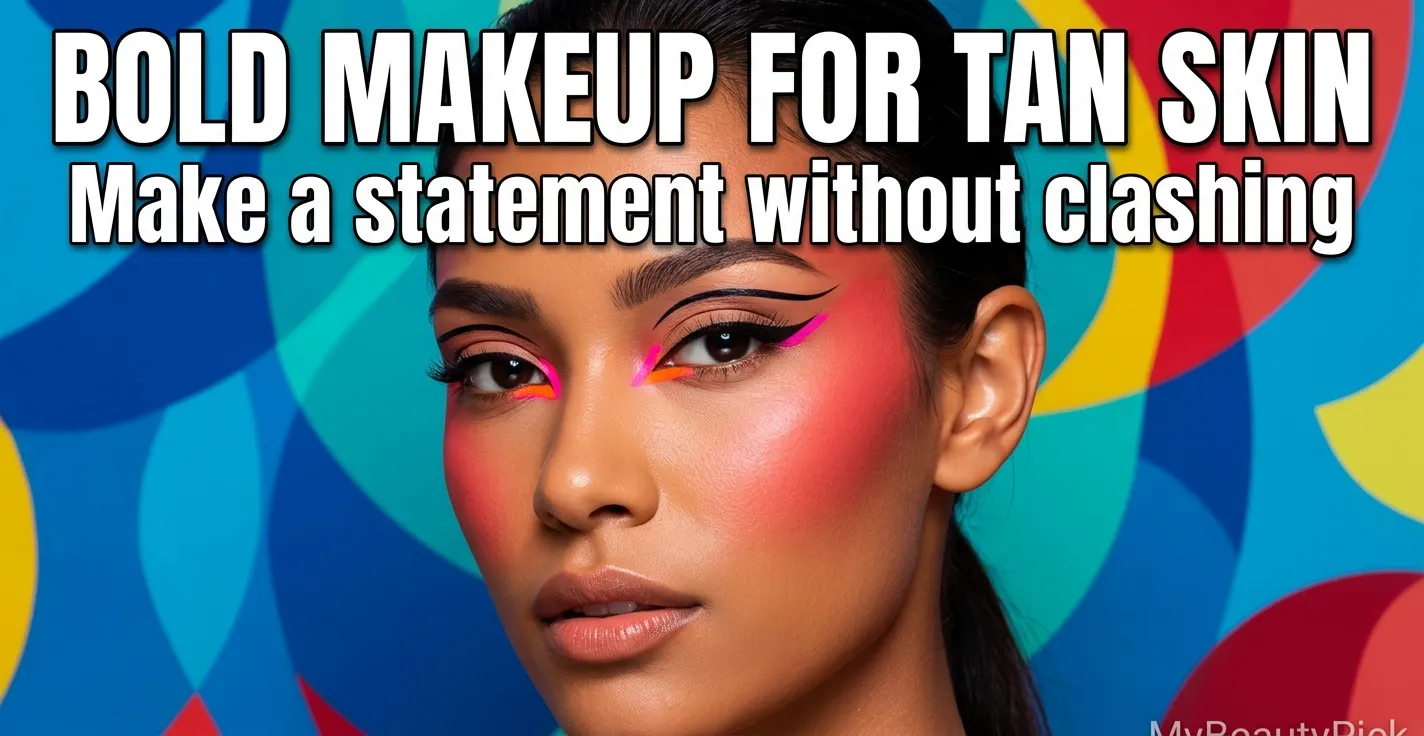
2026 has brought makeup’s bold era back in full. After years of skinimalism and quiet neutrals dominating every feed and every salon request list, the pendulum has swung toward colour, graphic precision, and self-expression. Bold colours, floating liner, blush draping, statement lips — all of it is back and more visible than it’s been since before the clean girl era started.
For tan and warm skin tones, this shift is particularly significant. Bold makeup doesn’t just work on tan skin — it works better. The richness of melanin-rich skin creates contrast and depth that makes graphic liner more striking, bold colour more vivid, and statement lips more impactful than the same products on lighter complexions. The key is knowing which colours amplify that richness and which ones clash with it.
- Bold makeup on tan skin works best when the bold colour has a warmth relationship with the skin — or creates intentional warm-cool contrast (like electric blue against warm skin).
- One bold element per look: bold eye OR bold lip OR bold cheek. Not all three simultaneously unless you understand colour theory deeply enough to balance them.
- The base for any bold look on tan skin must be neutral and polished — bold elements need a clean canvas, not a competing heavy contour.
- Electric blue liner on warm tan skin is one of the most visually striking combinations in makeup — the warm-cool complementary contrast is graphic and intentional.
- Warm reds, terracotta, deep plum, burnt orange, and forest green are the bold colours that amplify tan skin. Cool lavender, icy pink, and grey-adjacent shades work against it.
Why Bold Makeup Works Differently on Tan Skin
Bold makeup on tan skin is not the same experience as bold makeup on a lighter complexion. The visual contrast between a strong colour and the skin surface is different — and for tan skin, it’s almost always more impactful.
A deep red lip on fair skin is dramatic. On tan skin, that same deep red has a richness and warmth that the fair skin context doesn’t allow. An electric blue graphic liner on neutral skin creates one kind of contrast. On warm tan skin, the warm-cool complementary relationship between the blue and the skin’s warmth creates an entirely different — and more graphically striking — visual effect.
The risk on tan skin is not that bold looks are too intense — it’s that clashing bold choices create a disconnected visual where the colour looks like it belongs to a different face. The specific colours to avoid, and why, are rooted in colour theory rather than personal preference.
Colour Theory for Bold Makeup on Tan and Warm Skin Tones
Warm and tan skin has yellow-golden-orange undertones. Every bold colour you apply either amplifies, complements, or clashes with that underlying warmth. Understanding which category each colour falls into is the framework that makes every bold choice work.
✓ Amplifies
✓ Amplifies
✓ Amplifies
✓ Contrasts (intentional)
✓ Works with warmth
⚠ Handle carefully
✗ Often clashes
✗ Clashes — too cool
✗ Washes out
The complementary contrast principle: blue and orange are complementary colours — they sit opposite each other on the colour wheel. Warm tan skin has orange undertones. Electric blue applied against it creates the most vivid, intentional colour contrast in makeup — the two colours make each other look more saturated. This is why electric blue liner on warm tan skin photographs so dramatically and looks so purposeful. It’s colour theory working correctly.
The One Bold Element Rule
This is the single most important principle for bold makeup on tan skin: choose one bold element per look. Bold eye or bold lip or bold cheek — not all three simultaneously unless you’re creating an intentional editorial look and know exactly what you’re doing with the balance.
Bold makeup is about having a clear focal point — one thing the eye goes to first. When three elements compete for attention simultaneously, the result reads as overwhelming and unintentional rather than as a considered bold look. The boldness loses its impact because there’s no hierarchy telling the viewer where to look.
The second element should support the first. The third should recede. If the bold lip is the statement, the eye gets one coat of mascara and defined brows, nothing more. If the bold graphic liner is the statement, the lip is muted and warm neutral. If bold blush draping is the statement, both the eye and lip stay minimal.
Bold Lip Looks for Tan and Warm Skin Tones
The Best Bold Lip Colours for Tan Skin
Warm Red
The classic bold lip for tan skin — but only when the red has an orange or brick warmth base. A warm red on tan skin creates a richness and vibrancy that fair skin can’t produce with the same shade. The orange base in the red amplifies the warmth of the complexion rather than creating cool contrast.
Avoid: blue-red. This creates a cool, disconnected effect on warm skin that looks more like a costume choice than a considered bold look.
- Best formula: matte or satin — matte photographs most accurately under flash
- Lip liner: one shade deeper in the same warm undertone family, slightly extended at the cupid’s bow
Deep Burgundy / Plum-Red
The autumn and winter bold lip for tan skin. Deep plum-red has enough red warmth to complement rather than fight warm undertones, while the depth adds drama without being purely warm (like terracotta). This is the shade that reads as both bold and sophisticated simultaneously on tan skin.
- Best for: cooler months, evening events
- Balance with: clean skin, defined brows, mascara only — the lip carries everything
Burnt Orange / Terracotta
The most directly warm bold lip for tan skin — it shares the exact undertone family as warm melanin-rich skin, creating a monochromatic warmth effect. On tan skin, burnt orange reads as a rich, deliberate colour choice rather than an accidental match. The face looks cohesive and sun-kissed.
Requires: a nearly bare face with clean skin, mascara, and absolutely nothing else. The warmth of the burnt orange lip and the warmth of tan skin together are enough — any additional product risks reading as muddy.
Lip Application for Bold Looks on Tan Skin
Bold lips on tan skin need a defined edge to look intentional rather than approximate. Lip liner is not optional for any bold lip — it prevents bleeding, extends wear, and creates the precision that separates a bold lip that looks professional from one that looks carelessly applied.
Apply liner first, fill the entire lip with liner as a base, then apply lipstick over the top. Blot with a tissue after the first coat, apply a second coat without blotting. This gives maximum longevity. For matte formulas: blot and let it set — do not apply gloss over matte. For satin formulas: the second unblotted coat provides the finish.
Graphic Liner for Tan Skin: 2026 Trend Breakdown
Graphic liner is one of 2026’s defining makeup directions. Statement eyes, floating liner, geometric shapes, unexpected placement — all of this is back after years of tight-lined, barely-there definitions. For tan skin specifically, graphic liner has an impact level that exceeds what it achieves on lighter complexions.
Liner Colours That Work on Warm Tan Skin
| Liner Colour | Why It Works on Tan Skin | Best Shape |
|---|---|---|
| Black | The highest-contrast graphic liner on any skin tone — clean, precise, timeless | Extended wing, floating liner, geometric shapes |
| Electric Blue / Cobalt | Warm-cool complementary contrast — the blue-orange relationship is the most visually striking on tan skin | Extended wing, double liner under black, graphic shapes at inner corner |
| Forest / Hunter Green | Deep greens have enough warmth and depth to create rich contrast without reading cold | Extended wing, colour liner on lower lash line |
| Copper / Bronze | The warmest graphic liner — reads luxurious and harmonious. Lower contrast, higher elegance | Soft graphic shapes, inner corner accent, lower lash line only |
| Deep Burgundy | Warm-dark — has the intensity of black with warm-red undertones that complement warm skin | Smudged or precise graphic liner on upper lash line |
| Silver / Grey Liner | Creates ashy disconnection against warm skin when used graphically — reads cold and flat | Avoid as primary graphic liner on warm tan skin |
Graphic Liner Shapes for Tan Skin
Extended Wing
The extended wing — a thin, precise liner along the lash line that extends 5–8mm past the outer corner — is the most wearable graphic liner shape. On tan skin with dark eyes, even a standard wing reads with more impact than on lighter complexions because the liner-eye-skin colour contrast is higher.
In electric blue or black, the extended wing on warm tan skin is the simplest bold look that consistently photographs beautifully. Follow the lower lash line angle outward and then slightly upward — never the crease angle, which creates a drooping effect.
Floating Liner
Floating liner is placed on the eyelid above the lash line rather than on it — sitting in the space where eyeshadow typically goes, but as a clean graphic line rather than blended colour. On tan skin with a clean, near-bare lid underneath, floating liner reads as abstract and fashion-forward.
Electric blue floating liner on warm tan skin with no other eye makeup and a muted warm nude lip is one of the strongest editorial-but-wearable looks of 2026. The negative space of the bare lid creates the context that makes the floating line more impactful than it would be surrounded by eyeshadow.
- Best liner formula: gel or felt-tip for precision at this placement
- Best colours on tan skin: black, electric blue, deep forest green
Double Liner
Two separate liner lines: a thin black line on the lash line and a separate colour liner (electric blue, copper, or forest green) placed 3–5mm above it, following the same shape. The gap between the two lines becomes part of the design.
On tan skin, the most striking double liner combination: black lower line plus electric blue upper line. The complementary contrast between the warm skin and the blue creates an almost three-dimensional graphic quality in photographs.
Bold Eye Colours That Work on Tan Skin
Emerald and Forest Green
Deep greens have a warmth in their depth that amplifies the richness of tan skin rather than reading cold. Emerald green eyeshadow on warm tan skin with dark brown eyes creates one of the most striking complementary colour combinations in makeup. The orange-red warmth in tan skin and the green create the same colour-wheel relationship as red-green complementaries — high contrast, high vibrancy, completely intentional.
Application: deep green on the lid with a slightly lighter warm green in the transition zone. No shimmer needed — matte deep green with a clean edge is more striking on tan skin than glittery green. Gold or warm champagne shimmer in the inner corner provides contrast and brightness without competing with the green’s depth.
Deep Burgundy / Wine Eye
Burgundy and wine eyeshadow on tan skin reads as the warm, sophisticated alternative to the classic smoky eye. The red-warm base in the burgundy complements tan skin’s warmth while the depth creates a dramatic, moody effect. This works particularly well in autumn and winter, and in event or evening contexts.
The application approach: treat it like a warm smoky eye with burgundy at the outer corner and deeper wine at the outer V, warm terracotta or bronze as the transition shade, and a gold shimmer on the lid for contrast. Muted warm nude lip only.
Terracotta and Burnt Orange Eye
Bold terracotta or burnt orange eye shadow on warm tan skin is one of the most cohesive bold looks available — because the colour is in the same warmth family as the skin, it reads as a rich amplification rather than a contrast. The result looks editorial but intentional, saturated but harmonious.
Best approach: terracotta or rust across the entire lid, blending upward through the crease with a slightly lighter warm orange-brown. Dark espresso at the outer corner. Gold or warm bronze shimmer pressed into the centre of the lid. This is a one-palette look that photographs as a complete, considered colour editorial on tan skin.
Blush Draping for Tan Skin: The Bold Cheek Direction
Blush draping is the bold cheek trend of 2025–2026 — applying blush high on the cheekbone and sweeping it up toward the temple, sometimes across the under-eye area, for a saturated, flushed effect that’s clearly intentional rather than a subtle glow.
For tan skin, blush draping needs saturation and warmth. Sheer or cool-toned blush products in draping amounts on tan skin simply don’t register — there isn’t enough pigment or warmth to read against the melanin in the skin. You need a cream or powder blush with genuine pigment concentration and a warm shade: deep terracotta, burnt sienna, warm brick-orange, or rich coral.
Placement for blush draping on tan skin: start at the inner cheekbone (closer to the nose than a standard blush placement) and sweep upward and outward toward the temple. For the full draping effect: continue the sweep slightly below the outer eye area. Apply with a large fluffy brush using very light pressure, building up rather than saturating in one pass.
Balance: when blush is the bold element, keep the eye to mascara and brow gel only. The lip should be a warm neutral — nothing with colour intensity. Bold blush draping is a complete look on its own; it doesn’t need another statement element.
How to Build a Bold Look for Tan Skin: The Decision Framework
Before you start, answer these three questions:
- What is the bold element? Bold eye (colour shadow or graphic liner), bold lip (warm red, terracotta, deep plum), or bold cheek (blush draping). Choose one. Everything else supports it.
- Does the bold colour have a warmth relationship with my skin? If it amplifies warmth (terracotta, warm red, forest green, burnt orange): the rest of the face stays warm and minimal. If it creates warm-cool contrast (electric blue, cobalt, navy): balance with a warm neutral base and let the contrast be the statement — don’t add more cool colours elsewhere.
- What is the occasion? Events: full intensity of your chosen bold element. Evening out: slightly reduced intensity. Daytime: the most restrained version — one precise graphic liner or a sheer version of the bold lip, nothing more.
Bold Makeup Mistakes on Tan Skin
- ✗Choosing cool-toned bold colours expecting them to “pop”Icy pink, silver, cool lavender, and ashy mauve don’t pop on warm tan skin — they clash. They read as a colour choice made without understanding the undertone relationship. Replace with warm equivalents or use the complementary cool contrast approach (electric blue) deliberately.
- ✗Bold eye plus bold lip simultaneously without a clear focal pointTwo competing statements with no hierarchy reads as overdone rather than bold. Bold makeup needs one focal point. If you want both, ensure one dominates clearly — deeper and more intense — with the other playing a significantly smaller role.
- ✗Heavy base with a bold lookHeavy contouring, full highlight, structured base, AND a bold colour is too many elements competing. Bold makeup needs a neutral, polished base to do its work. A medium-coverage satin base with minimal additional face products lets the bold element read clearly.
- ✗Applying bold eyeshadow in one heavy passBold pigmented shadows on tan skin need slow build, not one saturated application. One heavy pass creates uneven distribution and visible patchiness. Build in 2–3 thin layers, assessing after each layer, for the most even and intense colour payoff.
- ✗Using blush draping with a sheer or cool blush formulaSheer blush doesn’t register on tan skin at any placement amount. Cool blush shades read as wrong-undertone rather than bold. Blush draping on tan skin requires a high-pigment, warm-toned cream or powder formula — terracotta, brick coral, or warm burnt sienna.
- ✗Silver shimmer eyeshadow as the bold lid shadeSilver has no warmth relationship with tan skin. It reads flat and ashy rather than striking. Swap silver for copper, bronze, or warm gold — same metallic quality, warm undertone that works with rather than against warm tan complexions.
Frequently Asked Questions
What bold lip colours suit warm and tan skin tones?
Warm red (orange or brick base), deep burgundy-plum with red warmth, burnt orange or terracotta, and dark warm nude (mocha-brick). All of these share a warmth relationship with tan skin that reads as harmonious and intentional. Avoid blue-red, cool fuchsia, cool pink, and pale beige nudes — these have cool undertones that fight the warmth of tan skin and read as disconnected rather than bold.
Can I wear cool-toned eyeshadow on tan skin?
Yes, but it requires a different approach than warm-toned shadow. Cool-toned bold shadow (electric blue, deep navy, forest green) creates warm-cool complementary contrast on tan skin rather than warm amplification. This contrast is visually striking when the rest of the face is warm and neutral — the cool eye and warm skin work together as a colour relationship. If you also add cool elements to the lip and cheek, you lose the contrast and the look becomes a cool-on-warm colour conflict. One cool bold element, warm everything else.
What is the best graphic liner colour for brown eyes and tan skin?
Electric blue is the single most visually striking graphic liner for brown eyes on warm tan skin. The warm-cool complementary contrast between the blue and the warm skin, combined with the dark-eye contrast of brown eyes against the blue liner, creates a multi-layered visual impact that photographs dramatically and reads as intentional rather than trendy. Black is the timeless alternative. Forest green and copper are the warm-toned alternatives that amplify rather than contrast the skin’s warmth.
How do I prevent bold eyeshadow from looking muddy on tan skin?
Build in thin layers rather than one saturated application. Use a dedicated brush for each shade — cross-contamination between brushes is the primary cause of muddy bold colour. For graphic colour eyeshadow: apply with a flat shader brush and press the product in rather than sweeping. For blended bold shadow: blend edges outward from the colour zone rather than blending the colour itself inward toward areas you want to keep clean. A setting spray applied over the completed eye locks in the colour and prevents fallout from muddying the look throughout the day.
Can I do bold eye and bold lip at the same time?
You can, but one must clearly dominate. If the eye is the statement — a full electric blue graphic liner or a deep colour eyeshadow look — the lip is a warm nude or very muted terracotta. If the bold lip is the statement, the eye is mascara and brows only. The version where both are done at equal intensity simultaneously creates a look with no focal point, which reads as overwhelming rather than bold. The professional approach is always: one hero element, everything else in support.
What is blush draping and does it work on tan skin?
Blush draping is a bold cheek technique that applies blush high on the cheekbone, sweeping it up toward the temple — sometimes extending below the outer eye area — for a saturated, flushed effect. It works particularly well on tan skin but requires high-pigment, warm-toned formulas. Sheer or cool-toned blush doesn’t register at draping amounts on tan skin. Use a cream or powder blush in deep terracotta, burnt sienna, or warm coral with genuine pigment concentration. The result is a strong, intentional colour statement that reads as a complete look without any additional bold elements on the eye or lip.