

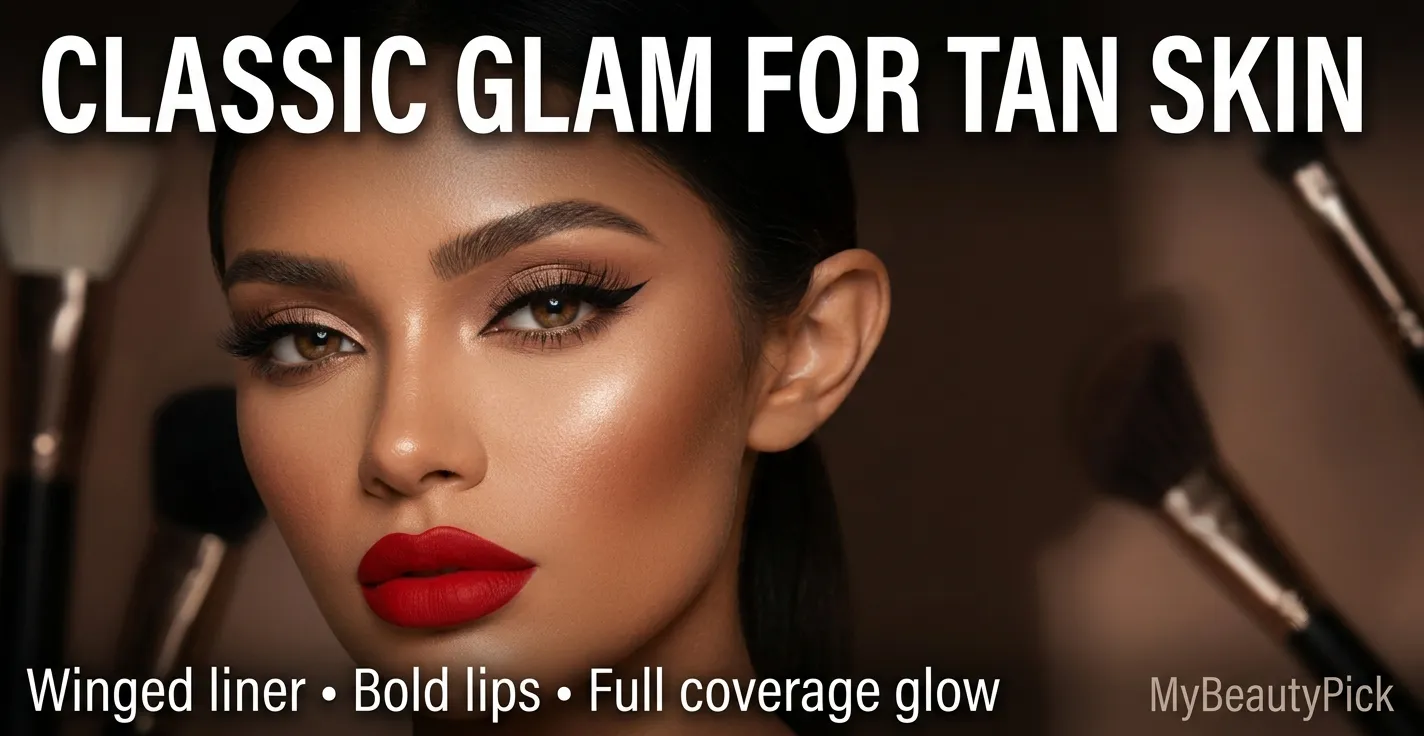
Classic glam is the highest-impact makeup look that remains timeless — flawless base, a sharp winged liner, full lashes, and a statement lip. On tan skin, it hits differently than on lighter complexions. The contrast between a rich skin tone and a precise wing, or between warm melanin-rich skin and a brick-red lip, is striking in a way that makes classic glam particularly powerful for tan and warm complexions.
The catch: every element of classic glam — foundation undertone, wing colour and shape, lip shade — needs to be calibrated for warm skin. A blue-red lip that looks classic and sophisticated on fair skin reads cold and disconnected on tan skin. This tutorial covers every step with the undertone-specific guidance that most classic glam tutorials skip.
- Classic glam on tan skin requires full-coverage, long-wear foundation — but the undertone determines whether it photographs correctly.
- The wing should be in dark brown or black. The angle follows the lower lash line, not the crease.
- The statement lip for warm tan skin: warm red (orange or brick base), deep plum-red, or dark warm nude — not blue-red, cool pink, or pale beige.
- Physical SPF in foundation causes flash photography flashback on tan skin — use chemical SPF in skincare only.
- White translucent setting powder reads grey in photos on tan and deeper skin. Use banana powder on the T-zone.
What Classic Glam Looks Like on Tan Skin
Classic glam on tan skin is high-impact and precise. It’s the look you wear to an event where you want to be genuinely dressed up — not dressed up by daily-wear standards, but the full version. Every element is finished, set, and deliberate. Nothing is approximate.
For tan and warm skin tones, classic glam has a particular visual power that lighter complexions can’t replicate. A sharp winged liner against dark eyes framed by rich tan skin reads as a more dramatic contrast than the same liner on lighter skin. A warm red lip on tan skin glows in a way it doesn’t on fairer complexions. The melanin-rich warmth of tan skin amplifies the impact of every classic glam element.
This tutorial is ordered from base to finish. Classic glam, more than any other makeup look, requires the products to go on in the right sequence — and for the sequence to be followed consistently.
Full Coverage Foundation for Classic Glam on Tan Skin
Formula Selection
Classic glam requires a foundation that holds all day without touch-up. The base for this look is intentional and finished — any breakdown in coverage compromises the whole look. Choose a long-wear, full-coverage formula with a silicone-based or polymer-based binder system. These resist sebum breakdown significantly better than water-based formulas on tan skin.
Finish: natural matte or satin. Dewy finish under the intensity of classic glam creates competing textures — the shiny skin under a heavy eye and bold lip reads as too much happening at once. Natural matte or satin keeps the skin polished and lets the liner and lip be the statements they’re designed to be.
What to avoid: hydrating or serum-foundation formulas — these are not designed for all-day, no-touch-up wear and will break down under the demands of a full classic glam look.
Undertone and Oxidation
Getting foundation undertone right is more critical in classic glam than in any other look — because the coverage is higher and more uniform, the wrong undertone is visible across the entire face rather than in isolated areas.
For warm tan skin: warm or neutral-warm foundation base. A pink-biased foundation reads visibly wrong in photos against warm tan skin, particularly when photographed under flash with the high contrast of a bold lip and dramatic liner.
Oxidation: tan skin — especially oily or combination tan skin — causes foundation to shift warmer over time as sebum interacts with iron oxide pigments in the formula. For classic glam, which is often worn to evening events where photographs are taken hours into the wear, this is particularly important. Choose a shade half a step cooler than your exact match. The warm oxidation shift will bring it closer to your true tone over the course of the evening, and the coverage will remain more consistent.
Test classic glam foundation not just at the point of application but after 30–45 minutes. Apply to your jaw in natural light, wait 30 minutes, then assess both the shade match and the finish quality. Foundation that looks exactly right at minute zero but shifts or separates at minute 30 is not the right formula for an all-evening classic glam wear.
Base Application Sequence
-
1
Primer
A silicone-based pore-blurring primer creates the smoothest surface for full-coverage foundation and significantly extends wear on tan skin. Apply a thin layer over the entire face, allow 60 seconds to set, then proceed. For oily T-zone: apply a mattifying primer to the T-zone only, allow to set, then apply a pore-blurring primer to the rest of the face.
-
2
Targeted Concealer Before Foundation
Apply full-coverage concealer matched to your skin tone (not lighter) over any blemishes or significant dark spots before foundation. This places the highest-coverage product closest to the skin where it adheres best, with foundation blending over the top to blend the edges. For under-eye: use concealer 1 shade lighter than foundation (same undertone) after foundation is applied, not before.
-
3
Foundation Application
Apply with a flat foundation brush using pressing and light buffing motions for the most even full-coverage result. A damp sponge is the alternative — pressing technique only, not dragging. For classic glam, build coverage in two thin layers rather than one heavy application. Set the T-zone with banana powder after the first layer dries before applying the second layer on the rest of the face.
-
4
Under-Eye Concealer and Set
After foundation is applied and the T-zone is set: apply under-eye concealer (1 shade lighter, same warm undertone) using a flat brush, pressing it into the under-eye area. Blend the edges and set immediately with a light press of banana powder. Setting under-eye concealer immediately prevents creasing throughout the evening.
-
5
Contour and Bronzer
Classic glam contour is more structured than soft glam. Apply a warm-toned contour powder (2–3 shades deeper than your foundation) under the cheekbone using a small contour brush, pressing in a C-shape from temple to under the cheekbone. Blend upward into the bronzer that follows. Bronzer over the temples, the perimeter of the forehead, and across the cheekbones adds warmth and ensures the heavily set base doesn’t look flat.
-
6
Final Set Before Eyes
Before starting eyes: do a final light press of banana powder over the T-zone. Lock the completed base with one mist of setting spray at 30cm. Allow the spray to dry completely — about 30 seconds — before starting the eye look. This prevents any eye makeup application from disturbing the finished base.
Winged Liner for Classic Glam on Tan Skin
Liner Formula Choice
Classic glam requires a liner that stays sharp and precise all evening. Three formula options:
- Gel liner with an angled brush: the professional standard. Gel gives the most control for building line thickness, corrections are possible while wet, and gel formulas stay sharp for 12+ hours when set with eyeshadow powder.
- Felt-tip liquid liner: fastest application, sharpest initial line, no correction possible once applied. Best for experienced hands who draw consistent wings without practice strokes.
- Avoid pencil for the wing: pencil wings smudge and are not precise enough for the clean, sharp lines classic glam requires.
Wing Angle and Shape
The most common classic glam liner mistake: following the angle of the eye crease rather than the lower lash line. The crease angles downward toward the outer corner on most eye shapes. A wing drawn along the crease angle points downward and creates a drooping effect. Always follow the lower lash line angle — extend the liner outward from the outer corner in the same direction as the lower lash line, then flick upward.
Wing length: extend the wing 3–5mm past the outer corner for classic glam. Shorter than this looks like a liner that was meant to be longer; longer than 8mm starts looking theatrical rather than classic.
Wing thickness: at the outer corner, the wing should be approximately the same height as the visible part of the iris. Use this as your proportion guide.
Colour: black is the classic choice. Brown-black (a very deep, warm-toned dark brown) reads slightly softer and more harmonious against warm tan skin — it creates less of the stark contrast that pure black can create. Either works; warm skin tones suit both.
Wing Application Technique
The stamp-and-connect method is the most reliable for consistent wings:
- Draw the flick first — from the outer corner, angle outward and upward, stamp the wing tip
- Draw a line from the wing tip back toward the lash line at an angle, creating the outer wing triangle
- Fill in the triangle
- Connect from the inner corner of the eye along the lash line to the base of the triangle
- Clean the edges with a flat concealer brush loaded with a small amount of setting powder (not foundation — powder gives sharper correction without adding coverage)
Tightlining: after the wing, press a dark pencil along the upper waterline from inner to outer corner. This creates the illusion of lash density at the root and makes the liner appear to grow from the lash line rather than sitting above it. On tan and dark brown eyes, this step adds significant depth and intensity to the overall liner look.
False Lashes for Classic Glam
Classic glam without false lashes is incomplete — the lashes are what complete the eye’s finished, high-impact quality. Two approaches:
Full strip lash: the highest-impact choice. Choose a style with a thin, flexible band and fibres that are dense but not so long they look theatrical. Strip lash styles that work for classic glam on tan skin: natural-to-glam styles with graduated length (shorter at inner corner, longer at outer), not uniform-length styles that can look false from a distance.
Individual clusters: the more modern approach. Apply 3–5 clusters at the outer corner and 1–2 at the centre for lift and volume without the fullness of a strip lash. Individual clusters also photograph more naturally at very close range than strip lashes.
Lash adhesive: dark-drying adhesive doubles as additional definition at the lash root. Clear-drying adhesive leaves a clean finish. Allow adhesive to become tacky (30–45 seconds) before applying lashes — lashes applied immediately to wet adhesive slide before setting.
After lashes are applied and adhesive is fully set, apply one coat of mascara over the false lashes and your natural lashes together. This melds the two sets of lashes into one uniform look rather than having a visible seam between natural and false. Use a dark mascara to also reinforce the tightlining at the lash root.
The Statement Lip for Tan Skin: The Undertone Guide
The lip is the defining element of classic glam — it’s the product that signals this is a complete, intentional look rather than everyday makeup that’s been slightly dressed up. For tan skin, choosing the right statement lip shade comes down almost entirely to undertone.
Orange or brick base. The quintessential classic glam lip on tan skin. Creates warmth and intensity without the cold disconnect of blue-red.
Rich and dark. Autumn’s classic glam lip — the warmth in the red base keeps it harmonious with tan skin even at depth.
Dramatic and editorial. Has enough red-warm base to work with warm tan undertones. Avoid shades that pull purely purple without red warmth.
Mocha-brick or dark terracotta — the modern classic glam lip. Sophisticated and understated. Keeps the focus entirely on the liner and lashes.
Blue-based reds, cool fuchsia, cool pink, and pale nude lipsticks all have cool undertones that fight with warm tan skin. They read as disconnected from the face rather than as a natural extension of it. Test any statement lip shade on the back of your wrist next to your skin — if it reads as warm and harmonious, it’s right for warm tan skin. If it reads as a separate cool colour, it isn’t.
Lip Application for Classic Glam
Lip liner first: match the liner to your lipstick shade or go one shade deeper. Line the natural lip line — do not dramatically overdraw. A slight (1mm) extension at the cupid’s bow centre and lower lip centre creates fuller appearance without looking artificial. Fill the entire lip with liner before applying lipstick — this extends the wear of the lipstick significantly and prevents colour from bleeding.
Lipstick application: apply directly from bullet onto filled lip. Blot with a single-ply tissue for the first coat. Apply second coat without blotting. This sets the lipstick for maximum longevity. For a matte formula: stop here. For a satin or gloss formula: the second coat provides the finish.
Classic Glam on Tan Skin: Photography Considerations
Classic glam is typically worn to events where photographs are taken. Several product choices that look fine in the mirror create visible problems in flash photography on tan and deeper skin tones.
Physical SPF flashback: titanium dioxide and zinc oxide (physical/mineral SPF ingredients) reflect camera flash and create a white or grey cast in photos on tan skin. If your foundation, primer, or setting spray contains these ingredients, this will appear in photographs even when the makeup looks correct in person. Use chemical SPF filters (avobenzone, octinoxate) in skincare only, and choose foundation without added SPF for events where you’ll be photographed.
Setting powder: white translucent powders contain titanium dioxide and create the same flashback problem as physical SPF. On tan skin under flash photography, white translucent powder reads as grey across the T-zone and forehead. Use banana powder (yellow-toned) on the T-zone and any set areas. The yellow pigment absorbs flash rather than reflecting it.
Highlight placement: keep highlight to the very tip of the cheekbone only. Over-highlighted areas on tan skin under flash photography create blown-out spots that photograph as significantly overexposed patches. Classic glam highlight should be invisible unless you tilt your head into direct light.
Matte vs. glossy lip in photos: matte lipstick photographs true to colour under flash. Glossy or satin lipstick reflects flash and reads lighter in photos than it appears in person. For events with significant flash photography, a matte lip formula performs most consistently.
Classic Glam Mistakes on Tan Skin
- ✗Wrong foundation undertonePink-biased foundation on warm tan skin reads visibly wrong in photos even when it looks acceptable in mirror light. Always test in daylight, wait 30 minutes for oxidation, check in photos.
- ✗Wing angle pointing downwardFollowing the crease angle instead of the lower lash line angle produces a drooping wing. Always extend the liner in the same direction as the lower lash line — outward and then upward, not following the downward crease.
- ✗Cool-red or blue-red lip shadeBlue-based reds have no warmth relationship with warm tan skin. They read as a separate cool colour on the face rather than as an amplification of natural warmth. Switch to warm red with orange or brick base.
- ✗Physical SPF in foundation or primerTitanium dioxide and zinc oxide reflect flash and read as grey or white on tan skin in photos. Use chemical SPF filters in skincare. Avoid SPF-containing foundation for event and photography situations.
- ✗White translucent setting powderCreates flashback in photos on tan and deeper skin. Switch to banana powder for T-zone setting and a pigmented pressed powder that matches your undertone for any other areas that need powder.
- ✗Heavy foundation without primerFull-coverage foundation without primer breaks down faster on tan skin with any oil production. The primer layer is what gives full-coverage foundation its all-evening longevity — skipping it halves the wear time.
Frequently Asked Questions
What red lipstick shades work best on tan skin?
Warm reds with an orange or brick base are the most flattering on tan and warm skin tones. The orange base creates warmth that amplifies the natural richness of tan skin rather than creating a cool, disconnected contrast. Avoid blue-based reds — these have no warmth relationship with tan skin and read as a separate cool element on the face. Test red lipstick on the back of your hand near your skin tone: if the red has warmth that echoes your skin’s warmth, it’s right. If it reads as a cool, distinctly pink-red, it isn’t.
How do I stop winged eyeliner from smudging on oily lids?
Three steps prevent liner smudging on oily lids: prime the lid before liner (eyeshadow primer creates a long-lasting adhesive surface), use a gel liner formula (gel lasts longer than pencil), and dust a tiny amount of translucent or dark eyeshadow powder over the liner after application using a fine brush — this sets the formula and prevents smudging. Avoid touching the eyelid area after application. For very oily lids, an eyelid-specific setting spray pressed with a tissue directly onto the liner also works well.
What foundation formula lasts longest for classic glam on tan skin?
Long-wear silicone-based or polymer-rich formulas with natural matte or satin finish hold longest on tan skin for classic glam wear. These resist sebum breakdown significantly better than water-based or hydrating foundation formulas. Applied over a silicone primer and set with banana powder on the T-zone, a good long-wear formula should hold without touch-up for 8–12 hours. Look for “24-hour wear” or “long-wear” formulas at medium-to-full coverage with oil-free or oil-control descriptions.
How do I prevent foundation from oxidising during an evening event?
Three things slow oxidation: a silicone-based primer barrier between skin oils and foundation, choosing a shade half a step cooler than your exact match (the warm oxidation shift brings it to your true tone over time), and setting spray applied immediately after the full base routine. If you know you oxidise significantly, use a blotting paper on the T-zone at the 4-hour mark to remove excess oil from the skin surface — this slows the continued oxidation reaction without disturbing the coverage.
Can classic glam work for daytime occasions?
Yes, with adjustments. For daytime, reduce coverage to medium-full rather than full and use a satin rather than natural matte finish for a slightly more luminous, less heavily set appearance. Use a thin liner wing rather than a thick one. Use individual lash clusters at the outer corners rather than a full strip lash. Choose a warm nude or terracotta statement lip rather than a deep red or burgundy. These adjustments bring classic glam into appropriate daytime territory for events, weddings, or formal occasions without losing the precision and polish that defines the look.