

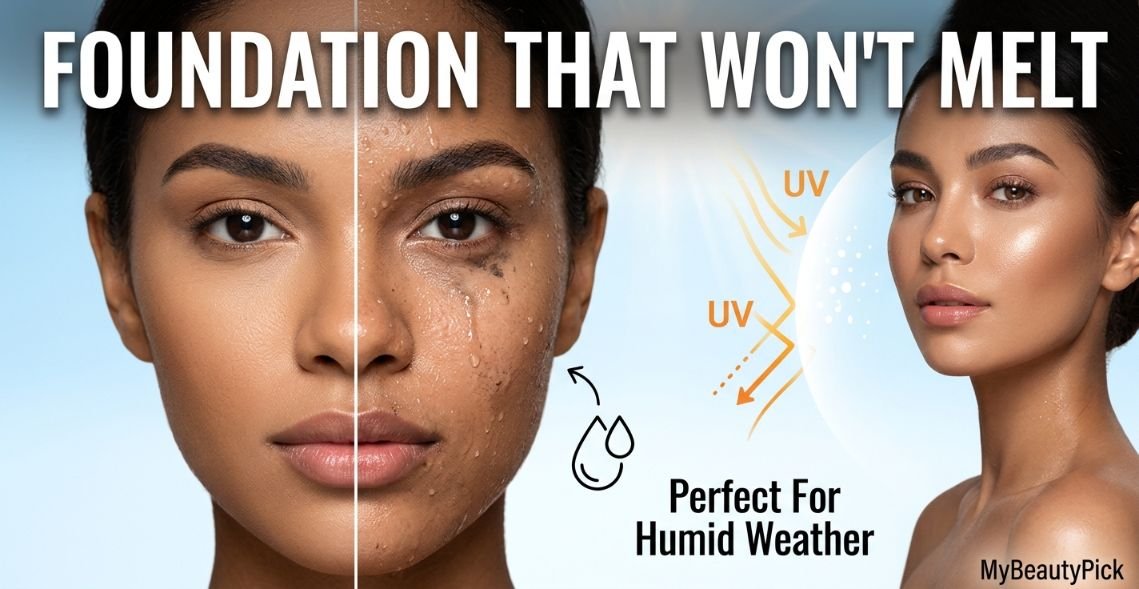
Humidity is a specific enemy of foundation because it attacks from two directions simultaneously. High ambient moisture slows the evaporation that allows most foundations to set, while heat accelerates sebum production that breaks them down from underneath. The result — foundation that slides, transfers, and looks greasy by early afternoon — isn’t just a product problem. It’s a chemistry problem that needs both the right formula and the right application system to address properly.
- The best foundation for humid weather uses polymer film formers that resist moisture disruption — not just silica and clay that absorb oil.
- Matte or natural matte formulas hold better in humidity than dewy or satin ones. High ambient moisture already adds luminosity; a dewy formula on top tips into greasy.
- Application technique in humidity: thinner layers, pressed (not swiped) with a sponge, set immediately with pressed banana powder, finishing spray last.
- On tan skin, go one shade cooler than your exact match in summer — heat accelerates oxidation and a cooler starting shade lands at your true tone by midday.
- No physical SPF (titanium dioxide, zinc oxide) in any makeup product on tan skin — flash photography issue regardless of season.
Why Foundation Melts in Humid Weather
Most foundations need some degree of evaporation to set properly. Water-based foundations rely on the water content evaporating to leave the film formers and pigments bound to the skin. In high humidity — 80% and above — that evaporation is dramatically slowed. The formula stays wetter, and a wetter formula slides more easily.
Heat compounds this. Higher temperatures stimulate sebum production, and the combination of surface moisture from the environment and oil from the skin creates exactly the conditions that most foundations are designed to resist but struggle with in combination. The result is a formula that never fully set and is now being disrupted from underneath by sebum — which is why it migrates and looks greasy rather than just dull.
The solution isn’t switching to a more expensive foundation. It’s using a formula with stronger polymer film formers and layering the supporting products correctly so the foundation has a chance to adhere before humidity can prevent it from setting.
What to Look for in a Summer Foundation Formula
Check for these in the ingredient list:
- Acrylates copolymer or trimethylsiloxysilicate — these are the film-forming polymers that give long-wear foundations their staying power in moisture. Formulas with these high up in the ingredients list (positions 3–8) tend to hold in humidity.
- Cyclopentasiloxane or dimethicone — silicone carriers that create a moisture-resistant layer and help the formula sit on rather than in the skin surface.
- Silica or kaolin clay — oil absorbers that help, but aren’t sufficient on their own for humidity resistance. Supporting ingredients, not primary ones.
Avoid in summer formulas: heavy humectants like glycerin or hyaluronic acid in a high position in the ingredient list. These draw moisture to the skin surface — which is great for dry skin in winter, but in humid weather, they pull additional ambient moisture into the skin surface and can accelerate formula breakdown.
Best Foundations for Humid Weather
Estée Lauder Double Wear Stay-in-Place Foundation
Double Wear is the consistent answer to humidity because it was engineered specifically for extreme wear conditions. The polymer system creates a film that resists moisture disruption from both the environment and sebum more effectively than most alternatives. In tropical or subtropical climates — or simply during summer in any region — it outlasts practically every other formula.
The natural matte finish is well-suited to humid conditions. It doesn’t reflect ambient moisture the way a satin or dewy formula can, so it reads as controlled skin rather than wet-looking even when conditions are working against it. On tan skin, the warm shade options are among the more stable in this category — the oxidation rate is lower than most matte alternatives.
The limitation everyone who uses this formula hits: it sets fast and is difficult to blend after about 90 seconds. In humid conditions where the formula sets more slowly than usual, this actually gives slightly more working time — but not much. Apply quickly, in sections, and work fast.
- Holds in genuine tropical humidity
- Natural matte — controls sweat-shine
- Lower oxidation rate than most matte formulas
- 24-hour wear claim holds in most summer conditions
- Sets fast — needs quick blending
- Heavy feel in very hot conditions
- Needs oil cleanser to remove fully
L’Oréal Paris Infallible 24H Fresh Wear Foundation
The Fresh Wear is the most accessible summer foundation that genuinely holds in heat and humidity. The name is accurate — it’s significantly lighter in feel than Double Wear while maintaining respectable humidity resistance. In outdoor summer conditions, a client testing it told me it was still holding coverage at hour seven of a festival in 32-degree heat with intermittent rain. That’s a real-world test most foundations fail well before that point.
Coverage is medium to full and builds with a second layer without caking in the way many budget formulas do in heat. The shade range is the main limitation — 28 shades with warm-undertone gaps in the deeper tan range.
- Lightweight for medium-full coverage
- Holds in heat and humidity
- Budget-friendly for summer outdoor use
- Natural matte finish
- Only 28 shades
- Warm-undertone options limited at deeper tan
- Can feel slightly drying on combination skin cheeks
Make Up For Ever HD Skin Foundation
The HD Skin sits between the heavy hold of Double Wear and the lighter grip of Infallible. In moderate humidity — 60–75% — it holds well with a primer underneath. In genuinely tropical humidity, it needs more support from primer and powder to last a full day, but the skin finish it produces in those conditions looks significantly more natural than Double Wear’s slightly coating quality.
The 40-shade range is the widest in this group and the undertone matching is among the most precise available in a soft-matte formula. For tan skin specifically, the warm-neutral shade range covers the medium-to-deep tan spectrum with more accuracy than most alternatives.
- 40 shades — widest range in this category
- Natural skin finish even in humidity
- Medium-full coverage without coating feel
- Needs stronger primer support in very high humidity
- Shorter hold than Double Wear in extreme conditions
- Price is high
Fenty Beauty Pro Filt’r Soft Matte Longwear Foundation
The Fenty Pro Filt’r holds in humidity at a level close to the Double Wear while producing a significantly more natural, skin-like finish. The 50-shade range is the best in any of these categories for undertone variety — particularly for tan and deeper skin tones where the warm-undertone options are more precise than most alternatives.
On tan skin in summer, the W (warm) shade variants in the medium-tan range hold their undertone without orange shift better than many alternatives at this formula type. The soft matte finish is flattering across skin tones — it controls shine without the flat coverage that some matte formulas produce.
- 50 shades — best range in the group
- Precise warm-undertone options for tan skin
- Holds well in humidity with primer
- Skin-like soft matte finish
- Needs primer for maximum humidity hold
- Doesn’t hold quite as long as Double Wear in extreme heat
- Can look patchy without primer on oily skin
The Summer Foundation Routine That Actually Works
The right foundation helps, but the routine around it determines how long it lasts. In humid conditions, technique changes matter as much as formula.
The layering order
- Skincare first, properly absorbed. Don’t rush this. Humid weather makes foundation slip more readily over unabsorbed skincare than in normal conditions.
- Chemical SPF only — no physical SPF. Titanium dioxide and zinc oxide sit on the skin surface and create a physical barrier that foundation slides over in heat. Chemical SPF absorbs into the skin and doesn’t create this sliding layer.
- Mattifying primer on T-zone, light touch on the rest. In very humid conditions, some people apply primer more broadly. On combination skin with dry cheeks, keep the hydrating primer minimal in summer to avoid creating the surface slip that causes foundation to slide.
- Foundation in one thin layer. Not two layers in one go. One pass of a damp sponge with pressing motions. Let it settle.
- Concealer only where needed — wait for foundation to set first.
- Banana powder pressed on T-zone immediately. Set within 60 seconds of foundation on the T-zone. On tan skin: banana powder, not white translucent.
- Waterproof or long-wear setting spray. Not a hydrating mist — that adds water to the surface in conditions already high in ambient moisture. A setting spray specifically formulated for long wear.
Blotting papers rather than powder for midday touch-ups in humidity. Pressing extra powder over foundation that’s been exposed to several hours of heat and moisture builds product layers that eventually look cakey and uneven. A single blotting paper press on the T-zone removes surface oil without disturbing coverage, and the original set powder underneath continues doing its job. Keep a small bottle of setting spray in your bag for a refreshing top coat after blotting if coverage looks slightly uneven.
Summer Foundation Adjustments for Tan Skin
Tan and warm complexions have two specific summer concerns that require intentional adjustments:
Shade selection: In heat and humidity, foundation oxidation accelerates. Iron oxide pigments shift warmer faster when the skin is hot and producing more oil. Going one step cooler or more neutral than your exact shade match in summer means the formula lands at your true tone by midday rather than reading orange. This is a consistent client complaint every summer — and the fix is in the shade choice before application, not in any product applied afterward.
Setting powder: White or translucent powders with titanium dioxide read ashy on tan skin and can create a grey or washed-out appearance that becomes more obvious as the day goes on and the powder interacts with sweat. Banana powder — yellow-toned, pigmented slightly warm — maintains the foundation’s warmth and absorbs oil without colour distortion.
| Foundation | Humidity Hold | Best Skin Type | Shade Range | Finish |
|---|---|---|---|---|
| Estée Lauder Double Wear | Excellent — tropical conditions | Oily, combination | 45 | Natural matte |
| L’Oréal Infallible 24H | Good — heat and moderate humidity | Oily, combination | 28 | Natural matte |
| MUFE HD Skin | Good — moderate humidity with primer | All types | 40 | Soft matte |
| Fenty Pro Filt’r | Good — moderate humidity with primer | Oily, combination, normal | 50 | Soft matte |
Frequently Asked Questions
What foundation stays on in humid weather?
Foundation with polymer film formers (acrylates copolymer, trimethylsiloxysilicate) stays on in humid weather better than standard formulas. Estée Lauder Double Wear and L’Oréal Infallible 24H Fresh Wear are the most consistently reliable. The formula type matters less than the supporting routine — a mattifying primer underneath, pressed powder setting on the T-zone, and a long-wear setting spray over everything extends almost any foundation’s wear in humidity significantly.
Why does my foundation melt off in hot weather?
Foundation melts in hot weather primarily because heat accelerates sebum production and ambient humidity prevents the formula from fully setting. Most formulas rely on evaporation to set — in high humidity, that evaporation slows, leaving the formula in a semi-liquid state that slides more readily. Formulas with stronger film-forming polymers and a mattifying primer underneath resist this more effectively than standard foundations.
Should I wear less foundation in summer?
Applying less foundation in a thinner layer actually holds better in summer than a built-up application. A thin layer of a long-wear formula adheres more firmly than a thick application of the same product. If you need full coverage, use a thin layer of foundation and target specific areas with concealer rather than building coverage with multiple foundation layers — multiple layers give heat and humidity more to disrupt.
Is matte or dewy foundation better for summer?
Matte or natural matte foundation holds better in summer and humidity. Dewy formulas amplify moisture from the environment and the skin’s own sebum, often reading as greasy by midday in warm conditions. On dry skin that wants some glow in summer, a satin finish with a mattifying primer on the T-zone only is the most practical compromise — controlled where the skin is oiliest, slightly luminous where it’s drier.