

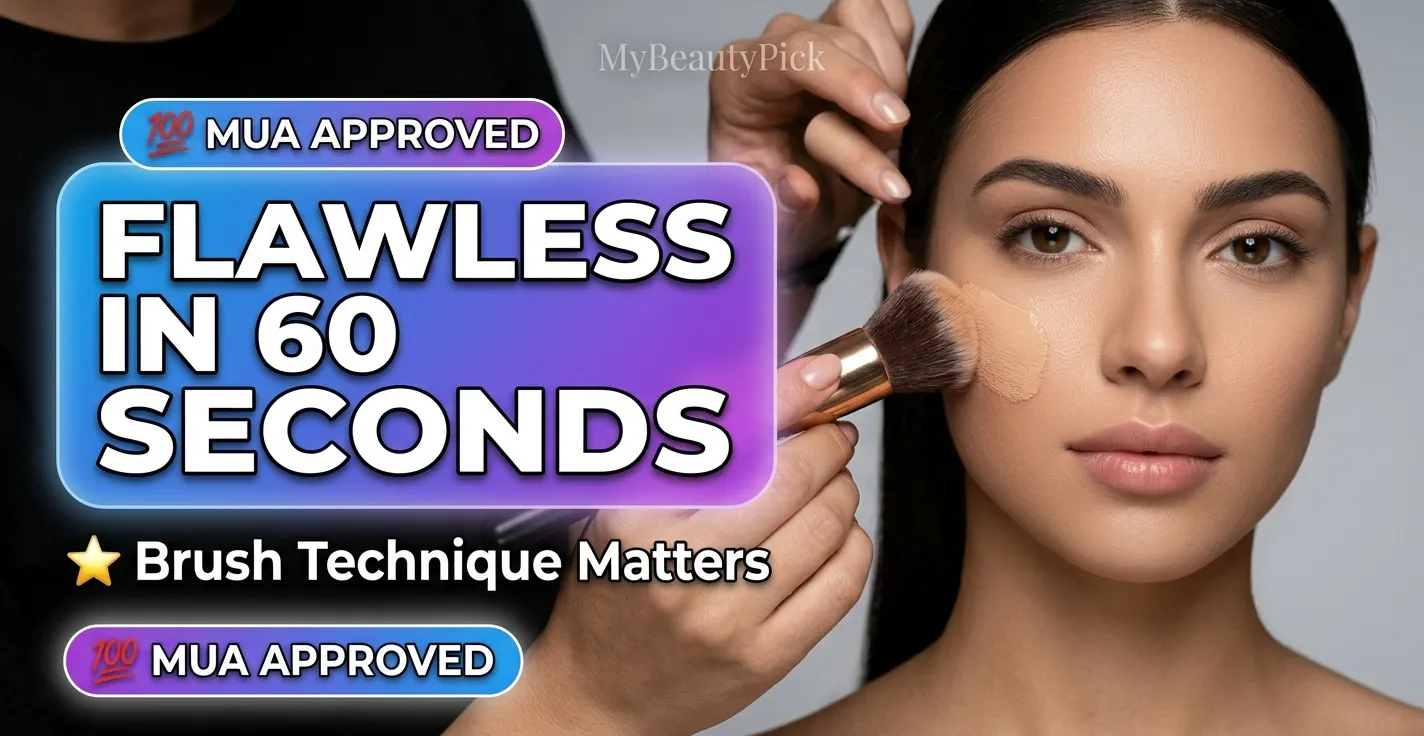
A brush will give you better coverage than your fingers and more control than a sponge, but only if you load it correctly and move it the right direction across your face. I have watched clients drag streaks across their cheeks for years with an expensive brush simply because nobody ever showed them where to start.
Quick answer: to apply foundation with a brush, pick up product from the back of your hand rather than dipping straight into the bottle, start at the center of your face where redness is heaviest, and buff outward in small circular motions with a dense brush, or sweep in one direction with a flat brush, finishing at the hairline and jaw where you need the least product.
Key Takeaway
- Dipping a brush directly into the bottle wastes the most product and gives the least coverage, since most of it gets trapped in the bristles
- Brush shape determines technique: dense and flat-top brushes buff in circles, flat paintbrush-style brushes sweep in one direction
- Start at the center of the face, where redness and discoloration are heaviest, and work outward toward the hairline and jaw
- Streaking almost always comes from too much product on the brush at once, not from the wrong brush
Choosing the Right Brush for Your Foundation
The brush you pick changes the entire application, not just the speed of it. Match the brush density to the formula, and match the brush shape to the finish you want.
Flat Foundation Brush
Best for: Liquid foundation, thin layering, beginners.
Why it works: Lays product down evenly in thin layers, easy to control, lower risk of streaking when you sweep with the grain of the brush.
Watch for: Can leave visible brush strokes if you press too hard or move in only one direction without a follow-up buff.
Dense, Rounded Buffing Brush
Best for: Liquid and cream foundation, medium to full coverage, a skin-like airbrushed finish.
Why it works: Circular buffing motion presses product into the skin instead of sitting on top, which is what creates that airbrushed look.
Watch for: Holds the most product in the bristles, so it wastes foundation fastest if you load it directly from the bottle.
Stippling or Duo-Fiber Brush
Best for: Tinted moisturizer, skin tints, sheer to medium coverage.
Why it works: Airy bristle structure sheers out product for a lighter, more natural finish than a dense brush.
Watch for: Will not build to full coverage well. If you need to cover dark spots, a stippling brush alone is not enough.
Step-by-Step: How to Apply Foundation With a Brush
Prep skin first
Cleanse, moisturize, and let primer sit for about thirty seconds before foundation. Skin that is dry under the brush will drag product unevenly no matter how good your technique is.
Dispense onto the back of your hand, not the brush
Pump a small amount onto the back of your hand or a mixing palette. Loading the brush this way coats the bristles evenly and uses far less product than dipping straight into the bottle.
Pick up product from the hand, not a fresh dip each time
Tap the brush lightly into the foundation on your hand. You want a thin, even coat on the bristles, not a saturated brush. You can always go back for more.
Start at the center of the face
Begin where redness and discoloration are usually heaviest: the center of the cheeks, nose, and chin. This is where you want the most coverage, so it should get the freshest, most saturated brush strokes.
Work outward toward the hairline and jaw
By the time your brush reaches the hairline, temples, and jawline, it should be nearly out of product. These areas need the least coverage and this is also exactly how you avoid a harsh foundation line at the jaw.
Use small, tapered strokes for tricky areas
Around the nose, under the eyes, and at the corners of the mouth, switch to small, light strokes with just the tip of the brush. Heavy pressure here is what causes foundation to settle into fine lines.
Buff, do not wipe
Whether you are using circular or straight strokes, keep the motion light. Wiping or dragging the brush is what creates visible streaks, especially on a flat brush.
Layer only where you need more coverage
If a spot still shows through, go back with a small amount of product on the brush rather than adding a second full layer everywhere. Targeted layering avoids the cakey look that comes from overall buildup.
Stop dipping straight into the bottle
This is the fix that changes everything for most people who feel like they go through foundation too fast. A dense brush dipped directly into the bottle traps a huge amount of product deep in the bristles where it never reaches your skin. Dispense onto your hand first and you will use noticeably less product for the same, or better, coverage.
Brush Technique by Coverage Level
| Coverage Goal | Brush Type | Technique |
|---|---|---|
| Sheer, natural | Stippling or duo-fiber | Light outward strokes, minimal pressure |
| Medium, buildable | Dense rounded buffing brush | Small circular motions, layer only where needed |
| Full coverage | Dense flat-top or rounded brush | Firmer circular buffing, build in thin layers, never one thick layer |
| Precision, small areas | Tapered or small flat brush | Light dabbing strokes around nose, eyes, and mouth corners |
Why Foundation Streaks or Looks Patchy With a Brush
Streaking is almost never about brush quality. It comes down to three things in most cases I have seen in the chair.
- Too much product loaded at once. A heavily saturated brush drags instead of buffing, leaving visible lines.
- Moving against the direction of facial hair growth. Brushing against the grain on the cheeks and jaw can lift fine hairs and create a streaky texture, especially with flat brushes.
- Skipping the buff-out step. Applying product and walking away without a final light buffing pass leaves visible placement marks where the brush first touched down.
When a Brush Is Not the Right Tool
If you want a dewy, second-skin finish, a brush will generally look more done and more full coverage than a damp sponge will, even with a light hand. A brush presses product onto the skin’s surface, while a sponge sheers it out. For sheer, glowy looks, a sponge or fingers will usually serve you better than a brush.
Mistakes That Ruin Brush Application
- Dipping straight into the foundation bottle. Wastes product and traps most of it in the bristles instead of on your skin.
- Using a heavily saturated brush on the first pass. Leads directly to streaking, especially on cheeks and forehead.
- Skipping the center-out direction. Starting at the jaw or hairline wastes your freshest, most product-loaded strokes on areas that need the least coverage.
- Using the same dense brush for every area of the face. The nose, under-eyes, and mouth corners need a smaller, lighter touch than the cheeks and forehead.
- Not cleaning the brush regularly. A dirty brush holds old product and bacteria, which affects both how foundation applies and how your skin reacts to it.
Caring for Your Foundation Brush
Rinse bristles under lukewarm water with a gentle brush cleanser at least once a week, reshape the bristles, and lay the brush flat to dry. Never store it standing upright while wet, since water can seep into the handle and loosen the bristles over time. A clean brush applies foundation more evenly and is far less likely to cause breakouts or irritation.
FAQ
Is it better to apply foundation with a brush or fingers?
A brush generally gives more even, buildable coverage and avoids the fingerprint marks fingers can leave, while fingers can feel more natural for sheer, light coverage. Both work, the right choice depends on the coverage and finish you want.
How much foundation should I put on a brush?
Start with a small amount, about the size of a pea for the whole face when using a dense brush, dispensed onto the back of your hand first rather than directly onto the brush or face. You can always build more in thin layers.
Why does my foundation look streaky when I use a brush?
Streaking usually comes from too much product loaded onto the brush at once, or from dragging the brush instead of buffing in light, even strokes. Working in small sections and buffing rather than wiping fixes most streaking issues.
What brush is best for liquid foundation?
A dense, rounded buffing brush or a flat foundation brush both work well with liquid foundation, with the dense brush giving a more airbrushed, full coverage finish and the flat brush giving smoother, thinner layering.
Should I use a brush or sponge for foundation?
A brush is better suited for full coverage and a more polished finish, while a damp sponge gives a more natural, dewy, second-skin look by sheering the product out as you press it into the skin.