

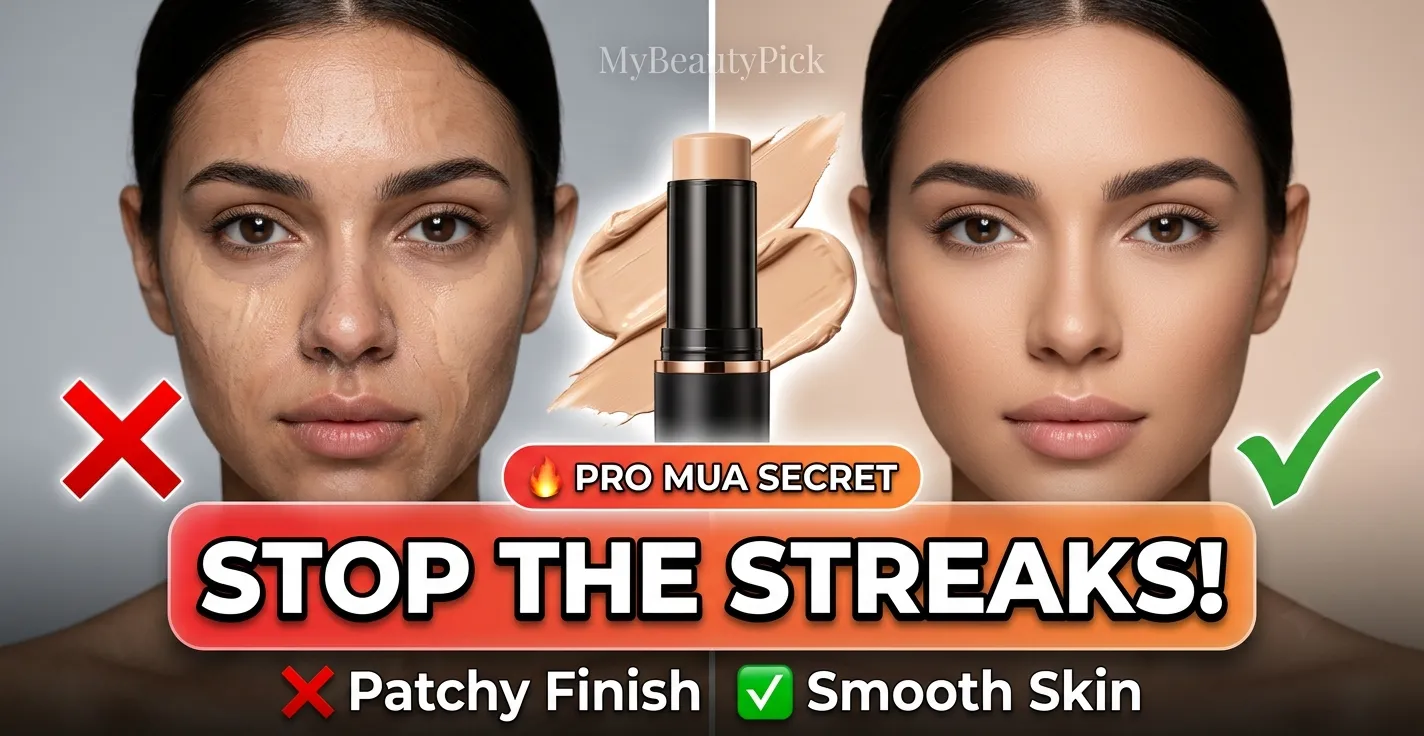
Stick foundation should be the fastest, most forgiving format in your makeup bag. In practice, it is the one that causes the most streaks, patchiness, and build-up — not because it is a difficult formula, but because the application rules are different from liquid and most people use liquid habits on a cream-wax base. This guide covers how to apply stick foundation without streaks, how to use liquid foundation correctly, and why the two formats need to be treated as entirely separate products.
The Most Important Things to Know First
- Stick foundations streak because they are wax-based and set faster than liquid. The blending window is short — you have roughly 20 to 30 seconds before the formula begins to lock in place.
- Warming the product before application is not optional for a streak-free finish. Cold formula drags. Warm formula melts into skin.
- The “apply directly to face and blend” method works on some skin types and fails on others. Tan, dry, and textured skin almost always needs the back-of-hand warm-up method first.
- Liquid foundation and stick foundation need different tools, different prep, and different blending motions. Using liquid habits on a stick formula is the single most common cause of streaking.
- Setting direction matters on tan skin. Blend outward and downward to avoid a visible product line along the jaw, which reads more obviously against tan skin.
Why Stick Foundation Streaks — and Why It Happens More on Tan Skin
Stick foundation is built on a wax-and-oil base rather than water. There is no aqueous phase to keep the formula fluid as you blend. The moment it contacts skin, body heat begins to soften the wax, and the clock starts on your blending window. If you apply too much product, move too slowly, or work in a direction that pulls the formula across already-setting product, you get drag marks and streaks. That is not a technique failure — it is a physics problem that requires a different approach.
Tan skin adds a specific layer of difficulty. Higher melanin concentration creates a surface where formula colour mismatches and uneven blending are more visible than on lighter skin tones. A streak that reads as subtle on fair skin reads as a clear line on tan or medium-deep skin. The product’s base colour also matters more: a stick formula with a peach-warm base will drag warmly across a tan surface and leave an orange streak even when blended correctly. Choosing the right formula for your undertone removes one variable before technique even enters the picture.
Before you buy a stick foundation, swatch it on your inner wrist and wait 60 seconds without blending. If the formula hardens noticeably in under a minute, it has a high wax content and will require the warm-up method every time. If it stays soft and pliable for 90 seconds or more, it has a higher oil content and will blend more forgivingly directly on skin.
Understanding Stick Foundation Formulas
Not all stick foundations are alike. The ratio of wax to oil in the base changes everything about how the formula behaves on skin — how fast it sets, how easy it blends, and which skin types it suits. Knowing what kind of stick you are working with shapes every decision about application.
Wax-Heavy Stick Formulas
Ceresin, carnauba wax, or synthetic wax high on the ingredient list. These formulas are firmer, set faster, and need the most prep to blend without streaks. They give full coverage and long wear. They are unforgiving on dry or textured skin without proper prep and a warming step.
- Best for: Oily skin, events, long wear
- Blending window: 15–25 seconds
- Always warm on back of hand first
- Tool: Dense buffing brush or fingertips
Oil-Heavy Stick Formulas
Ethylhexyl palmitate, isononyl isononanoate, or dimethicone high on the ingredient list. These formulas feel creamier, stay pliable longer after application, and are more forgiving for beginners and dry skin. Coverage is medium-to-full. They can slip on very oily skin.
- Best for: Dry, combination, normal skin
- Blending window: 30–45 seconds
- Can apply directly to face with care
- Tool: Damp sponge or warm fingertips
Silicone-Based Stick Formulas
Dimethicone or cyclopentasiloxane as primary base. These feel the most lightweight and skin-like but dry down the fastest. They blur pores and texture well. They are incompatible with water-based primers and will pill or separate. They suit normal to oily skin.
- Best for: Normal, oily, pore-concerned
- Blending window: 15–20 seconds (fastest)
- Must pair with silicone-based primer
- Tool: Dense brush or silicone sponge
How to Apply Stick Foundation Without Streaks: Step by Step
Prep skin with moisture — even if you have oily skin
Cannot be skipped
Wax-based formulas grip dry texture, dehydrated patches, and surface flakiness immediately. Any unevenness on the skin surface shows up amplified under a stick foundation. Apply a lightweight moisturiser and let it absorb fully — five to eight minutes minimum. For oily skin, a gel moisturiser or hydrating toner works without adding slip. The goal is a smooth, hydrated base; not a slick or greasy one.
For tan skin specifically: pay attention to any areas of dryness around the nose, the sides of the mouth, and the forehead where natural skin texture is more pronounced. These are the areas where streaking is most visible and most persistent.
Choose the right primer for your formula base
Silicone formula = silicone primer. Water formula = water primer.
Primer and foundation base compatibility is not a preference — it is a chemistry rule. Silicone-based stick foundations (dimethicone-first formulas) need a silicone-based primer. Water-based or oil-heavy stick foundations need a water-based or hydrating primer. Mixing a silicone primer under an oil-heavy stick foundation causes the product to ball up and pill on the skin, which looks like severe streaking and cannot be blended out.
If you are not sure which base your stick is, the first two to three ingredients on the list tell you everything. Dimethicone or cyclomethicone first: silicone base. Ethylhexyl palmitate, isononyl isononanoate, or plant oils first: oil base. Wax (ceresin, carnauba) first: wax-heavy.
Warm the product before it touches your face
The single most effective streak-prevention step
Swipe two to three times across the back of your non-dominant hand. Wait five seconds. The friction and body heat from your hand softens the formula from firm to creamy. Pick up this softened product with your brush or sponge, or use fingertip warmth directly if applying with fingers. Formula that has been warmed to skin temperature melts into the skin on contact rather than dragging across it.
In warm or humid weather, you may not need this step — the ambient temperature keeps the formula pliable. In cold climates or air-conditioned rooms, this step is non-negotiable for a streak-free result. A wax-heavy formula applied cold in a cool room will leave drag marks almost every time.
Apply in short dots and lines — never long swipes across the face
Application pattern determines blendability
Dot or draw short lines of product onto your forehead, cheeks, nose bridge, and chin. Keep each mark small — no longer than 2 to 3 centimetres. Do not draw a long line from one side of the face to the other. Long swipes apply too much product in a single line, and by the time you reach the end of the stroke, the start has already begun to set. You will blend the middle, but the edges stay raised and visible.
Work one section at a time: one cheek, then the other, then the forehead, then the T-zone. Doing the entire face before blending anything means the first areas you applied have set before you get back to them.
Blend immediately, section by section, with the right motion for your tool
Motion type changes finish dramatically
Dense buffing brush: Circular buffing motions from the centre outward. Work quickly. The brush should press the product into skin, not pull it across the surface. Keep the pressure even and light — heavy pressure creates streaks by dragging already-setting formula.
Damp sponge: Bouncing and pressing motions — never dragging or wiping. A damp sponge slightly sheers the coverage while blending seamlessly. Press the flat side against the skin and bounce off rather than roll. Get into the sides of the nose and inner corners of the eyes with the pointed tip, pressing rather than stroking.
Fingertips: Pat and press rather than rub. Use the pads of the middle and ring fingers — they exert the least pressure and provide the most body heat. Circular rubbing motions remove product rather than blend it. Pressing and patting fuses the formula with the skin.
Blend edges outward and downward — especially along the jaw
Critical for tan skin — jaw demarcation is more visible
The jaw is where most stick foundation applications fail. Product stops at the jawline and a clear edge forms — visible as a line of colour difference between the face and neck. On tan skin, this line reads more sharply because the contrast between the foundation shade and bare neck skin is more defined.
Blend the jaw product outward toward the ear and then downward onto the neck, using a brush or sponge with very light product. The goal is to soften the edge to invisibility, not to cover the neck. Extend to just below the jaw, not down to the collar. Check the blend in natural light or natural daylight before setting.
Build coverage in thin additional layers only where needed
Wait 30 seconds between layers
After the first layer is fully blended and has settled for 30 seconds, assess where you need more. Stick formula over a set stick layer needs light pressing — not buffing — to avoid disturbing the first layer. If you buff aggressively over a set layer, it pills. Add product to your back of hand, warm it, pick it up with a sponge or clean brush section, and press it precisely onto the spot that needs more coverage.
For tan skin with PIH or acne scarring: use the stick formula as a spot concealer at this stage rather than adding a second all-over layer. Warmed product pressed with a fingertip over individual dark spots conceals effectively without adding overall weight to the foundation.
Set with translucent powder pressed in, not swept
Sweeping powder moves product. Pressing powder locks it.
A large fluffy brush sweeping powder across a stick foundation disturbs the set product and creates streaks in the product underneath. Press a powder puff or dense powder brush loaded with finely milled translucent powder gently against the skin. Work in a pressing and rolling motion rather than a sweep. Focus on the T-zone and areas that produce the most sebum, and apply powder more lightly on the cheeks and temples to maintain the skin-like quality of the stick foundation.
Finish with a light mist of setting spray to meld all layers together and soften the powder without disturbing coverage.
Which Tool Gives the Best Result with Stick Foundation
Dense Buffing Brush
Full coverage, matte finish
Best overall tool for stick foundation. Buffs product into skin rather than pulling it across. Use circular or pressing motions, not sweeping strokes. Clean between uses — residue causes streaks.
- Best for: oily skin, full coverage
- Warm product on hand first
- Work section by section
- Pick up with brush tip, not brush side
Damp Beauty Sponge
Natural, skin-like, slightly sheered
Gives the most seamless, second-skin finish. Slightly sheers coverage so you may need one more layer over blemishes. Bounce, never drag. Wring out so it is damp, not wet — excess water dilutes formula.
- Best for: dry, combo, tan skin
- Sheers coverage by 15–20%
- Best for oil-heavy stick formulas
- Not ideal for silicone-based sticks
Fingertips
Natural, warm finish — fastest method
Body heat from fingertips warms product as you blend, making this the most streak-resistant method for oil-heavy or creamy stick formulas. Not ideal for oily skin — skin oils from fingers accelerate formula breakdown.
- Best for: dry, normal, mature skin
- Pat and press — never rub
- Use ring and middle finger pads
- Wash hands first, no skincare residue
Combine two tools for the best result. Apply with a dense brush for controlled placement, then press over the entire face with a barely-damp sponge to meld everything together into a seamless finish. The brush builds; the sponge refines. This combination works for every skin type and produces a result that looks more like skin than either tool alone.
How to Apply Liquid Foundation: The Full Guide
Liquid foundation is more forgiving than stick — the water base keeps the formula workable for longer — but it has its own set of errors that produce streaks, patchiness, and uneven coverage. The rules for liquid are different from stick, and different from each other by tool type.
The Step-by-Step Method for Liquid Foundation
Cleanse, then moisturise and allow full absorption
Liquid foundation on top of active skincare products that have not fully absorbed causes pilling, separation, and uneven coverage. After moisturiser and SPF, wait at least five minutes — ten is safer. Press a clean tissue lightly against your face to absorb surface excess before applying foundation. This removes any residual greasiness without stripping moisture, and gives the foundation something to adhere to rather than slide over.
Shake or mix the formula before dispensing
Skipped by most people, affects coverage significantly
Liquid foundation separates in the bottle between uses. Pigment settles toward the bottom, and the carrier fluids rise to the top. Dispensing without shaking means the first half-pump is mostly carrier fluid — thin, sheer, and poorly pigmented — and a later pump is thick and over-pigmented. Shake for five seconds or invert the bottle three times before dispensing.
Dispense onto the back of your hand, not directly onto the face or tool
Applying foundation directly from the bottle onto a brush loads the brush unevenly, making it almost impossible to achieve an even distribution across the face. Dispensing onto the back of your hand lets you control how much product the brush or sponge picks up per section. It also gives the foundation a moment to warm slightly, which improves blendability.
Dot onto the face from the centre outward before blending
Apply small dots to the forehead, cheekbones, nose, and chin before blending any of it. This distributes the product across the full face before the formula starts to set at any one point. The order matters: centre first, then outward. The centre of the face typically needs more coverage (redness, blemishes, hyperpigmentation). The outer zones, hairline, and jaw need less — and should get less, because too much product at the edges causes the obvious “foundation face” look.
Blend using the correct motion for your tool
Brush (buffing/flat): Circular buffing motions from the nose outward. Keep the brush moving; pausing in one spot over-blends the product into the skin and creates a thin patch. Use light pressure — the weight of the brush itself is enough. A flat brush used with short downward strokes gives a more natural finish than swirling motions.
Damp beauty sponge: Bounce and press — never wipe. Load the sponge from the back of your hand. Press the flat side against a cheek and bounce off. Repeat across the face. Use the pointed tip for eyes, nose sides, and cupid’s bow. The sponge delivers the most natural, skin-like finish and sheers coverage slightly — ideal for tan skin where heavy coverage can look mask-like.
Fingertips: Press and pat in circular motions. The warmth of fingertips melts liquid foundation beautifully for a natural look. Works best with light-to-medium coverage formulas and skin tints. Not ideal on oily skin — fingertip oils can mix with the formula and contribute to breakdown.
Extend to hairline, jaw, and a touch below the chin
Foundation that stops at a visible line — at the hairline, along the jaw, or just above the chin — reads obviously as foundation. Use the very last trace of product on your tool (or a clean, lightly loaded sponge) to feather the edges. The transition zone should have near-invisible product, not a hard edge. For tan skin: check the jaw blend in natural light specifically. The line between a tan foundation shade and bare neck skin can be stark if left unblended.
Set strategically — not all over
Setting the entire face with powder dulls the skin-like quality that liquid foundation creates, particularly for tan skin where luminosity is an asset. Instead, set the T-zone, under-eyes, and any areas that produce sebum with a pressed or lightly packed translucent powder. Leave the cheeks and outer face with minimal or no powder. Finish with a setting spray over the full face to meld everything, reduce powder appearance, and extend wear.
Liquid Foundation: Brush vs Sponge vs Fingers — Full Comparison
| Tool | Finish | Coverage Effect | Best Formula Type | Best Skin Type | Streak Risk |
|---|---|---|---|---|---|
| Dense buffing brush | Matte, full coverage | Builds coverage, minimal sheer | All liquid, cream | Oily, combo, normal | Low if circular motion |
| Flat foundation brush | Smooth, polished | Full coverage, some streaking possible | Medium-full liquid | Normal, oily | Medium — short strokes needed |
| Damp beauty sponge | Natural, skin-like, dewy | Sheers 15–20% vs brush | Lightweight to medium liquid | All types, best for tan and dry | Very low (bounce motion) |
| Fingertips | Natural, slightly dewy | Sheer to medium | Lightweight, skin tints, serums | Dry, normal, mature | Low — but adds skin oils |
| Stippling brush | Airbrushed, semi-matte | Medium-full, no streaks | Light to medium liquid | Normal, combo | Very low (press and lift) |
Stick Foundation by Skin Type
Oily Skin
Choose a wax-heavy or silicone-based stick with matte finish. Apply with a dense brush — do not use fingertips as skin oils accelerate formula breakdown. Prime with a silicone-based mattifying primer, set with pressed powder at the T-zone, and finish with a long-wear setting spray. Warm the product on the back of your hand and work in small sections quickly.
Dry Skin
Choose an oil-heavy stick with a satin or dewy finish. Hydrating primer is essential — skip this and the formula clings to dry patches and streaks no matter how well you blend. Apply with warm fingertips or a damp sponge. Use minimal setting powder — powder on dry skin emphasises texture. A dewy setting spray helps restore moisture appearance.
Combination Skin
A balanced oil-and-wax formula works best. Apply a hydrating primer to dry zones and a mattifying primer to the T-zone before the stick foundation. Blend with a damp sponge for the most even result across different skin zones. Set only the T-zone with powder. Spot-press extra product where oily zones break through during the day.
Mature Skin
Wax-heavy formulas emphasise fine lines and settle into wrinkles — choose an oil-rich or hydrating stick formula. Apply with warm fingertips or a very lightly dampened sponge. Avoid setting powder on areas with visible lines. A hydrating setting spray finishes the look without flattening texture or emphasising lines the way a dry powder finish can.
Tan and Olive Skin
Undertone in the formula is as important as application technique. A peach-warm stick base will streak with warmth even when blended correctly. Choose yellow-neutral or olive-warm shade designations. Blend outward and downward at the jaw to soften the shade transition against your neck. Check the blend in natural daylight before setting.
Sensitive Skin
Fragrance-free formulas only. Many stick foundations contain fragrance — check the ingredient list. Apply with a clean sponge rather than fingertips to minimise bacterial transfer. Wax-heavy formulas with alcohol can irritate reactive skin; oil-rich or mineral formulas are gentler. Patch test on the inner forearm before full face application.
Troubleshooting: When Your Application Has Already Gone Wrong
Real problems, real solutions — without starting over
Visible streaks that won’t blend out
The formula has set. Do not try to blend it further — you will pill and disturb the surrounding coverage. Instead: lightly press a barely-damp sponge over the streaked area with no additional product. The moisture softens the set wax slightly and allows the edges to re-blend. If that fails, dip a cotton bud in micellar water and carefully lift the streaked line, then re-apply a thin warmed layer over the area only.
Foundation is pilling and balling up
Primer/formula incompatibility. A silicone primer under an oil-based stick causes pilling immediately. Gently press a dry sponge over the pilled area to remove the balled-up product. Do not rub. Allow the remaining product to fully dry, then apply a thin layer of warmed foundation over the top with a pressing motion only. Long-term fix: match your primer base to your formula base.
Foundation clings to dry patches and looks flaky
Under-prepped skin. If you have time: gently press a damp cloth or face mist over the dry area to rehydrate, then use a clean fingertip to press the foundation around the patch — not over it. In future: exfoliate dry areas two to three times per week with a gentle AHA or enzyme exfoliant, and apply a richer moisturiser two to three minutes before primer.
Product looks cakey and heavy after setting with powder
Too much powder, or powder applied with a sweeping motion. Press a damp sponge over the cakey areas — the moisture dissolves excess powder and re-melds the layers beneath. If the entire face looks over-powdered, mist lightly with setting spray and press a clean dry sponge to even out the finish.
Orange cast appearing along jaw or cheeks on tan skin
The formula has a peach-warm base that does not suit your undertone, or oxidation has shifted the shade. For an immediate fix: a light dusting of a cool-toned translucent powder or a peach colour-corrector blended over the orange zone and set again can neutralise the shift temporarily. Long-term fix: switch to a yellow-neutral formula or go one shade lighter to account for oxidation.
Visible foundation line at the jaw or hairline
Blend the edge with a clean, barely-loaded brush or the clean side of a damp sponge, using a feathering motion outward. No additional product — the trace amount on a used-but-unloaded tool is enough. If the line is very defined, a small amount of moisturiser or face mist on a sponge can soften the edge without disturbing coverage further inward.
Common Application Mistakes
8 Mistakes That Cause Streaky Foundation on Tan Skin
- Applying stick foundation cold and dry directly to the face. The wax-based formula drags across skin surface rather than melting into it. Always warm the product on the back of your hand first, especially in a cool environment.
- Using a sweeping or wiping motion rather than pressing. Sweeping and wiping motions pull product away from where it was placed and create drag marks. Pressing, patting, and buffing in short circular motions keeps product where you need it.
- Applying the whole face before blending any section. The areas you applied first have set by the time you return to them. Apply and blend one section at a time: one cheek, blended; then the other cheek, blended; then the forehead; then the nose and chin.
- Using a dirty brush or sponge. Residual product on a brush changes the formula’s behaviour, adds unwanted pigment from a previous colour, and increases drag. Clean tools with every use for stick foundation — the formula’s wax component builds up faster than liquid in brush bristles.
- Mismatching primer and formula base. Silicone primer under an oil-based stick causes pilling that looks like severe streaking. Water primer under a silicone-based stick causes the same. Check the first two ingredients of both products before layering them.
- Skipping moisturiser to control oiliness. Dehydrated oily skin produces more sebum to compensate. The resulting excess sebum then mixes with the foundation formula and causes breakdown and streaking within hours. Moisturising is not optional for any skin type.
- Setting powder with a sweeping brush motion over a stick foundation. Sweeping disturbs the product underneath. Use a pressing motion with a powder puff or dense powder brush. Press the powder in; do not sweep it on.
- Judging shade match in bathroom lighting. Warm bathroom bulbs make every shade look like a match. Tan skin specifically reads differently under warm yellow artificial light versus daylight. Always check the blend in natural light or near a window before setting the foundation.
Frequently Asked Questions
How do you apply stick foundation without streaks?
Warm the stick on the back of your hand before touching your face. Apply short dots and lines of product onto cheeks, forehead, nose, and chin — never long sweeping strokes. Blend immediately, one section at a time, using a dense buffing brush in circular motions or a damp sponge with pressing and bouncing motions. Work quickly because stick formula begins setting within 20 to 30 seconds. Blend edges outward and downward at the jaw. Set with pressed translucent powder using a pressing motion, not a sweep.
Why does my stick foundation look streaky?
The most common causes are applying the formula cold without warming it first (wax-based formula drags on cool skin), mismatched primer and formula bases (silicone primer under oil-based stick causes pilling), dry or dehydrated skin (formula clings to texture), too much product applied at once, and blending too slowly after the formula has begun to set. The blending window for most stick foundations is 20 to 30 seconds after application. Work faster, work section by section, and warm the product first.
Is it better to apply stick foundation with a brush, sponge, or fingers?
It depends on your skin type and the formula. A dense buffing brush gives the most even full coverage and the most control — best for oily skin and high-coverage needs. A damp beauty sponge gives the most natural, skin-like finish and reduces streak risk significantly — best for dry, combination, and tan skin. Fingertips provide body heat that melts cream formulas beautifully and are fastest for a natural look — best for dry and normal skin, less ideal for oily skin. Combining a brush for placement and a sponge for blending gives the most professional result.
Do you need to warm up stick foundation before applying it?
For wax-heavy formulas, yes — warming is essential. Swipe the product two to three times on the back of your non-dominant hand and allow five seconds for friction and body heat to soften it. Then pick up the softened product with your brush or sponge. Cold wax-based formula applied directly to the face drags across the skin and leaves marks that cannot be blended out once the formula sets. For oil-rich or cream-hybrid sticks, the warming step is helpful but less critical since these formulas stay pliable longer naturally.
How do you apply liquid foundation without streaks?
Shake the bottle before dispensing. Dispense onto the back of your hand, not directly onto a brush. Dot the product onto the forehead, cheeks, nose, and chin before blending any of it. Blend with a damp sponge using bouncing and pressing motions (not wiping), or with a buffing brush using circular motions from the centre outward. Work one section at a time. Blend edges at the hairline and jaw until invisible. Set the T-zone only with translucent powder pressed in — not swept — and finish with a setting spray.
Can you use stick foundation on tan skin without it looking orange?
Yes, but shade and formula selection matter as much as application. The orange cast on tan skin comes from peach-warm base tones in the formula, not from the stick format itself. Look for shade names with “golden,” “warm beige,” “olive,” or “warm sand” rather than “peach,” “apricot,” or “warm rose.” The warm shades in brands like Milani, NARS, and Make Up For Ever tend to lean yellow-neutral rather than peach-warm, which suits tan and olive skin much better. Always swatch on the jawline in natural daylight and wait two to three minutes before deciding on a match.
How do you use stick foundation as a concealer?
After the foundation layer is applied and has set for 30 seconds, take a clean fingertip or small concealer brush and warm a tiny amount of the stick on the back of your hand. Press it precisely over the blemish, dark spot, or under-eye area. Use a tapping or pressing motion — do not rub. For tan skin with PIH: you may need a colour-correcting peach concealer underneath the stick to neutralise the dark pigment first, then the foundation stick pressed over the top locks everything in with coverage and sets the colour correction.
What primer should I use under stick foundation?
The primer base must match the foundation base. Check the first two to three ingredients of your stick foundation. If dimethicone or cyclopentasiloxane appears first: use a silicone-based primer. If ethylhexyl palmitate, plant oil, or isononyl isononanoate appears first: use a water-based or hydrating primer. If ceresin or synthetic wax appears first: use a lightweight water or silicone primer — avoid heavy oil-based primers which can prevent proper adhesion of a wax-heavy formula. Mismatching causes pilling that cannot be blended out.
More From MyBeautyPick
- Best Drugstore Full Coverage Foundation Under $20
- How to Find Your Undertone at Home: Vein, Jewellery, and Sun Test
- Why Your Foundation Oxidises on Tan Skin and How to Stop It
- Best Foundation for Oily Tan Skin: Matte and Long-Wear Tested
- Best Foundation for Hyperpigmentation on Tan Skin
- How to Choose the Right Concealer Shade for Tan Skin