

If you have tan skin, you already know the struggle: foundations that promise to match your complexion often turn out too pink, too ashy, or so light they make you look completely washed out. Finding the perfect foundation shade for tan skin is not just about aesthetics — it is about confidence.
Tan skin is one of the most beautifully diverse complexion categories. Whether you describe yourself as warm tan, golden tan, or caramel, your skin has unique undertones that need a very specific formula to look flawless, natural, and lit from within. In this guide, I will walk you through everything you need to know — from understanding your undertone to testing shades like a professional makeup artist.
Understanding Tan Skin Tones: The Foundation of It All
Before you can find your perfect foundation shade, you need to understand what “tan skin” actually means — because it covers an incredibly wide spectrum. As a makeup artist, I break tan complexions into four key categories.
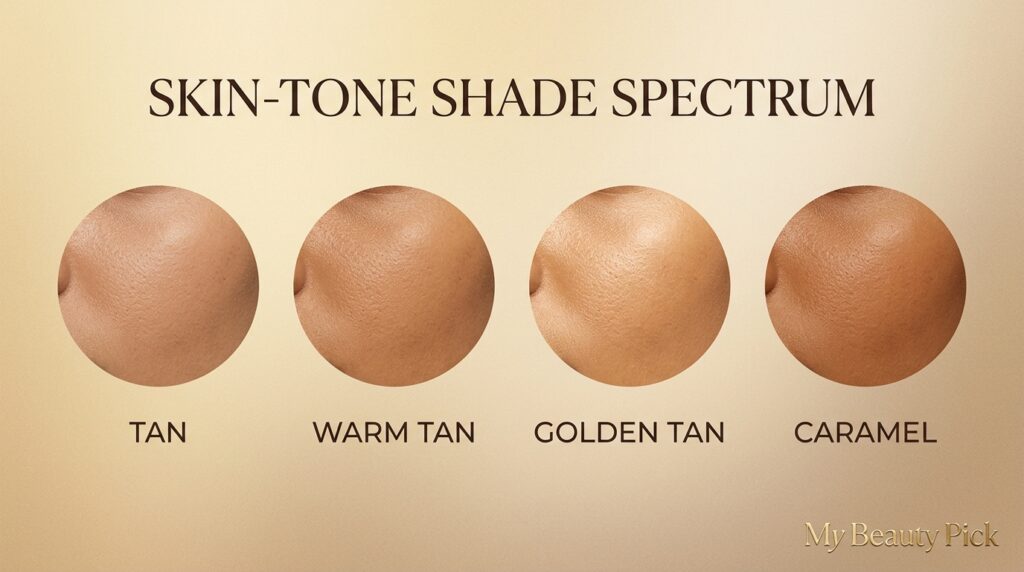
| Skin Category | Description | Common Undertone | Foundation Range |
| Tan | Light-medium warmth, sun-kissed | Warm / Neutral-Warm | W25–W35 |
| Warm Tan | Medium with golden warmth | Warm / Yellow | W35–N40 |
| Golden Tan | Rich golden depth, luminous | Golden / Yellow-Olive | N40–W45 |
| Caramel | Deep warm-brown, rich tone | Warm / Golden-Red | W45–W50 |
Each of these categories has a different undertone personality, which is what ultimately determines which foundation formula will look most natural on your skin. Understanding where you fall on this spectrum is the single most important step in the entire shade-matching process.
Decoding Your Undertone: The Secret Weapon for Shade Matching
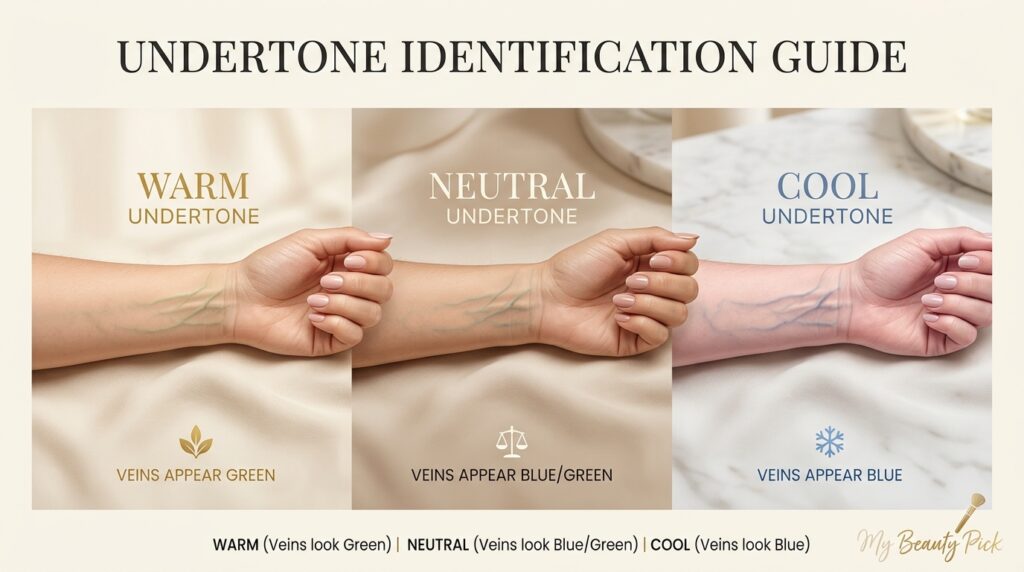
The single most important skill in foundation matching is identifying your undertone. Undertone is the subtle hue beneath your skin’s surface — and it does not change with tanning or seasons. Getting this wrong is the number-one reason women end up with mismatched foundation.
Warm Undertone
If your veins appear greenish, gold jewelry flatters you more than silver, and you tan easily without burning — you have a warm undertone. Look for foundations with yellow, golden, or peachy-warm pigments.
Keywords to look for on labels: “warm,” “golden,” “honey,” “caramel.”
Neutral Undertone
If your veins look blue-green, you look equally good in silver and gold, and you fall somewhere between warm and cool — you are neutral. Neutral-undertone tan skin is the most versatile and can wear a wide range of shades.
Look for “neutral,” “beige,” or “natural” descriptors on foundation labels.
Olive / Cool-Warm Undertone
If you have a subtle greenish cast and look ashy in both purely warm and purely cool foundations — you are olive. Olive undertones need foundations with yellow-green pigments to avoid looking grey or dull.
Look for “olive” or “yellow-olive” labels when shopping for foundation with this undertone.
💡 Pro Tip — Vein test: Step outside in natural daylight and hold your inner wrist up. Greenish veins = warm undertone. Bluish veins = cool undertone. Blue-green mix = neutral. Artificial light distorts undertone dramatically — never test indoors.
3. How to Test Foundation Shades Like a Professional
Most people test foundation on the wrong spot — the back of the hand. The hand has completely different pigmentation from your face and will almost never give you an accurate match. Here is the professional approach I use on every single client.
- Test on the jawline, not the back of the hand — your jawline is where your face meets your neck, and it tells you whether your foundation will blend seamlessly
- Apply three shades at once in parallel stripes directly on your jawline
- Step outside into natural daylight and wait at least 5 minutes for the formulas to oxidize
- The shade that “disappears” into your skin — the one you can barely see — is your match
- Come back and check after 30–60 minutes to catch any oxidation shift
💡 Pro Tip — Between two shades? Always go slightly lighter. You can warm up a lighter foundation with bronzer and add warmth effortlessly. Going too dark adds heaviness that is much harder to correct.
Best Foundation Shades by Tan Skin Category
Here is my professional breakdown of the ideal foundation shade characteristics for each tan skin type. I have kept this brand-agnostic so you can apply this knowledge to any product you pick up at any price point.
Tan Skin
Tan skin needs shades in the light-medium range with a warm or neutral-warm finish. Avoid foundations that lean pink or rose — they will create a mismatched, ashy look against warm tan skin. Look for shades described as “nude,” “beige,” or “warm sand.”
- Best undertone in formula: Warm or Neutral
- Coverage sweet spot: Medium to buildable
- Best finish: Satin or natural — matte can flatten and dull tan skin
- Watch out for: Pink-based formulas that oxidize darker and clash with warmth
Warm Tan Skin
Warm tan skin looks incredible in golden and honey-toned foundations. This is where shades labeled “honey,” “golden beige,” or “warm sand” truly shine. The golden pigment in the formula enhances your skin’s natural warmth rather than fighting it.
- Best undertone in formula: Yellow-warm or golden
- Coverage sweet spot: Medium to full
- Best finish: Dewy or luminous — it amplifies the natural warmth beautifully
- Watch out for: Neutral-cool foundations that dull your glow and flatten your complexion
Golden Tan Skin
Golden tan skin is one of the most luminous complexions in existence. Foundations with a golden or olive-warm base allow the natural radiance of this skin tone to come through. Many golden tan skin tones also benefit from a lighter-coverage formula — a little goes a very long way.
- Best undertone in formula: Golden-olive or warm-olive
- Coverage sweet spot: Light to medium — let the natural skin glow through
- Best finish: Luminous or glow-serum hybrid
- Watch out for: Heavily pigmented formulas that mask your natural radiance
Caramel Skin
Caramel skin is a rich, deep warm tone that has historically been underserved in mainstream shade ranges. Look for foundations at the deeper end of the medium range with warm or golden-red undertones. Caramel skin can carry full coverage beautifully without looking heavy or cakey.
- Best undertone in formula: Warm golden or golden-red
- Coverage sweet spot: Medium-full to full
- Best finish: Natural to satin — dewy finishes look breathtaking on rich caramel skin
- Watch out for: Ashy or cool-toned formulas that completely drain your skin of warmth
Understanding Oxidation: Why Your Foundation Changes Colour
One of the most common complaints I hear from clients with tan skin is: “My foundation matches perfectly in the store but looks completely different after an hour.” This is called oxidation — and it is especially pronounced on warm and oily skin types.
What Is Oxidation?
Oxidation happens when the iron oxide pigments in your foundation react with your skin’s natural oils and the oxygen in the air. The result? Your foundation gradually gets darker and can sometimes shift towards an orange or grey tone.
This is especially noticeable on tan and warm complexions, making shade selection and preparation even more important.
How to Combat Oxidation on Tan Skin
- Choose a shade one to two levels lighter if you have oily skin
- Set foundation immediately with a translucent or colour-matching powder to lock in the tone
- Look for “long-wear” or “oxidation-resistant” in the product description
- Use an oil-controlling primer at the base before application
- Always test foundation in natural light — artificial lighting hides oxidation dramatically
Pro Tip — Already found a great formula that still oxidizes? Mix it with a drop of your lighter shade to create a custom blend. Two shades mixed together gives you far more control over the final oxidized result.
The Best Foundation Finishes for Tan Skin
Finish is just as important as shade. The wrong finish can make even a perfectly matched foundation look unflattering on tan skin. Here is how to choose the right finish based on your skin type.
Matte Finish
Best for oily skin or humid climates. Can look flat or heavy on dry tan skin if used alone. Works beautifully for caramel skin tones when balanced with a glow highlighter to add dimension back into the face.
Satin / Natural Finish
The most universally flattering finish for tan skin across all four categories. Offers a healthy, skin-like quality without looking greasy. Ideal for warm tan and golden tan skin tones especially.
Dewy / Luminous Finish
Perfect for golden tan and warm tan skin — it amplifies the natural radiance in warm undertones and makes skin look alive. Avoid if you have oily skin or live in a humid climate. Use a setting spray to control shine instead.
Serum / Skin-Tint Finish
Best for light-to-medium coverage needs on tan and warm tan skin. The sheer, glowing finish makes skin look healthy and natural. Ideal for everyday wear and minimal-makeup days.
Common Foundation Mistakes on Tan Skin (and How to Fix Them)
In my years as a professional makeup artist, I have seen the same mistakes appear over and over. Here is what to watch out for — and exactly how to fix each one.
Mistake 1: Going Too Light for a “Natural” Look
A lighter foundation does not look more natural — it simply looks mismatched. Your actual natural skin is your reference point, not a lighter ideal. Always match your foundation to the real depth and warmth of your complexion.
Mistake 2: Ignoring the Neck
Many people match their foundation to their face but forget the neck entirely. If your face and neck are different depths — and on tan skin they often are, especially in summer — blend a small amount of foundation down the neck and décolletage. This creates a seamless, undetectable finish.
Mistake 3: Using a Cool-Toned Concealer
A bright peach or cool-toned concealer under warm tan eyes will clash with your warm foundation. Always use a warm-toned concealer that is one shade lighter than your foundation for the most natural, undetectable undereye look.
Mistake 4: Skipping Primer
Tan skin with warm undertones tends to be oilier in the T-zone. A good primer locks in your foundation, prevents oxidation, and keeps your complexion looking fresh for hours longer. It is not an optional step — it is the base that makes everything else work.
Mistake 5: Setting with the Wrong Powder
White or purely translucent setting powders can leave a white cast — called flashback — in photos on tan skin. Always use a translucent-to-skin-tone matching powder or a finely milled banana powder to set without any ashy residue.
How to Build a Complete Foundation Routine for Tan Skin
A great foundation never works in isolation. Here is the full step-by-step routine I recommend to all my clients with tan skin for a flawless, long-lasting result.
- Skincare Prep — Moisturise and allow it to fully absorb for at least 5 minutes before touching your makeup
- SPF — Apply sunscreen and wait another 3 to 5 minutes. Layering foundation directly over wet SPF causes pilling
- Primer — Use a pore-minimising primer for oily skin or an illuminating primer if you want a glow finish
- Foundation — Apply with a damp beauty sponge using a stippling motion for the most natural, skin-like finish
- Concealer — Warm-toned concealer one shade lighter on undereyes, blemishes, and any redness
- Set — Banana powder or a skin-tone-matching setting powder to lock in colour and prevent oxidation
- Finishing Spray — A hydrating or long-wear setting spray melts everything together and adds a professional finish
9. Adjusting Your Foundation Shade Seasonally
Your tan skin is not static throughout the year. In summer, UV exposure naturally deepens your complexion. In winter, you may lose a full shade of depth — and this is completely normal.
As a professional, I always recommend keeping two foundation shades on hand and mixing them throughout the year rather than repurchasing constantly.
- Summer: Use your deeper warm shade directly, or mix to create an accurate match
- Winter: Shift to your lighter warm shade to avoid looking muddy or heavy
- Transition seasons: Mix the two shades in a 1:1 ratio for a perfect in-between tone
- After a holiday or beach trip: Test your shade again — sun exposure can change everything
💡 Pro Tip — Never throw away a “wrong” shade: A foundation that is too dark in winter becomes your perfect summer match, and vice versa. Always hold onto both ends of your seasonal range.
Quick Reference: Tan Skin Foundation Cheat Sheet
Before you go shopping, save or bookmark this quick-reference guide so you always know exactly what to look for when choosing a foundation for tan skin.
- Identify your undertone first — warm, neutral, or olive — before anything else
- Test on the jawline in natural daylight, never the back of the hand
- Wait 30 to 60 minutes to test for oxidation before committing to a shade
- Choose your finish based on skin type: dewy for dry skin, satin for normal, matte for oily
- Keep two shades for seasonal transitions and mix them throughout the year
- Always use a warm-toned concealer — cool concealers clash with tan skin foundations
- Set with banana powder or a tone-matching powder to avoid ashy flashback in photos
- Never skip primer — it is what separates a six-hour foundation from a two-hour one
Final Thoughts: Embrace Your Tan Skin with the Right Foundation
Finding your perfect foundation shade for tan skin is not about following a rigid formula — it is about understanding your individual complexion and working with it, not against it. Whether you are a warm tan, a golden tan, or a rich caramel, there is a shade and formula out there that will make your skin look genuinely incredible.
Take the time to test properly, trust the jawline method, and always check in natural light before you decide. Your tan skin is naturally beautiful — a great foundation simply lets that beauty take centre stage.
Did this guide help you find your shade match? Save it for later and share it with a friend who has been struggling with foundation matching! 💄