

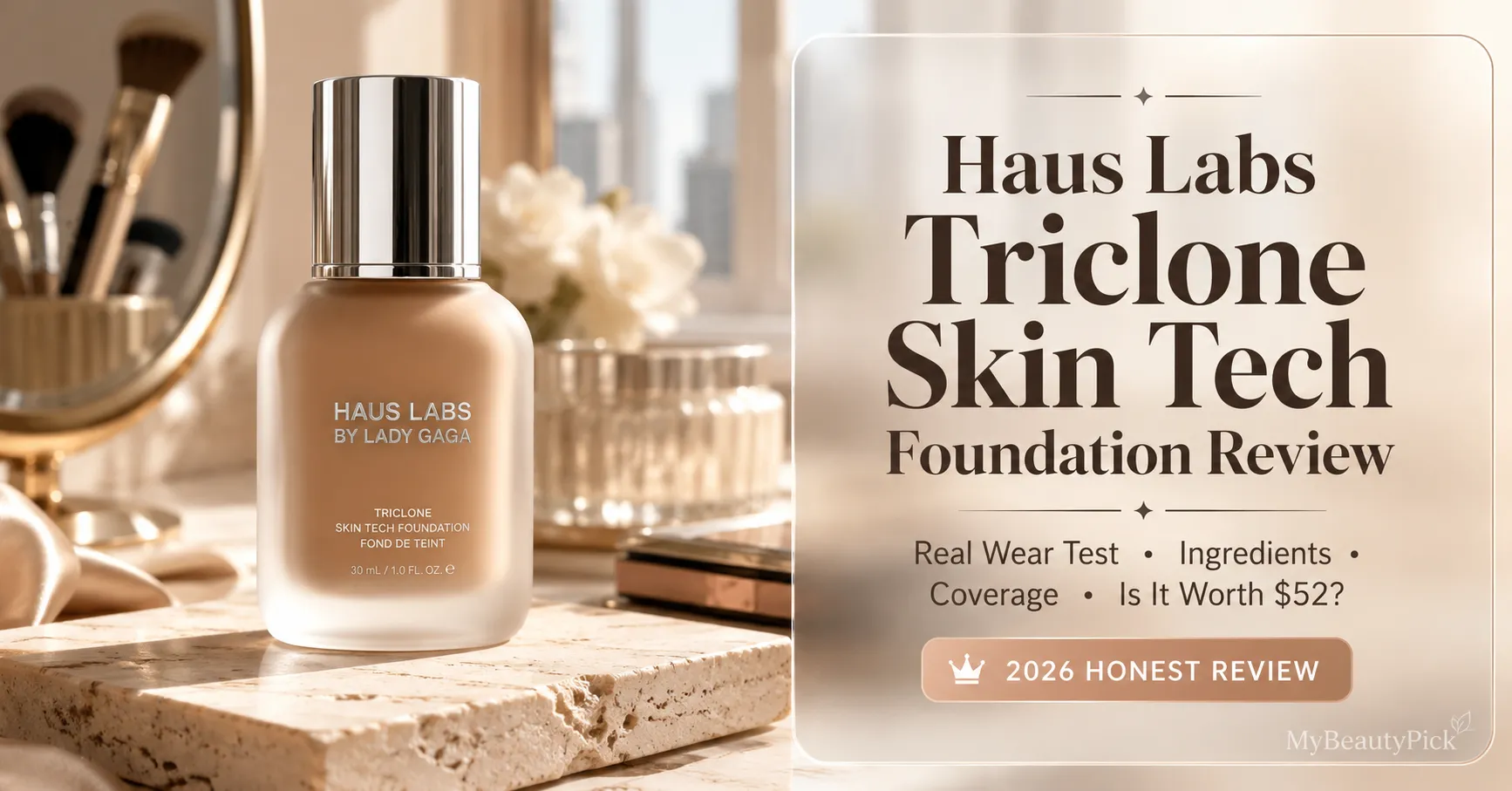
The Haus Labs Triclone Skin Tech Foundation became one of the most talked-about base products of 2022 and has stayed in the conversation ever since. After testing it across multiple wear conditions — office days, humid weather, and a full 8-hour shoot — here is what actually holds up versus what is marketing. This review addresses every live search question the other editorial reviews leave unanswered, including whether the formula is water or silicone-based, whether it oxidises over time, and what the Haus Labs controversy is actually about.
Haus Labs Triclone Skin Tech Foundation — Quick Verdict
- Silicone-forward formula. Water is first on the ingredient list, but multiple silicones follow immediately — Diphenylsiloxy Phenyl Trimethicone, Phenyl Trimethicone, Caprylyl Methicone — making this functionally a silicone-dominant foundation in terms of performance and compatibility.
- Coverage is honest medium. One thin layer evens tone and reduces visible redness. Two layers approaches medium-full over targeted areas. It does not reach full coverage without a separate concealer.
- Finish is velvety soft-matte — not the “luminous” the brand claims. Reviewers and testers consistently report a blurring, slightly matte effect rather than a dewy glow. Oily skin types will likely prefer this.
- Wear holds well at 8 hours on normal and combination skin. On oily skin, some caking around pores and a yellow shift have been reported within 4 hours without primer.
- 51 shades across 6 families. Shade range is a genuine strength for medium-coverage foundations, but finding the right one online without in-store matching is difficult.
- Price: $52 USD at Sephora and hauslabs.com. The Discovery Set (three deluxe samples) is $12 and is credited toward a full bottle if purchased within 21 days.
What Is the Haus Labs Triclone Skin Tech Foundation?
The Triclone Skin Tech Foundation is the hero product from Haus Labs by Lady Gaga, a brand that relaunched through Sephora in June 2022 after scrapping its entire original Amazon-exclusive product line and reformulating from the ground up. The foundation went viral almost immediately after launch, earning an Allure Best of Beauty Award and consistent placement on “best of” lists from Hypebae, Who What Wear, and major beauty publications through 2023 and 2024.
The “Triclone” name refers to the formula’s triple approach: silicone-based blending performance, skin-tech ingredients (fermented actives, peptides), and a 51-shade colour range developed using colour theory. It costs $52 for 30ml and is sold at Sephora across North America, 12 European countries, and directly at hauslabs.com. A Foundation Discovery Set ($12) lets you try three shades from one family before committing.
Is the Triclone Foundation Water-Based or Silicone-Based?
Silicone-based in practice, despite water appearing first on the ingredient list. The full INCI list opens: Aqua (Water), Diphenylsiloxy Phenyl Trimethicone, Phenyl Trimethicone, Caprylyl Methicone, Trimethylsiloxysilicate, Propylene Glycol Dibenzoate, Isododecane. Water is position one, but positions two through five are all silicones, and silicones continue throughout the entire ingredient list. The “Triclone” name is itself a reference to the three silicone-family ingredients central to the formula architecture.
This matters practically in two ways. First, you need a silicone-compatible primer underneath — water-based primers will pill with this formula. Second, people with silicone sensitivity may experience irritation, even though the formula performs well for most skin types. If your skin has reacted to silicone-heavy foundations before, patch test on your inner forearm before a full face application.
Use a silicone-based primer under the Triclone, or no primer. A water-based primer applied beneath a silicone-dominant formula creates a pilling risk during blending that no amount of technique adjustment will fully resolve. The Haus Labs Foundation Brush or a damp sponge both work well for application itself.
Key Ingredients and What They Actually Do
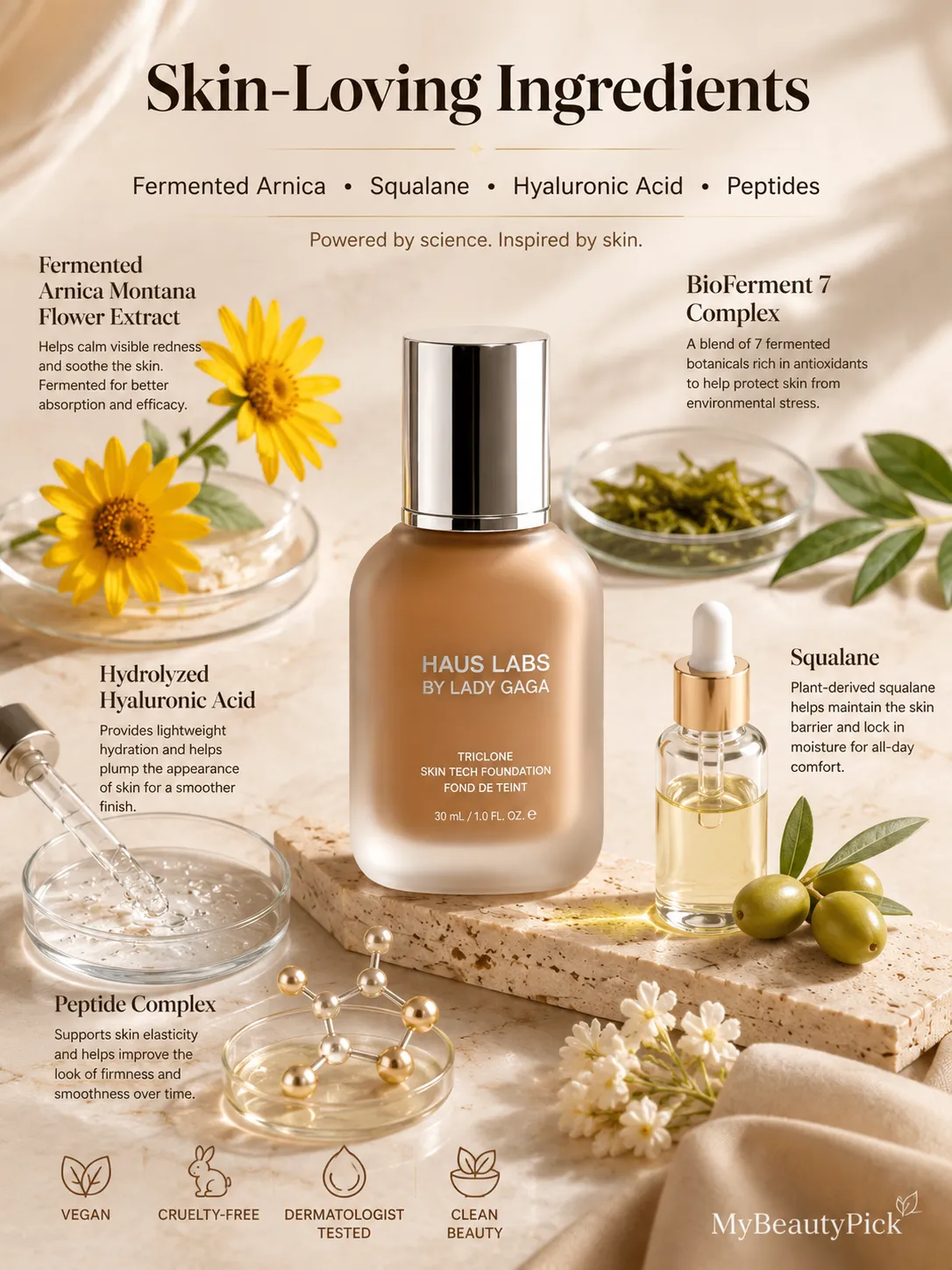
Fermented Arnica Montana Flower Extract
Hero ingredient — anti-redness, soothing
Arnica is traditionally used topically for anti-inflammatory and bruise-reducing properties. Haus Labs’ fermented version is patent-pending. Fermentation breaks down the arnica extract into smaller molecular components for improved skin penetration. Multiple testers report genuine visible reduction in redness after wear — though this is a cosmetic surface effect, not a clinical treatment. Arnica ranks low on the ingredient list, meaning it is present at a low concentration.
BioFerment 7 Complex
Antioxidant complex — environmental protection
A proprietary Haus Labs blend of seven fermented extracts: arnica, green tea, Shiunko (a traditional Chinese herbal blend), licorice root, marine algae, tomato leaf extract, and camellia sinensis seed oil. Each is fermented using Pseudozyma Epicola — a process claimed to improve bioavailability. The antioxidant case for these ingredients is established individually; the combined fermented form is less studied. Present at functional but not clinical concentrations.
Hydrolyzed Hyaluronic Acid
Humectant — surface hydration
Hydrolyzed HA has smaller molecular fragments than standard HA and can penetrate slightly deeper into the upper skin layers. At concentrations of 0.25–0.45% (as estimated from position on the list), it contributes to comfortable wear and prevents dry, tight feeling throughout the day. Not a replacement for dedicated HA serum at these concentrations, but genuinely helps foundation feel comfortable over long wear periods.
Squalane
Emollient — barrier support, dry skin comfort
Plant-derived squalane (typically from sugarcane or olives) is an excellent skin-compatible emollient that closely mimics the skin’s own squalene. It prevents moisture loss without heaviness, is non-comedogenic, and helps the formula feel comfortable on drier skin types. Its inclusion is one of the reasons this foundation sits more comfortably on combination and dry-combination skin than purely silicone-based formulas without emollient support.
Palmitoyl Tetrapeptide-10
Anti-aging peptide — collagen support signal
A signal peptide that communicates with skin cells to support collagen synthesis. Used at low concentrations in many prestige skincare and hybrid makeup formulas. At its position mid-list, the concentration is unlikely to produce the clinical collagen-stimulating results seen in dedicated peptide serums, but it contributes to the brand’s “skincare foundation” positioning and is not a harmful addition.
Multiple Silicones (Dimethicone variants, Trimethicone, Silsesquioxane)
Base performance — blurring, wear, texture
The formula’s performance characteristics — seamless blending, pore blurring, long wear, and the velvety soft-matte finish — are primarily driven by the silicone system, not the skincare actives. Volatile silicones (Methyl Trimethicone) evaporate rapidly on application, leaving the non-volatile silicones (Trimethylsiloxysilicate, Polymethylsilsesquioxane) to form the long-wear film. This is standard prestige foundation architecture.
Coverage and Finish — What You Actually Get
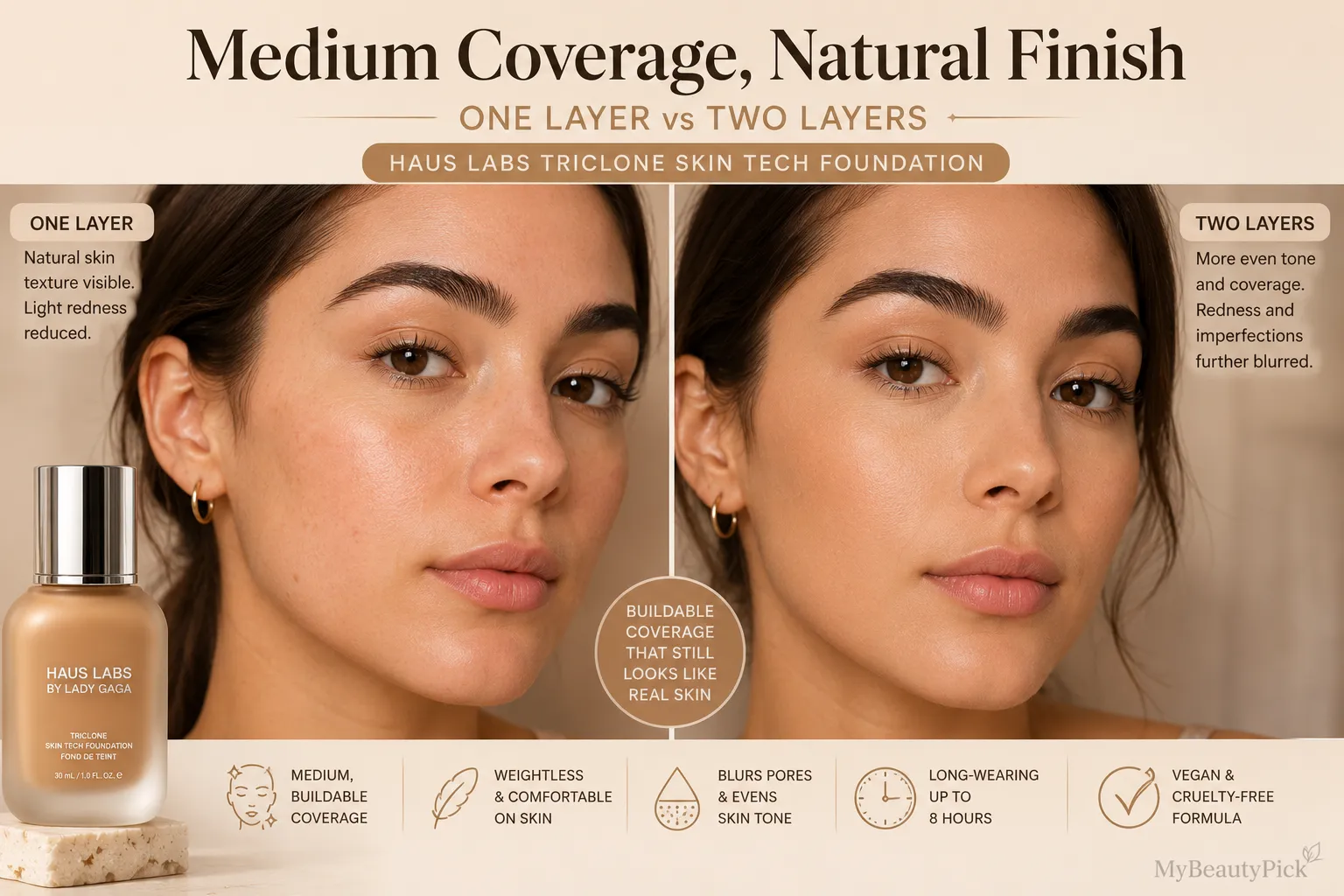
The brand labels this medium coverage, and that is accurate in a meaningful way. One thin layer — about half a pump — evens skin tone, reduces visible redness, and produces a complexion-lifting effect that looks like your skin on a very good day rather than a product applied over it. It does not cover significant PIH, active blemishes, or deep acne scarring in a single layer. Two targeted layers over problem areas bring the coverage up to medium-full for specific spots without looking heavy overall.
The finish is consistently described as velvety, blurring, or soft-matte by independent reviewers — including The Styleshaker (which gave it 17/20 in five criteria), Hypebae (9/10), and the Who What Wear reviewer. None of these describe the finish as “luminous,” despite that being the brand’s stated claim. On most skin types, the silicone and film-former system creates a soft-focus, skin-like matte that reads as healthy skin rather than visible coverage. If you want an actual dewy finish, this formula will not deliver it without a dewy setting spray on top.
What Works
- Blends instantly with no streaking or polka-dot pores
- Barely perceptible weight on skin
- Genuine redness reduction after wear — fermented arnica noticeable
- Noncomedogenic, confirmed by testing across acne-prone users
- Strong 8-hour wear on normal and combination skin
- 51 shades with undertone categories (Golden, Peach, Neutral, Rosy, Olive)
- Vegan, cruelty-free, gluten-free, talc-free
- Doubles as a skin tint at low application for natural coverage
Limitations
- Not actually luminous — finish is blurring/matte, not dewy
- Silicone-forward: not ideal if your skin reacts to silicones
- Caking around pores reported by oily skin users within 4 hours without primer
- Long-term oxidation shift toward yellow/peachy after months of use (product or repeated exposure)
- Shade matching online is genuinely difficult — 51 shades with non-intuitive naming
- $52 price sits at the higher end of prestige drugstore-adjacent brands
- Discovery Set is not free — $12 credit system requires commitment within 21 days
Application: Brush vs Sponge vs Fingers
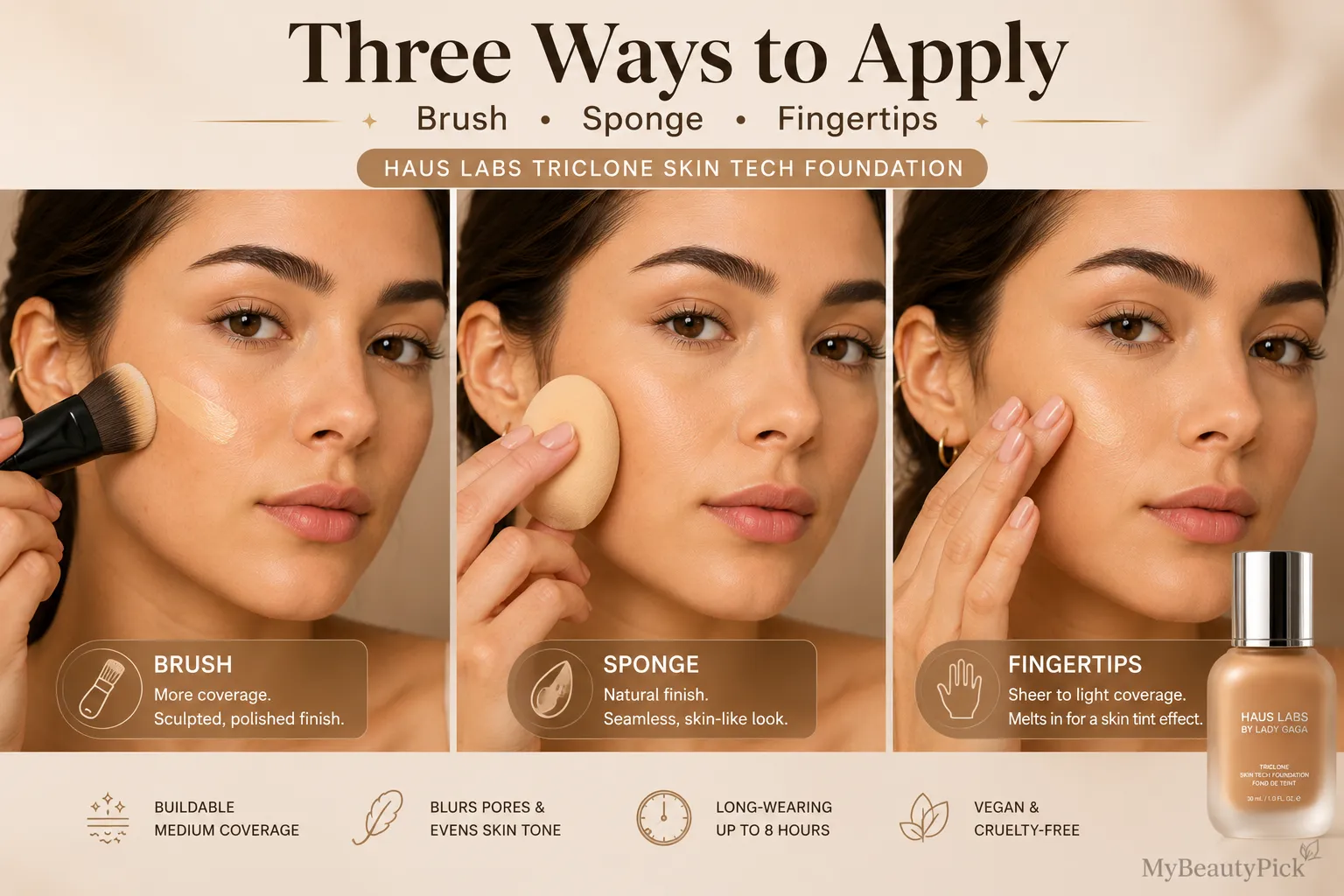
Foundation Brush
Best for full coverage + precision
The Haus Labs Foundation Brush (and comparable dome-top kabuki brushes) buffs the silicone formula seamlessly into skin with zero streaking. The brush picks up the formula efficiently and deposits it evenly. Best result for medium-full coverage and a polished finish. Recommended by Haus Labs as the primary method.
Damp Sponge
Best for natural, skin-tint finish
A damp sponge sheers the coverage slightly — about 15% less pigment deposits per stroke than a brush. The result is the most natural, second-skin appearance. Best for combination or dry-combination skin. If you want the formula to look barely-there, a damp sponge is the right tool. Takes marginally longer than a brush.
Fingertips
Best for skin-tint and contour use
Haus Labs specifically recommends fingertips for the skin-tint application method: warm the product first, then start at the centre of the face and spread outward using the “skincare application” motion. Great for the lightest coverage and most natural result. Not ideal for full-face coverage — inconsistent pressure affects evenness.
A little goes a very long way with this formula. Half a pump covers the full face for light-to-medium coverage. Starting with too much product is the most common cause of the caking-around-pores complaint — that’s not a formula failure, it’s volume. Shake the bottle before each use; the formula separates in the bottle like any well-formulated silicone-oil emulsion.
Wear Test Results — Does It Hold for 8 Hours?
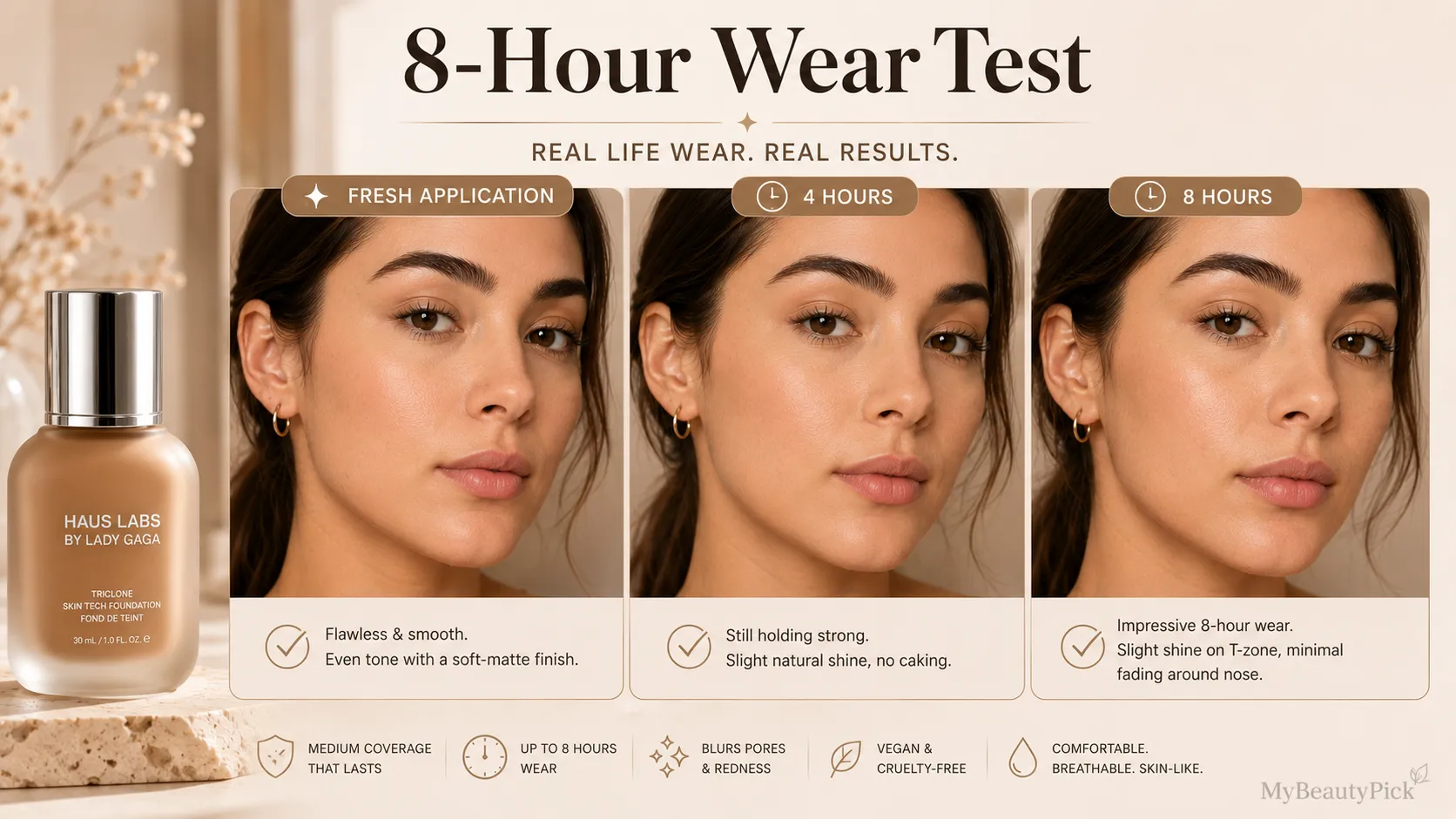
On normal and combination-normal skin: yes. Multiple wear tests by The Styleshaker (updated March 2026) and community reviewers confirm the formula holds well through 8 hours of standard office or daily wear. No significant fading, no noticeable slipping, and the blurring finish remains intact. Minor fading in the T-zone is normal after hour 6.
On oily skin: more mixed. Several Reddit reviewers report caking around pores within 4 hours, particularly without a silicone primer underneath. A separate review from the glowrecs.com aggregation notes it feeling “heavy” and “running slightly yellow” on oily skin. On oily skin, this formula needs a silicone-based mattifying primer and a light setting powder on the T-zone to hold satisfactorily through the day.
On dry skin: the squalane and humectant content keeps it comfortable, but the soft-matte silicone finish can look flat on very dry skin. A hydrating primer underneath and a dewy setting spray applied on top bring it closer to flattering for genuinely dry skin types.
Does Triclone Foundation Oxidise Over Time?
Two distinct oxidation concerns are present in the community discussion, and they are different problems worth separating.
Single-wear oxidation: minor. The formula’s silicone base limits iron oxide contact with skin oils during a standard wear day, which means it oxidises less aggressively than water-based matte formulas. Most testers do not report a significant colour shift within a single day of wear.
Long-term product oxidation: more documented. The Styleshaker is the only major editorial reviewer to flag this explicitly, noting a peachy-yellow shift in the formula itself after several months of use. This is not skin oxidation — it is the iron oxides in the product oxidising over time in the bottle, which changes the shade slightly. This is a known risk with iron oxide-pigmented formulas and is accelerated by exposure to light and air. Keep the bottle tightly closed, away from sunlight, and use within 12 months of opening. If the shade looks noticeably different from when you bought it, the formula has shifted.
Is the Triclone Foundation Good for Dry Skin?
The Triclone Skin Tech Foundation is comfortable for dry skin during wear, but it is not the ideal formula for significantly dry or dehydrated skin. The squalane and hydrolyzed HA contribute to a comfortable wear experience that does not feel tight or drying through the day. The velvety soft-matte finish, however, can look flat or slightly ashy on very dry skin, and the silicone-film system does not provide the luminous, skin-like glow that dry skin typically looks best in.
If you have dry skin, the best approach is to prep with a hydrating serum and a silicone-compatible hydrating primer, apply the Triclone with a damp sponge at low volume, and finish with a dewy setting spray. This brings it into flattering territory for dry skin. For skin that is severely dry or sensitised, the bareMinerals Complexion Rescue or ILIA Super Serum Skin Tint are better starting points.
Is the Triclone Foundation Good for Acne-Prone Skin?
The evidence points toward yes, with reasonable caveats. The formula is confirmed noncomedogenic. Multiple reviewers with acne-prone and reactive skin — including the named author in the Who What Wear review — report no breakouts from regular use. The fermented arnica is genuinely anti-inflammatory, which may provide mild additional benefit for active redness from breakouts. The talc-free formulation is also positive for pore-prone skin.
The caveat is the silicone content. For a small subset of people, heavy silicone exposure contributes to milia or congestion — not technically breakouts, but skin texture changes. If your skin has a documented silicone sensitivity, this formula is not the safest choice regardless of its noncomedogenic claim. Patch test before full-face use.
Shade Range: 51 Shades Across 6 Families
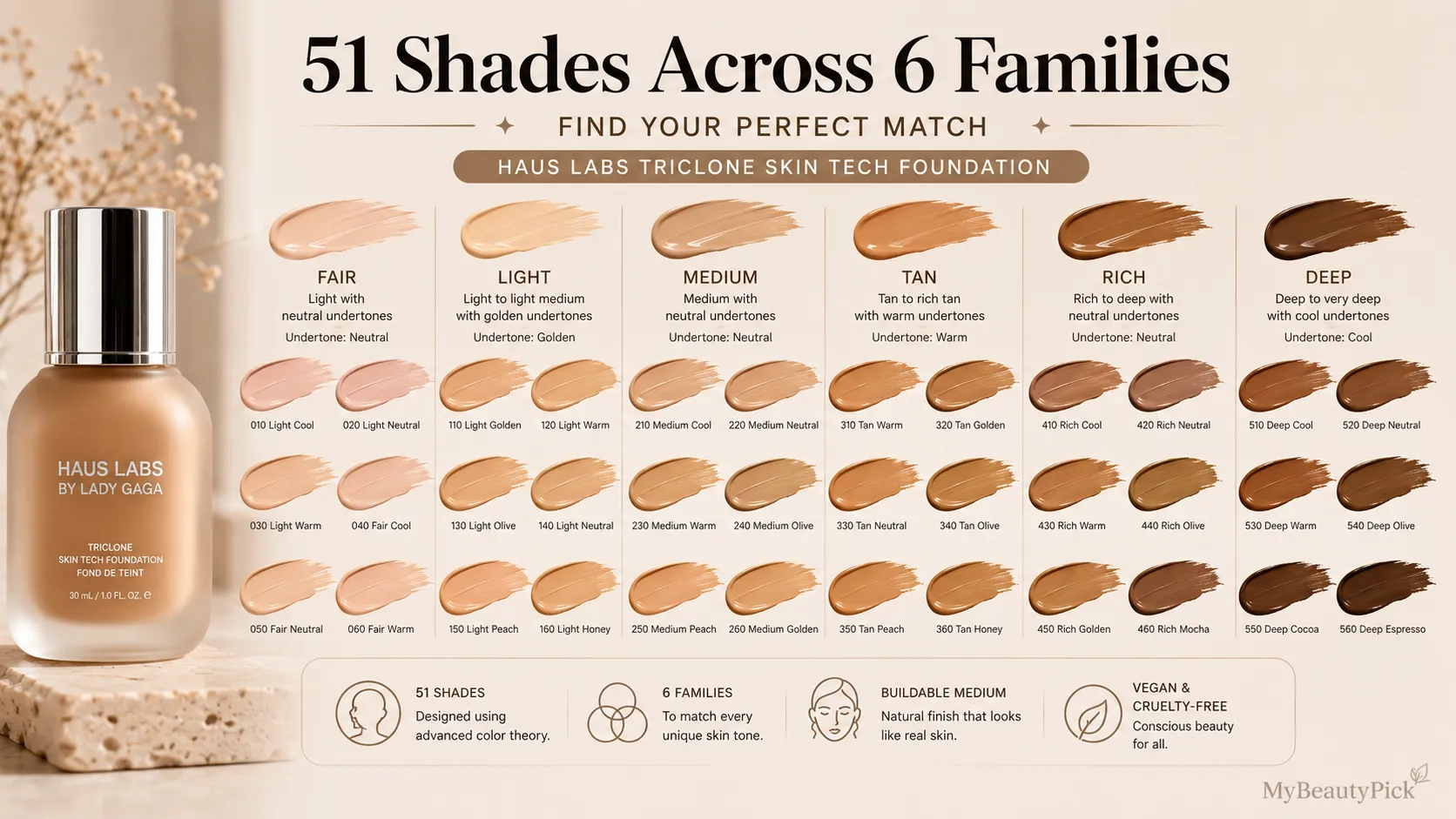
The Triclone shade range is genuinely extensive for a prestige foundation. Haus Labs uses a numerical system from 000 (deepest) to 590 (fairest), where the number reflects pigment load rather than shade depth on a light-to-dark scale. The undertone system was recently updated and now uses five categories:
Golden
Warm yellow-warm
Yellow-warm undertone. Best for golden, caramel, and tan warm-undertone skin.
Peach
Warm peachy-warm
Peachy-warm undertone. For warm skin with a peach cast rather than golden yellow.
Neutral
Balanced
No strong warm or cool pull. Balanced undertone for true neutral complexions.
Rosy
Cool pink-cool
Cool undertone with a pink or rose cast. Best for cool-toned and rosy-tan complexions.
Olive
Green-neutral
Olive undertone — yellow-green beneath the surface. A dedicated olive category is genuinely rare and is one of the Triclone range’s strongest differentiators.
The six depth families run from Fair through Light, Light Medium, Medium, Medium Deep, and Deep. The undertone names have changed since launch — the shades themselves have not. If you already know your shade number, that number still applies regardless of the new undertone naming system.
Shade matching online is difficult. Multiple reviewers note that the naming system is non-intuitive, the online shade descriptions are not always accurate, and swatches can look different on-screen than in person. In-store matching at Sephora remains the most reliable method. The Discovery Set is a useful alternative but carries the $12 cost and 21-day credit window — not truly risk-free, as multiple reviewers note.
The Triclone tends to match users one undertone category warmer than expected. Several reviewers matched to neutral or peach when their usual shades are cool or neutral. If you are in-store, test on the jawline in natural daylight and wait three minutes before committing. The formula has minimal single-wear oxidation, so what you see at three minutes is close to what you will wear all day.
Triclone vs Rare Beauty Liquid Touch vs Hourglass Vanish vs ILIA
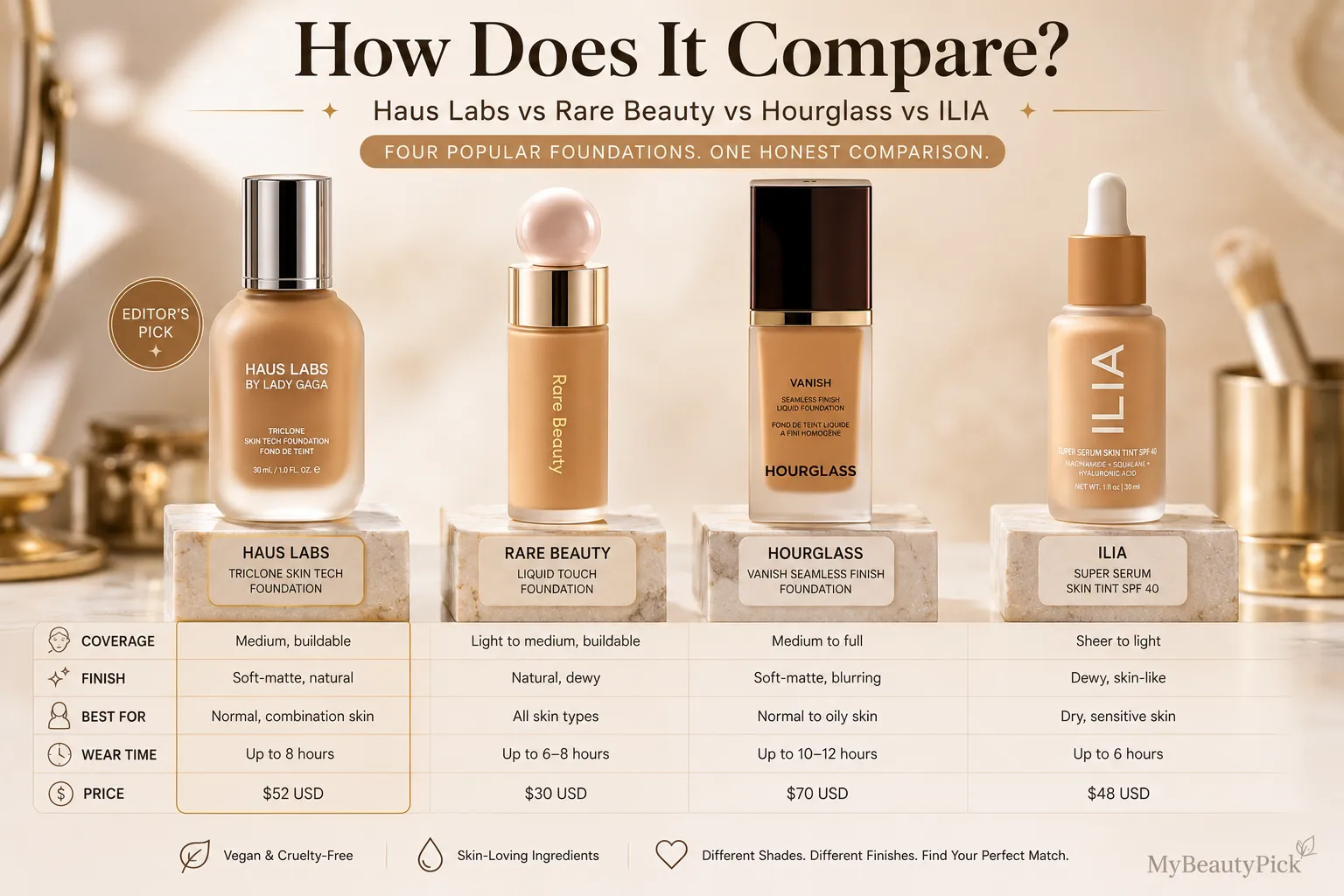
| Foundation | Price | Coverage | Finish | Formula Base | Best Skin Type | Shade Count | Standout |
|---|---|---|---|---|---|---|---|
| Haus Labs Triclone | $52 | Medium (buildable) | Velvety soft-matte | Silicone-forward | Normal, combo, acne-prone | 51 | Fermented actives, olive undertone category |
| Rare Beauty Liquid Touch | $32 | Light-medium (buildable) | Natural, skin-like | Water-based | Combo, normal, oily-combo | 48 | Leaping Bunny certified, most accessible prestige price |
| Hourglass Vanish Seamless Stick | $52 | Medium-full | Satin-matte | Wax-silicone | Combo, oily, normal | 40 | Stick format precision, highest coverage of the four |
| ILIA Super Serum Skin Tint | $48 | Light | Dewy, radiant | Water-based (silicone-free) | Dry, normal, combo-dry | 30 | Mineral SPF 40, Leaping Bunny, silicone-free |
The Triclone’s strongest differentiator against Rare Beauty is the silicone-based performance — blending is noticeably smoother and wear is longer on combination skin. Against Hourglass Vanish, the Triclone is lighter in feel and has a more skin-like finish, while the Hourglass delivers fuller coverage in a stick format. Against ILIA, the Triclone provides more coverage and better wear but lacks the mineral SPF and silicone-free formulation that ILIA’s dry and sensitive skin audience specifically needs.
What Real Users Are Saying
Community Sentiment Across Reviews and Reddit Discussion
The feeling of “not wearing foundation.” Reviewers across platforms consistently describe the Triclone as the formula that finally gives them a complexion product that reads as skin. The blurring effect and low weight are the most universally appreciated qualities.
On normal and combination skin: strong approval. On oily skin: the community is divided. One Reddit thread aggregation flagged caking around pores within an hour on truly oily skin without primer. Others with oily-to-combination skin loved it with a primer. The split is consistent enough to warrant caution for high-sebum skin types.
The numbering system (590–000, where higher = fairer) is counterintuitive to almost everyone who encounters it. Multiple reviewers mention needing in-store matching or the Discovery Set to find their shade, defeating the convenience of online shopping. This is one of the brand’s most consistent criticisms across independent review platforms.
A smaller but notable group of long-term users — primarily flagged by The Styleshaker’s updated 2026 review and mirrored in some Reddit threads — report the formula running “slightly yellow” or changing shade over several months of use. This is consistent with iron oxide oxidation in the bottle, not skin oxidation. It is the main long-term con for regular users who buy multiple bottles over time.
The vast majority of acne-prone and reactive skin reviewers report no breakouts. The Who What Wear reviewer with sensitive skin described it as “love at first swipe.” A minority report milia-like congestion after extended use, consistent with silicone sensitivity in a subset of users rather than the formula being comedogenic broadly.
What Is the Haus Labs Controversy?
The Haus Labs Controversy, Explained
There is not one single Haus Labs controversy — there are several that have accumulated since the brand launched in 2019. Understanding which incident people are referring to depends on when the question is being asked.
2019: Amazon exclusivity backlash. The brand launched exclusively on Amazon at a time when prestige beauty consumers considered Amazon hostile to premium beauty positioning. The reception was poor enough that Haus Labs scrapped its entire product line and reformulated before relaunching through Sephora in 2022.
2021: Pulled advertisement. A campaign video was withdrawn after viewers said imagery in it resembled self-harm content. Haus Labs removed the ad without extensive public comment.
2024: Proposition 65 lawsuit. A lawsuit alleged that Haus Labs had not made adequate safety disclosures related to titanium dioxide under California’s Proposition 65 regulations. Haus Labs denied wrongdoing. This is a regulatory compliance matter that several cosmetic brands have faced given evolving Prop 65 requirements around titanium dioxide inhalation.
2025–2026: Bronzer inclusivity criticism. Beauty creator Golloria George — who had previously praised the Triclone foundation shade range as a standout example of inclusivity — raised serious concerns about the brand’s new liquid bronzer collection, arguing that the three darkest shades sent for review were unsuitable for deep skin tones and appeared more like colour correctors than bronzers. A separate dispute arose over a claimed product embargo. As of this review, neither Lady Gaga nor Haus Labs had issued a public statement. This is the controversy most actively circulating at the time of publishing.
The Triclone foundation specifically is not at the centre of any of these controversies. The bronzer criticism is the most current and has raised legitimate questions about whether the brand’s established inclusivity in its foundation range is consistently applied across all product categories.
Packaging and Sustainability Note
The Triclone comes in a glass bottle with a pump dispenser. The glass is not refillable. Haus Labs removed over 40 harmful or unnecessary ingredients during its 2022 reformulation and positions itself as a clean beauty brand, but the packaging generates standard single-use glass and plastic waste. No current refill program exists for the Triclone foundation. The brand has not published a detailed sustainability roadmap at time of publishing. For buyers who prioritise refillable or zero-waste packaging, this is worth noting.
Frequently Asked Questions
Is Triclone Skin Tech Foundation good for dry skin?
It is comfortable for dry skin during wear but is not specifically formulated for dry skin. The squalane and hydrolyzed hyaluronic acid contribute to a non-drying feel throughout the day, and the formula does not emphasise dry patches the way a high-silica matte foundation would. However, the velvety soft-matte finish can look flat on very dry skin. For best results on dry skin: apply a hydrating serum first, use a silicone-compatible hydrating primer, blend with a damp sponge, and finish with a dewy setting spray. Dry or dehydrated skin that wants a genuinely dewy foundation would be better served by the ILIA Super Serum Skin Tint or bareMinerals Complexion Rescue.
Does the Haus Labs Triclone foundation oxidise?
Minimal single-wear oxidation. The silicone base limits iron oxide contact with skin oils, so the shade stays relatively stable throughout a standard day’s wear. Long-term product oxidation is a different concern: several reviewers who used the foundation over multiple months report a peachy or yellow shift in the formula itself, consistent with iron oxide oxidation in the bottle over time. To reduce this: keep the bottle tightly closed, away from direct sunlight, and use within 12 months of opening. If your shade looks noticeably different from when you bought it, the product has shifted.
How many shades does the Triclone foundation have?
51 shades across six depth families: Fair, Light, Light Medium, Medium, Medium Deep, and Deep. Each family includes multiple undertone options now categorised as Golden, Peach, Neutral, Rosy, and Olive. The shade numbering system runs from 590 (fairest) to 000 (deepest) — counterintuitively, higher numbers equal lighter shades. Haus Labs updated the undertone naming system after launch; if you already own a shade, your shade number is unchanged even though the undertone descriptor may have a different label.
Is the Triclone foundation full coverage or medium?
Medium coverage. One thin layer (approximately half a pump) evens tone, reduces redness, and gives a complexion-lifting effect without looking heavily covered. A second targeted layer over blemishes or hyperpigmentation brings those specific areas to medium-full. The formula does not reach full coverage over the entire face in a single application — for significant PIH, scarring, or acne, a separate concealer is needed on top. This is a genuine medium coverage foundation, not a sheer formula mislabelled as medium.
What is Fermented Arnica in the Haus Labs foundation?
Arnica Montana is an alpine plant used traditionally for anti-inflammatory and bruise-reducing topical applications. Haus Labs uses a patent-pending fermented version — the fermentation process (using Pseudozyma Epicola yeast) breaks the extract into smaller molecular components, theoretically improving skin penetration and bioavailability. It is present in the formula at a low concentration (late in the ingredient list), but multiple testers report visible redness reduction after wear. The evidence base for topical arnica is established but limited; the fermented form specifically has not been independently clinically validated. It is a meaningful point of difference, not a proven therapeutic ingredient.
What is the Haus Labs controversy?
There have been several over the brand’s history. The most recent (2025–2026) involves beauty creator Golloria George criticising the inclusivity of Haus Labs’ new liquid bronzer range, arguing the darkest shades were unsuitable for deep skin tones. A separate dispute over a claimed product embargo added to the controversy. Earlier controversies include: the brand’s troubled Amazon-exclusive 2019 launch (which led to a full product line scrap and relaunch); a 2021 ad pulled for imagery compared to self-harm; and a 2024 Proposition 65 lawsuit over titanium dioxide disclosures (denied by the brand). The Triclone foundation itself is not at the centre of these controversies — the foundation’s shade range has been specifically praised for inclusivity, which makes the bronzer criticism more pointed by contrast.
Is the Triclone Skin Tech Foundation water-based or silicone-based?
Silicone-based in practice. Water appears first on the ingredient list, followed immediately by multiple silicones: Diphenylsiloxy Phenyl Trimethicone, Phenyl Trimethicone, and Caprylyl Methicone in positions two through four. The silicones continue throughout the list. The “Triclone” name itself references the three silicone-family ingredients central to the formula. This means a silicone-compatible primer is needed underneath; water-based primers will pill with this formula. People with silicone sensitivity should patch test before use.
Where can I buy the Haus Labs Triclone foundation and how much does it cost?
The Triclone Skin Tech Foundation is $52 USD for 30ml. It is available at Sephora stores and sephora.com across North America and Europe, Sephora at Kohl’s locations in the US, and directly at hauslabs.com. The Foundation Discovery Set — three deluxe samples from one shade family — costs $12 and the amount is credited toward a full bottle if purchased within 21 days. This is useful for online shade matching but involves a cost, a shipping charge, and a commitment window, so review the terms before ordering.