

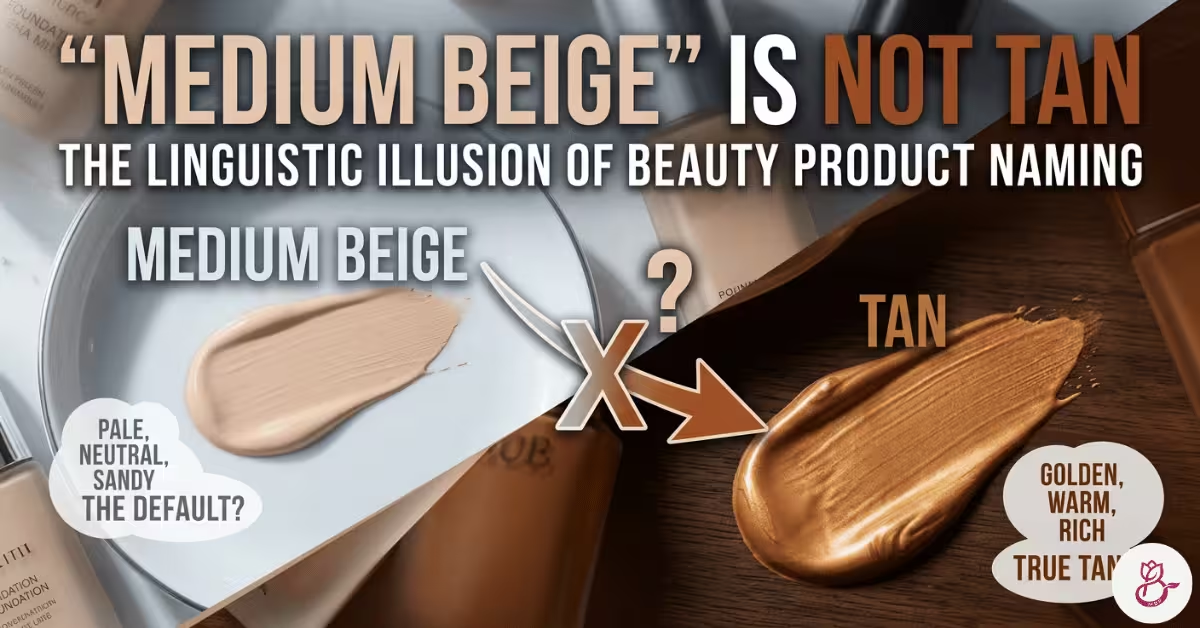
A foundation shade chart looks helpful. It shows all the shades laid out in order, maybe with undertone groupings or a depth scale. But for a tan-skinned buyer, a shade chart designed around a fair-skin default communicates far less than it appears to. The chart assumes a reference point that is not yours, and if you read it the way the brand intends, you will consistently end up in the wrong place.
This guide covers how to actually read a foundation shade chart as a tan-skinned buyer, which brand systems genuinely work, and what to look for when the chart itself is not giving you enough information.
Step 1: Identify Where Your Depth Actually Falls in the Chart
Most shade charts are organized from lightest to darkest, either left to right or top to bottom. The first thing to do is locate where the chart’s “medium” label sits relative to the total range — because in many ranges, “medium” starts at a depth that reads as light to light-medium on tan skin.
If a range has 40 shades, the true midpoint is shade 20. If your skin reads as genuinely tan or medium-tan, you should be looking at shades 18 to 26, not in the shades labeled “medium” which often sit in the first third of the range.
“Medium” in the chart label tells you nothing useful without knowing the total range size. A shade at position 15 of 40 is different from a shade at position 15 of 20. Locate your position relative to the full range, not relative to the brand’s category naming.
Count how many shades fall in the medium-tan zone (roughly the middle third of the range). If fewer than 8 shades cover your depth range, the chart is not built for you and you will likely end up between shades rather than finding a genuine match.
Step 2: Read the Undertone System Before the Shade Name
The shade name is the least useful piece of information on a shade chart for tan-skinned buyers. The undertone coding — if it exists — is the most useful. Before reading any individual shade name, identify whether the brand has an undertone system and what it means.
| Brand System | How to Read It | What Tan Buyers Should Look For |
|---|---|---|
| Fenty (100-500, W/N/C) | Number = depth. W = warm, N = neutral, C = cool. 300W = medium-warm, 340N = medium-deep neutral | 300 to 380 range, W or N suffix depending on undertone |
| MAC (NC/NW + number) | NC = warm golden undertone, NW = pink-cool undertone. Higher number = deeper shade | NC35 to NC50 for most warm tan, NW35 to NW45 for cooler tan |
| L’Oreal True Match (number + W/N/C) | 4 = medium, 5 = medium-tan, 6 = tan. W/N/C = undertone | 5W or 6W for warm tan, 5N for neutral-medium tan |
| NARS (place names, no code) | No depth or undertone coding in the name itself | Must use NARS shade finder tool or swatch guide — name alone is not navigable |
| Descriptive names only (Warm Sand, Honey Beige) | Undertone partially communicated by adjective, depth not coded | Use brand’s online shade finder or shade comparison chart alongside the name |
If a brand does not have an undertone coding system, treat the shade chart as incomplete. You cannot reliably navigate it from the chart alone and will need a secondary source — shade comparison swatches, YouTube swatching videos from reviewers with tan skin, or in-person testing.
Step 3: Identify Your Undertone Before Using Any Chart
A shade chart is only useful if you know which undertone column to look in. Using a chart without knowing your undertone means reading across all columns with no filter, which increases the chance of landing in the wrong product significantly.
Tan skin has three main undertone families: warm (golden, yellow, peachy), neutral (balanced, slightly olive), and cool (pink-based, slightly grey-adjacent). Each of these points to a different column in any undertone-coded shade chart, and the gap between warm and cool at tan depth is often dramatic — two foundations at the same depth but different undertones can look completely wrong and completely right on the same person depending on which one they pick.
Our full guide to undertones for tan skin walks through the vein test, the white paper test, and the jewellery test in detail. Identify your undertone before using any shade chart and the chart becomes significantly more navigable.
Step 4: Understand the Oxidation Adjustment
Shade charts show foundation as it looks in the bottle or on a swatch. For tan skin, this is not how it will look on your face after an hour of wear. Tan skin oxidizes foundation faster than lighter skin due to higher sebum output and a more acidic skin pH. This means the shade that looks right on the chart swatch may look one step too dark or too warm after 30 to 60 minutes.
When using a shade chart to select a foundation for tan skin, consider going half a shade lighter than your closest chart match if you know you oxidize. The swatch shows the formula before skin chemistry affects it. The shade you wear all day will be slightly deeper.
Which Brand Shade Systems Actually Work for Tan Buyers
Systems That Work
The numbered system with W/N/C coding is the most straightforward for tan buyers. Once you know your depth range (200s = light, 300s = medium, 400s = medium-deep) and your undertone letter, you can navigate the chart online without swatching. The depth increments are small enough that few buyers fall in gaps at the tan range.
The NC/NW system requires a one-time learning investment but pays off consistently. NC30 to NC50 covers the warm-golden tan range reliably. The depth increments (NC35, NC37, NC40, NC42, NC44, NC45) are granular enough to find an exact match at medium-tan depth rather than having to blend between two shades.
The best drugstore system for tan buyers specifically. The number-plus-letter code (5W, 6W, 5N) communicates exactly what you need without a tutorial. The shade chart online maps these codes clearly against visible swatches. 5W and 6W cover a significant portion of warm tan complexions at a price point that makes trial purchases low risk.
Systems That Require Workarounds
The shade names communicate nothing about depth or undertone. The chart is visually useful for relative depth placement but undertone is impossible to assess from the name alone. Use NARS’s shade finder quiz or look for swatch comparison videos from reviewers with tan skin before purchasing online.
Uses a number (1 through 30) with N/W/C suffix. The number scale is useful for depth. The undertone coding is reliable. The main issue for tan buyers is that the range thins at medium-warm and warm-tan depth specifically, with fewer warm options than neutral across the tan range.
Any brand using only descriptive names (Warm Honey, Golden Sand, Medium Beige) without a depth or undertone code requires you to use the brand’s digital shade finder, locate swatch comparisons, or test in person. The chart alone is not enough information for reliable online selection as a tan-skinned buyer.
How to Use a Shade Finder Tool as a Tan-Skinned Buyer
Many brands now offer online shade finder tools — questionnaires or virtual try-on features. These are more useful than charts alone for tan buyers because they account for undertone, but they have their own limitations worth knowing about.
Screen color calibration varies too much between devices. A shade that looks right on your laptop screen may look completely different in person. Use virtual try-on to narrow down options, not to make the final call.
Many shade finders ask “what is your undertone?” with warm, cool, neutral as options. If you have not done a proper undertone test, your instinct may be wrong — especially on tan skin where the surface warmth is often mistaken for a warm undertone when the true undertone is neutral or cool.
After getting a recommendation, locate that shade in the full shade chart and check what sits immediately above and below it. If the shade above looks like a viable alternative too, request a sample of both rather than committing to one based on the tool recommendation alone.
The Test That No Chart Can Replace
For all the value of shade charts and shade finders, the only definitive test for tan skin is applying the foundation to the jaw and checking it in natural daylight after 30 minutes. This accounts for oxidation, skin chemistry, and the difference between swatch appearance and wear appearance that affects tan skin more than lighter skin tones.
When possible, request samples before buying full size. Most prestige counters will provide samples, and many online retailers now offer sample programs. The cost of a sample program is significantly less than the cost of a full-size foundation purchase that does not work.