

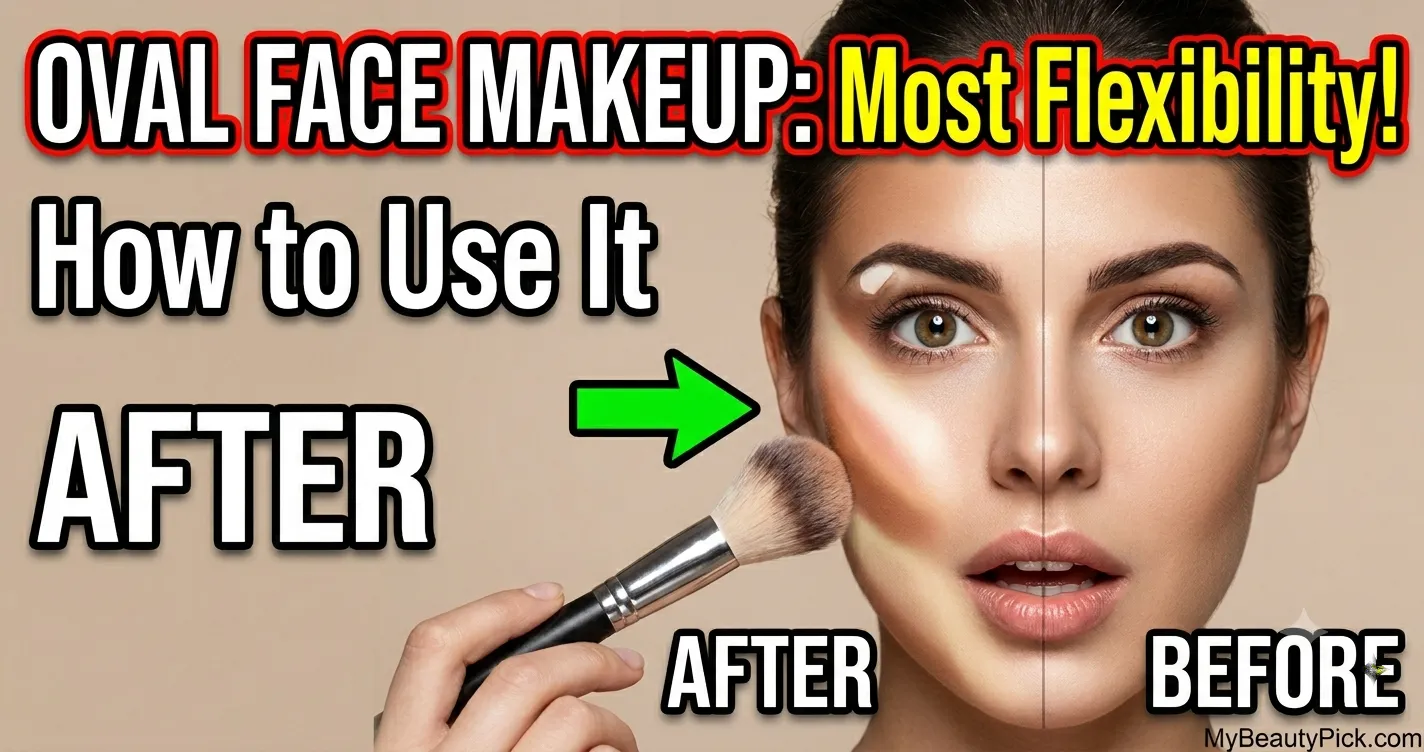
An oval face is the reference point most makeup guides use when describing “universally flattering” techniques — because oval faces genuinely have more flexibility than any other shape. Balanced proportions, a forehead that’s slightly wider than the jaw, and a gently tapering chin mean very few makeup techniques actively look wrong. The question for oval faces is not what to correct. It’s how to use that structural flexibility to genuinely experiment, express, and choose looks with confidence.
- An oval face is slightly longer than it is wide, with balanced proportions and a gently tapering jaw.
- The makeup goal is not corrective — it’s expressive. Almost any technique, placement, and style works proportionally.
- Any blush direction works on oval faces. Choose based on the effect you want, not structural correction.
- Any brow shape flatters — choose based on personal preference, not face-shape rules.
- Any eye shape, liner angle, and eyeshadow technique reads correctly on balanced oval proportions.
How to Identify an Oval Face Shape
Pull your hair back and look straight into a mirror in natural light. An oval face shows: the face is slightly longer than it is wide; the forehead is slightly wider than the jaw; the face tapers gently toward the chin without strong angles; and the overall silhouette reads as a soft, elongated egg shape. No single feature is disproportionately wide, narrow, long, or short.
The distinction from oblong: an oval face has balanced proportions where the length is only slightly more than the width. Oblong faces are noticeably longer, with the length clearly the dominant characteristic. The distinction from round: round faces have equal width and height; oval has a slight length advantage with a more tapered jaw.
Contour for Oval Face: Preference, Not Correction
Oval faces do not require corrective contour. No area is disproportionate enough to need reduction or augmentation. Contouring on an oval face is an aesthetic choice — used to add warmth and dimension rather than to reshape.
If you contour: a light bronzer sweep under the cheekbone, along the temples, and along the jaw adds warmth and the appearance of healthy depth. Keep it soft and diffused. This is decoration, not correction — which means it can be as subtle or as defined as you prefer.
On tan skin, a warm-toned bronzer used lightly across the perimeter of the face creates a naturally sun-kissed effect that reads as healthy rather than structured. This is the most naturalistic version of contour and works beautifully on oval faces with warm complexions.
Most face-shape makeup content tells you what to do. Oval face content should tell you what you’re free to try. The absence of structural corrections means every technique you’ve seen on someone else and wanted to try — floating liner, blush draping, overdrawn lips, dramatic brow shapes — is available to you without the risk of it looking disproportionate on your face.
Blush Placement for Oval Face
Almost any blush placement works on an oval face. The choice should be based on the effect you want rather than structural requirements.
High and Swept — Lifted Editorial
Apply blush from the cheekbone upward toward the temple. Creates a lifted, sculpted appearance. Best for event looks, editorial aesthetic, and faces where you want cheekbone definition.
Apple of Cheek — Natural and Fresh
Apply to the apple of the cheek and blend gently in all directions. Creates the most natural, sun-flushed appearance. Best for everyday looks, natural makeup, and a dewy fresh-faced effect.
Blush Draping — Bold and Modern
Apply blush high on the cheekbone and sweep across toward the temple and slightly under the eye. The most fashion-forward placement. Best for editorial looks, bold makeup moments, and occasions where you want blush to be the statement.
Low and Inward — Soft and Romantic
Apply blush just below the cheekbone, blending slightly inward and downward. Creates a romantic, diffused flush. Best for bridal looks, soft glam, and occasions where a natural but warm finish is the goal.
Eye Makeup for Oval Face: Experiment Freely
Oval faces have the most flexibility in eye technique of any face shape. The eye techniques that are used to create elongation, rounding, or widening for other face shapes are all optional personal choices on an oval face — not corrective ones.
Classic Wing
Always works. Any angle, any length, any thickness. The balanced proportions make the wing read as intentional at any size.
Floating Liner
Liner placed above the lash line rather than on it. The 2026 editorial trend. Reads as modern and fashion-forward on oval proportions.
Graphic Shapes
Geometric liner, double liner, angular shapes. All work. Oval faces are the best canvas for liner experimentation.
Bold Colour Eye
Any colour eyeshadow reads proportionally. Emerald, electric blue, deep burgundy, terracotta — try what appeals.
Smoky Eye
Any smoky variation: warm, cool, deep, soft. The balanced face structure handles intensity without looking heavy.
Tightline Only
Minimal liner that adds definition without visible product. Works beautifully for natural and everyday looks on oval faces.
Brow Shape for Oval Face
Any brow shape flatters an oval face. This is the face shape where brow choice is entirely personal preference rather than structural guidance. Consider what you want the brow to communicate rather than what the face shape needs:
- Strong, arched brows: polished and defined — adds framing and presence
- Flat, brushed-up brows: modern and editorial — the current trend toward natural-looking full brows
- Natural, lightly defined brows: understated and relaxed — works for natural and soft glam styles
- Bold, thick brows: makes a statement — the most dramatic framing option
- Thin, precisely defined brows: creates a different kind of elegance — works for classic looks
None of these are wrong on an oval face. Choose based on what you like, what suits your personal style, and what fits the occasion.
Lip Shape and Colour for Oval Face
Any lip shape and size works proportionally on an oval face. This is the face shape where lip experiments are most reliably successful.
Bold, dark lips: deep plum, wine, brick red — all work. The balanced proportions handle strong lip colour without any feature dominating unexpectedly.
Overdrawn lips: slightly drawn outside the natural lip line for a fuller appearance. One of the safest experiments to try on an oval face.
Graphic cupid’s bow: a defined, angular cupid’s bow that reads as architectural. Works well on oval because the balanced proportions can handle a graphic lip shape without it looking disproportionate.
Very minimal or nude lips: equally flattering. The flexibility goes in both directions.
The risk with oval face flexibility is defaulting to the same safe choices because you can. If you have an oval face and you’ve always wanted to try a floating liner, a dramatic brow shape, or a graphic lip — this is the face shape where those experiments are most likely to succeed. Use the freedom intentionally rather than defaulting to neutrality out of habit.
Makeup Style Guide for Oval Face
Natural Look
- Skin tint or light foundation
- Cream blush on the apple of the cheek
- Mascara and clear brow gel
- Tinted lip balm in warm nude
- No contour needed
Soft Glam
- Medium-coverage satin foundation
- Warm bronzer for dimension
- Warm blush swept upward toward temple
- Copper shimmer lid, warm taupe crease
- Satin lip in terracotta or warm rose
Classic Glam
- Full-coverage long-wear foundation
- Gel liner wing, full lashes
- Statement lip in warm red or deep plum
- Precise highlight on cheekbone tip
- Defined contour for warmth and structure
Bold / Experimental
- Medium coverage satin base
- Electric blue floating liner
- Warm bronze or copper lid
- Warm nude muted lip
- Blush draping over cheekbones
Frequently Asked Questions
Is oval really the best face shape for makeup?
Oval faces have the most flexibility in makeup technique — which is often described as “ideal” — but it doesn’t mean other face shapes can’t wear any look. Every face shape has techniques that flatter it specifically and every face shape can wear any look with appropriate technique adjustments. Oval faces have the advantage of requiring fewer adjustments — almost any technique reads proportionally. But a round face with the right contour, blush direction, and eye technique can wear the same bold looks with equally striking results.
What blush direction suits an oval face?
Any blush direction works on an oval face. High and swept for a lifted editorial effect; apple of the cheek for a natural flush; blush draping over the cheekbone for a modern bold look; low and inward for a romantic soft effect. The choice should be based on the look you want rather than structural face-shape requirements — oval faces don’t need blush in any specific direction for proportion reasons.
Can oval faces wear any makeup style?
Yes — with the caveat that skin tone and undertone still determine which specific colours work best (which is true for every face shape). The structural flexibility of oval faces means almost every technique, placement, and style reads proportionally. Bold liner, graphic shapes, dramatic smoky eyes, overdrawn lips, strong arched brows, flat brushed brows — all of these work on oval proportions. The main constraints are the same ones that apply to all face shapes: undertone-appropriate colour choices and technique execution quality.
Do oval faces need contour?
No — contouring on an oval face is an aesthetic choice, not a corrective one. Oval faces have balanced proportions that don’t need any area reduced or augmented. If you enjoy contouring for warmth and dimension, a light bronzer sweep under the cheekbone and along the temples reads as natural and healthy on an oval face. If you prefer a simpler routine, skipping contour entirely doesn’t leave any proportional issue unaddressed.