

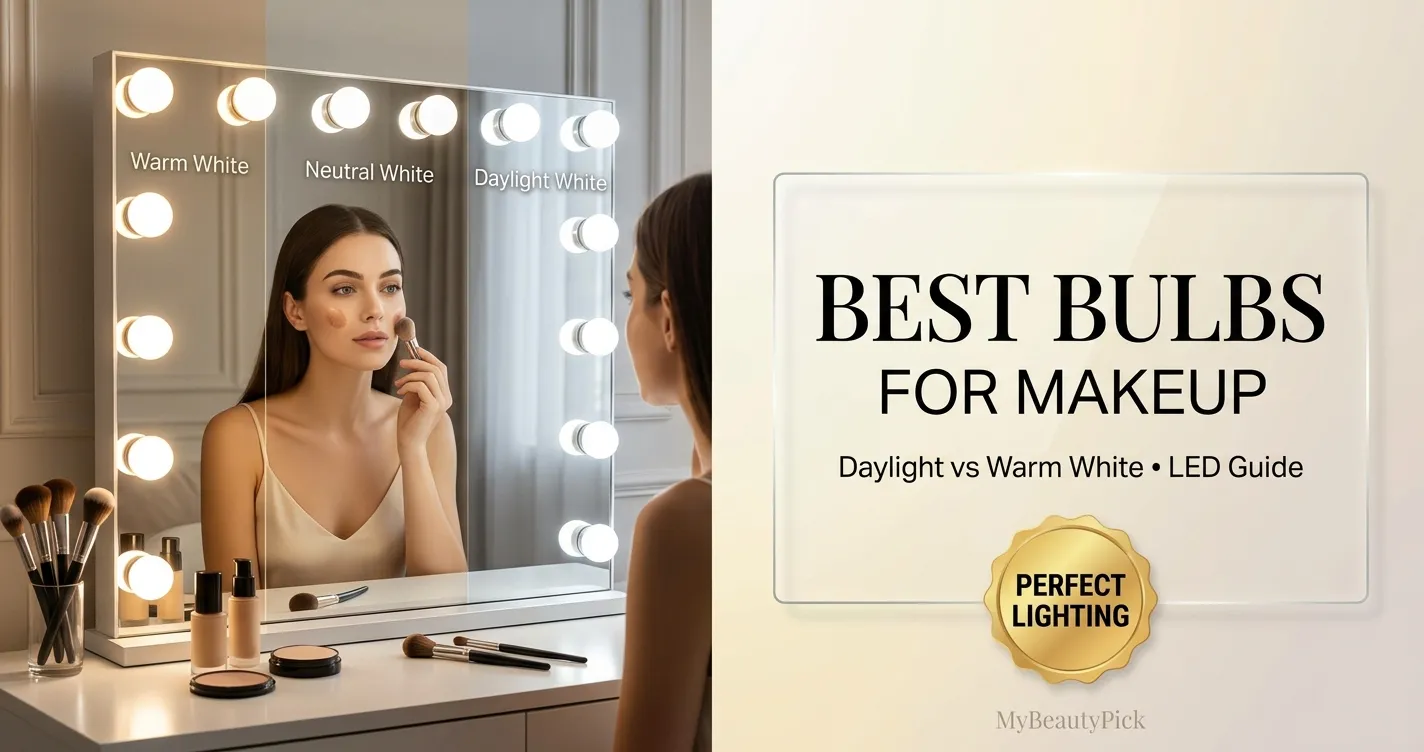
The best bulbs for makeup fall between 4000K and 5000K with a CRI of 90 or higher, closely mimicking natural daylight without the orange cast of warm bulbs or the blue cast of cool ones. LED bulbs in this range, such as the ELECWISH NorbBEAUTY G25 (CRI 98) or Dekang LED Vanity Bulbs (CRI 85+), are the most reliable choice across budgets. The exact Kelvin you need shifts slightly depending on whether you are doing everyday makeup or color-accurate, editorial-level work.
The makeup that looked flawless in your bathroom and strange the moment you stepped outside is not a technique problem. It is almost always a lighting problem. Bathroom vanity bulbs are frequently warm, dim, or overhead-only, which means your face is being lit in a way that has nothing to do with how it will actually be seen in the world.
This is the technical breakdown makeup artists actually use, translated into plain language, with real bulbs you can buy at every budget.
Pairing this with a lighted vanity mirror? Read our best mirror for makeup with light guide for picks where we report the exact CRI and Kelvin of the mirror’s built-in LED ring, not just the brand name.
Why Your Bulb Choice Is Sabotaging (or Saving) Your Makeup
This is the scenario nearly everyone who wears makeup has lived through: foundation looks seamless in the bathroom mirror, blush looks soft and correct, everything reads as polished. Then you step into daylight, an office, or a restaurant, and the foundation looks orange, the blush looks muddy, or there is a visible line where the makeup ends.
The reason is almost never the makeup itself. Most bathroom vanity lighting is either warm incandescent-style bulbs around 2700K, which cast a yellow-orange tone that makes your skin look more golden than it is, or a single overhead fixture, which creates shadows under the eyes, nose, and chin that do not exist in real-world lighting. Your eye and brain adjust to the colour cast of whatever light you are standing in, so you genuinely cannot see the distortion while it is happening. You only see it once you are somewhere else.
The 3 Numbers That Actually Matter: Kelvin, CRI, and Lumens
Every bulb you are choosing between has three specifications on the packaging that determine whether it will help or hurt your makeup application. Understanding what each one means takes about two minutes and changes how you shop permanently.
Color Temperature (Kelvin)
Kelvin measures how warm or cool a light appears, on a scale that runs from roughly 2000K to 6500K for residential bulbs. Lower numbers look warmer and more orange-yellow, like candlelight or an old incandescent bulb. Higher numbers look cooler and more blue, like an overcast sky or a fluorescent office. For makeup application, the useful range sits between 4000K and 5000K, often labelled “natural white” or “daylight” on the packaging. This range gives the most accurate read of your actual skin tone, your foundation match, and how your finished look will translate outside the bathroom.
Package label takeaway: Look for “4000K” to “5000K” or “Natural/Daylight White” printed directly on the box. Avoid “Warm White” (2700K-3000K) and “Cool White” (6500K+) for your primary makeup light.
Color Rendering Index (CRI)
CRI measures how accurately a light source reveals the true colour of whatever it is illuminating, on a scale up to 100. Natural daylight sits at 100. A CRI of 90 or above is the threshold lighting professionals recommend for any task involving colour accuracy, including makeup. Below that threshold, colours start to shift and distort in ways that are subtle but real: a CRI of 80 might make a warm-toned blush look slightly muddier or a foundation look slightly off from how it appears in true daylight.
Package label takeaway: Look for “CRI 90+” explicitly printed on the packaging. Bulbs that only advertise brightness or Kelvin without listing CRI are usually lower quality and worth skipping for this specific use.
Lumens and Brightness
Lumens measure total brightness output, independent of colour. For makeup application specifically, most lighting professionals recommend a range of roughly 1500 to 3000 lumens total across your setup, not from a single bulb. A setup that is too dim makes it hard to see subtle blending errors; one that is too bright can wash out the contrast you need to judge depth and shadow accurately. Watts measure energy consumption, not brightness, and are largely irrelevant for LED bulbs since they produce far more light per watt than older incandescent technology.
Package label takeaway: For a single vanity bulb, look for 450 to 800 lumens. If using multiple bulbs around a mirror, the combined total should land in the 1500-3000 lumen range.
What Kelvin/CRI Combo Should You Buy?
| Use Case | Kelvin Range | Minimum CRI | Bulb Type |
|---|---|---|---|
| Everyday glam | 4000K-4500K | CRI 90+ | LED, natural white |
| Color-accurate / editorial work | 5000K-5600K | CRI 95+ | LED, daylight |
| Evening glam preview | 2700K-3000K (secondary, not primary) | CRI 90+ | LED, warm white, used alongside daylight bulb |
| Mature skin (softer rendering) | 4000K | CRI 90+ | LED, natural white with a frosted or diffused cover |
If you regularly do makeup that will be worn under warm restaurant or event lighting in the evening, a second bulb at 2700K-3000K lets you preview how your finished look will read in that environment, without using it as your primary application light. Apply makeup under the 4000K-5000K daylight bulb for accuracy, then switch to the warm bulb for a final check before you leave.
LED vs. Incandescent vs. Fluorescent (And Why LED Wins)
Three bulb technologies show up in vanity lighting and they are not interchangeable for makeup purposes. Incandescent bulbs emit warm, yellow-toned light with a relatively low CRI by today’s standards, and they run hot, which becomes uncomfortable during a longer makeup application. Fluorescent bulbs run cooler in temperature but often have a greenish or blue cast and can flicker, which causes eye strain over time and makes fine blending work harder to judge accurately.
LED has effectively replaced both for serious makeup lighting, and the reasons are not just about energy savings. Modern LED bulbs are available at any Kelvin and CRI specification, run cool to the touch, do not flicker, and last dramatically longer than either alternative, with many vanity-specific LED bulbs rated for tens of thousands of hours of use. According to Energy Star guidance, LED bulbs use up to 90% less energy than incandescent bulbs while lasting up to 25 times longer, which makes the slightly higher upfront cost of a quality CRI 90+ LED bulb a better long-term value than repeatedly replacing cheaper alternatives.
The Best Light Bulbs for Makeup, By Category
ELECWISH NorbBEAUTY G25 Vanity LED Bulb
This is the rare drugstore-accessible bulb with a genuinely near-perfect CRI rating of 98 out of 100, making it the most colour-accurate option in this category at a reasonable price. The 5500K colour temperature sits at the cooler end of the recommended range, which makes it especially strong for foundation matching and detailed colour work. Globe-shaped G25 bulbs distribute light evenly around a mirror rather than creating a single harsh point source, which reduces the shadowing that a standard bulb shape produces.
Base type: E26 medium screw base, compatible with most vanity fixtures. Best for: Anyone prioritising color accuracy above all else, including content creators and anyone matching foundation shades carefully.
Dekang LED Vanity Light Bulbs (8-Pack)
At roughly $1.50-2 per bulb in an 8-pack, this is the most accessible option that still clears a genuinely useful CRI threshold. The 4000K natural daylight temperature sits comfortably in the recommended range, and 500 lumens per bulb across eight bulbs gives more than enough combined brightness for a full vanity setup. The CRI of 85+ is slightly below the ideal 90+ threshold professionals recommend, but it remains a meaningful step up from typical bathroom bulbs, which are frequently far lower without disclosing a CRI rating at all.
Base type: E26 medium base, non-dimmable. Best for: Budget-conscious vanity setups needing multiple bulbs around a large mirror.
Hansang G25 LED Globe Bulbs, 5000K Daylight
For anyone doing makeup that needs to translate accurately to photography or video, a true 5000K daylight bulb with a high CRI rating is essential. This range most closely simulates the natural daylight a camera or external viewer will eventually see your finished look in. The G25 globe shape again helps with even distribution rather than harsh point lighting, and the flicker-free LED chips reduce eye strain during longer, detail-focused application sessions.
Base type: E26 medium screw base. Best for: Content creators, photographers, and anyone whose makeup needs to read accurately on camera.
Philips Hue White Ambiance Smart Bulb
For anyone who wants the flexibility to shift between an accurate daylight setting for application and a warmer preview setting for evening events, an adjustable smart bulb solves both needs without buying two separate fixtures. Philips Hue’s White Ambiance line covers the full warm-to-cool range through an app or compatible switch, which means you can dial in 5000K for application and shift to 2700K to preview how your look will appear under restaurant or party lighting before you leave the house.
Base type: E26 medium base, requires the Hue Bridge or Bluetooth direct control for full functionality. Best for: Anyone who wants one fixture to handle both accurate application and realistic evening preview.
AIBOO Hollywood-Style LED Mirror Light Kit
For the classic Hollywood-mirror look with bulbs surrounding the frame, this kit delivers genuine CRI 90+ performance with a frosted globe cover that softens the light for comfortable, extended wear during application. The dimmable touch control lets you adjust brightness to match natural light levels at different times of day, and the 4000K colour temperature sits squarely in the recommended natural-white range. USB powered, it is straightforward to install on most mirror frames without hardwiring.
Power: 5V USB, dimmable. Best for: Anyone wanting the classic ring-of-bulbs vanity aesthetic without sacrificing colour accuracy.
Where to Place Your Bulbs for Shadow-Free Application
The bulb specification matters, but placement determines whether you actually get the benefit of it. A single overhead light, regardless of how good the bulb is, creates downward shadows under the brow bone, nose, and chin that do not exist when you are seen in normal daylight or room lighting.
Side Lighting (Recommended)
Bulbs positioned on both sides of the mirror at face height, roughly eye level when seated, eliminate the shadows that overhead lighting creates. This is the setup professional makeup mirrors and theatrical dressing rooms use, and it is the single most effective placement change most people can make. If your bathroom only has an overhead fixture, a Hollywood-style bulb string or a freestanding lighted mirror solves this without an electrician.
Overhead-Only (Avoid as Primary)
Overhead lighting alone creates downward shadows that exaggerate under-eye hollows, nose shadow, and chin shadow in a way that misrepresents how your face actually looks from the front under normal conditions. If overhead is your only fixed light source, supplement it with a side-mounted lighted mirror or bulb string rather than relying on it alone.
Ring Light Setup
A ring light positioned directly in front of your face, with the camera or mirror centred inside the ring, distributes light evenly around the entire face and is particularly effective for video and photography-focused makeup application. The even, shadow-free distribution it produces is similar in effect to professional side lighting but concentrated from a single front-facing source.
Combination: Side Bulbs Plus Lighted Mirror
The most thorough setup pairs side-mounted vanity bulbs with a lighted makeup mirror for close-up detail work. This avoids the double-shadowing that can occur when two strong light sources are positioned incorrectly relative to each other. For specifics on choosing a mirror with the right built-in CRI and Kelvin, see our companion guide on the best lighted makeup mirrors.
Common Mistakes That Ruin Makeup Lighting
What’s Actually Distorting Your Application
-
✕
Relying on a single overhead fixture
Creates downward shadows that do not reflect how your face is actually seen in everyday lighting, leading to over-correction with contour and concealer that looks unnatural outside the bathroom.
-
✕
Mixing warm and cool bulbs in the same space
Using a 2700K bulb on one side and a 5000K bulb on the other creates an uneven colour cast across your face that makes it genuinely impossible to judge blending and shade matching accurately. Keep all primary application bulbs at the same Kelvin.
-
✕
Ignoring how natural light shifts through the day
A bulb that looks accurate at 7am may read differently once afternoon sunlight is also entering the room and mixing with the artificial light. If your vanity gets significant natural light, check your makeup under a window at midday occasionally to catch any colour shift the mixed lighting may be causing.
-
✕
Choosing “flattering” rose or pink-tinted bulbs
Some vanity bulbs are marketed as flattering specifically because they cast a soft pink or rose tint. This tint genuinely does make skin look smoother and more even in the mirror, but it is lying to you about your actual colour accuracy, which means foundation shade matching and blush placement will be wrong once you step into neutral lighting.
Frequently Asked Questions
What color light bulb is best for makeup?
A bulb between 4000K and 5000K labelled “natural white” or “daylight,” with a CRI of 90 or higher, is the best choice for makeup application. This range most closely mimics natural daylight, giving an accurate read of skin tone and foundation match without the orange cast of warm bulbs or the blue cast of very cool ones.
Is 4000K or 2700K better for applying makeup?
4000K is significantly better for application accuracy. 2700K casts a warm, yellow-orange tone that makes foundation and skin tone appear more golden than they actually are, leading to mismatched shade choices once you step into neutral or daylight conditions. 2700K bulbs are useful as a secondary light to preview how a finished look will appear under warm evening lighting, but should not be the primary bulb used for application.
What CRI do makeup artists recommend?
A CRI of 90 or above is the standard threshold professionals recommend for any makeup application task. For color-critical or editorial work, including anything that will be photographed or filmed, a CRI of 95 or higher is preferable, since it renders colour even closer to true natural daylight, which has a CRI of 100.
Can I use regular LED bulbs for my vanity mirror?
Standard LED bulbs sold for general household use often do not disclose a CRI rating and can fall well below the 90+ threshold needed for accurate makeup application, even if the Kelvin temperature looks correct on the package. Always check specifically for a stated CRI of 90 or higher; a bulb advertised only by Kelvin or brightness, without a CRI figure, is not reliably suited to makeup application.
How many lumens do I need for makeup lighting?
Most lighting professionals recommend a combined total of 1500 to 3000 lumens across your vanity setup, not from a single bulb. For a single bulb in a small mirror fixture, 450 to 800 lumens is typically sufficient. If your setup is too dim, subtle blending errors become hard to see; too bright, and you can lose the contrast needed to judge depth and shadow accurately.