

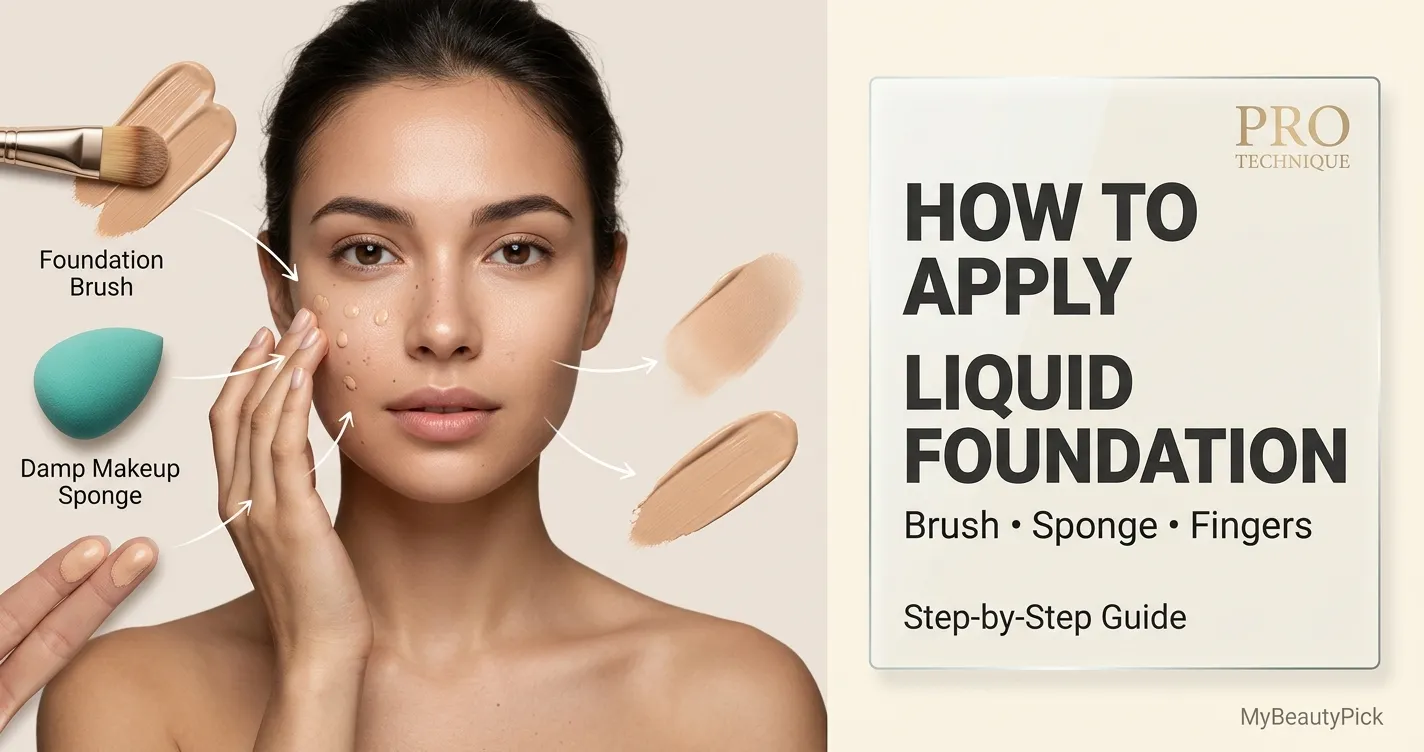
How you apply liquid foundation changes the finish as much as which formula you choose. The same foundation applied with a brush, a damp sponge, and your fingers produces three noticeably different results — different coverage levels, different finish qualities, different wear characteristics. Understanding what each method actually does gives you real control over your base rather than leaving the outcome to chance.
- Brush: highest coverage, most control, least product waste, fastest for full-face application.
- Damp sponge: most natural finish, diffused second-skin effect, gentle on dry and sensitive skin.
- Fingers: warmest, most intuitive application; best for skin-like lightweight coverage.
- Skin prep — moisturiser, SPF, primer — determines how well any application method performs.
- Always start at the centre of the face and blend outward regardless of tool.
Before You Apply: Skin Prep for Liquid Foundation
No application method compensates for skipped prep. The skin surface before you apply foundation determines whether the formula adheres evenly, blends smoothly, and holds through the day. This step takes 10 minutes but determines everything that follows.
-
1
Cleanse
Apply foundation to clean skin. Oil, sunscreen residue, and dead skin on the surface all create an uneven barrier between the formula and your skin. A gentle cleanser removes these and gives foundation a clean surface to adhere to. Pat dry — do not rub, which can create micro-irritation that makes liquid foundation sit unevenly.
-
2
Moisturise — Then Wait
Apply your moisturiser and allow it to absorb for a full 5 minutes before foundation. This is the step most people skip and then wonder why foundation looks patchy or slides off. Unabsorbed moisturiser creates a slick, hydrated surface that foundation cannot adhere to properly. Let it sink in completely. Dry skin benefits from a slightly richer moisturiser; oily skin benefits from a gel or water-based formula that hydrates without adding excess oil.
-
3
SPF
Apply a separate SPF as part of your skincare routine rather than relying on SPF in foundation. Foundation is not applied in the quantity needed to achieve the stated SPF protection on the packaging. Apply chemical SPF (not physical/mineral on tan skin — it causes white cast and flash photography flashback), allow 2–3 minutes to settle, then proceed to primer or foundation.
-
4
Primer (When Needed)
Primer extends foundation wear and creates a smooth surface — particularly important for oily skin, pores, or textured skin where foundation tends to break down quickly. Apply primer matched to your skin type: silicone-based for oily skin and large pores; hydrating for dry skin; blurring/smoothing for textured skin. Allow primer to set for 60 seconds before foundation. Using foundation immediately over wet primer creates mixing that reduces both products’ effectiveness.
Method 1: How to Apply Liquid Foundation with a Brush
Foundation Brush Application
A foundation brush deposits product efficiently without absorbing it into the tool the way a sponge does. More formula reaches your skin per application, which means you need less product to achieve the formula’s stated coverage. A buffing brush (flat-top kabuki) used in circular motions produces a polished, airbrushed finish. A flat brush used with pressing and short sweeping strokes gives precise, maximum-coverage placement.
Step by step:
- Pump a small amount of foundation onto the back of your hand — never directly onto the brush from the pump. Dispensing to the hand lets you control how much product goes onto the brush.
- Pick up a small amount with the brush tip by pressing into the product on your hand. Start with less than you think you need.
- Apply to the centre of the face first — nose, inner cheeks, centre forehead, chin. These areas typically need the most coverage and receive the most product in the first pass.
- Blend outward from the centre using short sweeping or circular motions depending on brush type. For a flat brush: short pressing and sweeping strokes. For a buffing brush: small circular buffing motions.
- Build coverage where needed by picking up additional product and applying a second pass only over areas that need it — not uniformly all over the face again.
- Blend the jawline and hairline with what’s left on the brush after applying coverage — this creates a natural fade rather than a visible foundation edge.
Common brush mistake: using long, sweeping strokes across the whole face in one motion. This creates streaks and applies product unevenly. Keep strokes short and deliberate.
Method 2: How to Apply Liquid Foundation with a Sponge
Beauty Sponge Application
A damp sponge applied with a bouncing stippling motion creates the most natural, skin-like finish of any application tool. The porous foam absorbs some product as it presses foundation into the skin, which sheers out the formula slightly and creates a diffused, second-skin quality that reads as healthy skin rather than applied makeup. The damp surface also helps foundation melt into the skin rather than sitting on top of it.
Step by step:
- Wet the sponge under running water. Squeeze out all excess water firmly — it should be damp throughout but not dripping. A damp sponge absorbs less foundation than a dry one, which means more product reaches your skin rather than being soaked into the tool.
- Dispense foundation onto the back of your hand. Dip the sponge into the product and bounce it lightly on the back of your hand first to remove any large globs and distribute the product across the sponge surface evenly.
- Starting at the centre of the face, bounce the sponge onto your skin using a stippling motion — straight up and down, pressing and releasing. Do not drag or wipe the sponge across the skin. Dragging moves product across the surface rather than pressing it in, creating uneven, streaky coverage.
- Work outward from the centre to the cheeks, forehead, and chin. Use the pointed tip of the sponge for the nose area and under-eye — the narrow tip gets into these areas without over-applying product.
- Build coverage by picking up additional product and repeating the stippling process over areas that need more. Two passes of light coverage always look more natural than one heavy pass.
Important: if you’re using a silicone-based or oil-based foundation, dampen the sponge with setting spray or leave it slightly drier than usual. Water and oil-based formulas don’t interact well — the wet sponge can dilute or disrupt silicone-based formula.
The most effective approach many makeup artists use combines both tools: apply foundation with a brush first for precise placement and coverage control, then bounce lightly over the finished face with a damp sponge. This single pass with the sponge softens any visible brush marks and unifies the whole finish into a more natural, skin-like quality — without sheering out the coverage you built with the brush. The sponge is used here for finish refinement, not for primary application.
Method 3: How to Apply Liquid Foundation with Fingers
Finger Application
Applying liquid foundation with fingers is the oldest method and still one of the most effective for achieving a genuine skin-like finish. The warmth of your fingertips partially melts the formula into the skin before it sets, creating a seamless blended result that reads as improved skin rather than coverage applied on top of it. The warmth factor is particularly useful for cream and stick foundations, where fingertip warmth helps break down and blend the formula more effectively than a cold brush or sponge.
When fingers work best: lightweight liquid formulas, skin tints, and tinted moisturisers — formulas designed for a natural finish where sheering out slightly is acceptable. For full-coverage formulas, fingers tend to sheer out the product and require significantly more passes to build coverage than a brush would.
Step by step:
- Wash hands thoroughly. This is non-negotiable for hygiene — bacteria, oil, and residue from your hands transfer directly to your face. Clean hands, every time.
- Dispense a small amount of foundation onto the back of your hand. Use your index or middle finger to pick up a small amount from there.
- Dot foundation onto the forehead, both cheeks, the nose, and the chin. Dotting distributes the product across the face before blending begins — this prevents you from applying too much in one area and too little in another.
- Using all fingers, blend the foundation outward from each dot using circular, tapping motions. The warmth of your fingers melts the formula — the motion is less important than the heat and pressure.
- Use your ring finger for the under-eye area and around the nose. The ring finger applies the least pressure of any finger — ideal for delicate areas where pressing too hard can disrupt the skin or create a cakey result in fine creases.
- Blend the jawline and hairline with clean fingertips using very light tapping to fade the foundation edge naturally.
Who should avoid finger application: oily skin. The natural oils from your fingers add to the oils already on your skin and can cause foundation to slide off faster. If you have oily skin and prefer the natural finish of finger application, apply with fingers and then set immediately with a pressed powder on the T-zone.
Which Method Should You Use? A Quick Decision Guide
| If you want… | Best method | Why |
|---|---|---|
| Full coverage | Brush (flat or buffing) | Bristles don’t absorb product — maximum pigment reaches skin |
| Natural, skin-like finish | Damp sponge or fingers | Sponge diffuses and sheers; fingers warm and melt the formula |
| Dewy, luminous finish | Damp sponge | Sponge creates the diffused, hydrated quality that reads as dewy |
| Fastest application | Brush | Covers the full face in fewer passes than stippling |
| Polished, airbrushed finish | Buffing brush | Circular buffing motion polishes formula into skin, blurs pores |
| Beginner-friendly | Damp sponge | More forgiving — softens errors and over-application |
| Dry skin comfort | Damp sponge or fingers | Gentler than brush bristles on dry or sensitive skin |
| Best for oily skin | Brush | Less friction means formula sits more stably on oily surfaces |
| Minimum product waste | Brush | Sponge absorbs some product; brush deposits maximum to skin |
How to Apply Liquid Foundation on Tan Skin: Specific Considerations
On tan and warm skin tones, application method interacts with two specific challenges: oxidation and undertone consistency.
Oxidation and tool friction: tan skin with oily or combination T-zones experiences faster foundation oxidation because sebum interacts with iron oxide pigments in the formula. Applying foundation with pressing and stippling technique — rather than dragging — creates less mechanical disruption of the formula on the skin surface, which slows the oxidation rate slightly. Use a brush with a pressing technique rather than long sweeping strokes, particularly on the T-zone.
Shade testing in natural light: always check your foundation match in natural daylight — never in bathroom lighting, which skews both warm and cool tones. On tan skin, the wrong undertone (too pink, too cool) is more visible than on lighter complexions because the contrast between the wrong undertone and warm melanin-rich skin is more pronounced. Swatch on your jawline, not your wrist — wrist skin tone is often significantly different from face skin tone.
Setting powder on tan skin: after any application method, set the T-zone with banana powder or an undertone-matched pressed powder — not white translucent. White translucent powder contains titanium dioxide that reads ashy and causes flash photography flashback on tan and deeper skin. Banana powder absorbs flash rather than reflecting it and maintains the warm undertone of the foundation.
Common Liquid Foundation Application Mistakes
-
✗Applying foundation to unabsorbed moisturiserFoundation applied over moisturiser that hasn’t fully absorbed sits on a slick, hydrated surface and slides rather than adhering. Always wait 5 full minutes after moisturiser before foundation. If you’re in a rush, press a clean tissue gently to the face before foundation to remove surface moisturiser without stripping the hydration.
-
✗Using too much product in one passOver-application is the single most common cause of cakey, heavy foundation. One thin layer, built where needed, always outperforms one heavy uniform application. Start with less than you think is necessary — you can always add more, you can’t easily remove excess once it’s set on the skin.
-
✗Wiping a sponge across the face instead of bouncingWiping moves product across the skin surface rather than pressing it in. The finish is streaky, uneven, and often picks up what’s already been applied. The sponge motion is always a bounce: straight down onto the skin and lift. Every time, without exception.
-
✗Long sweeping strokes with a brushLong strokes deposit product unevenly and leave visible streaks — more product at the start of the stroke, less at the end. Short, deliberate strokes or circular buffing motions distribute product evenly. Work in sections of the face rather than swiping across the whole face in one stroke.
-
✗Matching shade in indoor or artificial lightIndoor lighting skews colour perception consistently. A foundation that looks correct in bathroom lighting can look visibly wrong in natural daylight. Always do your final shade assessment — and your touch-up assessment — in natural light. For tan skin, this matters especially for undertone accuracy.
-
✗Setting with white translucent powder on tan skinWhite translucent powder reads ashy in photos on tan and deeper skin. It reflects camera flash and creates a grey, washed-out appearance. Switch to banana powder on the T-zone and a pigmented pressed powder matching your undertone for any other areas that require setting.
How to Make Liquid Foundation Last Longer
Whichever application method you use, longevity is determined by what comes before and after the foundation — not just the formula itself.
- Primer before foundation — matched to your skin type — extends wear by creating an adhesive surface and slowing the sebum breakdown that causes coverage to fade.
- Set with powder on the T-zone immediately after foundation application. Don’t wait until the whole face is done — setting the T-zone immediately limits the ongoing oil-and-formula interaction from the start.
- Setting spray as a final step over the completed full look locks all layers together and reduces continued oxidation by limiting oxygen and oil exposure to the foundation pigments.
- Blot, don’t powder, for touch-ups. Re-powdering throughout the day builds up multiple layers that create cakiness by end of day. A single blotting paper pressed gently to the T-zone removes surface oil without disturbing coverage, and the existing set powder maintains control afterward.
Frequently Asked Questions
What is the best way to apply liquid foundation?
The best way to apply liquid foundation depends on the finish you want. For full coverage and the most polished result, use a buffing brush (flat-top kabuki) in circular motions or a flat brush with short pressing strokes. For a natural, skin-like second-skin finish, use a damp beauty sponge with a bouncing stippling motion. For the most intuitive, skin-melting application of lightweight formulas, use clean fingers. Many makeup artists combine tools: brush for coverage placement, then a light pass with a damp sponge to unify the finish.
How do you put on liquid foundation for beginners?
Start with a clean, moisturised face. Allow moisturiser to absorb for 5 minutes. Apply a small amount of foundation to the back of your hand. Using a damp beauty sponge or your clean fingers, dot the foundation onto your forehead, both cheeks, nose, and chin. Blend each dot outward using bouncing or circular motions, starting from the centre of the face and working outward. Use less product than you think you need in the first pass — build coverage only where needed. A damp sponge is the most forgiving tool for beginners.
Is it better to apply foundation with a brush or fingers?
For coverage and precision: a brush. For a natural, skin-like finish with lightweight formulas: fingers. Fingers warm the formula and create a seamless, intuitive blend — particularly effective with skin tints and lightweight liquids. A brush gives more control over where foundation goes and builds coverage more efficiently. Both methods work well — the right choice depends on the formula type and the finish you want, not on which is objectively better.
How do I apply liquid foundation without it looking cakey?
Use less product than you think you need in the first pass. Apply in thin layers and build only where necessary. Ensure moisturiser is fully absorbed before foundation goes on — unabsorbed moisturiser creates a slick surface that prevents adhesion and leads to the formula sitting on top of the skin. Avoid applying setting powder all over the face — set the T-zone only if you have oily skin, and use setting spray rather than powder on the cheeks and drier areas. If you must use powder, choose the finest-milled option available.
Should I apply foundation with a wet or dry sponge?
Always damp — not dry, not soaking wet. A damp sponge expands and becomes softer, creating the gentle bouncing motion that produces the best finish. More importantly, a wet sponge absorbs less foundation than a dry one because the foam is already saturated with water, which means more product reaches your skin rather than being wasted inside the tool. The exception is silicone or oil-based foundations, where a slightly drier sponge or setting-spray-dampened sponge works better — water and oil-based formulas don’t combine well.
How do I blend liquid foundation into my neck?
Use whatever product is left on your brush or sponge after applying to the face. The residual product creates a natural fade at the jawline without a visible foundation line. For a cleaner blend: after applying foundation to the face, wipe the brush or sponge once on a clean tissue to remove most residual product, then blend what’s left along the jaw and down slightly onto the neck. Never apply the same amount of product you use on the face to the neck — this creates a line of full coverage that reads as a mask rather than a seamless finish.