

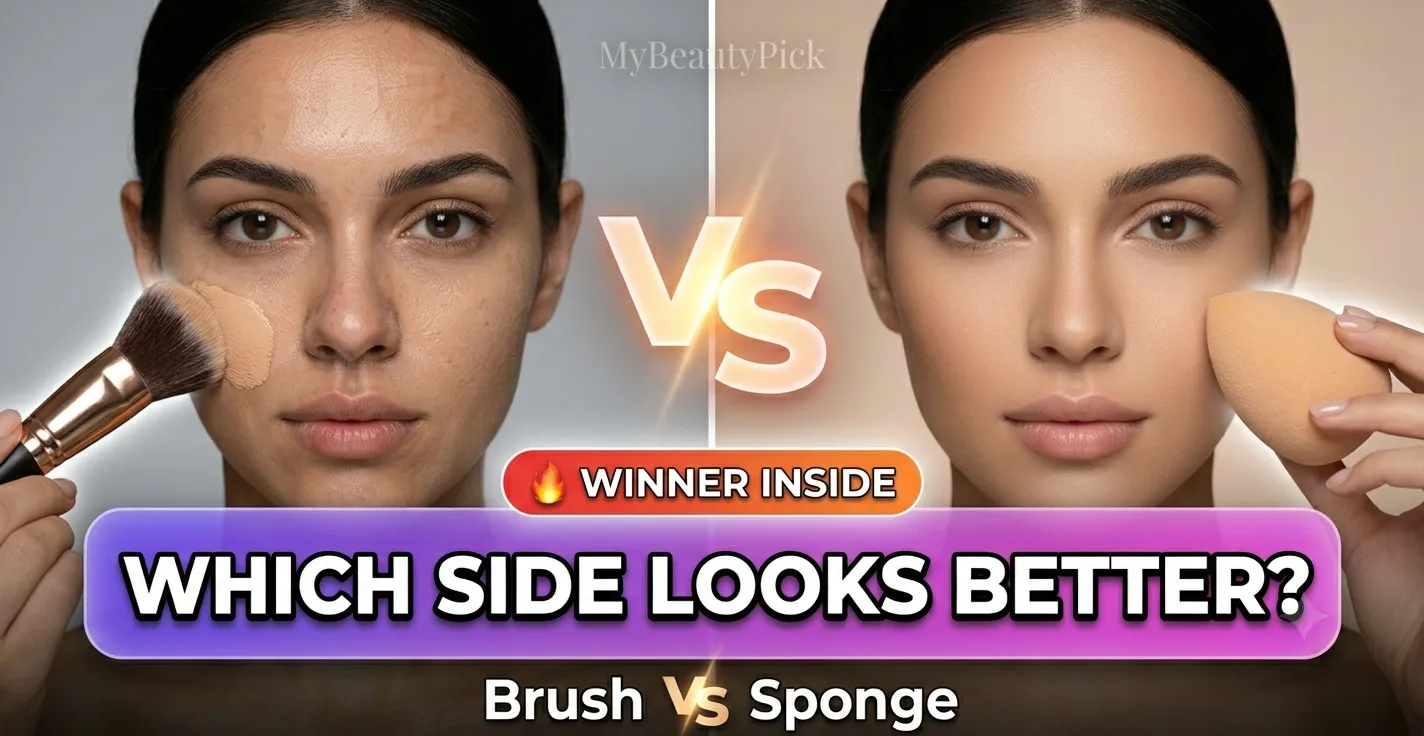
Foundation brush or sponge — neither is universally better. They do fundamentally different things to your foundation, and which one gives better coverage depends on the formula you’re using, the finish you want, and your skin type. Using the wrong tool for the job is often the real reason a foundation looks patchy, heavy, or disappears within hours. Here’s exactly how to decide.
- A foundation brush gives more control, higher coverage potential, less product waste, and faster application.
- A damp sponge gives a softer, more diffused finish, a second-skin effect, and more forgiving blending.
- Neither tool is better — the right choice depends on formula type, desired finish, and skin type.
- The most effective professional technique uses both: brush to place and build coverage, sponge to soften and perfect the edges.
- Formula type matters as much as tool: thick, pigmented foundations perform better with brushes. Lightweight, fluid foundations work beautifully with a damp sponge.
Foundation Brush vs Sponge: The Core Difference
A foundation brush and a sponge apply product through different mechanisms — and that difference determines everything about the finish you get.
A foundation brush guides, presses, and buffs product with bristles that direct where foundation lands. The structure of the bristles creates intentional placement — you decide exactly where coverage goes and how much builds in each area. The result is controlled, precise, and retains more of the formula’s coverage potential because bristles don’t absorb product the way a porous sponge does.
A makeup sponge, particularly when damp, works by a different principle entirely. The porous surface absorbs excess product as it presses foundation into the skin, creating a diffused, second-skin quality that brushes can’t replicate. The bouncing motion softens hard edges and blends foundation into the skin rather than placing it on top of it. The trade-off is that the sponge absorbs some product in the process — meaning more foundation is used per application.
Foundation Brush: Strengths, Limitations, and When to Use It
✓ Strengths
- Maximum coverage with less product — bristles don’t absorb formula
- Precise placement — you control exactly where foundation goes
- Builds coverage more efficiently with each pass
- Faster application across large areas of the face
- Works with every formula type including thick creams
- More hygienic long-term — easier to clean than a sponge
- Less product waste overall
✗ Limitations
- Can leave visible brush strokes if technique or formula is wrong
- Requires correct brush type matched to formula
- Less forgiving for beginners — errors show more clearly
- Circular buffing motion can emphasise dry patches on dry skin
- Doesn’t create the diffused, second-skin finish a sponge does
When to use a foundation brush:
- You want full or buildable coverage
- You’re using a thick, pigmented, or full-coverage formula
- You want to control exactly where coverage builds
- You’re applying cream or stick foundation
- You need fast, efficient coverage across the whole face
- You want to minimise product waste — particularly with expensive formulas
Foundation Sponge: Strengths, Limitations, and When to Use It
✓ Strengths
- Second-skin, diffused finish that reads like natural skin
- Softer blending — more forgiving of technique errors
- Gentle on sensitive, dry, or reactive skin
- Creates a dewy, luminous quality that brushes can’t replicate
- Excellent for light-to-medium coverage formulas
- Great for blending out edges after brush application
✗ Limitations
- Absorbs product — uses more foundation per application
- Slower to build full coverage — requires more passes
- Sponge must be replaced regularly (bacteria risk)
- Not ideal for very thick or full-coverage formulas
- Wet sponge doesn’t mix well with silicone or oil-based foundations
When to use a sponge:
- You want a natural, skin-like, or dewy finish
- You’re using a lightweight, fluid, or serum-textured formula
- You have dry or sensitive skin
- You want the most forgiving, beginner-friendly blending experience
- You’re using a skin tint or medium-coverage foundation where sheering out slightly is acceptable
- You want to soften and blend out edges after brush application
Foundation Brush vs Sponge: Side-by-Side Comparison
| Factor | Foundation Brush | Makeup Sponge |
|---|---|---|
| Coverage level | Higher — more product stays on skin | Lower — sponge absorbs some product |
| Finish | Polished, defined, controlled | Diffused, soft, second-skin |
| Product waste | Less — bristles don’t absorb formula | More — porous surface soaks some up |
| Application speed | Faster for full-face coverage | Slower — requires more bouncing passes |
| Best formula type | Liquid, cream, stick, full-coverage | Lightweight liquid, skin tint, serum foundation |
| Best skin type | Oily, combination, normal | Dry, sensitive, combination |
| Beginner-friendly | Moderate — technique matters | Higher — more forgiving of errors |
| Hygiene | Easier to clean properly | Needs replacing every 1–3 months |
| Dewy finish | Difficult to achieve with brush alone | Natural for damp sponge application |
| Pro technique | Stippling, buffing, flat pressing | Bouncing/stippling — never wiping |
Which Gives Better Coverage: Brush or Sponge?
For maximum coverage from your foundation, a brush consistently outperforms a sponge. The reason is simple: sponges absorb product. A significant portion of the foundation you apply with a sponge is absorbed into the sponge itself rather than deposited onto your skin. This sheers out the formula and reduces its coverage potential — which is why the same foundation often looks lighter when applied with a sponge than with a brush.
A foundation brush — particularly a flat or buffing brush — deposits product more efficiently. More of what you apply lands on the skin rather than being absorbed into the tool. This means you achieve the formula’s stated coverage level with less product per application.
However, “better coverage” is not always the goal. A sponge can produce a finish that looks more like skin — and for many people, that is a more flattering result than the same formula at full coverage potential. The sponge’s absorption and diffusion produces the natural, second-skin quality that many prefer to a polished, fully covered finish.
The approach most makeup artists use combines both tools. Apply foundation with a brush to place and build coverage where you need it. Then take a damp sponge and bounce it lightly over the entire face to soften brush marks, blend edges, and give the whole finish a more natural, skin-like quality. This is the hybrid technique that delivers coverage control with diffused finish — the best of both tools in one application.
Formula Type Determines Tool Choice More Than Skin Type Does
The most important pairing consideration is formula type — not skin type. The same formula behaves differently with each tool, and that formula-to-tool relationship determines coverage and finish more reliably than any other factor.
Full-Coverage Liquid → Brush
- Dense bristles deposit maximum pigment
- Less product needed for full coverage
- Flat or buffing brush recommended
- Sponge sheers out too much for full-coverage result
Serum / Skin Tint → Sponge or Fingers
- Lightweight formula benefits from diffusion
- Sponge creates the skin-like finish these formulas promise
- Brush can over-deposit lightweight formulas
- Damp sponge presses product in without creating streaks
Medium Buildable Liquid → Either
- Brush for more coverage in fewer passes
- Sponge for a softer, more natural result
- Most versatile formula type — tool determines finish, not coverage level
- Hybrid method (brush then sponge) works best here
Cream / Stick → Brush
- Thick texture needs bristles to warm and spread it
- Sponge can drag or apply unevenly on thick formulas
- Dense buffing brush or flat brush recommended
- Follow with damp sponge tap-over only if needed
Foundation Brush vs Sponge for Tan Skin
For tan and warm skin tones, tool choice interacts with two specific concerns: oxidation management and undertone consistency across the face.
A brush applied with pressing technique places foundation more precisely and creates less friction on the skin surface. This matters on tan skin with oily T-zones because less mechanical disruption means the formula’s iron oxide pigments oxidise more slowly — the foundation stays truer to its applied colour longer.
A damp sponge, while excellent for finish quality, can push product into pores and fine lines more readily on oily-combination tan skin — the very areas where oxidation is fastest. If you prefer a sponge finish on tan skin, the compromise is using a brush first to place the foundation, then bouncing with a lightly damp sponge to unify the finish without pressing product into the skin.
For dry tan skin: the damp sponge is the most comfortable application tool. It doesn’t catch on dry texture the way a buffing brush can, and the slightly damp surface helps foundation melt into the skin without dragging over dryness.
Sponge Hygiene: The Maintenance Reality Most Guides Skip
A beauty sponge must be washed after every use. The porous foam traps foundation residue, oil, and bacteria in its core — and that bacteria transfers directly to your face on the next use. On acne-prone skin, unwashed sponges are a significant breakout trigger.
Sponges should be replaced every 1–3 months regardless of how well you clean them. The foam degrades over time, and a compromised sponge absorbs more product and applies it less evenly than a fresh one.
A foundation brush, by contrast, lasts years when properly cared for. A thorough weekly clean with brush shampoo maintains performance indefinitely. For anyone who frequently forgets to clean their tools, a brush is the more hygienically forgiving choice over time.
Never wipe foundation across the face with a sponge — always bounce or stipple. Wiping moves product across the skin rather than pressing it in, creates uneven coverage, and picks up already-applied foundation and moves it around. The entire point of a sponge is the bouncing stippling motion that diffuses product into skin rather than across it.
Frequently Asked Questions
Does a foundation brush or sponge give better coverage?
A foundation brush gives better coverage in almost every test. Bristles don’t absorb product the way a porous sponge does, so more of the formula’s pigment lands on your skin rather than being soaked into the tool. A brush also allows more precise building in specific areas. A sponge sheers out the formula through absorption, which gives a more natural finish but lower overall coverage. If full or buildable coverage is your goal, a brush is the better tool.
Is a sponge or brush better for beginners?
A damp sponge is generally more forgiving for beginners. The bouncing motion is intuitive and self-correcting — over-application gets absorbed into the sponge rather than sitting on the skin, and blending errors are easier to smooth out. A brush requires matching the right brush type to the right formula and developing the right stroke technique to avoid streaking. That said, a beginner using a buffing brush with circular motions will also get good results — the buffing brush is the most fool-resistant brush type.
Can I use both a brush and a sponge to apply foundation?
Yes — this is the approach many makeup artists use and it consistently produces the best results. Apply foundation with a brush first: precise placement, coverage control, efficient product use. Then bounce lightly over the face with a damp sponge to soften brush marks, blend edges, and create a more natural, skin-like quality. The brush delivers coverage, the sponge delivers finish refinement. Most people who struggle with either tool alone get significantly better results using both in sequence.
Does a sponge use more foundation than a brush?
Yes — a sponge consistently uses more foundation than a brush because the porous foam absorbs product during application. The amount absorbed depends on the sponge type (drier sponges absorb more) and the formula’s viscosity (watery formulas absorb more than thick ones). If you’re using an expensive foundation or a highly pigmented formula where product efficiency matters, a brush is the more economical choice. The exception is anti-absorption sponge designs, which use denser foam to reduce product absorption — but even these absorb more than bristles.
What is the best way to apply foundation for a natural finish?
A damp sponge used with a bouncing stippling motion gives the most natural, skin-like finish. The sponge’s absorption softens the formula and the stippling motion presses it into the skin rather than placing it on top, creating the diffused quality that reads as skin rather than makeup. For an even more natural result, use a brush first with light coverage, then bounce a damp sponge over the face to blend everything into a unified, natural finish. Keep foundation light in the first pass and only build where needed.
Should I wet the sponge before applying foundation?
Yes — always dampen the sponge before use. A damp sponge expands and becomes softer, which creates the gentle bouncing motion that gives the best finish. More importantly, a wet sponge absorbs less foundation than a dry one because the foam is already saturated with water — this means more product reaches your skin and less is wasted. Wet the sponge under running water, then squeeze out all excess until it’s damp but not dripping. One exception: if you’re using a silicone or oil-based foundation, dampen with setting spray or leave the sponge slightly drier, as water and oil-based formulas don’t mix well.