

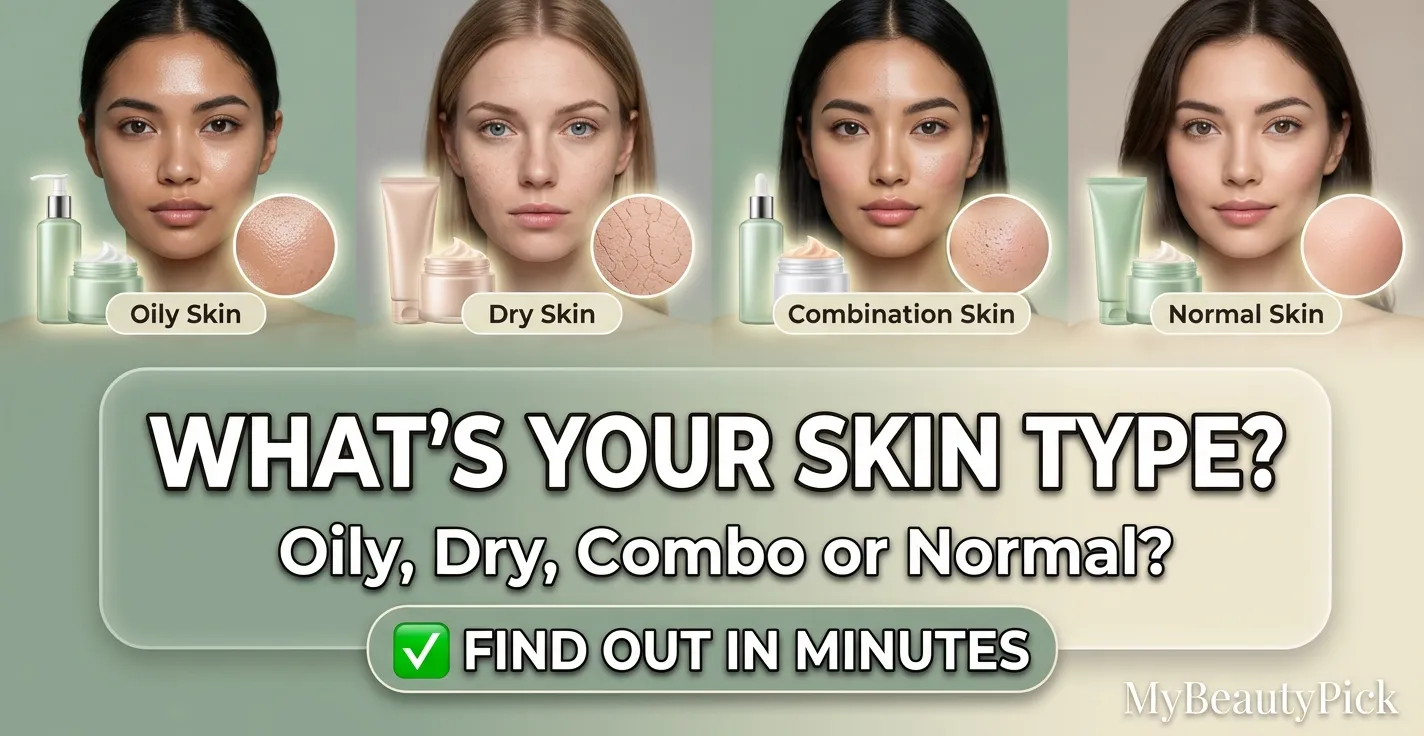
Knowing your skin type is the single most useful piece of information you can have for choosing makeup and skincare. It explains why a foundation that works brilliantly for someone else breaks down on your skin by noon. It explains why your T-zone shines while your cheeks feel tight. And it explains why the same product reads differently depending on the season, your cycle, or the climate you’re living in. This guide tells you exactly how to identify your skin type — and critically, what changes it.
- There are four primary skin types: oily, dry, combination, and normal — plus sensitive, which can overlay any of them.
- Skin type is not fixed. Hormones, climate, age, skincare products, and diet all change it temporarily or permanently.
- The bare-face test after cleansing is the most reliable at-home method for identifying your current skin type.
- Foundation formula selection is the most direct makeup consequence of knowing your skin type — the wrong formula breaks down faster, looks heavier, or sits unevenly depending on the mismatch.
- Combination skin is the most common type and the most frequently misidentified — many people with oily T-zones and normal cheeks don’t realise they’re combination.
How to Know Your Skin Type: The Bare-Face Test
The most accurate at-home skin type test requires nothing but a clean face and 30–60 minutes. No products, no touching, no activity — just observing what your skin does on its own after cleansing.
- Wash your face with a gentle, pH-balanced cleanser. Avoid anything stripping or heavily foaming.
- Pat dry gently. Apply nothing — no moisturiser, no serum, no toner.
- Wait 30–60 minutes in a neutral environment (not immediately after exercise, not in extreme heat or cold).
- After the wait, look at your face in natural daylight. Feel different zones — the forehead, nose, chin, and both cheeks.
What you observe is your skin behaving without interference. This is your skin type.
Oily Skin: What It Looks Like and Why It Happens
After the bare-face test, oily skin shows visible shine across most of the face — the forehead, nose, chin, and cheeks. Pores may look enlarged. The skin has a consistently glossy, sometimes greasy quality even without any product on it.
Oily skin is caused by overactive sebaceous glands producing excess sebum. Sebum is not inherently a problem — it’s the skin’s natural moisturiser and antimicrobial barrier. The challenge in makeup terms is that excess sebum breaks down foundation formulas, accelerates oxidation of iron oxide pigments in the formula, and causes coverage to migrate into pores and fine lines.
What oily skin looks like in makeup wear: foundation disappears from the T-zone fastest, often leaving a shiny, coverage-free zone across the nose and forehead within a few hours. The skin can look wet rather than dewy. Powder foundations and setting products break down faster than expected.
What this means for foundation selection: long-wear, silicone-based or polymer-rich formulas, natural matte or satin finish, set with a matched pressed powder on the T-zone. Avoid dewy or luminous finishes that amplify natural oil production. Primer is essential — a mattifying primer on the T-zone creates a sebum-resistant barrier that significantly extends foundation wear.
Dry Skin: What It Looks Like and Why It Happens
After the bare-face test, dry skin feels tight, sometimes itchy or uncomfortable. It may look dull or matte — not in a controlled way, but in a flat, lifeless way. Fine lines may appear more visible than usual. Some areas, particularly around the cheeks and jaw, may show flaking or rough texture.
Dry skin produces less sebum than normal, which means the skin’s natural moisture barrier is weaker. The lipid layer that keeps moisture from evaporating is thinner, leading to water loss and the tight, uncomfortable feeling. This is different from dehydrated skin — dehydrated skin lacks water and can happen to any skin type; dry skin specifically lacks oil production.
What dry skin looks like in makeup wear: foundation clings to dry patches and textured areas, creating a flaky or uneven look within hours. Matte foundations emphasise these patches. Setting powder over-dries the skin further. By midday, foundation can look cracked or flaky in dry areas.
What this means for foundation selection: hydrating or satin-finish liquid foundations with humectants (hyaluronic acid, glycerin) in the formula. Avoid matte formulas — they exacerbate the tight, textured appearance. Apply over a rich moisturiser that has been given time to fully absorb. Skip powder on dry areas or use only the lightest, finest-milled option. Setting spray is more appropriate than powder for locking in the finish.
Combination Skin: What It Looks Like and Why It Happens
Combination skin is exactly what it sounds like: two different skin type behaviours happening on the same face simultaneously. After the bare-face test, the T-zone (forehead, nose, chin) shows shine or greasiness, while the cheeks and jaw feel normal to dry. The difference between zones is the defining characteristic.
Combination skin is the most common skin type. Sebaceous gland density is higher in the T-zone for almost everyone — the concentration of oil glands in the forehead-nose-chin area is genuinely different from the cheek area. In combination skin, this natural variation is pronounced enough to create two distinctly different skin surface environments on the same face.
What combination skin looks like in makeup wear: foundation breaks down and shines in the T-zone while the cheeks may look fine or even slightly dry. Coverage migrates from oily areas. A single foundation formula struggles to serve both zones equally — full matte on the whole face dries out the cheeks; dewy on the whole face amplifies T-zone shine.
What this means for foundation selection: satin or natural-satin finish, zone-based primer application (mattifying T-zone, hydrating or neutral cheeks), and selective powder setting on the T-zone only. The combination skin approach requires treating each zone slightly differently rather than applying one uniform product and technique everywhere.
Normal Skin: What It Looks Like and Why It Happens
Normal skin after the bare-face test shows no significant shine, no tightness, no visible flaking. The skin looks even, comfortable, and balanced. Pores are small or not visible. There’s a quality of looking like skin is supposed to look — neither working against you nor requiring constant management.
Normal skin produces sebum at a balanced rate — enough to maintain the lipid barrier without excess. The skin’s pH and moisture levels stay in a comfortable range without significant intervention. This is genuinely the least common skin type — most people have some imbalance in at least one zone.
What this means for makeup: normal skin has the most flexibility in foundation formula choice. Most formulas perform well on balanced skin. The focus for normal skin is on shade matching, undertone accuracy, and desired finish rather than formula type management.
How to Know If You Have Sensitive Skin
Sensitive is not a primary skin type in the same category as the four above — it can overlay any of them. Sensitive skin reacts more readily to products, environmental factors, and physical irritants than non-sensitive skin. Reactions include redness, stinging, burning, itching, or visible flushing.
The hallmarks of sensitive skin: reactions to fragrance in skincare or makeup, redness that appears with product application or weather changes, visible capillaries on the cheeks, and a history of diagnosed conditions like rosacea, eczema, or psoriasis.
What this means for makeup: fragrance-free, non-comedogenic, dermatologist-tested formulas. Patch-test new products on the jaw or behind the ear before full-face application. Avoid alcohol-heavy formulas, heavy chemical SPF filters that can irritate reactive skin, and heavily fragranced setting sprays.
Skin Type vs. Skin Condition: A Critical Distinction
Skin type is the baseline behaviour of your skin determined largely by genetics and sebaceous gland activity. Skin condition is a temporary or modifiable state layered on top. This distinction matters because many people misidentify their skin type based on a current condition rather than their genuine baseline.
| Skin Type (Genetic Baseline) | Skin Condition (Temporary / Modifiable) |
|---|---|
| Oily — high sebum production | Dehydrated — any skin type can be water-depleted |
| Dry — low sebum production | Congested — clogged pores from product build-up |
| Combination — T-zone vs. cheek imbalance | Sensitised — temporary reactivity from over-exfoliation |
| Normal — balanced sebum | Breakout-prone — diet, hormones, product-triggered |
The most common misidentification: people with dehydrated oily skin mistake themselves for dry skin. Dehydrated oily skin produces excess oil but is also short on water — it feels tight and dry in some areas but shines in others. The skin is trying to compensate for water loss by producing more oil. The fix is hydration, not switching to dry-skin products.
What Changes Your Skin Type
Skin type is not permanently fixed. Several factors shift it over time or seasonally:
Hormones
Hormonal fluctuations are the most significant driver of skin type changes. During the menstrual cycle, sebum production spikes in the days before menstruation — many people experience a temporary shift toward oily skin during this window. Pregnancy, hormonal contraceptives, perimenopause, and menopause all create longer-term shifts. Many people’s skin becomes drier as oestrogen decreases with age.
Climate and Season
Cold, dry air in winter depletes the skin’s moisture barrier — combination skin can shift toward dry, normal skin can shift toward dry or sensitive. Hot, humid summer conditions stimulate sebum production — normal skin can shift toward combination, combination toward oily. People in tropical or subtropical climates (or who travel between climates) may need to reassess their skin type seasonally.
Age
Sebaceous gland activity decreases with age. Oily skin in your twenties often shifts to combination by your thirties and further toward normal or dry by your forties and fifties. The opposite shift — skin becoming oilier with age — is uncommon and typically hormone-driven rather than a natural aging trajectory.
Skincare Products
Over-stripping cleansers and excessive exfoliation disrupt the skin barrier, causing dehydration regardless of skin type — and a dehydrated skin can paradoxically produce more oil as a compensatory response. Introducing a consistent, well-matched moisturiser to oily skin can reduce sebum production over time by signalling to sebaceous glands that the skin is adequately moisturised. Product choices have more impact on skin behaviour than most people realise.
Medication
Certain medications directly alter skin behaviour. Isotretinoin (Accutane) significantly reduces sebum production. Oral contraceptives shift skin toward either oily or dry depending on the hormonal composition. Corticosteroids can thin the skin and increase sensitivity. If your skin type has shifted unexpectedly, a recent medication change is worth considering.
Skin Type and Foundation: Quick Reference
| Skin Type | Best Foundation Formula | Best Finish | Set With | Avoid |
|---|---|---|---|---|
| Oily | Silicone-based, long-wear, oil-free | Natural matte or satin | Banana or matched powder, T-zone only | Dewy, luminous, oil-based formulas |
| Dry | Hydrating liquid, serum foundation | Satin or natural | Setting spray, light powder only where needed | Matte, powder, high-silica formulas |
| Combination | Water-based or lightweight hybrid, satin | Satin or natural-satin | Powder on T-zone, setting spray on cheeks | Full matte all-over, full dewy all-over |
| Normal | Any well-formulated formula | Any finish | Based on preference | Formulas poorly matched to desired finish |
| Sensitive | Fragrance-free, non-comedogenic | Any, avoid heavy powders | Light setting spray | Fragrance, alcohol, harsh actives in formula |
Frequently Asked Questions
How do I know my skin type at home?
The most reliable at-home method is the bare-face test. Wash your face with a gentle cleanser, apply nothing, and wait 30–60 minutes. If your skin looks shiny across most of the face: oily. If it feels tight and looks dull with no shine: dry. If your T-zone (forehead, nose, chin) shines but your cheeks feel normal or dry: combination. If it looks and feels balanced with no particular issue: normal. Always do this test in a neutral environment — not immediately after exercise or in extreme temperatures.
Can your skin type change?
Yes — skin type changes with age, hormonal shifts, climate, medication, and skincare product habits. The most common shifts: oily skin in your twenties becoming combination or normal by your thirties and forties; combination skin shifting toward dry in winter and back toward oily in summer; skin becoming temporarily sensitised from over-exfoliation or product changes. Reassess your skin type seasonally and after any significant hormonal or lifestyle change.
What is the difference between dry skin and dehydrated skin?
Dry skin is a skin type: the skin produces less sebum than normal, creating a consistently oil-depleted surface. Dehydrated skin is a temporary condition: the skin is short on water, not oil. Any skin type can be dehydrated — including oily skin, which is why some oily-skinned people feel tight and dry in some areas while still producing excess sebum in others. Dehydrated skin improves with hydrating serums and adequate water intake; true dry skin requires additional lipid replenishment via richer moisturisers.
How does skin type affect how makeup wears?
Skin type is the single biggest determinant of foundation performance. Oily skin breaks down foundation formulas through sebum interaction, accelerates oxidation, and causes coverage to migrate. Dry skin causes foundation to cling to texture and dry patches, creating flaking and uneven coverage. Combination skin produces both effects in different zones. Choosing a foundation formula matched to your skin type — not just your coverage preference — determines whether it holds for two hours or eight.
Is sensitive skin a skin type?
Sensitive is more accurately described as a skin characteristic that can overlay any of the four primary skin types. You can have oily sensitive skin, dry sensitive skin, or combination sensitive skin. What defines sensitive skin is reactivity — the skin responds more readily to products, environmental triggers, and physical irritants with redness, stinging, or visible flushing. Rosacea and eczema are conditions associated with sensitive skin but are distinct diagnoses requiring their own specific considerations.