

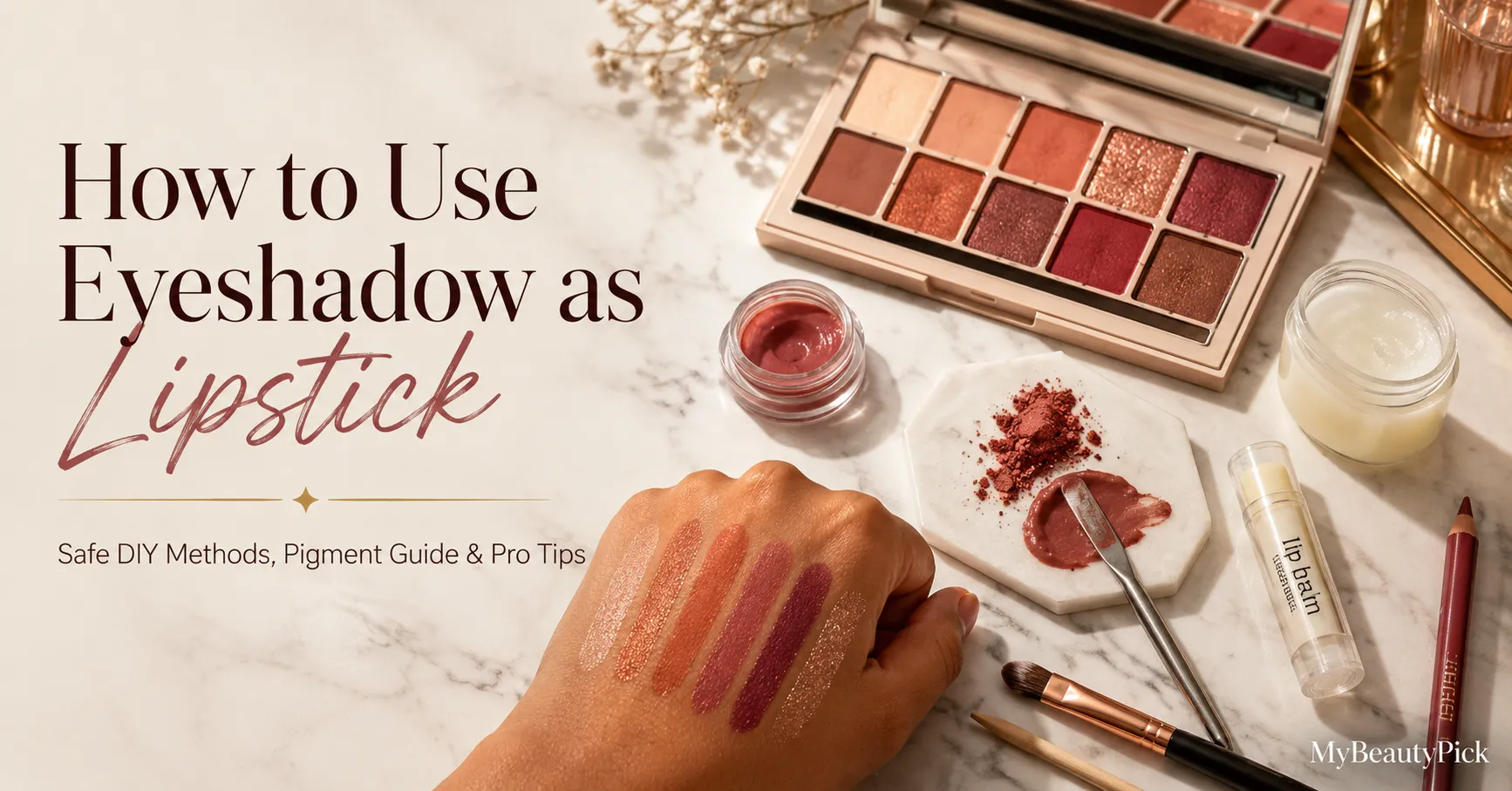
Using eyeshadow as lipstick works — but not all eyeshadows are safe to use on your lips, and not all methods give results worth the effort. The hack has circulated on TikTok and beauty blogs for years without anyone explaining the one thing that actually matters: the pigment safety question. Get that part right first. Then the mixing methods, finish options, and wear expectations make sense in context.
What You Need to Know Before You Start
- Not all eyeshadow pigments are approved for lip use. “Ext. D&C” colour additives are approved for external skin only — not lips or mouth. Some D&C colours also carry lip restrictions. This is not a minor caveat.
- Iron oxides, ultramarines, and mica are mineral pigments that are generally considered safer for lip use than synthetic dye-based eyeshadow pigments — but ultramarine blue is specifically approved for eye use only by the FDA, not for lips.
- The safest approach: use eyeshadows that are explicitly marketed as multi-use or lip-safe, or that are formulated only with FD&C and D&C colour additives cleared for lip products.
- There are three practical methods: dry eyeshadow pressed over lip balm, eyeshadow mixed into a base before application, and eyeshadow melted into a balm base. Each gives a different result and different wear time.
- Wear time is short — two hours maximum without reapplication, less if you eat or drink. This is a creative hack, not a lipstick replacement.
Can You Use Eyeshadow as Lipstick? The Honest Answer
Yes, with important conditions. Eyeshadow is pigment in a base — so is lipstick. The pigment can be transferred to lips and produce a genuine lip colour effect. The question is not whether it works visually. The question is whether it is safe.
Lips are not the same as eyelids. Lip products are ingested in small amounts throughout the day — through licking, eating, and drinking. Because of this, the FDA requires stricter safety approval for pigments used in lip products than for those used around the eyes. An eyeshadow can legally contain colour additives that have been tested for eye use only, and those same additives may not have been tested or approved for ingestion or lip contact.
Most beauty content about this hack skips straight to the tutorial. The safety step comes first.
The Pigment Safety Issue: Which Eyeshadows Are and Aren’t Lip-Safe
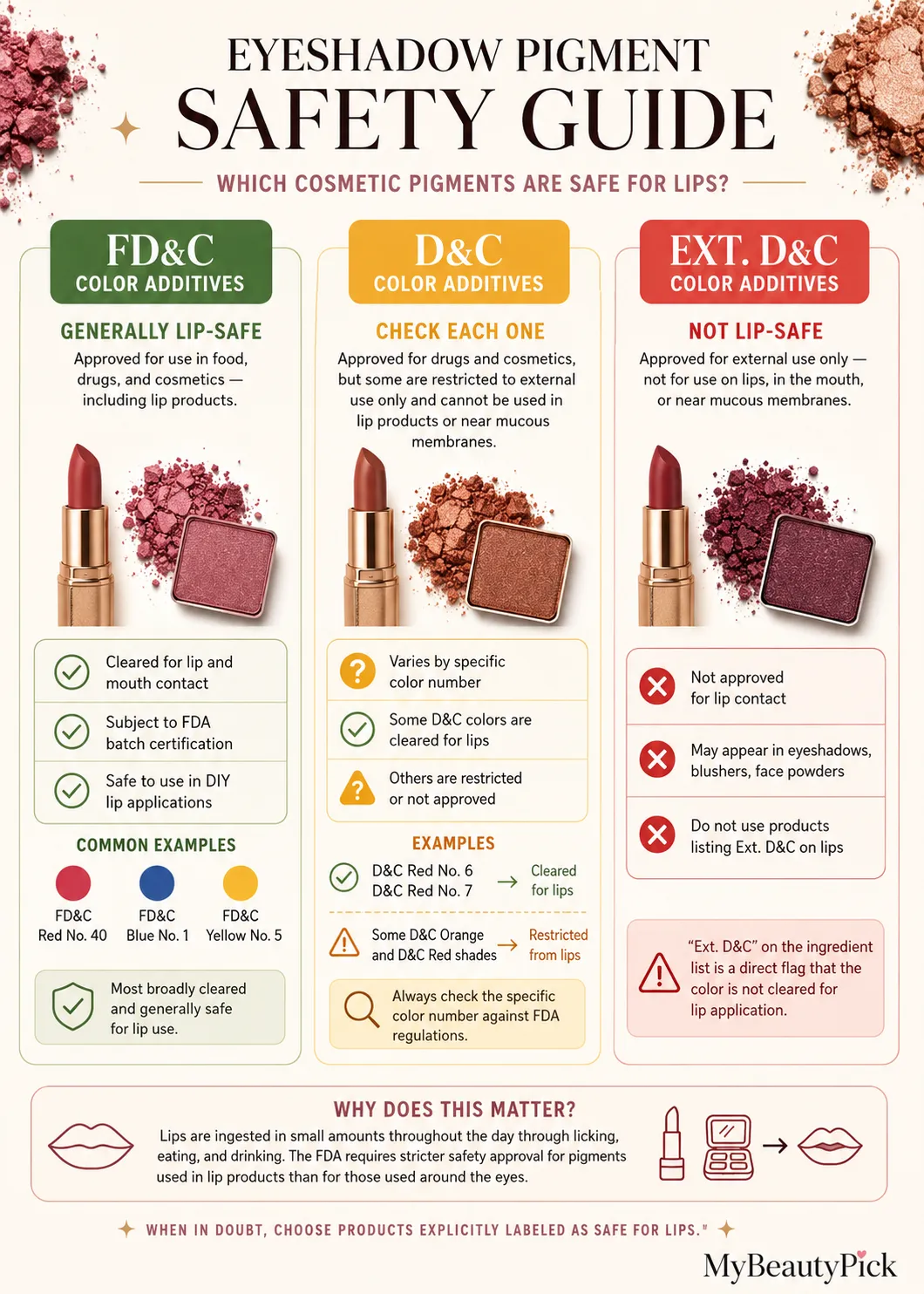
The U.S. Food and Drug Administration classifies colour additives for cosmetics into specific categories that determine where on the body they can be used. Understanding these three categories is the only reliable way to know whether an eyeshadow’s pigments are safe for your lips.
FD&C Colour Additives
Approved for use in food, drugs, and cosmetics — including lip products. FD&C colours are the most broadly cleared and generally considered safe for lip use. Examples include FD&C Red No. 40, FD&C Blue No. 1, FD&C Yellow No. 5. Present in many eyeshadows and lipsticks alike.
- Cleared for lip and mouth contact
- Subject to FDA batch certification
- Safe to use in DIY lip applications
D&C Colour Additives
Approved for drugs and cosmetics — but some are restricted to external use only and cannot be used in lip products or near mucous membranes. The “D&C” prefix alone does not confirm lip safety. Each D&C colour has its own use restrictions that must be checked individually against FDA regulations. Some D&C colours are cleared for lips; others are not.
- Varies by specific colour number
- D&C Red No. 6, No. 7: cleared for lips
- Some D&C Orange and D&C Red shades: restricted
Ext. D&C Colour Additives
Approved for external use only — not for use on lips, in the mouth, or near mucous membranes. “Ext. D&C” on an ingredient list is a direct flag that the colour is not cleared for lip application. These pigments appear in some eyeshadows and blushes and must be avoided when using products on the lips.
- Not approved for lip contact
- May appear in eyeshadows, blushers, face powders
- Do not use products listing Ext. D&C on lips
What About Mineral Pigments — Mica, Iron Oxides, Ultramarines?
Mineral pigments are where the situation gets more nuanced than most tutorials acknowledge.
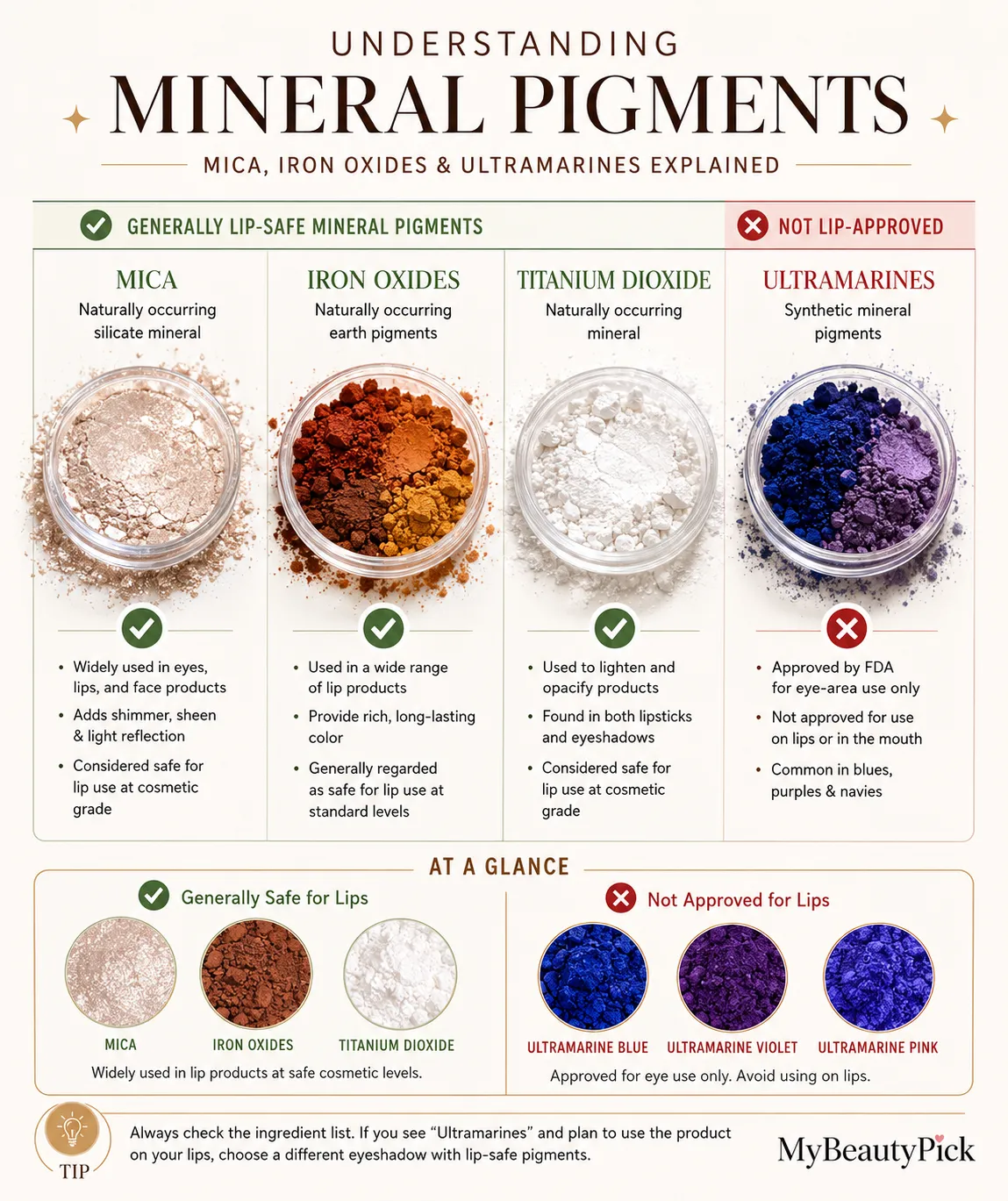
Iron oxides and titanium dioxide are mineral pigments considered exempt from FDA batch certification. They are widely used in both lipsticks and eyeshadows, and iron oxides are generally regarded as lip-safe at standard cosmetic concentrations. These are among the safer choices when selecting eyeshadows for lip use.
Mica is also broadly used across both eye and lip products and is not a lip-safety concern at standard cosmetic grades.
Ultramarines are where most people’s understanding breaks down. Ultramarine blue, ultramarine violet, and ultramarine pink are approved by the FDA for use in eye-area cosmetics — but are not approved for lip products. Many blue, purple, and navy eyeshadows contain ultramarines. If you are planning a blue or purple DIY lip colour and the eyeshadow lists “Ultramarines” on the ingredient label, that product is not cleared for lip use under FDA regulations.
Cosmetic glitter used in eyeshadows is often made from plastic or metallic film particles that are not approved for lip use or ingestion. Cosmetic-grade glitter approved for eye use is not the same as lip-safe glitter. Fine mica shimmer in pressed eyeshadow is generally a lower concern than chunky craft glitter or foil-based glitters. If the eyeshadow contains visible chunky glitter particles, do not use it on your lips.
How to Actually Check If an Eyeshadow Is Lip-Safe
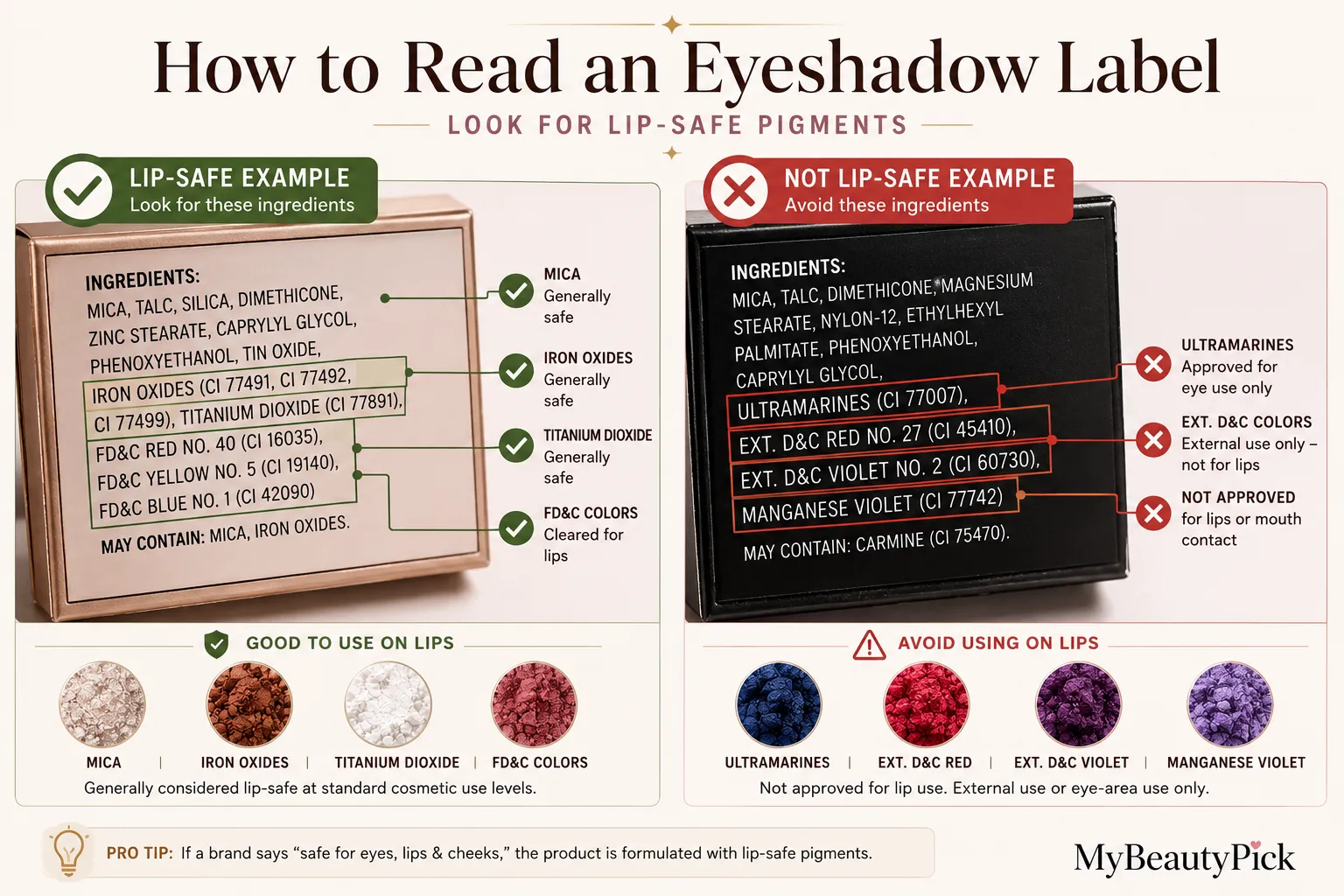
Read the ingredient list on the product packaging. Look for:
- Any “Ext. D&C” listing: Stop there. This product is not approved for lips.
- “Ultramarines” or “Ultramarine Blue/Violet/Pink”: Not approved for lip use by the FDA.
- D&C colour additives: Research the specific number against FDA’s colour additive tables, or choose a product explicitly labelled as lip-safe.
- FD&C colour additives: Generally cleared for lip use.
- Iron oxides, mica, titanium dioxide: Generally considered lip-safe at standard concentrations.
If an eyeshadow is marketed as multi-use — safe for eyes, lips, and cheeks — the brand has typically formulated it with only lip-safe pigments and tested accordingly. Products from brands like ColourPop, e.l.f., and MAC’s multi-use pigment lines are examples where the brand has designated specific products as safe for multiple facial zones. This is the most straightforward route for DIY lip colour without having to research individual pigment codes.
The easiest way to confirm safety without reading FDA pigment tables: check whether the brand explicitly lists the product as safe for lips on the product page or packaging. If a brand says “safe for eyes, lips, and cheeks,” they have taken responsibility for lip-safe formulation. If the product says “for eye use only,” believe it — do not apply it to your lips regardless of what the colour looks like.
What You Need Before You Start
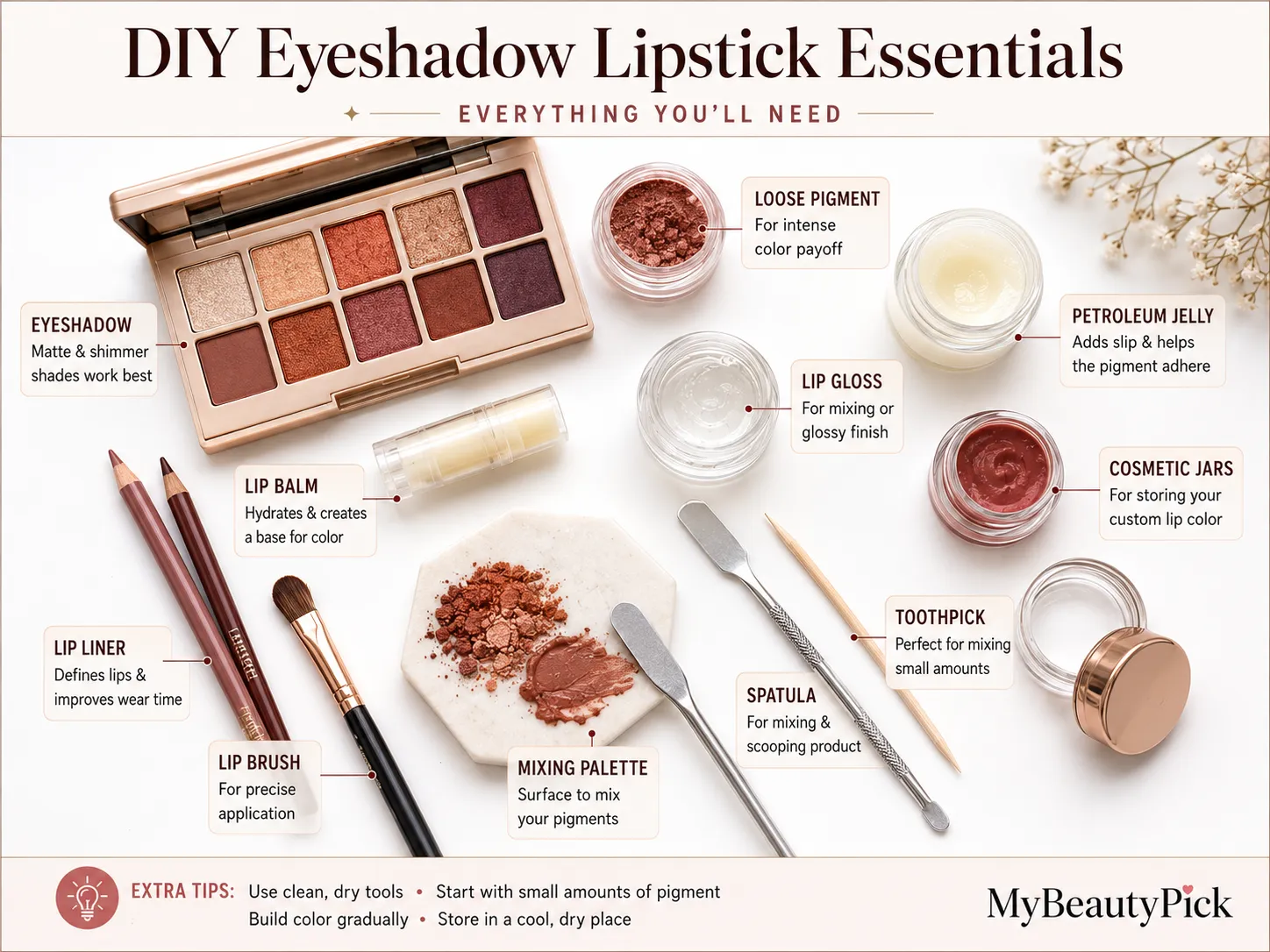
The materials are different depending on which method you use. These are the core items across all three approaches.
| Item | What to Use | Notes |
|---|---|---|
| Eyeshadow | Pressed or loose — confirmed lip-safe pigments | Matte shades give the most opaque, true-colour result. Shimmer adds metallic dimension. Check ingredient list first. |
| Lip base (method 1 & 2) | Clear lip balm, petroleum jelly, or clear gloss | Plain unflavoured lip balm is easiest to work with. Petroleum jelly gives more slip. Clear gloss gives the glossiest finish. |
| Lip base (method 3) | Unscented chapstick or lip balm for melting | Coloured lip balm shifts the final colour. Choose plain/clear. |
| Mixing tool | Clean spatula, toothpick, or back of a clean spoon | Keep tools clean and dry — moisture affects powder pigment. |
| Application tool | Lip brush or clean fingertip | A lip brush gives more precise placement. Fingertips warm the mix and help it adhere. |
| Storage (method 3) | Small cosmetic jar or old lip balm pot | Clean thoroughly before use. Melted mixture needs to be poured while still liquid. |
| Lip liner (optional) | Matching shade to intended lip colour | Significantly improves longevity and prevents feathering. Worth including. |
Method 1: Dry Eyeshadow Pressed Over Lip Balm
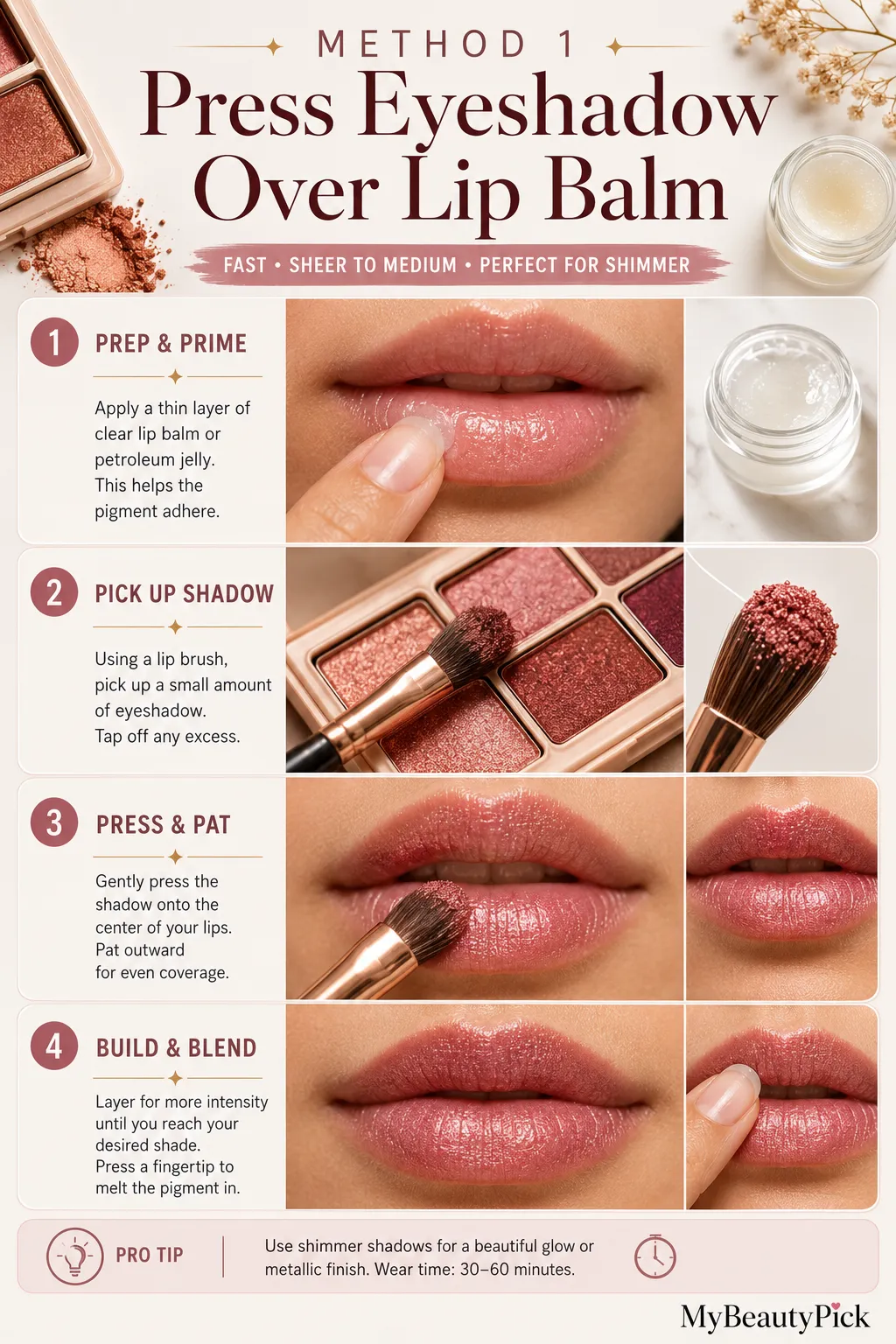
Dry Application Over Balm Base
Fastest method — best for on-the-go, sheer colour, shimmer
Apply a thin layer of clear lip balm or petroleum jelly to bare lips first. Allow it to sit for ten seconds — this gives the pigment something to cling to. Using a lip brush or clean fingertip, pick up a small amount of eyeshadow and press it onto the centre of the lips. Blend outward toward the edges. Layer additional pigment gradually rather than loading too much at once.
This method works best for sheer, natural lip colours and for shimmer or metallic effects. It does not give the saturated, opaque result of a real lipstick. The balm keeps the pigment from dusting off, but does not lock it in. Wear time is short — expect 30 to 60 minutes before significant fading, and immediate fading after eating or drinking. Reapplication is simple since both materials are already on the lips.
- 1Exfoliate lips gently with a damp cloth or soft toothbrush the night before or morning of for the smoothest base. Dry, rough lips absorb pigment unevenly.
- 2Apply a thin layer of clear lip balm or petroleum jelly. Thin is key — too thick and the eyeshadow slides around rather than adhering.
- 3Load a lip brush with eyeshadow, tapping off the excess. Press onto the centre of lips and pat outward. Do not swipe — pressing deposits the pigment more evenly.
- 4Build in thin layers. Two or three light applications produce better saturation than one heavy press that smears the pigment into the balm underneath.
- 5Press a fingertip over the finished colour to slightly warm and meld the pigment into the balm layer. This extends wear slightly.
- Shimmer and metallic lip effects
- Testing a colour before committing
- Sheer everyday colour with a balm feel
- Quick application with no mixing needed
- Warm tan skin — golden shimmers read beautifully
- Very short wear time — fades fast after eating
- Cannot achieve full-coverage or matte result
- Pigment can migrate outside lip line without liner
- Colour appears lighter than the pan
Method 2: Eyeshadow Mixed Into a Base Before Application
Mix-and-Apply
Most control — better pigment saturation, cleaner application
Scrape a small amount of eyeshadow onto a clean palette, mixing tile, or back of your hand. Add a small drop of petroleum jelly or clear lip gloss and use a toothpick or spatula to blend the two together into a smooth, even paste. The ratio is roughly one part eyeshadow pigment to one part base — but this varies by how saturated you want the colour. More eyeshadow produces a deeper, more matte result. More base produces a sheerer, glossier finish.
Apply the mixed paste directly to the lips with a lip brush. The advantage over method one is control: you know exactly how pigmented the mixture is before it touches your lips, and a brush gives you a more defined edge. This method produces a more consistent, even colour than pressing dry powder over balm.
- 1Scrape eyeshadow onto a clean surface using a spatula or toothpick. Crush any lumps so the pigment is fine and even.
- 2Add petroleum jelly or clear gloss. Mix thoroughly until the paste is smooth with no dry pigment streaks. Test the colour on the back of your hand first — what you see on skin is what you will get on your lips.
- 3Outline with lip liner first if using one. Lining before colour application gives the DIY pigment a defined boundary to work within and significantly improves wear.
- 4Apply the mixture with a lip brush from the centre of the lips outward. Work in thin layers and let each one settle for a few seconds before adding more.
- 5For a matte finish: lightly press a folded tissue to the lips after application. For gloss: add a small dab of clear gloss to the centre of the lips over the finished colour.
- Matte eyeshadow shades that translate well
- More saturated, deeper lip colour
- Custom mixing — blend two shadows for a unique shade
- Better precision than Method 1
- Repurposing broken or depotted eyeshadow
- Requires mixing before each use — not quick
- Cannot be stored hygienically once mixed on skin
- Petroleum jelly base is not long-lasting
- Still fades significantly faster than lipstick
Method 3: Melt Eyeshadow Into a Lip Balm Base
Homemade Lipstick — Melt and Pour
Makes a reusable product — closest to actual lipstick performance
This method makes a small pot of tinted lip balm you can keep and reuse. Melt a plain, unscented chapstick or lip balm in a heat-safe container over a pot of hot water — do not use a microwave as it is difficult to control the temperature and lip balm scorches easily. Once fully melted, add your crushed eyeshadow pigment while the balm is still liquid and stir thoroughly. Pour immediately into a small clean cosmetic jar or empty lip balm pot. Allow to cool at room temperature for two hours before use.
The result is a satin tinted balm with built-in colour that applies exactly like a regular lip balm or pot lipstick. It is the most practical of the three methods because it is reusable, stores easily, and applies cleanly without remixing. The colour intensity depends on how much eyeshadow was added — start with more than you think you need, as the pigment appears lighter once set into the wax base.
- 1Crush the eyeshadow into a fine, smooth powder in a small bowl. Lumps in the powder will create uneven colour in the finished product.
- 2Melt the lip balm in a small heat-safe container set over hot water. Keep the heat low — you want it melted, not boiling. The balm is ready when completely liquid with no solid pieces.
- 3Add the crushed eyeshadow to the melted balm and stir constantly. The ratio depends on desired intensity — a rough guide is one full eyeshadow pan (1.5–2g) per standard chapstick. Add more pigment for deeper colour.
- 4Pour immediately into a clean pot or container. Work fast — the mixture begins to set within seconds of being removed from heat. Pour in one slow, steady motion.
- 5Leave undisturbed at room temperature for at least two hours. Do not refrigerate — rapid cooling can cause the surface to crack or become grainy. Label the container with the date made.
- Creating a reusable custom tinted lip balm
- Repurposing broken or expired-but-safe eyeshadow
- The most lipstick-like application of the three methods
- Gift-worthy — easy to make in multiples
- Colour is lighter than expected — add more pigment than seems necessary
- Wax base does not hold pigment as long as a real lipstick binder
- Melting process is messy and requires clean equipment
- Use within 2–3 months — no preservatives in DIY formulas
DIY lip products have no preservatives, no antimicrobial agents, and no stability testing. Use clean, dry tools at every stage. Keep the finished product in an airtight container. Discard after two to three months regardless of how it looks. If the texture changes, the scent shifts, or mould appears, discard immediately. Do not make in large batches you cannot use within the shelf life.
Getting the Right Finish
Matte
Method 2 or 3 — matte eyeshadow shade
Use a matte eyeshadow with no shimmer or metallic particles. After application, press a folded single-ply tissue to the lips. The tissue absorbs the balm carrier and leaves behind the dry pigment, creating a soft matte finish. A thin dusting of translucent setting powder pressed over the colour seals it further.
Satin
All methods — no tissue blotting
Skip the tissue step. The natural balm or petroleum jelly base gives a satin, low-shine finish that is the most natural-looking result from DIY eyeshadow lipstick. The colour is slightly sheerer than matte but more comfortable.
Glossy
Method 1 or 2 — apply gloss over colour
Apply the colour using Method 1 or 2, then layer a clear gloss or balm over the top. The gloss re-wets the surface and adds shine. This is also the least long-lasting finish since gloss carries the pigment off the lips faster.
Metallic / Shimmer
Method 1 — shimmer shadow over balm
Method 1 is the best for shimmer. Press a lip-safe shimmer eyeshadow over clear balm and it reads as a metallic lip tint. Limit to fine mica-based shimmer — not chunky glitter. Gold, bronze, and rose-gold shadows on tan skin produce a warm, dimensional result.
Eyeshadow Colours That Work Best as Lip Colours on Tan Skin
Tan and warm skin tones have a natural warmth that interacts with pigment in specific ways. Not every eyeshadow colour that looks striking in the pan reads well as a lip colour against tan skin. These broad colour families tend to translate well.
| Eyeshadow Colour | How It Reads on Tan Skin | Finish That Works Best | Safety Flag |
|---|---|---|---|
| Warm terracotta / brick | Rich, natural — complements warm undertones beautifully | Matte or satin | Check for Ext. D&C |
| Burnt orange / copper | Warm and striking — reads earthy rather than clashing | Matte or metallic | Check for Ext. D&C orange shades |
| Gold / bronze shimmer | Lit-from-within glow — reads very naturally on warm tan tones | Shimmer over balm | Mica-based — generally safe |
| Deep burgundy / wine | Dramatic contrast — more saturated and bold on tan skin | Matte | Verify D&C Red shades |
| Warm nude / taupe | Natural finish — a close match to tan skin’s neutral depth | Satin | Usually iron oxide-based — generally safe |
| Dusty rose / mauve | Reads slightly cool but flatters neutral and cool tan undertones | Satin or glossy | Check D&C Red and Pink designations |
| Navy / ultramarine blue | Bold editorial — but most navy shadows contain ultramarines | Any | High risk — ultramarines not lip-approved. Seek FD&C Blue alternatives. |
How Long Does DIY Eyeshadow Lipstick Last?
Shorter than almost every tutorial suggests. Here is what to realistically expect.
Method 1 (dry over balm): 30 to 60 minutes on its own. Eating or drinking removes most of the colour immediately. Talking and natural lip movement cause gradual fade. Fine for a photoshoot, a short event, or testing a colour concept — not for a full day of wear.
Method 2 (mixed paste): Up to two hours on lips that have been prepped with lip liner, applied carefully, and kept away from food and drinks. The liner significantly extends the colour longevity. Without liner, expect similar fade to Method 1.
Method 3 (melted balm): Similar to Method 2 — up to two hours in good conditions. The wax base holds slightly better than straight petroleum jelly, which is why this produces the longest-wearing of the three results. Still far shorter than commercial lipstick, which is designed with pigment binders specifically for longevity.
Setting powder pressed lightly over any method adds roughly 20 to 30 minutes to wear time and helps prevent bleeding into fine lines around the lip edge.
7 Common Mistakes With DIY Eyeshadow Lipstick
- Skipping the safety check. Using an eyeshadow that contains Ext. D&C pigments or ultramarines on your lips because the colour looks right is the most significant error in this hack. Read the ingredient list before anything else.
- Applying over dry, rough lips. Flaky lip texture causes the pigment to cling to dry patches and look patchy everywhere else. A gentle scrub or damp cloth the night before makes a visible difference in how evenly the colour applies.
- Using too much product at once. Eyeshadow pigment is concentrated — more than a small amount results in a dusty, uneven look that is difficult to blend and starts falling off immediately. Build colour in thin layers.
- Expecting lipstick longevity. DIY eyeshadow lip colour is not lipstick. Treating it as a replacement for a long-wearing formula leads to disappointment. It is a creative, short-term colour option, not a durable cosmetic product.
- Using shimmer eyeshadow that contains chunky glitter. Fine mica shimmer is manageable. Chunky glitter particles are not lip-safe, are uncomfortable, and can scratch the lips and mouth. Always check whether the shimmer is fine mica or glitter before applying to lips.
- Mixing on the lips rather than on a palette. Applying eyeshadow powder directly to a lip balm-coated lip and trying to blend it there produces a messy, uneven result. Mix or swipe separately; apply the finished product deliberately.
- Not using lip liner. DIY pigment in a balm base migrates easily. Lip liner tracing the edge of the lips before colour application prevents feathering and significantly extends how long the colour stays defined. It is the single biggest longevity improvement available.
Frequently Asked Questions
Can you use eyeshadow as lipstick safely?
Yes — but only if the eyeshadow’s colour additives are approved for lip use. Check the ingredient list for “Ext. D&C” (not lip-safe) and “Ultramarines” (not approved for lips by the FDA). FD&C colour additives and mineral pigments like iron oxides and mica are generally safer for lip use. If an eyeshadow is specifically labelled as safe for lips and eyes, the brand has formulated it for both zones. When in doubt, choose a product marketed as multi-use rather than guessing at individual pigment codes.
Is eyeshadow lip-safe?
It depends entirely on the specific product and its colour additives. Some eyeshadows contain pigments approved for lip use alongside others that are not. The FDA requires different colour additive approvals for lip products versus eye products because lip products are partially ingested. Eyeshadows formulated only with FD&C colours, D&C colours cleared for lips, and mineral pigments such as iron oxides and mica are closer to lip-safe. Eyeshadows containing Ext. D&C colours or ultramarines should not be applied to lips. There is no blanket answer — each product’s ingredient list must be checked.
What can I mix with eyeshadow to make lipstick?
Clear lip balm, petroleum jelly (Vaseline), clear lip gloss, or an unscented chapstick are the most practical bases. Each produces a slightly different finish: petroleum jelly gives the most slip and shine; clear balm gives a satin finish; clear gloss produces the glossiest result. For the melt-and-pour method, an unscented plain chapstick or beeswax-based balm works best because it solidifies cleanly. Avoid coloured lip balms as the base colour shifts the final result unpredictably.
Can you mix eyeshadow with petroleum jelly?
Yes. Petroleum jelly is one of the most common bases for DIY eyeshadow lipstick. Scrape eyeshadow onto a clean palette, add a small amount of petroleum jelly, and mix to a smooth paste. Apply with a lip brush. The result is a satin-to-glossy tinted lip product with medium pigment intensity. Petroleum jelly is non-toxic and widely considered safe for lip use. The limitation is wear time — petroleum jelly is slippery, which means the colour migrates off the lips faster than a wax or binder-based formula.
Does eyeshadow last on lips?
Not as long as lipstick. Without a lip liner base, expect 30 to 60 minutes before significant fading, and the colour is removed almost entirely by eating or drinking. With a lip liner outlining the lips first, the colour can last up to two hours in the best conditions. Setting powder pressed over the finished colour adds slight additional longevity. No DIY eyeshadow formula approaches the wear of a commercial long-wearing or transfer-resistant lipstick, because those contain specific polymers and binders formulated for adhesion that a DIY base cannot replicate.
Can you use glitter eyeshadow as lipstick?
Only if the glitter is fine mica-based shimmer, not chunky cosmetic glitter. Most “glitter eyeshadow” that produces a sparkly, chunky effect uses plastic or metallic film particles that are not safe for lip use or ingestion. Fine pressed shimmer eyeshadows where the shine comes from finely milled mica are a different matter — these are lower concern and widely used in lip colour products already. If the eyeshadow produces visible chunky sparkle when swatched on the hand, do not apply it to lips. If it produces a fine metallic sheen, it is more likely mica-based and lower risk.
Which eyeshadows are safe for lips?
Eyeshadows formulated and marketed as safe for multiple facial zones including lips are the most reliable choice. Brands including e.l.f. Cosmetics, ColourPop, and NYX have specific multi-use products labelled as safe for eyes, lips, and cheeks — these have been formulated with only lip-safe pigments. For any other eyeshadow, check the ingredient list: avoid products listing Ext. D&C colours or Ultramarines. Mineral pigment-based shadows (iron oxides, mica, titanium dioxide) are generally lower risk. When checking the label is not possible, choose a product you know is multi-use.
Can you use broken eyeshadow to make lipstick?
Yes — broken eyeshadow that has crumbled in its pan is one of the best candidates for DIY lip colour because you are going to crush and mix it anyway. The same safety rules apply: check the ingredient list before using it on your lips regardless of its condition. The melt-and-pour method works particularly well with broken pressed eyeshadow because the already-loose pigment mixes more easily into melted balm than a solid pressed pan does. Use a clean tool to scrape out the broken powder and ensure no debris or contamination has entered the pan since it broke.