

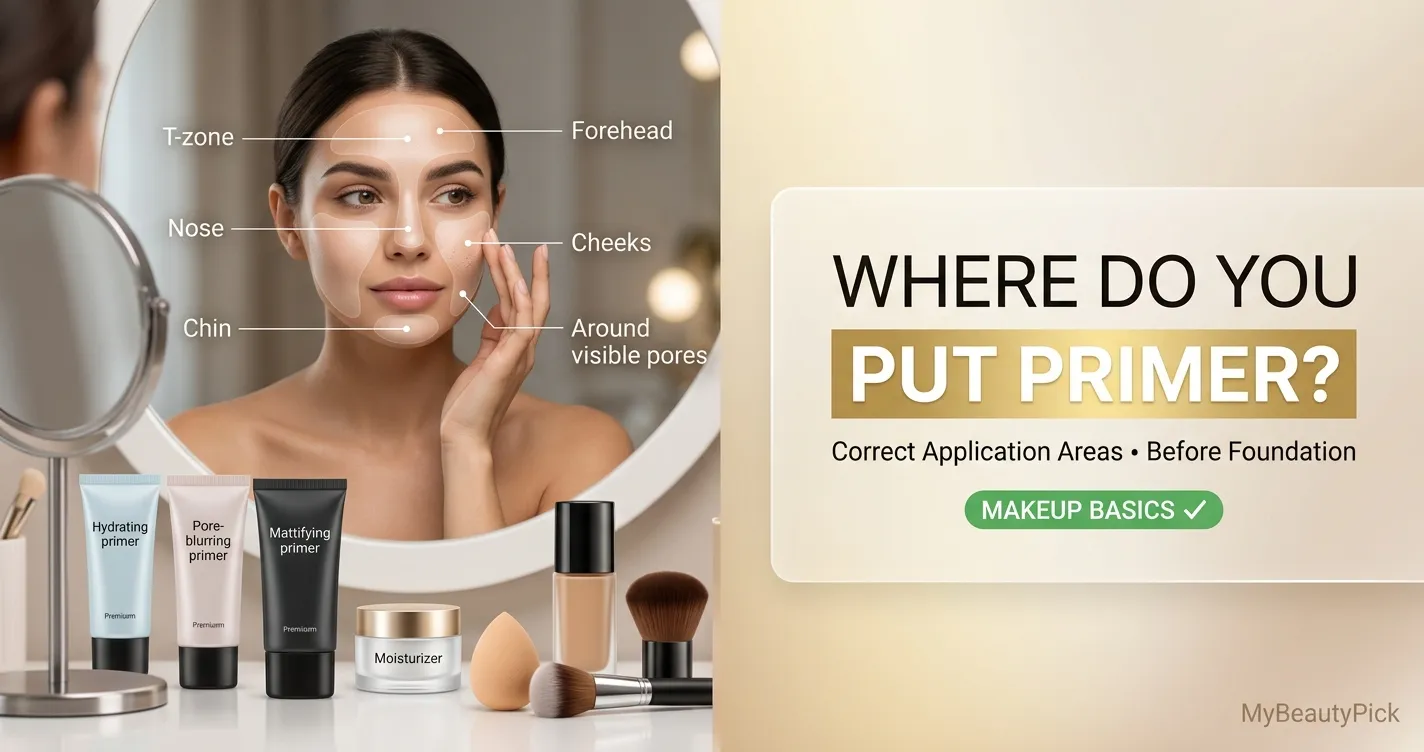
Where you put primer depends entirely on its type, not on some universal rule everyone follows. Mattifying primer goes on the T-zone and other oily areas. Hydrating primer goes everywhere, especially over dry patches. Pore-filling primer goes only on visible pores and fine lines. Color-correcting primer goes only where the discoloration actually is. Most confusion about primer placement comes from treating it as one product instead of four different jobs.
I’ve watched clients smear a full face of mattifying primer onto already-dry cheeks because a tutorial told them to apply it “all over,” and the result is exactly what you’d expect: flaking by noon. Here’s how placement should actually work, by type, plus the timing and rosacea questions that come up just as often.
Quick Answer
Where you put primer depends on its type. Mattifying primer goes on the T-zone and oily areas. Hydrating primer goes all over, especially dry patches. Pore-filling primer goes only on visible pores and fine lines. Color-correcting primer goes only on specific discoloration like redness or dullness. Matching placement to type matters more than applying primer uniformly across the whole face.
Primer Placement by Type: All-Over vs. Targeted Zones
Treating every primer the same way is the single biggest reason people get inconsistent results. Each type is solving a different problem, so each one belongs in a different place.
| Primer Type | Where It Goes | What It’s Solving |
|---|---|---|
| Mattifying | T-zone, oily patches only | Excess oil and shine breakthrough |
| Hydrating | All over the face | Dryness and uneven texture under foundation |
| Pore-filling / blurring | Visible pores and fine lines only | Texture, not oil or hydration |
| Color-correcting | Specific discoloration (redness, dullness) | Tone correction before foundation |
Combination skin is where this matters most in practice. Apply mattifying primer on the forehead, nose, and chin, then switch to a hydrating formula on the cheeks. Carrying two primers sounds excessive until you realize it solves the exact problem one universal product can’t.
Where Does Eye Primer Go? (Separate From Face Primer)
Eye primer is its own category and shouldn’t get folded into your face primer routine. It goes only on the eyelid, from lash line to brow bone, and its job is gripping eyeshadow and preventing creasing, not managing oil or texture on the rest of the face. Using a face primer on your lids, or eye primer anywhere outside that zone, won’t cause harm, but it also won’t do what either product is actually built for.
Primer vs. Moisturizer: Which Comes First
Moisturizer always goes first, followed by sunscreen if you’re wearing it, then primer. Primer is meant to sit on top of hydrated, protected skin, not underneath it. Applying primer before moisturizer traps the moisturizer beneath a layer it was never designed to penetrate, which usually shows up later as patchiness once foundation goes on.
How Long to Let Primer Dry Before Foundation
Give primer one to two minutes to set before applying foundation. It should feel matte or settled to the touch, not tacky. Rushing this step is the most common reason foundation pills, since wet primer and wet foundation mix together instead of sitting in clean layers.
Best Primer Approach for Rosacea-Prone Skin
This is general skincare guidance, not a diagnosis or treatment plan. If you have rosacea or suspect you do, a dermatologist is the right person to confirm what’s actually going on and recommend a treatment approach.
For makeup, a green-tinted, color-correcting primer is the most common professional recommendation, since green sits opposite red on the color wheel and helps neutralize visible redness before foundation goes on. Look for primers free of alcohol, added fragrance, and menthol, all of which show up repeatedly as rosacea triggers in dermatology guidance. Non-comedogenic, silicone-based formulas tend to sit more comfortably on reactive skin than heavier, oil-based ones.
Patch test any new primer on your jaw or neck before applying it to your full face, since rosacea-prone skin can react differently from one product to the next even within the “sensitive skin” category.
Can You Use Primer Instead of Foundation?
Yes, with a caveat. Primer alone evens texture and controls shine, but it provides little to no actual color correction or coverage. If your skin is already even-toned and you just want a smoother, longer-wearing base, primer alone can absolutely work, and this is exactly what’s driving the current skin-tint and “skip foundation” trend. If you have visible redness, discoloration, or breakouts you want to cover, primer alone won’t get you there. It’s a base, not a substitute for the product whose actual job is coverage.
- Applying one primer type everywhere. Mattifying primer on dry cheeks or hydrating primer over an already-oily T-zone both work against the skin instead of for it.
- Skipping the wait time before foundation. Going straight in while primer is still tacky is the most common cause of pilling.
- Using face primer on the eyelids. It won’t grip eyeshadow the way an actual eye primer will, leading to creasing by midday.
- Applying primer before moisturizer. This traps moisturizer underneath a layer it can’t absorb through, leading to patchiness later.
Frequently Asked Questions About Primer Placement
Do you apply primer all over your face?
Only if you’re using a hydrating primer. Mattifying primer belongs on the T-zone and oily areas, pore-filling primer goes only on visible pores and fine lines, and color-correcting primer goes only where the discoloration actually is. Hydrating primer is the one type genuinely meant for all-over application.
Which primer is best for rosacea?
A green-tinted, color-correcting primer free of alcohol, fragrance, and menthol is the most commonly recommended option for rosacea-prone skin, since it helps neutralize visible redness before foundation. This is general guidance, not medical advice, and a dermatologist can confirm what’s right for your specific skin.
Can niacinamide be a primer?
Not in the traditional sense. Niacinamide is a skincare ingredient that supports the skin barrier and calms redness over time, but it doesn’t create the smoothing or grip that a true makeup primer provides for foundation. Some primers include niacinamide as an added skincare benefit, but the ingredient alone isn’t a substitute for primer’s actual job.
Can I just use primer instead of foundation?
Yes, if your skin is already even-toned and you mainly want smoother texture and longer wear. Primer alone provides little real coverage, so if you have visible redness, discoloration, or breakouts you want to conceal, you’ll still need foundation or a tinted product on top.
Do you wait for primer to dry before applying foundation?
Yes, give it one to two minutes until it feels set rather than tacky. Applying foundation too soon is one of the most common reasons makeup pills or separates shortly after application.