

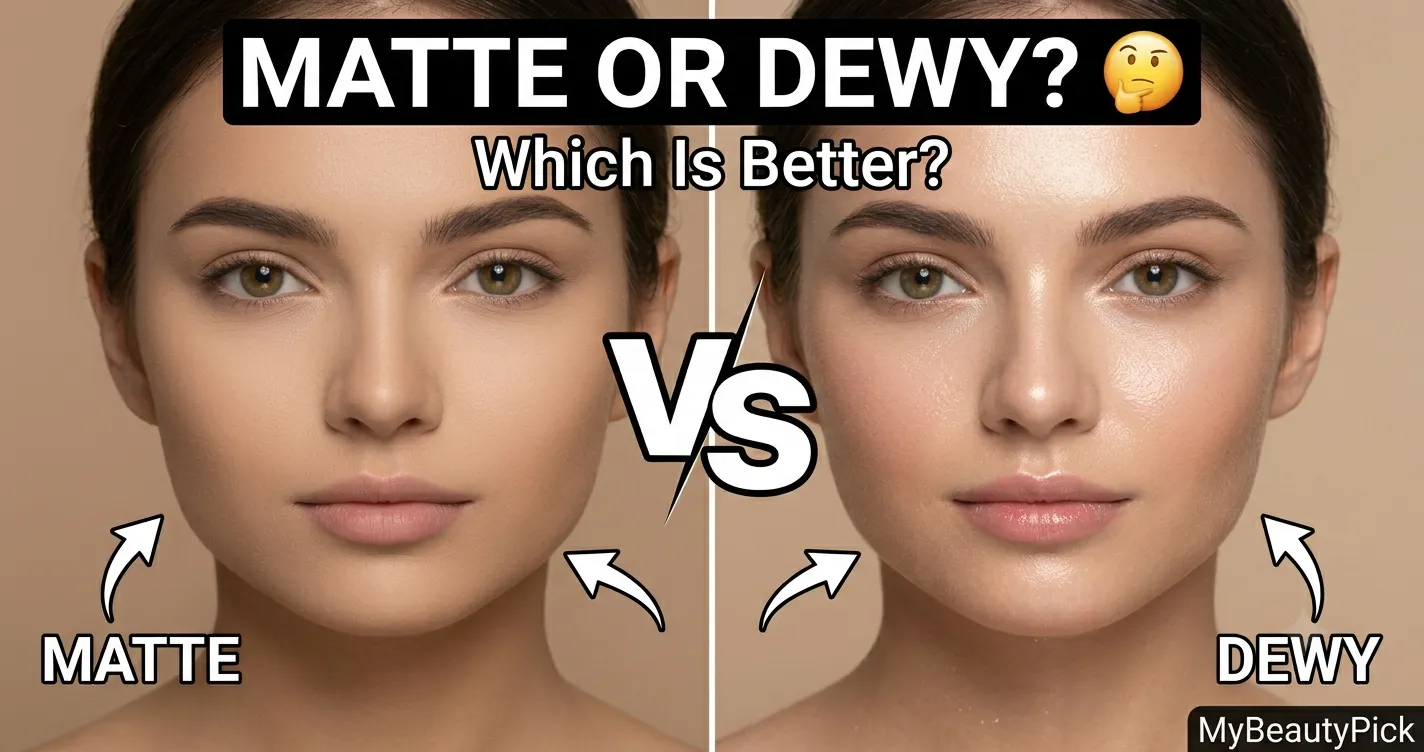
Matte versus dewy is one of those foundation questions that sounds simple until you realise the answer depends on at least four different variables: your skin type, the climate you’re in, how long you need the foundation to last, and whether you’re photographing the look or wearing it in real life. Neither finish is categorically better. They’re tools for different skin situations, and understanding when each one serves you well is more useful than picking a team.
- Matte foundation absorbs oil, stays put longer, and photographs cleanly — best for oily skin, humid climates, and long events.
- Dewy foundation adds luminosity and hydration — best for dry, normal, or mature skin and everyday wear.
- Satin finish sits between both and tends to work for the widest range of skin types without the extreme of either end.
- Combination skin often does better with a satin formula than committing fully to matte or dewy.
- Application method affects finish as much as the formula — dewy foundations applied with a brush look different than the same formula applied with a damp sponge.
What Matte Foundation Actually Does
A matte foundation absorbs oil and reflects minimal light. The finish reads as smooth, even, and shine-free — think polished skin rather than glowing skin. Good modern matte formulas have moved a long way from the flat, heavy coverage that dominated ten years ago. A soft-matte or natural-matte formula can still look like skin; it just looks like controlled skin.
The oil-absorbing ingredients in matte formulas — primarily silica and certain clays — are what create the finish. They soak up sebum from the skin surface and reduce the shine that comes with oil production. This is exactly why matte works so well on oily skin: it’s managing the skin’s behaviour rather than just sitting on top of it.
The problem is those same oil-absorbing ingredients on dry skin. Silica doesn’t distinguish between sebum you want removed and the minimal natural moisture dry skin already struggles to retain. On dry skin, a matte formula can pull what little moisture the skin has, creating a tight, flat, and sometimes cracking finish.
What Dewy Foundation Actually Does
A dewy foundation is formulated to reflect light and create the appearance of hydrated, healthy skin. The reflected light is what creates the glow — light-reflecting particles (usually mica or synthetic particles) in the formula bounce light off the skin surface. Many dewy formulas also contain humectants like glycerin or hyaluronic acid that hold moisture to the skin surface.
The distinction between dewy and oily is worth understanding because it trips a lot of people up. Dewy is reflected light from the formula’s particles. Oily is excess sebum sitting on the skin surface. They can look similar in photos but feel completely different. If a foundation makes your skin look wet two hours after application on oily skin, that’s probably sebum breaking down the formula — not the dewy formula doing what it’s designed to do.
Matte Foundation
- Controls oil and reduces shine
- Stays put longer without touch-ups
- Photographs clearly without flash reflection
- Works best in humid or warm climates
- Best for oily and combination skin
- Can feel tight on dry or dehydrated skin
- Can settle into fine lines if skin prep is skipped
Dewy Foundation
- Adds luminosity and a glowing appearance
- Contains hydrating ingredients in most formulas
- Looks more natural and skin-like
- Best for dry, normal, and mature skin
- May need powder on T-zone for oily skin
- Can amplify shine on oily skin
- Reads beautifully in natural light
Matte vs Dewy Foundation by Skin Type
Oily Skin
Matte is the practical choice for skin that produces significant oil. The oil-control properties actually extend foundation wear because there’s less sebum interaction breaking down the formula. The caveat: if your oily skin is also dehydrated (tight in some areas despite being shiny), going full matte all over can make the dehydrated areas look worse. In that case, a satin formula with a mattifying primer only on the T-zone often performs better than committing to full matte everywhere.
Dry Skin
Dewy foundation is far more comfortable on dry skin and avoids the clinging-to-dry-patches problem that matte formulas cause. The light-reflecting particles in a dewy formula also minimise the appearance of fine texture that dry skin tends to show. One thing to watch: if your dry skin also has visible pores, a dewy formula applied too heavily can sit in those pores and read as uneven. Apply lightly and build only where coverage is needed.
Combination Skin
Satin finish is genuinely the most useful recommendation here. A satin or natural-satin formula doesn’t amplify oil in the T-zone the way a dewy formula can, and it doesn’t over-dry the cheeks the way a matte does. The second useful approach for combination skin is zoning: a mattifying primer on the T-zone before applying a satin or light dewy foundation overall. This manages the oily zones without committing the whole face to a matte formula.
Normal Skin
Both work. On normal skin the finish choice becomes purely aesthetic and occasion-based. Dewy for everyday wear and natural light, matte for events, photography, or humid weather.
Mature Skin
Dewy or satin formulas are significantly more flattering on mature skin. Matte foundation tends to settle into fine lines and can emphasise surface texture that a luminous formula would soften. The light-reflecting quality of a dewy formula can visually smooth skin in a way that no amount of matte coverage can achieve. Avoid over-powdering — powder on mature skin emphasises lines far more than on younger skin.
The Factor Most Guides Skip: Climate
In a humid climate or during summer, a dewy formula can tip into oily-looking by midday even on dry skin. The ambient moisture in the air adds to the luminosity and the formula has less ability to set firmly. Matte tends to hold better in heat and humidity because the oil-absorbing ingredients continue working throughout the day.
In cold or dry weather, the reverse applies. A matte formula on skin that’s already moisture-depleted from dry air can look papery and crack at the edges of dry patches. Dewy formulas hold up better in dry climates because they’re designed to maintain moisture at the skin surface.
If you’re in a location with significant seasonal variation — hot humid summers, cold dry winters — you may genuinely need two formulas rather than one. Many people in these climates run a satin formula year-round as the safest middle ground.
For tan skin specifically, a satin or natural-satin finish is often the most reliable choice across seasons. Full matte can look flat against warm melanin-rich skin tones, reducing the natural warmth and depth of the complexion. A satin formula maintains that natural depth while keeping oil in check better than a fully dewy formula would.
How Application Method Changes the Finish
The same foundation formula produces a noticeably different finish depending on how it’s applied. This matters because people sometimes switch formulas when the real issue is their application tool.
- Dewy foundations applied with a brush look more covered and slightly less luminous than the same formula applied with a damp sponge. The bristles disrupt some of the light-reflecting particles during application.
- Dewy foundations with a damp sponge produce the most luminous, skin-like result. The sponge doesn’t displace particles the way a brush does.
- Matte foundations with a damp sponge look significantly more skin-like than when applied with a dense brush. The sponge softens the formula’s texture and reduces the risk of a flat, over-covered appearance.
- Matte foundations set with a dewy setting spray read as satin rather than matte — which is a useful technique for combination skin when a true satin formula isn’t available.
Can You Mix Matte and Dewy?
Yes, and it’s a practical technique rather than a compromise. The most common approach: apply a dewy or satin foundation overall, then set the T-zone only with a translucent or banana powder. The T-zone reads matte, the rest of the face retains the dewy finish. This works on combination skin better than most single-formula solutions.
The reverse also works: a matte foundation with a drop of facial oil or liquid highlighter mixed in before application. The added glow softens the flatness of the matte finish and creates a natural satin result. This is useful when you want some oil control but the available matte formulas read too flat on your skin tone.
Matte vs Dewy: Quick Decision Table
| If your situation is… | Choose |
|---|---|
| Oily skin, humid climate | Matte |
| Dry skin, everyday wear | Dewy or satin |
| Combination skin | Satin, or matte T-zone primer plus dewy formula |
| Mature skin | Dewy or light satin — avoid heavy matte |
| Event with photography | Matte or satin — dewy can overexpose in flash |
| Everyday natural look | Dewy or satin |
| Cold/dry climate winter | Dewy or satin |
| Hot/humid summer | Matte or satin with T-zone powder |
| Tan and warm skin | Satin — maintains natural warmth better than full matte |
Very dewy or luminous formulas can cause overexposed patches in flash photography on tan and deeper skin tones. If you’re wearing a dewy foundation for an event where photos will be taken, keep highlight placement to the cheekbone tip only and consider a light setting spray over the dewy base rather than pressing additional luminous products on top. A satin formula is generally safer for photography than a full dewy finish.
Frequently Asked Questions
Should I use matte or dewy foundation?
If you have oily or combination skin and your makeup needs to last through a long day or humid conditions, matte is the more reliable choice. If you have dry, normal, or mature skin and want a natural, skin-like finish, a dewy or satin formula will look more comfortable and more realistic. Combination skin often does best with a satin formula or a zoned approach: matte primer on the T-zone and a dewy or satin foundation overall.
Can dewy foundation work on oily skin?
A dewy foundation on fully oily skin usually tips into greasy-looking rather than glowing within a couple of hours. The exception is oily skin that’s also dehydrated — if your skin produces oil but feels tight underneath, a dewy formula with a mattifying primer only on the T-zone can work. For most oily skin types, a satin finish is a better middle ground than choosing between full matte and full dewy.
Does matte foundation look cakey?
It can, but it doesn’t have to. Cakey matte foundation almost always comes from applying too much product or using a matte formula on dry skin without adequate moisture prep underneath. Modern soft-matte formulas are significantly lighter than older versions and rarely look cakey when applied in a thin, even layer over well-hydrated skin with a primer underneath.
What is the difference between dewy and satin foundation?
Dewy foundation has visible luminosity and reflected light — it reads as genuinely glowing skin. Satin sits between matte and dewy: it has a subtle sheen that reads as healthy skin without active glow. Satin is the more versatile finish for most skin types and occasions because it doesn’t amplify oil on oily skin the way dewy can, but it doesn’t flatten the skin the way a heavy matte can.
Can I turn a matte foundation dewy?
Yes. Mix a drop of facial oil or a liquid highlighter into the foundation before application. Setting spray with a luminous finish applied over a matte foundation also softens the flatness. Conversely, a dewy foundation can be mattified by applying a blurring primer underneath and setting with a light layer of translucent powder on the T-zone.