

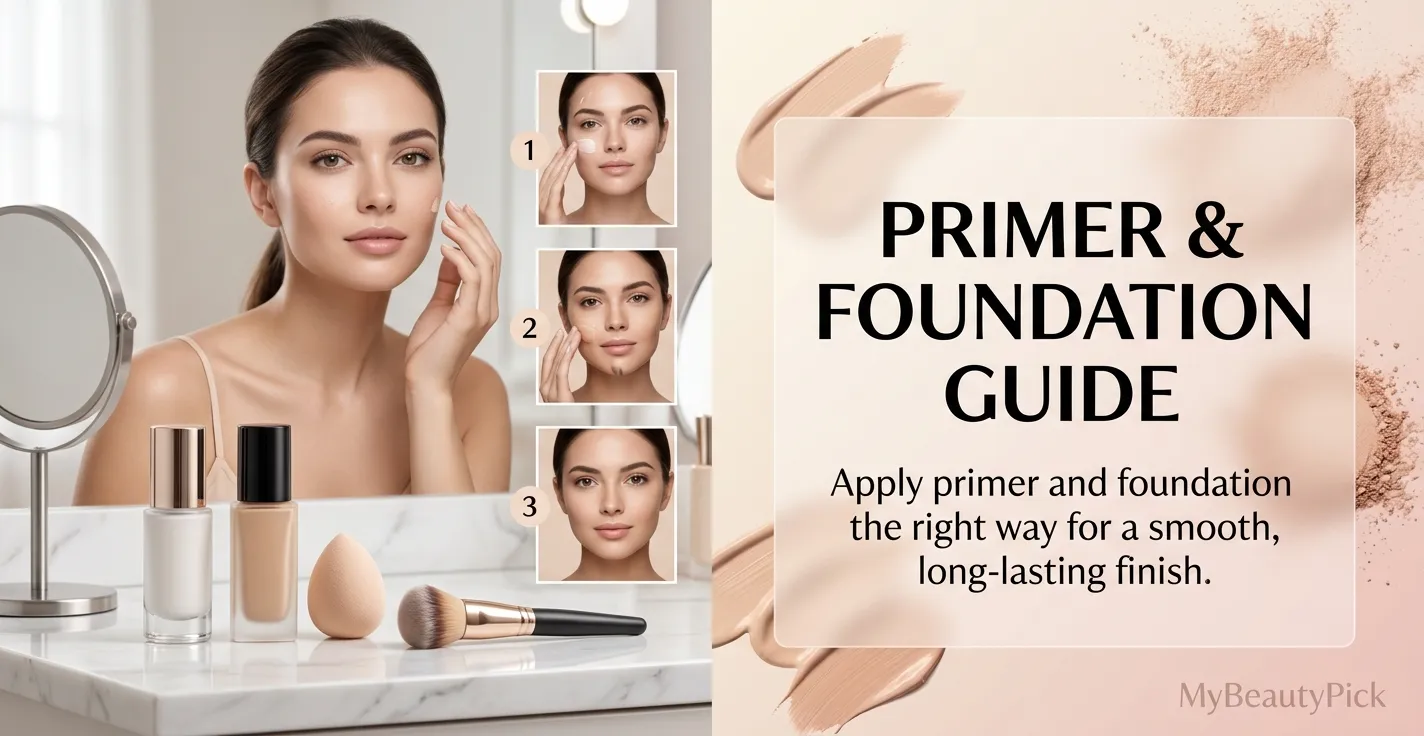
Primer always goes on before foundation. That’s the non-negotiable part — the rest of the layering order has some flexibility depending on your technique and what you’re trying to achieve. Getting the sequence right makes a real difference to how long foundation holds, how evenly it applies, and how natural the final result looks. This is the complete step-by-step guide, including where concealer fits and how the timing between each layer affects performance.
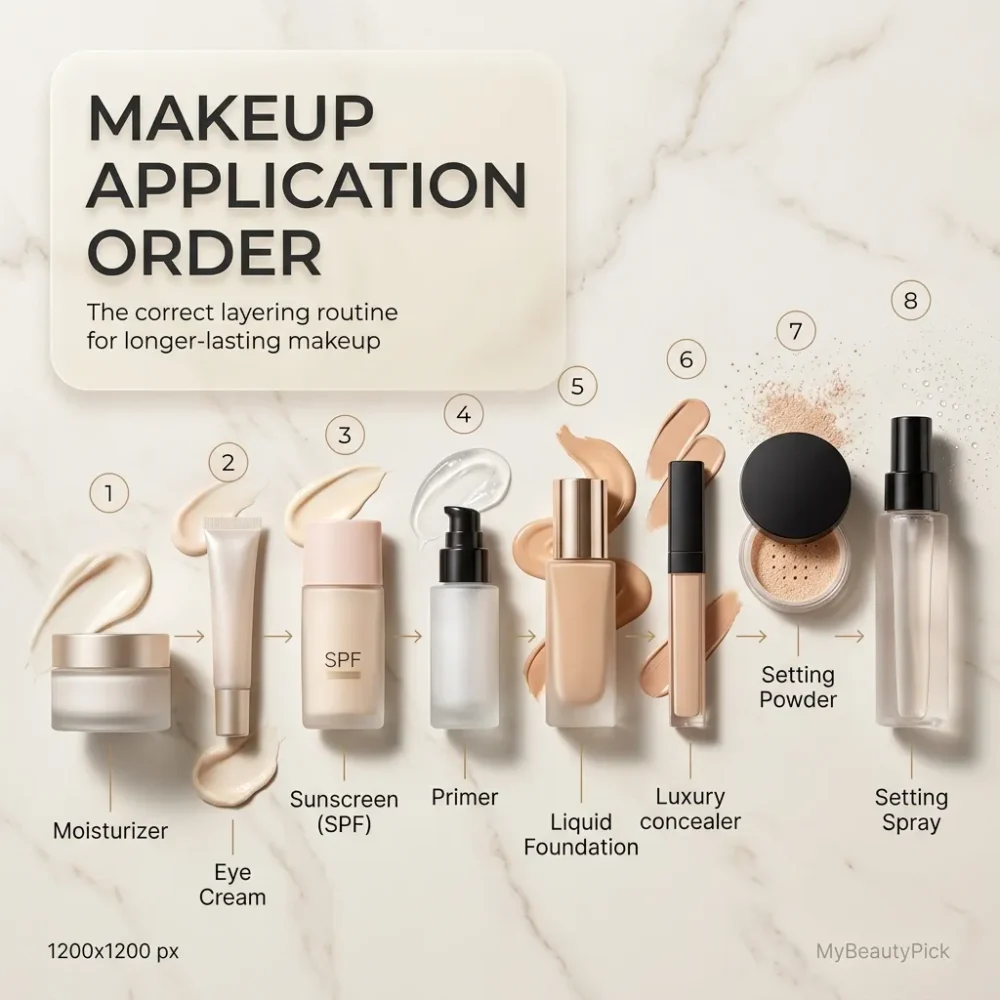
- Skincare (moisturiser + eye cream) → allow 2–3 min to absorb
- SPF → allow 2–3 min to absorb
- Primer → allow 1–2 min to set
- Foundation → blend immediately
- Concealer → target specific spots
- Setting powder → T-zone or all over
- Setting spray → locks everything
Step 1: Skincare First — Always

Foundation applies most evenly over skin that’s already hydrated and prepped. Dry, dehydrated skin makes foundation cling to patches and look textured by midday. Moisturiser gives the skin a smooth, even surface before anything else goes on.
Apply moisturiser and eye cream first. Give them 2–3 minutes to absorb before the next step. If you’re in a rush, a gentle press with a clean tissue after 60 seconds removes excess surface moisturiser without removing what’s absorbed — enough to move forward without waiting the full 3 minutes.
For tan and warm skin that tends toward oiliness: a lighter moisturiser or a moisturising serum rather than a heavy cream keeps foundation from sliding. The skin still needs hydration — skipping it doesn’t help, it just means the foundation is sitting on dehydrated skin that clings unevenly.
Step 2: SPF
If you’re using a dedicated chemical SPF, it goes between moisturiser and primer. Chemical SPF needs skin contact to work — applying it under moisturiser reduces its efficacy. Apply your SPF after moisturiser has absorbed, press gently into the skin rather than rubbing, and allow another 2–3 minutes before primer.
Physical SPF (mineral sunscreen with zinc oxide or titanium dioxide) sits on top of the skin surface and doesn’t need absorption time in the same way, but still benefits from 1–2 minutes of settling before primer goes over it.
Foundation with SPF 15 or 30 applied in a normal amount delivers a fraction of the tested SPF — you’d need to apply far more product than anyone normally uses to reach the rated protection. Always wear dedicated SPF under foundation. Any SPF in the foundation itself is a supplement.
Step 3: Primer — and Why Timing Matters
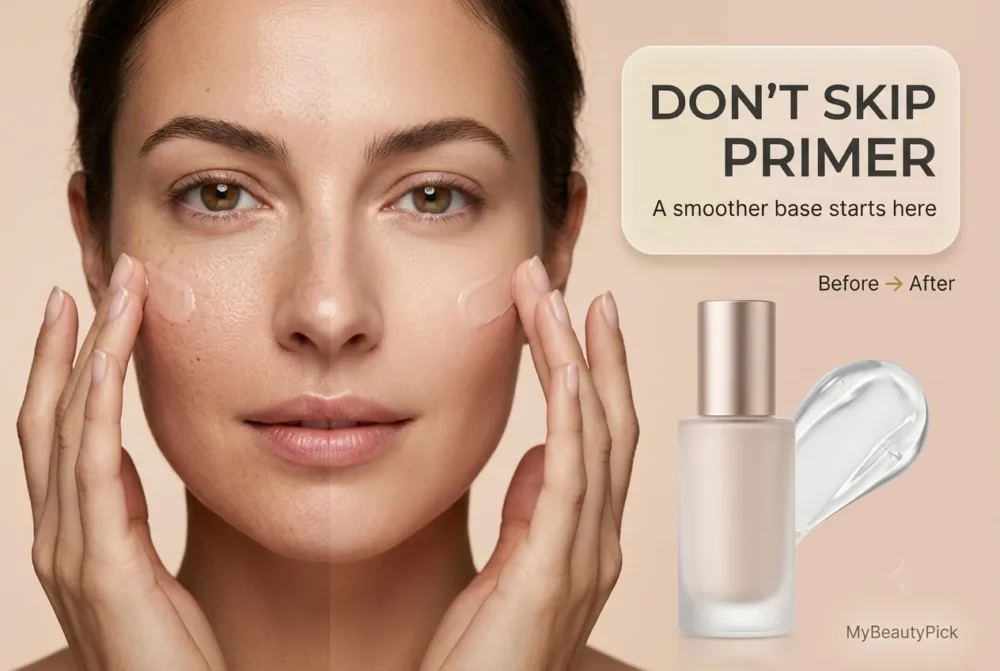
Primer goes on after SPF has settled. Apply a thin, even layer across the face — or just the areas that need it. You don’t have to prime the entire face: oily skin benefits from a mattifying primer concentrated on the T-zone; pore-blurring primer works best just on the nose and cheeks where pores are visible. Using primer everywhere when it’s only needed in specific zones wastes product and can create an overly smooth, artificial-looking base.
Wait 60–90 seconds after primer before applying foundation. Silicone-based primers need this time to create their smoothing film. Applying foundation immediately over wet primer causes two problems: the silicone can ball up as the brush or sponge drags it, and the foundation doesn’t adhere as cleanly. The short wait makes a real difference to how the foundation sits.
Match your primer base to your foundation base. Silicone primer under silicone foundation. Water-based primer under water-based foundation. Mismatched bases — particularly a thick silicone primer under a water-based foundation — is one of the most common causes of foundation pilling and separation. If your foundation keeps balling up, check whether the bases are compatible.
Step 4: Foundation Application
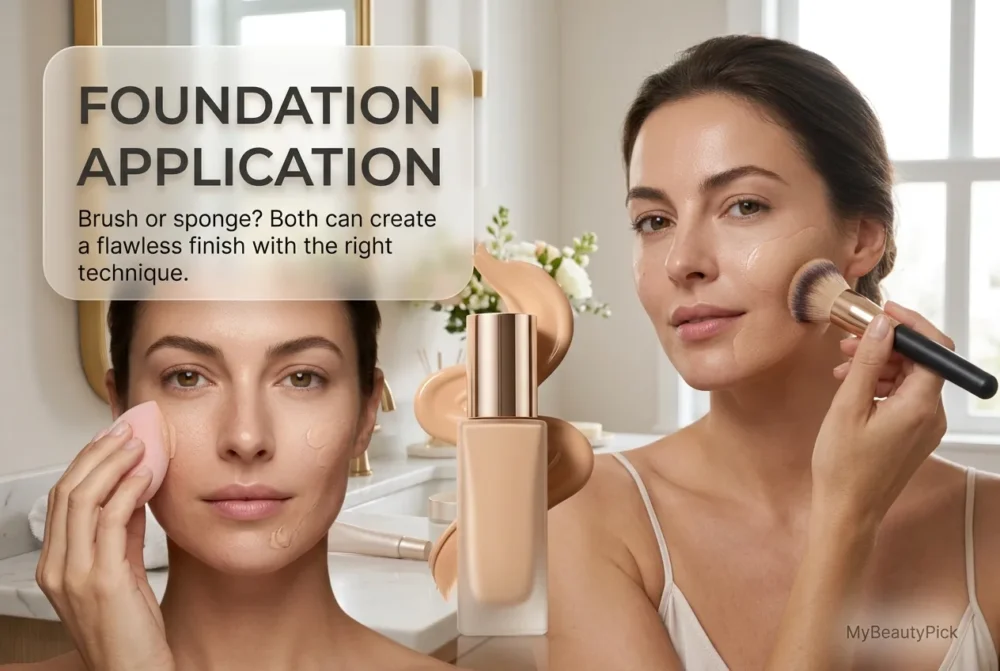
Apply foundation with a damp sponge or flat-top kabuki brush using pressing rather than swiping motions. Swiping streaks; pressing blends. Start at the centre of the face — nose, inner cheeks, forehead — and blend outward toward the hairline and jaw, letting coverage thin naturally at the edges rather than stopping with a hard line.
The amount matters as much as the technique. A pea-sized amount blended across the whole face gives a natural result on most skin. Building from thin is always easier than trying to thin down too much product. If coverage isn’t enough in specific areas after the first layer, add a second pass there only — not a second all-over layer.
Application by Skin Type
- Oily skin: set the T-zone with banana powder within 60 seconds of foundation application before moving to concealer. The powder locks the foundation before sebum can interact with it.
- Dry skin: damp sponge over brush. The pressing motion melds foundation into dry skin more smoothly. Skip powder on the cheeks.
- Combination skin: apply a mattifying primer on the T-zone only before foundation. Set the T-zone with powder; use setting spray on the cheeks.
- Tan skin in heat: go one shade cooler or more neutral than your exact match to account for oxidation during the day.
Step 5: Concealer — Before or After Foundation?
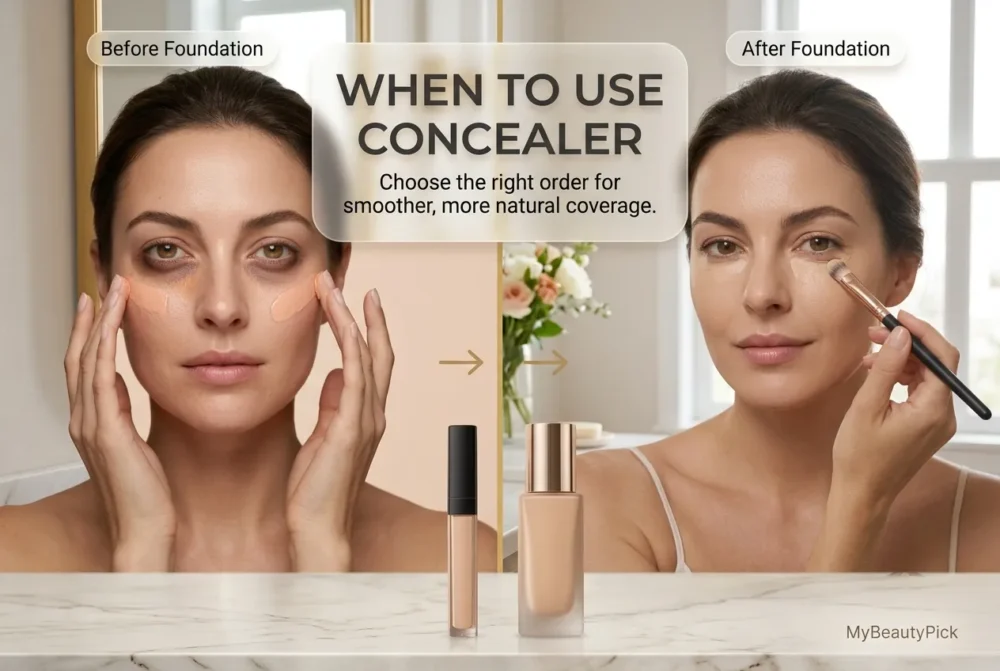
The honest answer is both approaches work, and the right one depends on what you’re covering and how much coverage you need.
Concealer after foundation is the most common approach and works for most people. Foundation covers the overall base first, evening out general tone. Then concealer goes over the top with a smaller brush or fingertip on spots, dark circles, or hyperpigmentation that needs extra coverage. Less concealer is needed because foundation has already done most of the work in that area.
Concealer before foundation is useful when colour correcting — using a peach or orange corrector under the eyes before foundation covers the corrector layer without disrupting it. It also works for spot treatment when you want a thick, precise layer of concealer without the foundation blending it down.
| Situation | Concealer Timing | Why |
|---|---|---|
| Dark circles, general under-eye | After foundation | Foundation reduces the amount of concealer needed |
| Active spots and acne marks | After foundation | Foundation does base coverage; concealer targets |
| Colour correcting (peach/orange corrector) | Before foundation | Foundation covers the corrector without lifting it |
| Significant hyperpigmentation | After foundation | Layer for layer control of coverage depth |
| Baking technique under eyes | Before foundation | Concealer bakes while foundation is applied elsewhere |
Step 6: Setting Powder

Setting powder locks foundation in place and controls shine. On oily skin, banana powder pressed on the T-zone immediately after foundation (and before concealer if you’re applying concealer after) extends hold significantly. On dry skin, skip powder on the cheeks entirely — just a light press on the T-zone if needed, and setting spray everywhere else.
Press rather than sweep powder for better hold. A large fluffy brush swipes product around; a dense velour puff or dense brush pressed firmly deposits it without disturbing the foundation underneath.
Step 7: Setting Spray
Setting spray is the last step in the base. After all powder is applied, a fine mist of setting spray over the face softens any powder finish, melds the layers together, and extends hold. On dry skin, setting spray replaces powder as the primary setting step for the cheeks. On tan skin in heat, an oil-control setting spray on the T-zone alongside a hydrating spray on the cheeks gives zone-specific control.
The Full Correct Order of Makeup Application
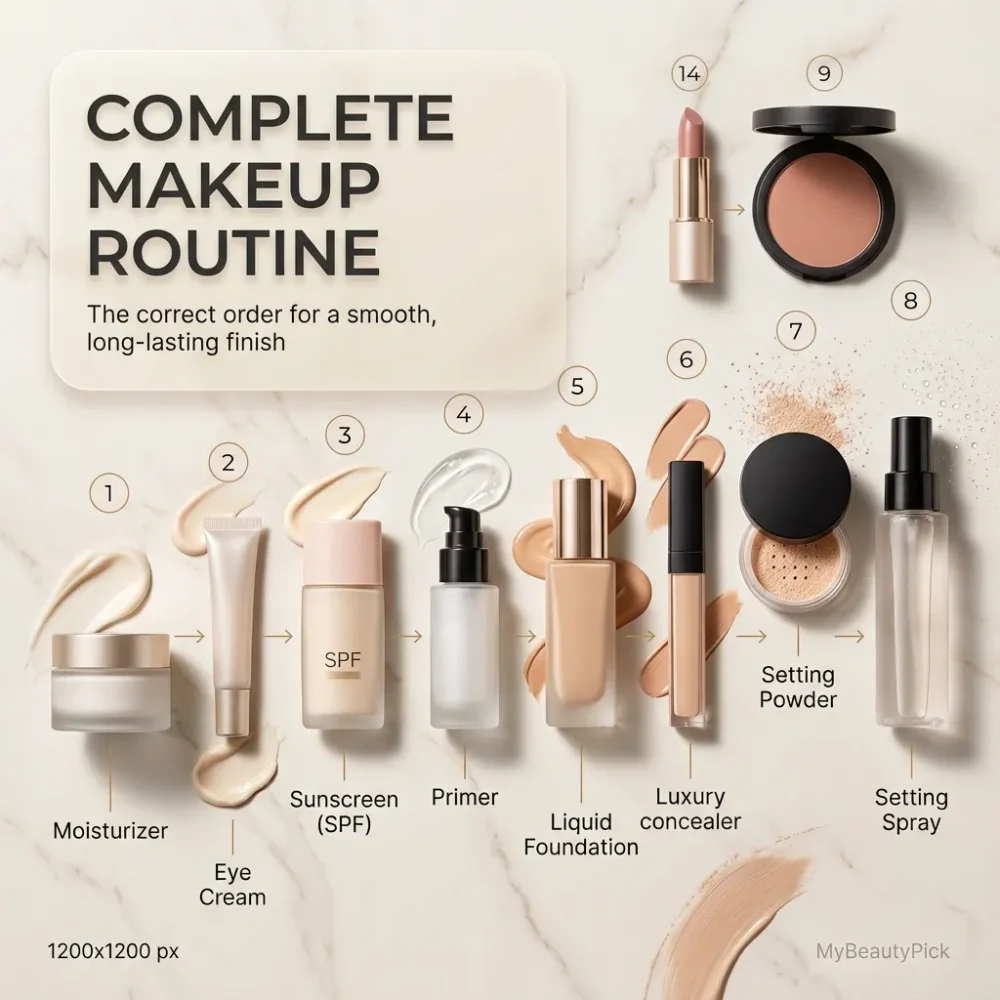
- 1Moisturiser + eye cream — allow 2–3 min
- 2SPF — allow 2–3 min
- 3Primer (T-zone or all over) — allow 60–90 sec
- 4Foundation — damp sponge, pressing motions, centre out
- 5Concealer — targeted areas
- 6Setting powder — pressed on T-zone; skip on dry skin cheeks
- 7Bronzer, blush, highlighter
- 8Eye makeup
- 9Lips
- 10Setting spray — final step
Frequently Asked Questions
Do you put primer on before or after foundation?
Primer always goes on before foundation. Primer’s job is to create an even, adhesive base for foundation to grip — applying it after defeats its purpose entirely. The correct order: skincare, SPF, primer (1–2 min to set), then foundation.
How long should you wait after primer before foundation?
Wait 60–90 seconds after primer before applying foundation. Silicone-based primers need time to settle and form their smoothing film. Applying foundation immediately over wet primer causes pilling and poor adhesion. A 60–90 second wait is enough; longer is fine.
Does primer go over or under moisturiser?
Primer goes over moisturiser. The correct order is: moisturiser (absorb), SPF (absorb), then primer. Primer applied over unabsorbed moisturiser pills and slides. Always give moisturiser 2–3 minutes to absorb before applying primer.
Does concealer go on before or after foundation?
Usually after. Foundation covers the overall base first; concealer targets specific spots with less product needed. Concealer before foundation works when colour correcting — using a peach or orange corrector under the eyes before the foundation layer covers it without disturbing it.
What is the correct order of makeup application?
Skincare → SPF → primer → foundation → concealer → setting powder → bronzer/blush/highlight → eye makeup → lips → setting spray. SPF and primer need absorption/setting time before the next step; everything after foundation can follow immediately.