

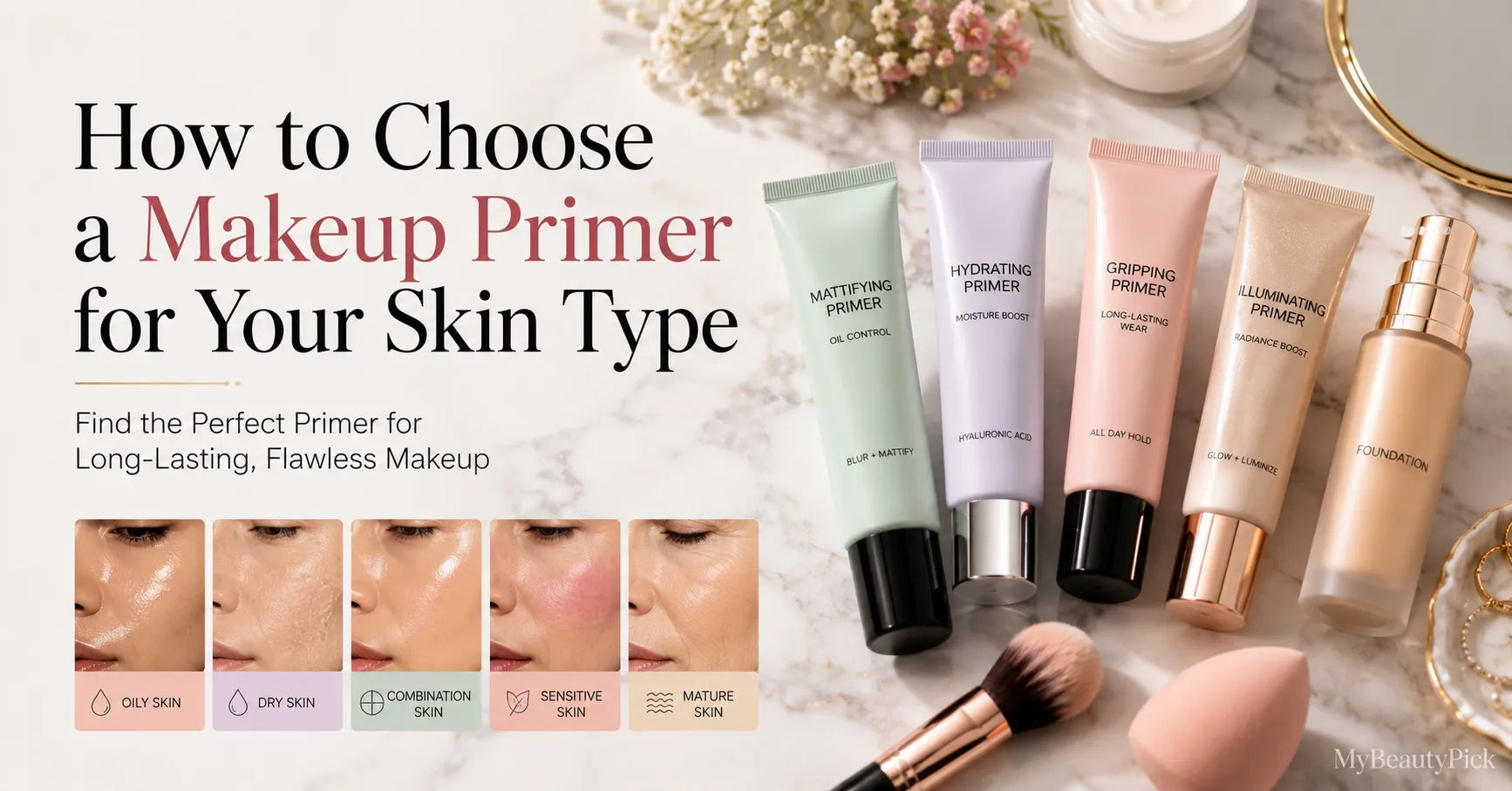
Choosing the right makeup primer is not about picking the most expensive one or the one your favourite influencer uses. It comes down to three things: your skin type, the skin concern you’re trying to address, and the foundation formula going on top. Get any one of those wrong and the primer works against you instead of for you. This guide walks through every variable so you can make a decision that actually suits your skin.
- Oily skin: silicone-based or water-based mattifying primer; avoid rich, hydrating formulas
- Dry or mature skin: hydrating water-based primer with hyaluronic acid or glycerin; avoid silicone-heavy formulas that cling to dry patches
- Combination skin: zone prime — mattifying primer on the T-zone, hydrating primer on dry cheeks
- Sensitive or acne-prone skin: fragrance-free water-based primer; avoid heavy silicones that can trap debris
- The compatibility rule: silicone primer under silicone-based foundation; water-based primer under water-based foundation. Mixing the two causes pilling.
What Does Makeup Primer Actually Do?
Before choosing a primer, it’s worth being clear on what it’s actually solving. Primer sits between your skincare and your foundation, and it serves different functions depending on its formula.
A mattifying primer creates a physical barrier between your skin’s sebum and the foundation above it, slowing the oil breakthrough that causes shine and colour shift. A hydrating primer fills in dehydration lines and dry patches so that foundation sits smoothly across the surface rather than clinging unevenly. A gripping primer creates a slightly tacky surface that foundation bonds to — extending wear on skin types where foundation tends to slide regardless of oil levels. A pore-filling primer uses silicones to physically fill the visible concave of enlarged pores, creating a temporarily smoother-looking surface.
None of these outcomes is better than the others. The right one is whichever addresses the specific reason your makeup currently fails. If your foundation slides off by noon, you need grip or oil control. If it looks patchy or emphasises dry areas, you need hydration. If it settles into pores, you need a filling formula. Identifying your actual problem is the first step.
Do you actually need a primer? Honestly, not always. For skin with minimal concerns, minimal coverage, and short wear requirements, a well-formulated moisturiser does much of what a lightweight hydrating primer would. Primer earns its place when you have a specific problem — oiliness, pore visibility, short foundation wear, colour concerns — that skincare alone doesn’t solve. If you’re applying primer out of habit rather than purpose, reconsider whether it’s improving anything.
How to Identify Your Skin Type (Quickly and Accurately)
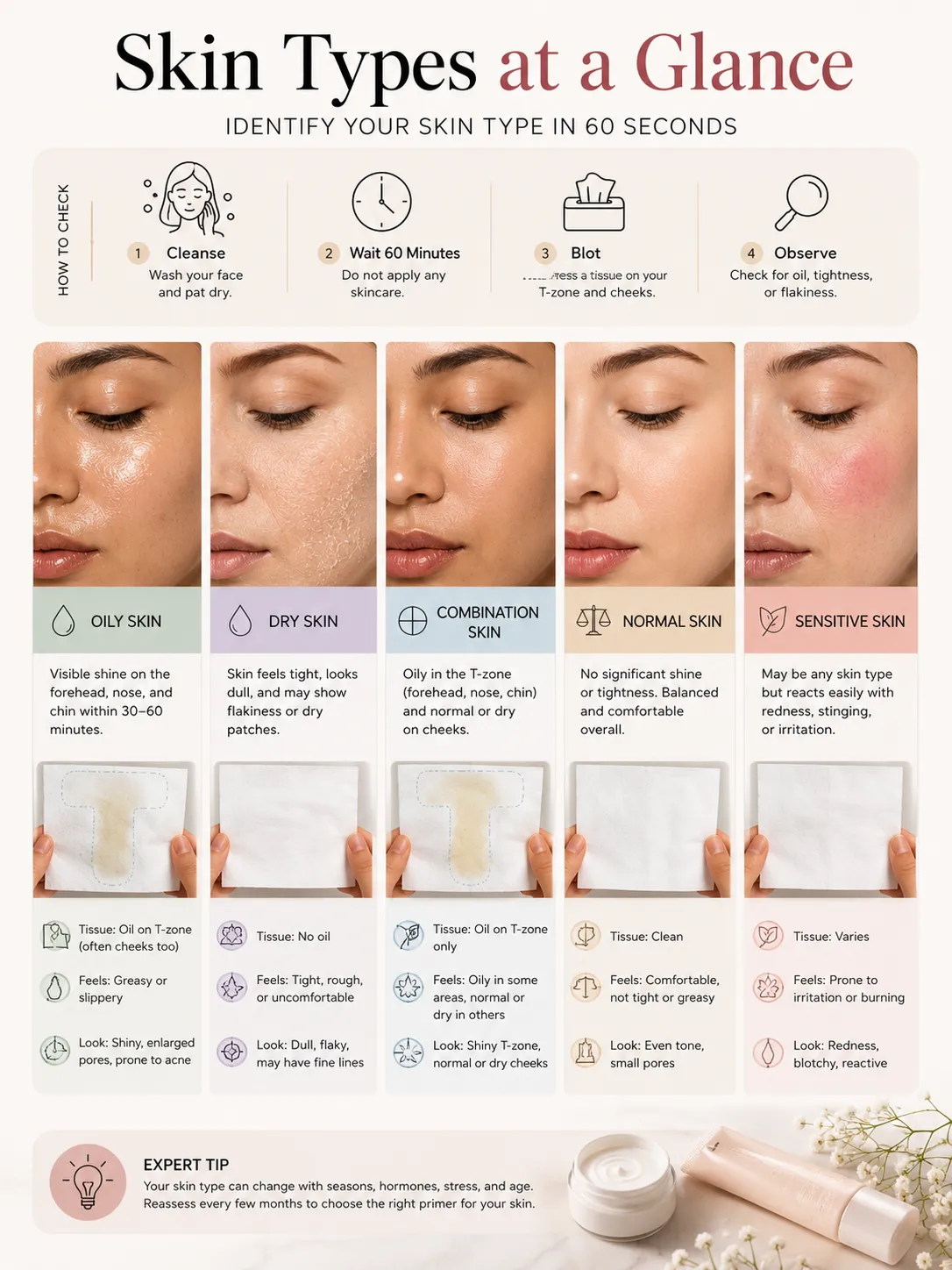
The easiest method: cleanse your face, apply no moisturiser or other products, wait 60 minutes, then look at your face in natural light and press a single-ply tissue against your T-zone and cheeks.
- Oily skin: visible shine on the nose, forehead, and chin within 30-60 minutes; tissue picks up oil on the T-zone and often the cheeks too
- Dry skin: skin feels tight, looks dull, and may show some flaking; tissue picks up nothing
- Combination skin: oily T-zone (nose, forehead, chin) with normal or dry cheeks; tissue picks up oil only on the T-zone strip
- Normal skin: no significant shine or tightness; tissue clean; balanced appearance
- Sensitive skin: any of the above types but with redness, reactive responses to new products, or a tendency to flush or sting with unfamiliar ingredients
- Mature skin: dry-to-normal type with fine lines, reduced elasticity, and surface dehydration even when the underlying skin isn’t clinically dry
Silicone vs Water-Based Primer: The Compatibility Rule That Changes Everything
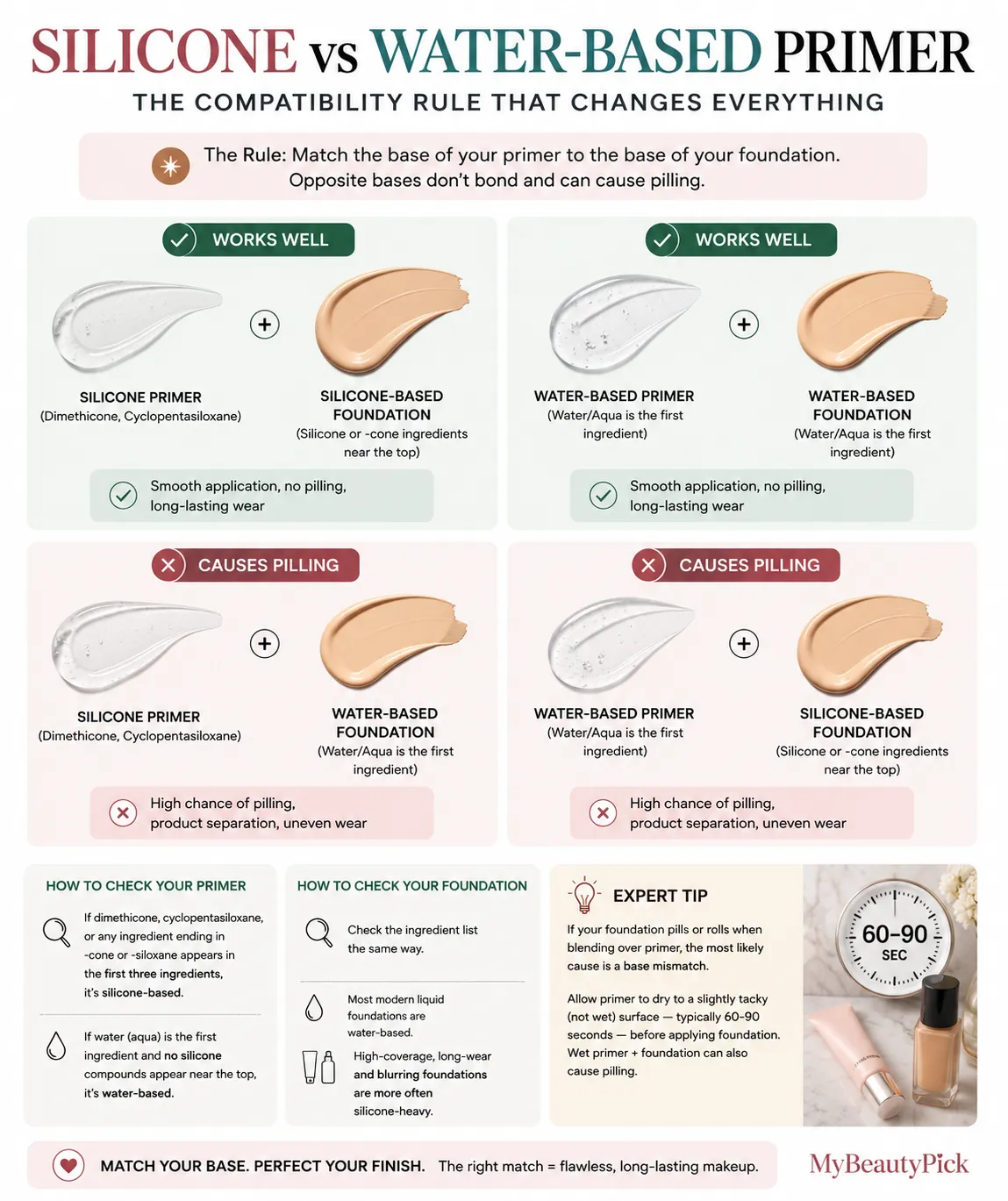
This is the single most practically important piece of information about primers, and it’s the most frequently skipped. Silicone-based and water-based products don’t bond together. When you apply a water-based product over a silicone surface (or vice versa), the two formulas bead up and separate rather than adhering. The result is pilling — small balls of product rolling across your skin as you try to blend — or separation within hours of wear.
The rule is simple: match the base of your primer to the base of your foundation.
To identify your primer’s base: if dimethicone, cyclopentasiloxane, or any ingredient ending in -cone or -siloxane appears in the first three ingredients, it’s silicone-based. If water (aqua) is the first ingredient and no silicone compounds appear near the top, it’s water-based.
To identify your foundation’s base: check the same way. Most modern liquid foundations are water-based, particularly drugstore and clean-beauty options. High-coverage, long-wear formulas and those with a blurring finish are more often silicone-heavy.
If your foundation pills when you try to blend it over primer, the most likely cause is a base mismatch. The second most common cause is applying foundation before the primer has fully set. Allow primer to dry to a slightly tacky but not wet surface — typically 60 to 90 seconds — before applying foundation. Wet primer plus foundation creates the same pilling effect as a base mismatch.
How to Choose a Makeup Primer for Your Skin Type
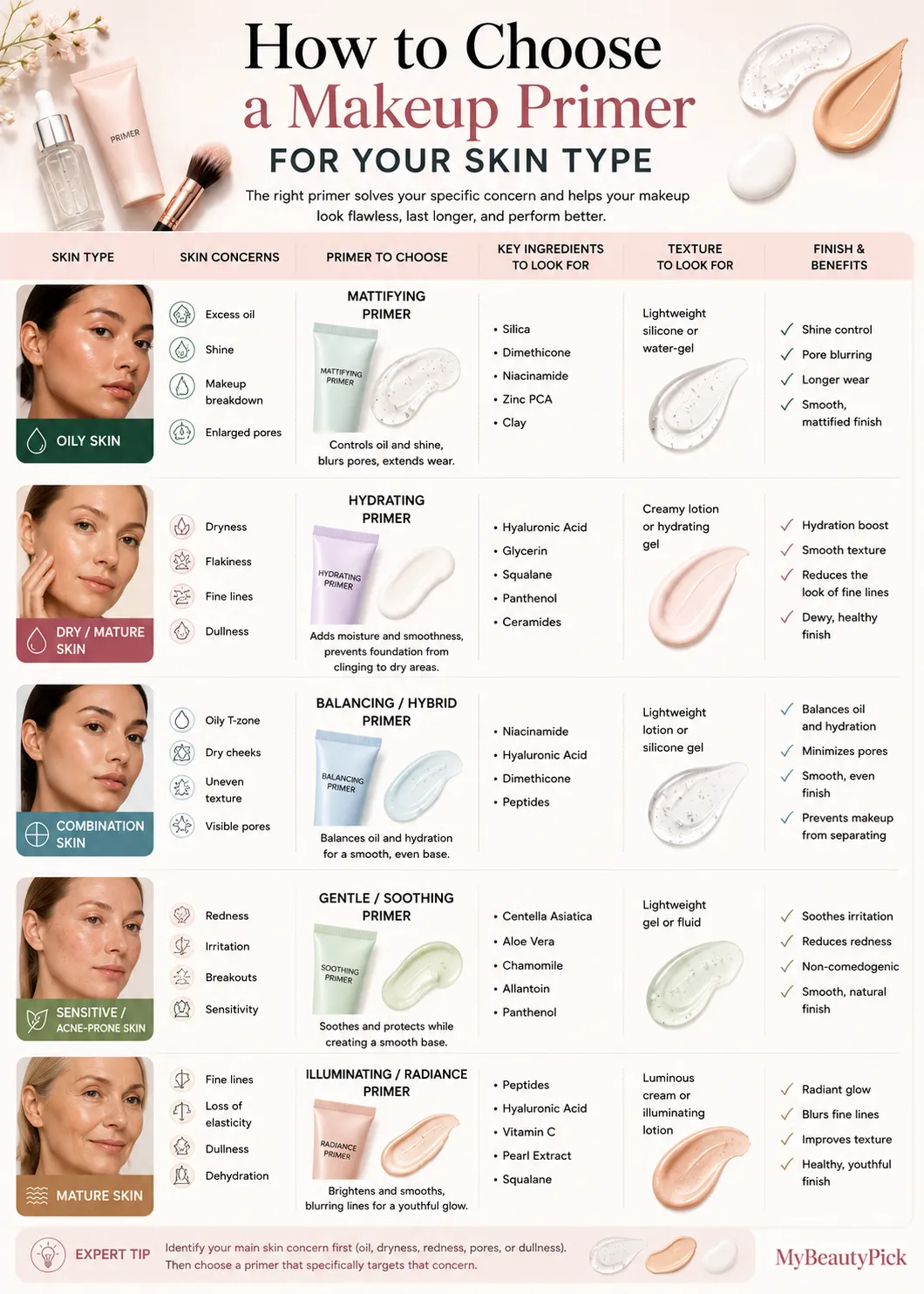
Primer for Oily Skin
Oily skin needs a primer that physically slows sebum migration from below the foundation layer. Two formula types achieve this in different ways.
Silicone-based mattifying primer creates a semi-occlusive barrier between skin and foundation. Dimethicone and cyclopentasiloxane form a film that sebum struggles to penetrate, keeping foundation in place and reducing shine breakthrough. The tradeoff: because silicone creates an occlusive barrier, it can trap oil, sweat, and debris on the skin surface in some cases, which is worth considering for acne-prone oily skin specifically.
Water-based mattifying primer uses oil-absorbing agents — silica, kaolin clay, niacinamide — to draw excess sebum to the product’s surface rather than blocking it from above. This approach allows skin to breathe more freely and is generally better tolerated by acne-prone oily skin.
Both work. The choice depends on what foundation you use. Silicone primer pairs with silicone foundations (most long-wear formulas); water-based mattifying primer pairs with water-based foundations (most everyday and clean-beauty formulas).
Ingredients to seek
- Dimethicone (silicone type)
- Silica (oil absorption)
- Kaolin clay (sebum control)
- Niacinamide (regulates sebum production)
- Salicylic acid (for acne-prone oily skin)
Avoid
- Heavy emollient oils as a base
- Illuminating or dewy finish primers
- Rich creams with glycerin-heavy formulas (adds moisture oily skin doesn’t need)
- Primers containing lanolin or cocoa butter
Recommended brands: Benefit Cosmetics The POREfessional (silicone, pore-filling), NYX Professional Makeup Pore Filler (silicone, blurring), Milk Makeup Hydro Grip Primer (water-based grip), Smashbox Photo Finish Pore Minimizing Primer (silicone, mattifying)
Primer for Dry Skin
Dry skin’s primer challenge is the opposite of oily: foundation clings to dry patches and flakes, producing visible texture that worsens through the day as the skin continues to dehydrate. A primer for dry skin needs to add moisture to the surface, smooth down flaky areas, and create enough slip that foundation spreads evenly rather than catching.
Water-based hydrating primers are consistently recommended for dry skin. They contain humectants — hyaluronic acid, glycerin, squalane — that pull moisture to the skin’s surface and keep it there, providing a plump, smooth base that foundation adheres to cleanly. Silicone primers, by contrast, sit on top of dry skin without adding moisture and can make parched skin look more matte and flat than desirable.
One technique worth knowing: on very dry skin, pressing 2-3 drops of facial oil into the skin before primer creates a slightly tacky, adhesive surface that primer grips better than bare dry skin. This is particularly effective for mineral and loose powder foundation users, where dry skin otherwise causes coverage to scatter unevenly.
Ingredients to seek: hyaluronic acid, glycerin, squalane, ceramides, vitamin E, aloe vera. Avoid: silicone-dominant formulas, high-alcohol content, kaolin or mattifying clay bases.
Recommended brands: Tatcha The Silk Canvas (smoothing, dry-skin friendly), Hourglass Veil Mineral Primer (hydrating, fragrance-free), Rare Beauty Always An Optimist Pore Diffusing Primer (water-based, skin-plumping)
Primer for Combination Skin
Combination skin is where zone priming becomes the most practical approach, and the one that most single-product solutions fail to deliver. A mattifying primer applied all over combination skin dries out the cheeks; a hydrating primer all over leaves the T-zone glossy within hours.
Zone priming means applying different products to different facial areas:
- T-zone (forehead, nose, chin): a pea-sized amount of mattifying primer, silicone or water-based, pressed specifically onto oily zones only
- Cheeks and dry zones: a separate hydrating primer or simply a well-absorbed moisturiser as the base
This sounds complicated but takes under 30 seconds once it’s habit. The result is noticeably better than any single formula applied uniformly, and it eliminates the “dry in some places, shiny in others” midday result that combination skin often gets.
Recommended brands: Smashbox Photo Finish Foundation Primer (versatile, works on both zones), Milk Makeup Hydro Grip on cheeks + e.l.f. Cosmetics Poreless Putty Primer on T-zone
Primer for Sensitive Skin
Sensitive skin’s primer requirements centre on what’s not in the formula rather than what is. Fragrance — both synthetic and botanical — is the most common cause of contact dermatitis in cosmetics. High-concentration silicones can create an occlusive environment that traps allergens against reactive skin. Alcohol denat, added as a quick-dry agent in many primers, strips the barrier and causes immediate stinging on sensitised skin.
For sensitive skin, a fragrance-free, alcohol-free water-based primer with barrier-supporting ingredients is the safest category. Look for: niacinamide (anti-inflammatory, barrier-strengthening), ceramides (barrier lipid replenishment), hyaluronic acid (gentle hydration), aloe vera (immediate calming). Patch test any new primer on the jaw or inner arm for 24 hours before full-face application.
Mineral-based primers with zinc oxide are particularly well-suited to sensitive skin — zinc provides anti-inflammatory benefit alongside any SPF function, and the simple mineral ingredient list eliminates the preservatives and emulsifiers that trigger most cosmetic reactions.
For primer for acne-prone skin specifically: water-based, fragrance-free, and non-comedogenic are the mandatory filters. Silicone primers are not inherently comedogenic — dimethicone itself doesn’t block pores — but they do create an occlusive surface that can trap sebum, sweat, and debris, potentially worsening active breakouts in high-sebum skin. Water-based primers with niacinamide or salicylic acid are better-matched to skin that both breaks out and is sensitive.
Recommended brands: Rare Beauty Always An Optimist (fragrance-free, water-based), NYX Professional Makeup Bare With Me Hydrating Primer (niacinamide, fragrance-free), e.l.f. Cosmetics Hydrating Face Primer (fragrance-free, non-comedogenic)
Primer for Mature Skin
Mature skin needs specific considerations that most primer guides skip entirely. Skin in its 50s, 60s, and beyond has reduced oil production, lower collagen density, slower cell turnover, and more visible surface texture from fine lines. The primer failure modes for mature skin are different from every other category: heavy silicone formulas settle into lines and emphasise them over the course of a wear day; mattifying primers remove the natural moisture that makes skin look plump; and over-application of any primer increases the product load that settles into creases.
The best primer for mature skin is typically a lightweight hydrating formula — often a serum primer — that adds moisture, creates enough slip for smooth foundation application, and doesn’t add significant product weight to the skin. Less product, more hydration, and a luminous rather than matte finish preference work consistently for this skin type.
Avoid: pore-filling silicone primers (they settle into fine lines the same way they fill enlarged pores — visibly and heavily), powder-first primers, and anything with high alcohol content. Cream and serum-weight primers with hyaluronic acid and niacinamide in a water-base consistently produce the best results.
Recommended brands: Hourglass Veil Mineral Primer (hydrating, blurring without heaviness), Tatcha The Silk Canvas (silk-smooth finish, doesn’t settle into lines), Benefit Cosmetics The POREfessional Pore Primer (used lightly — excellent for mature skin with pore concerns at the nose)
Choosing Primer by Skin Concern
Primer for Large Pores and Textured Skin
Pore-filling primers use silicones to physically fill the concave of visibly enlarged pores, creating a temporarily smoother-looking surface. The most common active ingredients are dimethicone and cyclopentasiloxane. Applying a pore-filling primer and then running your finger across the skin should feel like glass — completely smooth, with no sense of pore texture beneath the surface.
The key is applying it correctly. Pore-filling primer should be pressed into the skin with a fingertip, not swept with a brush. Pressing pushes the product into the pore opening; sweeping distributes it across the surface where it has no filling effect. Apply a small amount, press into oily or pore-visible zones, and allow 60 seconds before foundation.
For textured skin beyond pore concerns, a smoothing primer with blurring optical pigments (often mica or soft-focus particles) diffuses light at the skin surface, reducing the visual contrast of uneven texture without physically filling it.
Recommended: Benefit Cosmetics The POREfessional, Smashbox Photo Finish Pore Minimizing, e.l.f. Cosmetics Poreless Putty Primer
Gripping Primer: What It Is and Who Needs It
Gripping primer is a category most guides overlook — it sits in a different functional position from both silicone and water-based options. A gripping primer creates a slightly tacky, almost rubbery surface that foundation bonds to very strongly. The tacky film dramatically extends wear by giving the foundation something to physically cling to rather than sliding across a smooth surface.
Who benefits most: skin types where foundation slides regardless of oil levels — particularly those using dewy or luminous foundation formulas, those in humid climates, and those who’ve tried everything for makeup longevity without success. Gripping primers are also useful under mineral powder foundations, which often need a slightly tacky base to adhere at buildable coverage levels rather than dusting off the skin.
The sensation takes adjustment — the slightly sticky feel is unfamiliar compared to silicone’s silky slip — but the wear results consistently outperform other primer types for foundation longevity.
Recommended: Milk Makeup Hydro Grip Primer (water-based grip, hydrating), NYX Professional Makeup Marshmellow Smoothing Primer (gripping finish with niacinamide)
Illuminating Primer
Illuminating primers contain light-reflecting particles — mica, pearl, micro-glitter — that create a radiant, glowing effect underneath or mixed into foundation. They suit dry and normal skin types wanting a dewy finish, and dull or sallow skin that needs more luminosity.
On oily skin, illuminating primer adds visible glow on top of already-present natural shine — the result is greasy rather than glowing. Use illuminating primer only on zones that are genuinely dry or dull (cheeks, temples, high points of the face), not all over on any skin type with significant oiliness.
Colour Correcting Primer
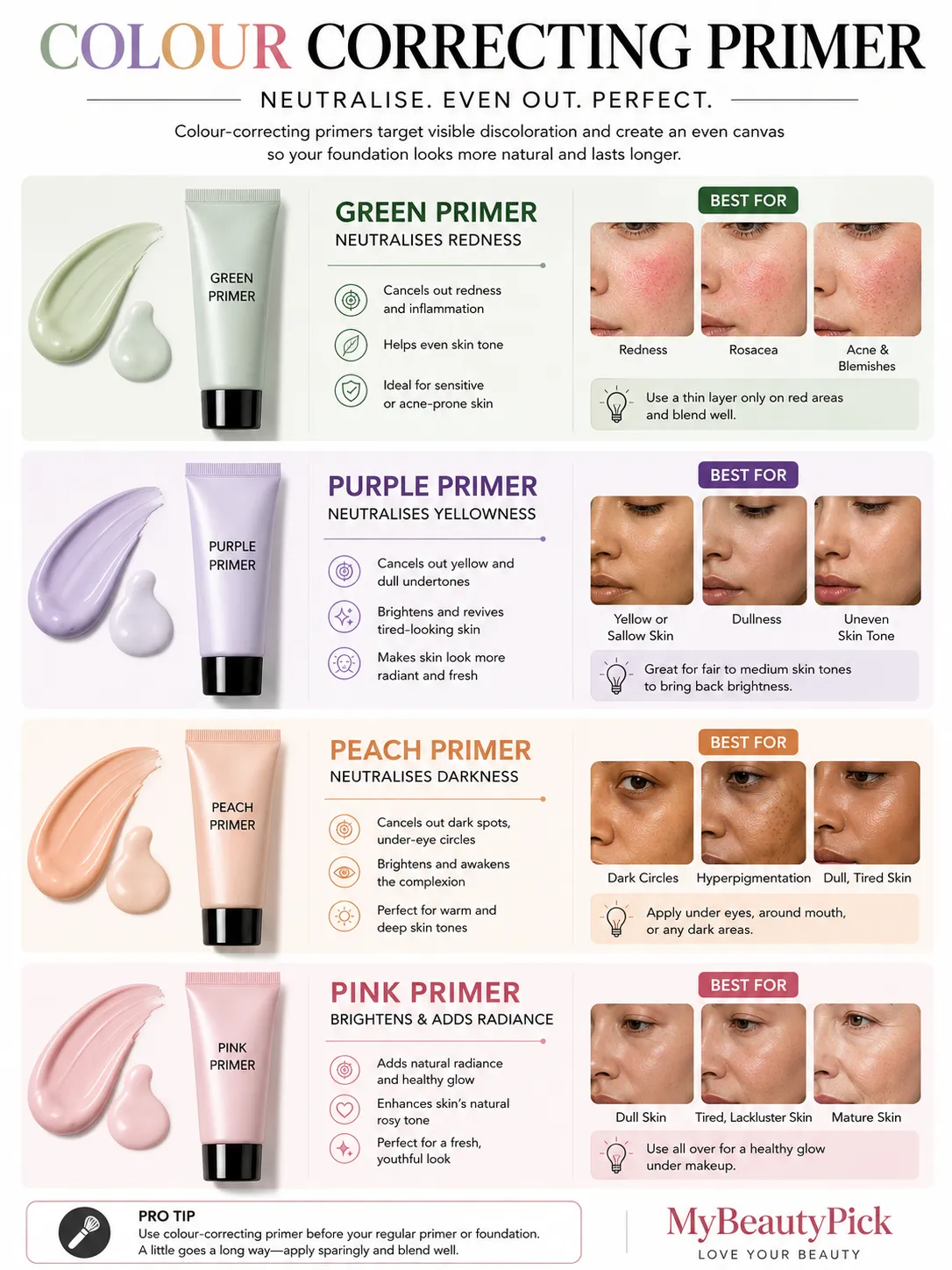
Colour correcting primers use the principles of colour theory — opposing colours on the colour wheel cancel each other out — to neutralise visible skin discolouration before foundation goes on. The result is that foundation only has to match skin tone rather than fight an underlying colour, reducing the coverage needed and creating a more natural result.
Apply colour correcting primer directly onto the concern area only — not all over the face. A thin press of green primer onto the cheeks and nose for rosacea, for example, needs only a small amount. Use too much and the corrector colour reads through foundation rather than disappearing beneath it.
Primer Types at a Glance
| Primer Type | Best For | Avoid If | Key Ingredients | Foundation Compatibility |
|---|---|---|---|---|
| Silicone (mattifying) | Oily skin, large pores, textured skin, long wear | Dry or mature skin; using a water-based foundation | Dimethicone, cyclopentasiloxane | Silicone-based foundation only |
| Water-based (hydrating) | Dry, sensitive, mature, acne-prone skin | Very oily skin wanting maximum oil control | Hyaluronic acid, glycerin, ceramides, aloe | Water-based foundation |
| Water-based (mattifying) | Oily or combination skin; acne-prone skin | Dry or mature skin | Silica, kaolin, niacinamide, salicylic acid | Water-based foundation |
| Gripping / tacky | Foundation longevity; dewy foundation users; humid climates | Those who dislike any surface texture during application | Grip polymers, niacinamide, aloe | Most water-based foundations |
| Illuminating | Dry, dull, or normal skin wanting glow | Oily or combination skin | Mica, pearl, light-reflecting pigments | Most foundations; dewy or satin finish best |
| Colour correcting | Redness, dullness, dark circles, sallowness | Skin without the specific concern the colour addresses | Iron oxides, mica (colour pigments) | Any foundation; medium-to-full coverage on top |
| Pore minimising / filling | Visibly enlarged pores, textured skin | Dry or mature skin — silicones settle into fine lines | High-concentration silicones, blurring polymers | Silicone-based foundation preferred |
How to Apply Primer: The Technique Most People Get Wrong
-
1Complete your skincare routine and wait
Cleanser, toner, serum, moisturiser, SPF in that order. Allow everything to absorb fully — 2 to 5 minutes. Applying primer over wet skincare layers causes both products to sit unabsorbed on the skin surface, creating pilling when foundation goes on top.
-
2Use less than you think
A pea-sized amount covers the full face for most primer types. Silicone pore-filling primers need even less — half a pea, pressed only into pore-visible zones. Over-application is the primary cause of primer-induced pilling and makeup separation. If your primer requires more than a small squeeze to cover, something else is wrong.
-
3Apply with fingers for most primer types
Fingertips warm the product slightly, helping it absorb into rather than sit on the skin. Press silicone primers into pore areas rather than sweeping. Distribute hydrating primers with gentle pressing and light circular motions. Brushes and sponges absorb product unnecessarily; fingers deliver more formula to skin with less waste.
-
4Wait for primer to reach the tacky window
60 to 90 seconds after application, primer should feel slightly tacky — not wet, not fully dry. This is the optimal window for foundation application. Wet primer mixes with foundation and both break down faster. Fully dry primer loses its grip and the foundation slides over rather than bonding to it. If you’ve rushed this step and found your foundation pilling, extend the wait time.
-
5Apply foundation with pressing motions over primer
Whether using a brush or a damp sponge, pressing and dabbing foundation over primer respects the layers beneath. Sweeping motions drag the primer across the skin rather than keeping it in the position you applied it. A damp sponge with a pressing and rolling motion deposits foundation evenly without disturbing primer placement.
Common Primer Mistakes
-
✕
Mismatching primer and foundation bases. Silicone primer under a water-based foundation is the most common cause of makeup pilling. Check the first three ingredients of both products before combining them. If you can’t identify the base from the label, search the product name plus “silicone or water based” before buying.
-
✕
Applying foundation immediately after primer. Foundation applied over wet primer mixes with it rather than sitting on top of it, reducing both products’ performance. The 60-90 second wait is not optional — it’s the difference between primer working and primer failing.
-
✕
Using too much product. More primer does not mean better coverage, longer wear, or more pore-filling. Excess product builds up on the skin surface, settles into pores and lines, and gives foundation nothing stable to adhere to. Use a pea-sized amount and resist the urge to add more when you don’t see immediate results.
-
✕
Using an illuminating primer all over oily skin. Illuminating primer adds glow on top of existing shine. The result is not radiant — it’s greasy. Use illuminating primer only on specific dry or dull zones (cheeks, temples) if you have any degree of oiliness, and use a mattifying formula on T-zone areas.
-
✕
Using a silicone pore-filling primer on mature skin. Silicone fills pores by filling concave indentations. Fine lines are also concave. The same formula that blurs pores settles heavily into fine lines and wrinkles over a wear day, making them look deeper by the afternoon. Mature skin benefits from smoothing and hydrating primers rather than pore-filling silicone formulas.
-
✕
Applying primer over skincare that hasn’t absorbed. A wet, fresh layer of serum or moisturiser under primer means two incompatible layers sitting against each other on the skin surface. They ball up and pill before foundation even goes on. Wait until your moisturiser feels absorbed and your skin surface is dry to the touch before priming.
-
✕
Applying colour corrector all over the face. Colour correcting primer is designed for the area with the specific concern. A green primer applied all over reads as green through foundation rather than neutralising the target area. Small amounts, pressed directly onto the concern zone, are how colour correction is meant to work.
Primer vs Moisturiser vs Sunscreen: What Goes When
| Product | Order | Purpose | Can One Replace the Other? |
|---|---|---|---|
| Moisturiser | 1st after skincare | Hydrates skin; supports barrier function | Can replace primer on very low-concern skin for natural or minimal coverage looks; cannot replace sunscreen |
| Sunscreen | 2nd (last skincare step) | UV protection; goes directly onto skin | Cannot be replaced by moisturiser or primer; primer with SPF adds attenuation on top but not full standalone protection |
| Primer | 3rd (first makeup step) | Extends foundation wear; addresses skin concern; creates compatible surface for foundation | Moisturiser can substitute for hydrating primer; nothing substitutes for mattifying or gripping primer function on oily or long-wear needs |
Primers labelled SPF rarely deliver meaningful sun protection in real-world use because they’re applied in quantities far below the 2mg/cm2 required to achieve the labelled SPF. A primer with SPF 30 applied at typical primer volume delivers closer to SPF 8-10 in practice. Use a dedicated sunscreen first, then primer on top. The SPF in primer functions as an additional thin layer of UV attenuation, not as a replacement for sunscreen.
FAQ
How do I know which makeup primer is right for me?
Start with your skin type (oily, dry, combination, sensitive, mature) and identify your primary concern (shine control, hydration, pore blurring, longevity, colour correction). Match the primer type to the concern, then verify it’s compatible with your foundation’s base (silicone with silicone, water-based with water-based). Those two filters narrow the choice down to a manageable shortlist within any budget.
What is the difference between silicone and water-based primer?
Silicone-based primers contain dimethicone or cyclopentasiloxane as the lead ingredient. They create a semi-occlusive barrier on the skin that blurs pores, smooths texture, and creates a physical layer sebum struggles to penetrate — making them effective for oily skin and long-wear needs. They pair only with silicone-based foundations.
Water-based primers list water (aqua) as the first ingredient. They absorb into the skin and add hydration, niacinamide, or other actives rather than sitting on the surface. They suit dry, sensitive, and acne-prone skin, and pair with water-based foundations.
Can I use moisturiser instead of primer?
For dry or normal skin with minimal coverage needs and low wear requirements, a well-formulated moisturiser provides enough base preparation that primer offers marginal additional benefit. For oily skin wanting oil control, acne-prone skin needing a specific non-comedogenic formula, or anyone wanting 8+ hours of foundation wear, moisturiser alone doesn’t substitute for primer’s targeted function.
How long should you wait after applying primer before foundation?
60 to 90 seconds. Primer should feel slightly tacky — not wet, not fully dry — before foundation is applied. This is the window where primer has set enough to grip foundation without being so dry that it’s lost its bonding properties. Applying foundation over wet primer causes the two to mix, disrupting both formulas. Rushing this step is one of the most common causes of foundation pilling and early breakdown.
Does primer really make makeup last longer?
Yes, but it depends on which type of primer and what’s causing the wear failure. A gripping or mattifying primer measurably extends foundation longevity by reducing the sebum breakthrough and surface movement that cause foundation to break down. A hydrating primer on dry skin reduces the flaking and uneven absorption that causes foundation to look patchy by midday. Primer does not help if the issue is wrong foundation formula, base mismatch, or over-application of any product.
Which primer is best for oily skin?
A silicone-based mattifying primer (Benefit POREfessional, Smashbox Photo Finish Pore Minimizing) or a water-based mattifying primer with silica or kaolin clay (NYX Pore Filler, e.l.f. Poreless Putty). The choice between silicone and water-based depends on your foundation’s base. Acne-prone oily skin generally does better with water-based mattifying formulas since silicone’s occlusive nature can trap debris and worsen breakouts.
Which primer works best for mature skin?
A lightweight hydrating serum primer — water-based, with hyaluronic acid or niacinamide — is almost always the best starting point for mature skin. Avoid silicone pore-filling primers; they settle into fine lines the same way they fill pores, making lines look heavier through the day. Tatcha The Silk Canvas and Hourglass Veil Mineral Primer are consistently recommended for mature skin because they smooth without heaviness and don’t settle into expression lines.
Can primer clog pores?
Dimethicone and most silicones are classified as non-comedogenic and do not directly block pores. However, silicone creates an occlusive layer that can trap oil, sweat, and debris on the skin surface, which may worsen congestion in high-sebum or acne-prone skin over time. Water-based non-comedogenic primers are the lower-risk choice for acne-prone skin specifically. Always verify the “non-comedogenic” claim and check for known pore-blocking ingredients (coconut oil, cocoa butter, isopropyl myristate) in the base.
Can you wear primer without foundation?
Yes — and for some skin types it’s a genuinely useful minimal-makeup approach. An illuminating primer alone on clear or near-clear skin adds radiance and a polished finish without foundation. A tinted primer or colour-correcting primer worn solo is effectively a very light base. Gripping and mattifying primers worn without foundation provide oil control and a matte appearance on their own, which suits those who want texture management without coverage.
Is gripping primer better than silicone primer?
They solve different problems. Gripping primers extend foundation longevity by creating a bonding surface — best for anyone whose foundation slides regardless of oil levels, or those using dewy or luminous foundation formulas. Silicone primers primarily blur pores and control oil — best for oily skin and textured skin wanting a smooth canvas. Gripping primers are generally water-based and compatible with water-based foundations; silicone primers pair with silicone foundations. Neither is superior — choose based on what’s causing your makeup to fail.