

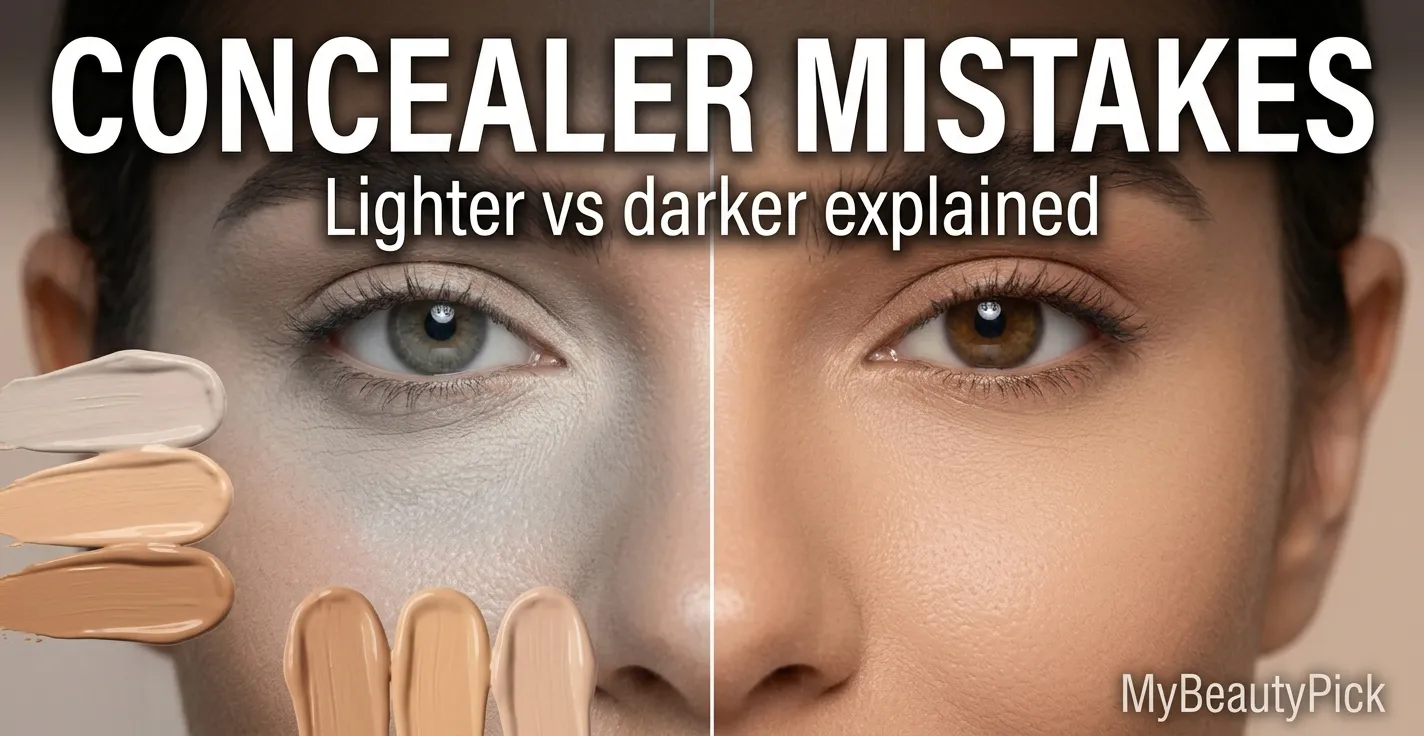
You’ve heard the rule — concealer should be lighter than your foundation. But you’re still getting a pale patch under your eyes, or a highlighted blemish instead of a hidden one. Here’s what’s actually going on.
The question “should concealer be lighter than foundation” gets a yes from almost every guide you’ll find. And almost every guide is giving you an incomplete answer.
Whether your concealer should be lighter or darker than your foundation depends entirely on where you’re applying it and what you’re trying to do. The rule that works perfectly under the eyes actively makes blemishes more visible. The shade that hides spots looks flat and unhelpful on dark circles. And on tan and warm skin tones, the undertone of that lighter concealer matters as much as the depth — possibly more.
Here’s the full picture.
The Short Answer — Use-Case Decision Table
Before anything else, here’s the rule broken down by exactly where and why you’re applying concealer. This is what the “always go lighter” shortcut is collapsing into a single answer.
| Where You’re Applying | Lighter or Darker? | How Much? | Why |
|---|---|---|---|
| Under eyes / dark circles | 1–2 shades lighter | 1–2 shades | Reflects light to counteract natural eye socket shadow |
| Highlighting centre face | 1–2 shades lighter | 1–2 shades | Brings light forward on bridge of nose, centre forehead, chin |
| Blemishes / active spots | Match foundation | Same shade | Blends seamlessly into surrounding skin — makes spot invisible |
| Hyperpigmentation / dark spots | Match foundation | Same shade | Avoids halo effect over flat discolouration |
| Redness / discolouration | Match foundation | Same shade | Colour correct first, then blend with foundation-match concealer |
| Eyelid primer use | Match or 1 shade lighter | Same or 1 shade | Creates neutral base for eyeshadow without lifting the lid colour |
| Contouring / sculpting | 1–2 shades darker | 1–2 shades | Creates shadow to recess areas and define features |
Why Lighter Concealer Works Under the Eyes — The Actual Reason
Understanding why lighter concealer works under the eyes tells you exactly when to use it — and when not to.
The under-eye area sits in a natural shadow created by the orbital bone above and the slight hollowing of skin beneath the eye. Shadows make areas appear darker and more recessed than surrounding skin. That’s what dark circles are doing visually — the shadow and any natural discolouration beneath the eye combine to create the appearance of depth and darkness.
Lighter pigment reflects more light than the surrounding skin. When you apply a lighter concealer to the under-eye area, it isn’t covering the darkness by being opaque on top of it — it’s reflecting enough light to optically fill in the hollow and reduce the appearance of shadow. The lighter shade counteracts the shadow with reflected light.
This is the same principle that makes highlight products work — lighter pigment on high planes of the face brings them forward, darker pigment recesses areas. The under-eye hollow is a low plane of the face sitting in natural shadow. A lighter concealer mimics how light would hit a less-recessed surface, optically pushing it forward and reducing its shadowed appearance. It’s not concealment through opacity; it’s concealment through light physics.
This is also why going too light creates the reverse problem. More than two shades lighter than your foundation means the under-eye area is now visibly brighter than the surrounding skin — creating a pale, stark patch that’s immediately obvious in person and photographs even worse. The under-eye area should read as the same tone as the rest of the face when you look at someone. Slightly lighter brings it to neutral; much lighter creates a highlight you didn’t intend.
Your dark circles look worse in photos than in person. That’s the same optical principle at work — camera flash reduces shadow, so the corrective effect of your lighter concealer is partly cancelled. Under flash, a too-light concealer shows as a pale patch immediately. This is why events and photography call for a more precisely shade-matched under-eye concealer, sometimes with a colour corrector underneath doing the heavy lifting instead.
The 1–2 shades lighter rule is a range, not a fixed point. One shade lighter gives subtle brightening. Two shades lighter gives stronger counteraction for deeper or more pronounced dark circles. Start with one shade lighter and assess in natural daylight before deciding you need more.
Why Matching Your Foundation Shade Works for Blemishes
A blemish is an area you want to make disappear into surrounding skin. The mechanism for invisibility is: match the surrounding skin tone exactly, so nothing registers as different.
If concealer matches the surrounding skin, it blends seamlessly and the covered area reads as the same tone as everything around it. To the eye — and to the camera — it doesn’t exist.
If concealer is lighter than surrounding skin on a blemish, it creates what makeup artists call the halo effect: a lighter patch or ring over the imperfection that draws the eye directly to it. You haven’t hidden the blemish — you’ve replaced a red or dark spot with a pale spot. In photos, the halo effect is stark and highly visible even when it looks acceptable in the mirror at home.
There is one exception. Very deep, dark blemishes — particularly cystic acne — can benefit from a slightly darker shade applied first specifically to block the blemish’s colour, followed by a foundation-matching shade on top to blend the edges into surrounding skin. The darker shade neutralises the darkness underneath; the foundation-match concealer makes the whole area disappear. This is a two-step process for severe cases, not the standard approach.
You cover a spot with your under-eye concealer before a night out. In the mirror it looks fine — slightly light, but blended. Every photo from the evening shows a pale patch exactly where you applied it. That’s the halo effect in flash photography. The fix for the next occasion: a separate concealer that matches your foundation shade exactly, applied only to the spot, blended into surrounding skin.
What About Hyperpigmentation and Dark Spots?
Flat dark spots — post-inflammatory hyperpigmentation, sun spots, melasma patches — follow the same rule as blemishes. These are areas where the skin surface is the same level as surrounding skin, just differently pigmented. A foundation-match concealer applied over the spot blends it into the surrounding skin tone without creating a halo.
The distinction from raised blemishes: flat hyperpigmentation sometimes benefits from a colour corrector applied before concealer, particularly on tan and deeper skin tones where dark spots can be very deep in pigmentation. A warm orange or red corrector applied to the dark spot first, then a foundation-match concealer over the top, neutralises the discolouration more effectively than relying on concealer alone — and keeps the concealer shade at foundation level rather than pushing it lighter.
The Undertone Rule Nobody Mentions — And Why It Matters More Than Shade
Every guide on this topic focuses on shade depth — lighter versus darker. Almost none of them address undertone. This is the gap that explains why following the standard rule still produces wrong results for a lot of people.
Undertone is the warm, cool, or neutral hue beneath your skin surface. It doesn’t change with depth — a warm-undertoned concealer at any lightness level still has yellow-golden tones. A cool-undertoned concealer at any lightness level still has pink-rosy tones.
Going 1–2 shades lighter with the wrong undertone produces a worse result than staying at foundation depth with the right undertone. A lighter cool-toned concealer on warm-undertoned skin doesn’t just look light — it looks ashy and grey, creating a visible mismatch against the warm skin surface. The depth is technically correct; the undertone makes it look wrong.
The complete under-eye concealer rule: go 1–2 shades lighter, within the same undertone family as your foundation.
| Undertone | Under-Eye Concealer Should Be | Watch Out For |
|---|---|---|
| Warm (yellow, golden, peachy) | 1–2 shades lighter with a peachy or golden base | Lighter cool-toned concealer — reads grey or ashy against warm skin |
| Cool (pink, rosy, bluish) | 1–2 shades lighter with a rosy or neutral-cool base | Lighter warm-toned concealer — reads too orange or yellow against cool skin |
| Neutral (balanced, olive) | 1–2 shades lighter, balanced neutral or slightly peachy | Very cool or very warm extremes — pick the balanced middle |
Why Undertone Matters More for Tan Skin Specifically
On fair skin, a slightly wrong undertone in concealer is less visible because the contrast between “slightly off” and “correct” is smaller at low melanin levels. On tan and deeper skin, the gap between correct and incorrect undertone is more pronounced — melanin concentration makes undertone mismatches contrast more sharply against the surrounding skin.
The most common mistake on tan skin: choosing a lighter under-eye concealer that is cool-toned when the skin is warm-undertoned. The result is an ashy, slightly grey patch under the eye that is more visible than the original dark circle. Particularly in photos, this reads as a pale-grey under-eye area regardless of how well it’s blended.
The undertone of your lighter concealer must match your foundation’s undertone. Not approximately — exactly. Test in natural daylight, blend over the back of the hand next to your foundation swatch, and check that the concealer reads warm, neutral, or cool in the same direction as your base.
When to Go Darker Than Your Foundation
Darker concealer has one primary use: contouring. It creates shadow where you want an area to appear more recessed or defined — the opposite of what lighter concealer does under the eyes.
Common contouring placements for darker concealer: the hollows beneath the cheekbones, the temples, the sides of the nose, under the jawline, and the perimeter of the forehead. One to two shades darker than foundation is the standard range. More than two shades darker reads as obvious striping in daylight and doesn’t blend into surrounding skin naturally.
Undertone applies here too. A warm or neutral darker shade reads as natural shadow. A cool darker shade — especially anything with obvious grey in it — can read as unnatural and obvious against warm or neutral skin. For tan skin specifically, a warm-neutral darker concealer for contouring blends far more naturally than a cool ashy one.
Concealer vs. Bronzer for Contouring — When to Use Which
Darker concealer is better for small, precise areas — the sides of the nose, under-eye hollowing, the lip corners. It has more pigment concentration than bronzer and applies precisely with a small brush or your fingertip.
Bronzer is better for large-area warmth — across the cheekbones, the forehead, around the perimeter of the face. Its formula is designed to spread over a larger surface area and still look natural. Using darker concealer across the full cheekbone area usually looks too dense and flat; bronzer has the right texture for that job.
Both have a role. Neither is a substitute for the other at the scale they’re designed for.
The Colour Corrector Exception — When the Shade Rule Changes Entirely
Colour correctors are a step that most shade guides ignore entirely, and they change the concealer shade equation.
A colour corrector works by neutralising a colour before concealer goes on top. If you use a corrector, the concealer’s job shifts from overpowering discolouration to providing coverage — which means you no longer need it to be as light to achieve the same result.
Without a corrector, a lighter shade compensates for darkness by reflecting more light. With a corrector handling the colour neutralisation, a foundation-match or minimally lighter shade can do the coverage job without the depth risk. This is often a better approach on tan skin, where going 2 shades lighter without a corrector produces more contrast problems than the corrector-plus-match-shade approach.
Colour Corrector Shades for Tan Skin
| Concern | Corrector Colour | Why | Then Use |
|---|---|---|---|
| Purple / blue dark circles (common on tan to deep skin) | Peach or orange | Warm tones neutralise blue-purple pigment | Foundation-match or 1 shade lighter concealer |
| Deep brown dark circles (melanin-heavy under-eye) | Warm orange or salmon | Darker corrector shade needed to neutralise deep melanin pigment | Foundation-match concealer on top |
| Redness / blemishes | Green | Green neutralises red opposite on the colour wheel | Foundation-match concealer |
| Deep hyperpigmentation / dark spots | Warm orange or red-orange | Counteracts dark blue-brown pigment in deep spots on tan skin | Foundation-match concealer to blend |
How to Test Concealer Shade Before You Buy
Shade rules only work if you’re testing correctly. Most people test in the wrong place and in the wrong light — and then wonder why the shade that looked right in store looks wrong at home.
Where to Swatch for Each Purpose
Under-eye concealer: Swatch on the inner corner of the eye or directly on the under-eye skin. The inner wrist approximates the thinner, more translucent skin in that area. Never test under-eye concealer on the back of the hand — it’s a different skin thickness, tone, and sebum level than the delicate under-eye area.
Blemish concealer: Swatch directly on or immediately adjacent to a spot or dark area on the face. This is the only way to see whether the concealer will match the skin tone around that specific area. The back of the hand is the wrong test site for spot coverage.
Contour concealer: Swatch along the jawline or temple to assess how the darker shade reads against your actual face skin, not hand skin.
When to Judge the Swatch
Never judge immediately after application. Wait 10–15 minutes for the concealer to oxidise and settle into your skin before assessing the match. A shade that looks right at zero minutes can shift noticeably in either direction once it’s reacted with skin oils and pH — particularly on tan skin where oxidation is faster.
Always check in natural daylight. Store lighting is almost always fluorescent, which distorts both warm and cool tones. Phone screens distort colour rendering. The only reliable test environment is natural daylight — outside, or near a window without tinted glass.
The 1-Shade Rule in Practice for Tan Skin
One to two shades lighter is relative to your specific foundation match, not to a fixed point on a shade range. On tan skin this typically means: if your foundation is a W4 or medium-warm shade, your under-eye concealer would be the equivalent of a W3 or light-medium warm — one step up in lightness within the same undertone family.
Going to the lightest shade in any range because “lighter is better for under eyes” consistently produces the grey patch problem on tan and deeper skin tones. The lightest shade in a range is usually built for the lightest skin tones and carries an undertone calibrated for that depth — which is almost never right for tan skin regardless of how light you want to go.
Common Mistakes When Choosing Concealer Shade
- Using the same concealer for under-eyes and blemishes. Two different jobs require two different shades. The lighter under-eye concealer creates a halo on blemishes. The foundation-match blemish concealer doesn’t brighten dark circles. Most routines benefit from two concealers — one lighter for under-eye, one matching for spots.
- Going more than 2 shades lighter under the eyes. The brightening effect plateaus at 2 shades and the contrast problem accelerates. More than 2 shades lighter creates a pale patch that’s more visible than the original dark circle — especially on tan skin where the contrast between the under-eye area and surrounding skin is more pronounced.
- Choosing shade depth but ignoring undertone. A lighter concealer with the wrong undertone looks worse than a correctly-undertoned foundation-match. This is the most common cause of the “grey under-eye patch” on warm-undertoned tan skin. Match the undertone direction of your lighter concealer to your foundation exactly.
- Applying lighter concealer on raised blemishes. The halo effect — a lighter ring around a raised spot — is more conspicuous than the spot itself. Match your foundation exactly for all blemish coverage, no exceptions.
- Testing shade in artificial or store lighting. Fluorescent store lighting neutralises both warm and cool undertones and makes almost any shade look acceptable. The same shade in natural daylight reveals undertone mismatches immediately. Always assess in natural light before committing.
- Not accounting for oxidation before judging the shade. Concealer that looks right at application can shift warmer, darker, or more orange within 30 minutes on tan skin due to sebum and pH interaction. Wait before finalising your shade choice — what you see at minute zero is not what you’ll be wearing at hour two.
Frequently Asked Questions
Should concealer be lighter than foundation?
Is concealer supposed to be lighter than foundation?
How much lighter should under-eye concealer be than foundation?
Should concealer match foundation for blemishes?
Does skin tone change how much lighter my concealer should be?
Can I use the same concealer for under eyes and blemishes?
Should concealer be lighter or darker than foundation for contouring?
The Bottom Line
Should concealer be lighter than foundation? Under the eyes, yes — 1–2 shades lighter within the same undertone family. On blemishes, spots, and hyperpigmentation, no — match your foundation exactly. For contouring, go 1–2 shades darker. Three different jobs, three different shade rules.
The blanket “always go lighter” rule works for exactly one of those three situations and actively causes the halo effect in another. Understanding which rule applies where — and why — is what separates coverage that looks intentional from coverage that draws attention to exactly what it was supposed to hide.
For tan and warm skin tones, the undertone of your lighter concealer matters as much as the depth. A correctly-undertoned foundation-match concealer will consistently outperform a too-light concealer with the wrong undertone. Get the undertone right first. Then adjust the depth. That order is what determines whether your concealer actually works — or just creates a different problem.
More from MyBeautyPick
- Concealer Guide for Tan Skin — Shades, Formulas & Application
- Undertones Explained: Warm vs. Neutral vs. Cool for Tan Complexions
- How to Find Your Foundation Shade for Tan Skin
- Concealer vs Foundation: Differences, Uses & Do You Need Both?
- How to Prep Tan Skin for a Flawless Foundation Finish
- Why Foundation Oxidizes on Tan Skin — and How to Fix It
- Best Foundation Shades for Warm Undertones