

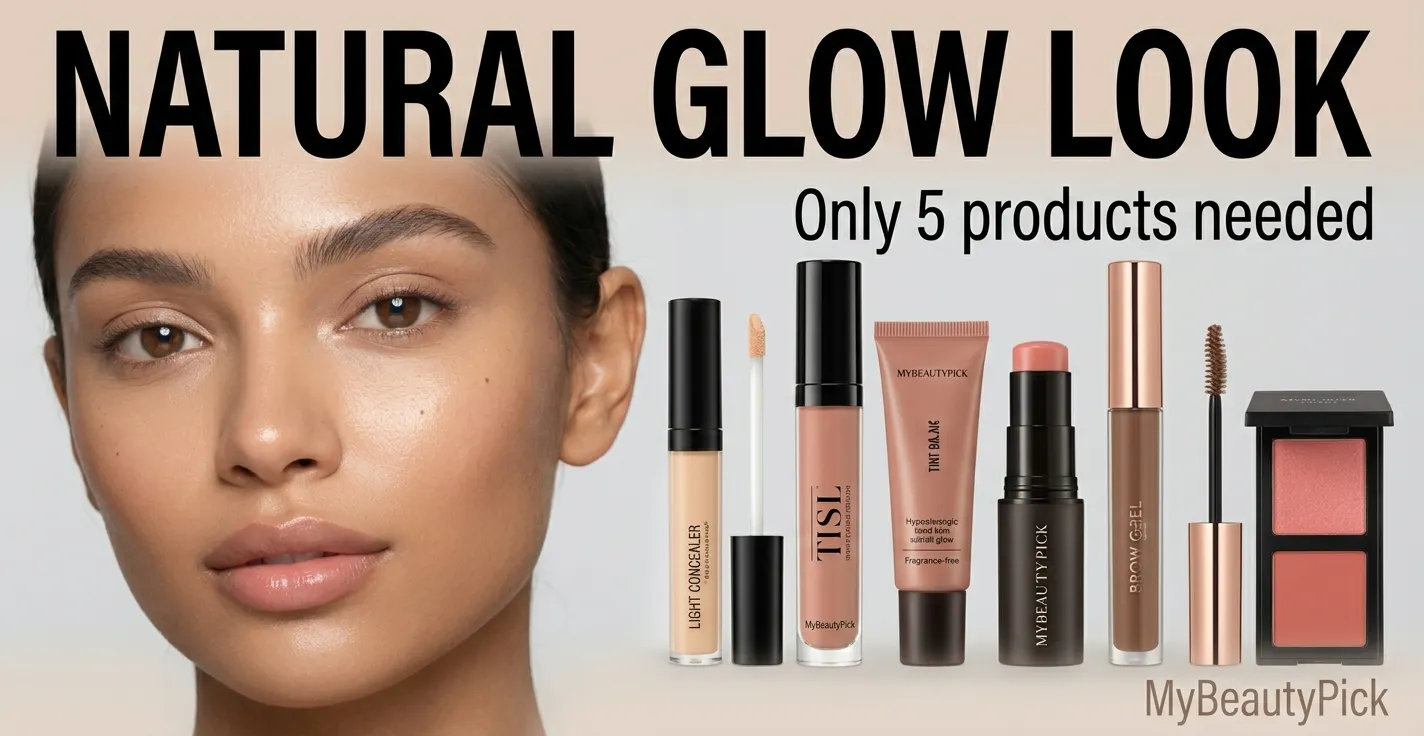
The best makeup for tan skin is the kind that makes people wonder if you’re wearing anything at all. Not because you’re not — but because every product you chose works with your skin instead of sitting on top of it. This is the 5-product natural glow makeup routine built specifically for tan and warm complexions, and every step explains not just what to do, but why it works on your skin tone.
- The natural glow makeup look on tan skin requires warm-undertoned products — cool-toned “no-makeup” formulas read ashy or flat against warm complexions.
- 5 products: skin tint, cream bronzer, cream blush, mascara, tinted lip balm. In this order, for these reasons.
- Cream textures throughout — they blend into the skin rather than sitting on top of it, which is what creates the skin-like finish.
- The biggest mistake in a natural glow routine is using too much product. Less, placed precisely, always outperforms more.
- SPF goes in skincare, not foundation — physical SPF causes flashback on tan skin in photos.
What Natural Glow Makeup Actually Means on Tan Skin
The phrase “natural glow” gets misapplied constantly on tan and warm skin tones. Most tutorials built around this aesthetic — the clean girl look, the no-makeup makeup look, the barely-there skin finish — are calibrated for fair-to-light complexions. Their product recommendations, shade choices, and finish types reflect that.
On tan skin, “natural glow” means warmth, luminosity, and an enhanced version of what your skin already looks like — not a muted, powder-set, cool-toned finish that suppresses your natural skin colour. When a fair skin tone tutorial says “use a neutral skin tint,” neutral for them means something entirely different from neutral on medium-tan skin. When they say “peach blush,” they mean a sheer, diluted peach. On tan skin, you need full-pigment peach or it simply disappears.
The 5-product routine below is built around this reality. Each product choice is deliberate and undertone-specific for warm and tan complexions.
The most common reason a natural glow routine looks “off” on tan skin is not technique — it’s undertone. A single cool-toned or pink-based product in a warm-skin routine creates visible disconnect. Every product in this routine should sit in the warm, golden, or peachy-warm family.
Why the 5-Product Edit Works for Natural Glow Makeup on Tan Skin
A long product list is not the goal here. The goal is skin that looks healthy and considered without visible makeup. That requires precision, not volume. Each of these five products serves a specific purpose that no other product in the routine duplicates.
| Product | Purpose | Why Not a Substitute |
|---|---|---|
| Skin tint | Even skin tone, light coverage, skin-like finish | Full foundation is too heavy — creates a visible base layer |
| Cream bronzer | Warmth, dimension, structure | Powder bronzer sits on top of skin — reads as product, not warmth |
| Cream blush | Natural flush, colour, life in the face | Powder blush over cream base creates texture contrast |
| Mascara | Eye definition without visible eye makeup | Any liner or shadow shifts the balance from natural to made-up |
| Tinted lip balm | Lip colour that reads as skin, not lipstick | Lipstick is identifiable as makeup — breaks the natural illusion |
Skin Prep Before the 5-Product Routine
The natural glow makeup look lives or dies on the skin underneath it. This is not a look that conceals — it enhances. If the skin is dehydrated, textured, or uneven before products go on, those qualities will be visible through a skin tint in a way they would not be through a medium-coverage foundation.
Cleanser: a gentle, non-stripping cleanser. Avoid anything that leaves your skin feeling tight — that tightness is your skin’s natural oils being removed, and those oils are part of what creates the dewy quality you’re building toward.
Moisturiser: a humectant-forward lightweight formula — look for hyaluronic acid, glycerin, or aloe as the first active ingredients. Apply and allow it to absorb for a full 5 minutes before anything else goes on top. Skin tint applied over unabsorbed moisturiser slides rather than adhering.
SPF: non-negotiable for sun protection, but choose a chemical SPF formula (avobenzone, octinoxate) rather than a physical/mineral formula (titanium dioxide, zinc oxide). Physical SPF on tan skin creates a visible white cast in photos — it causes flash reflection that reads ashy or grey against melanin-rich skin. Apply SPF, let it absorb for 3 minutes, then proceed.
Do not use a heavy facial oil or a thick rich cream immediately before a skin tint unless it has had at least 10 minutes to fully absorb. Heavy occlusive moisturisers prevent skin tint from adhering properly and cause the formula to slide around rather than sitting in the skin. For the natural glow look, a lightweight gel or lotion moisturiser works better than a rich cream for prep.
The 5-Product Natural Glow Routine: Step by Step
-
1
Skin Tint — The Coverage That Reads as Skin
A skin tint or tinted moisturiser is the base of this routine. Unlike foundation, which creates a coverage layer on top of skin, a skin tint blends into the skin surface and enhances what’s already there. The coverage is light and buildable — you control how much you apply and where.
Shade selection for tan skin: look for formulas described as “warm,” “golden,” “tan warm,” or with a yellow-gold undertone base. Avoid anything labelled “neutral” without checking the undertone — neutral in many brands still reads slightly pink. Avoid cool-toned, pink-based, or “brightening” skin tints — these cancel out the warmth of tan skin and create an ashy appearance.
Formula selection by skin type: dewy or luminous skin tint for dry tan skin; satin-finish or oil-free skin tint for oily tan skin; any lightweight formula for combination or normal skin types. Avoid skin tints with high SPF (above SPF 20) in the formula — these use physical filters that cause the white-cast problem described above.
Application: fingers only for the most skin-like finish. The warmth of your fingertips partially melts the formula into the skin before it sets. Work in small amounts — start with less than half the amount you think you need. Press and blend outward from the centre of the face. For slightly more coverage and a slightly more airbrushed result, use a slightly damp stippling sponge and press (do not drag) the product into the skin.
Where to build: if anything still needs coverage after the first application — redness, any dark spots — press a tiny additional amount specifically onto those areas and blend the edges. Do not apply a second layer all over the face. Layering everywhere defeats the skin-like quality you’re after.
-
2
Cream Bronzer — Warmth That Looks Like Skin, Not Contouring
Cream bronzer is the product that does the heaviest lifting in a natural glow routine for tan skin. It adds depth, dimension, and warmth in a way that reads as if your face has been in natural light rather than as a makeup application. Powder bronzer cannot replicate this — powder sits on top of the skin and has a visible layer quality; cream bronzer melts into it.
Shade for tan skin: a warm bronze with red or orange-brown undertones. The bronzer shade for tan skin needs to be noticeably deeper than the skin tint — a bronzer that’s only slightly darker than your skin will read as an uneven patch rather than dimension. Avoid grey-brown or taupe bronzers — these read cold and flat against warm tan skin and can make the face appear muddy.
Placement: the perimeter of the face, following the “3” shape. Starting at the temple: sweep bronzer along the hairline at the temple, under the cheekbone (not on it), and along the jawline. Repeat on both sides. This creates warmth and structure without changing the actual face shape. Do not apply bronzer to the centre of the forehead or to the nose — this creates a muddy, flat appearance rather than dimension.
Application: fingertip application in circular motions, then blend with a clean fluffy brush or the warm side of your palm to remove any hard edges. The finished result should look like warmth that lives in the skin, not a visible product application.
-
3
Cream Blush — The Flush That Comes from Within
Cream blush applied correctly on tan skin reads as a natural flush — the kind that happens when you’ve been outdoors or have just done something that made you feel good. Powder blush cannot replicate this. Powder on top of a cream skin tint creates a visible texture change — it sits on the surface rather than sinking into it. Cream layered over cream maintains the skin-like finish.
Shade selection for tan skin: warm peach, coral, terracotta, or warm berry are the shades that work. Avoid cool pink, baby pink, pale mauve, or lavender-pink — these have no warmth relationship with tan skin and will read as colour sitting disconnected on the face rather than as a natural flush. The specific shades that look like a natural blush on tan skin are the ones that sit in the peach-to-terracotta range: warm, golden-pink, sun-flushed tones.
Application: smile slightly and press a small amount of cream blush onto the apple of the cheek using your fingertip. Blend upward toward the temple using circular motions. If you want a sun-flushed effect — the look of warmth across the nose and cheeks — press a very small amount onto the bridge of the nose as well. Use significantly less than feels right: cream blush on tan skin delivers more colour payoff than it appears to in the packaging or on the fingertip.
How to fix over-application: if you’ve applied too much cream blush, press your clean fingertip gently over the area and then buff with a light clean sponge. Avoid trying to layer skin tint back over it — this disrupts the finish. Gentle pressing and buffing reduces intensity without removing the formula entirely.
-
4
Mascara — The One Eye Product That Keeps the Look Natural
In a natural glow routine, the only eye product that genuinely works without shifting the look from “naturally enhanced” to “wearing makeup” is mascara. Brow pencil, eyeshadow, and liner all create visible definitions that read as applied products. Mascara adds definition at the lash line that reads as naturally thick, healthy lashes.
Formula: a lengthening mascara rather than a volumising formula. Volumising mascara creates a noticeably dramatic lash effect — which is not the goal here. A lengthening formula darkens and extends the lashes while keeping them looking natural. One coat is almost always sufficient for a natural glow look.
Lower lashes: one very light coat on the lower lash line is optional but effective — it adds a subtle openness to the eye without creating visible lower lash makeup. Use just the tip of the mascara wand and apply with a light hand.
Brows: if your brows need grooming or definition, use a clear brow gel only — no pencil, no powder. The brow should look clean, groomed, and in place, not filled or sculpted. A clear or very lightly tinted brow gel brushed through the brows in an upward motion is all this routine needs.
-
5
Tinted Lip Balm — Colour That Could Be Your Real Lips
The final product in this routine is the one that completes the look while maintaining the natural illusion. A tinted lip balm adds colour and moisture to the lips in a way that reads as your lips looking their best — not as lipstick. The shine quality of a balm also adds to the overall dewy, healthy appearance the rest of the routine creates.
Shade selection for tan skin: warm nude-peach, warm caramel, warm rose, or a sheer terracotta. These shades amplify the natural colour of lips on tan skin rather than covering it or reading as obvious colour. Avoid nude shades with a cool pink or pale beige base — on tan skin these either disappear completely or read as pale and washed-out. Avoid anything with a blue-pink or mauve tone — these shades have no warmth relationship with tan skin in a natural look.
Application: press the balm directly onto the lips with a fingertip rather than applying from the tube — this creates a slightly diffused edge that looks more natural than a clearly defined lip line. Re-apply throughout the day as needed — the moisturising quality of a tinted balm means it wears comfortably and is not uncomfortable to reapply.
Natural Glow vs. No-Makeup Makeup on Tan Skin: What’s the Difference
These terms get used interchangeably but they describe slightly different outcomes. No-makeup makeup is the absolute minimum — often just a skin tint and mascara, with no colour product. The goal is skin that looks impeccably groomed without any visible colour makeup.
Natural glow includes a flush product (cream blush or bronzer) that adds warmth and dimension without reading as clearly “makeup.” The result is more luminous and more alive-looking than pure no-makeup makeup, but still reads as natural because all the colour products used work within the skin’s own warmth rather than adding an obvious colour layer.
For tan skin specifically, the natural glow version is almost always more flattering than the pure no-makeup version. Without any colour product, tan skin can read as flat or dull in photos — the warmth that makes tan skin beautiful in person doesn’t always translate without a little amplification.
Natural Glow Makeup for Tan Skin by Season
☀️ Summer
- Prioritise SPF skin tint with chemical filters
- Waterproof mascara — heat and humidity break down regular formulas
- Reduce to 3 products on very hot days: skin tint, cream blush, tinted balm
- Bronze-forward blush placement — more warmth on the cheekbones and nose
- Satin finish over dewy in humidity to prevent sliding
- Setting spray over finished look to lock lightweight products in heat
🍂 Autumn / Winter
- Add one extra layer of humectant moisturiser in prep — skin is drier in cold air
- Deepen bronzer to warm terracotta from golden bronze
- Deepen blush to warm berry or warm terracotta from peach
- Satin finish is more comfortable in winter than pure dewy
- Tinted lip balm: deeper warm nude or warm rose to complement autumn tones
- Avoid powder in winter — it emphasises dry texture on tan skin in cold months
Natural Glow Makeup Mistakes on Tan Skin
- ✗Choosing a skin tint shade matched to the hand, not the faceHand skin and face skin are often different shades and undertones. Always apply skin tint to the jaw and cheek, check in natural daylight.
- ✗Using cool-toned products in a warm-skin routineA single pink-biased blush, cool-toned skin tint, or lavender SPF creates visible disconnect against warm tan skin. Every product must read warm or golden.
- ✗Applying setting powder all over the facePowder kills the dewy skin-like quality this routine builds. If oil control is needed, apply a very finely milled translucent powder to the T-zone only — not the cheeks, not the forehead temples, not the under-eye area.
- ✗Over-applying cream blushCream blush on tan skin delivers significantly more pigment than it appears to in the packaging. Start with a pea-sized amount on one cheek, assess in natural light, then match the other side.
- ✗Skipping skin prep and applying products directly on unmoisturised skinSkin tint on dehydrated skin settles into dry lines and texture. The prep routine — particularly the 5-minute moisturiser absorption wait — is not optional for this look to work.
- ✗Using a volumising mascaraVolumising mascara creates a visibly dramatic lash — which is not the goal in a natural glow routine. Switch to a lengthening formula and apply one coat only.
Product Categories to Look for (Without Brand Dependency)
Rather than specific product names that change with reformulations and availability, here are the formula characteristics to look for in each of the 5 products for tan skin:
Skin Tint
- Warm or golden undertone base
- Hyaluronic acid or glycerin in formula
- SPF 20 or below (to avoid physical filter issue)
- Described as: dewy, luminous, or skin-like finish
- Buildable light coverage
Cream Bronzer
- Warm bronze or brown-red undertone
- No shimmer or very fine shimmer only
- Cream or balm texture (not powder)
- Deeper than your skin tone by at least 2 shades
- No grey or taupe base
Cream Blush
- Peach, coral, terracotta, or warm berry tone
- Cream or liquid formula
- Buildable pigment (start light)
- No cool pink, mauve, or lavender base
Tinted Lip Balm
- Warm nude-peach, caramel, or warm rose shade
- Moisturising formula (not drying)
- Sheer to medium coverage
- No cool pink or pale beige base
Frequently Asked Questions
What is the best base for natural glow makeup on tan skin?
A warm-undertoned skin tint or tinted moisturiser with a dewy or satin finish is the best base for natural glow makeup on tan skin. It provides light, buildable coverage that sits in the skin rather than on top of it, maintaining the skin-like quality essential to this look. Look for formulas with hyaluronic acid or glycerin, a golden or warm undertone, and SPF delivered via chemical filters rather than physical mineral filters.
Can I skip foundation entirely for the natural glow look?
Yes — and for most people wearing this look, skipping traditional foundation is the right choice. A skin tint gives sufficient coverage for a natural glow result without the visible base layer that foundation creates. If you have significant redness or hyperpigmentation, use a small amount of cream concealer matched to your skin tone only over those specific areas, and blend the edges carefully. The rest of the face stays with the skin tint only.
What cream blush shades work best on tan skin?
Warm peach, coral, terracotta, and warm berry are the shades that create a natural flush on tan skin. The specific requirement is warmth — any blush shade with a cool pink, mauve, or lavender base will read as disconnected from the warm undertone of tan skin rather than as a natural flush. If you’re unsure whether a blush is warm or cool, swatch it on the back of your hand next to your skin: if it looks like a warmer, rosier version of your skin, it’s right. If it looks like a separate cool colour, it isn’t.
Why does my natural makeup look heavy on tan skin?
Heaviness in a natural glow routine almost always comes from one of three things: too much product, the wrong product texture, or incorrect application order. Too much product — especially skin tint — creates a visible coverage layer. Wrong texture — powder products over cream bases — creates surface layering that reads as applied makeup. Incorrect order — powder before cream — traps a dry layer between products, creating patchy, heavy results. Stick to cream textures throughout, apply less than you think you need, and build only where necessary.
How do I stop dewy skin makeup from sliding off during the day?
The most effective approach for keeping dewy natural glow makeup on tan skin through the day: use a satin-finish skin tint rather than a pure dewy formula if your skin is oily or combination. Apply a very light press of finely milled translucent powder to the T-zone only after the cream bronzer and blush are applied. Finish the entire routine with a setting spray — this both locks the products in place and blurs the very light powder into the rest of the dewy finish, so the whole face reads consistently.
Is natural glow makeup appropriate for professional settings?
Yes — it is one of the most appropriate makeup looks for professional environments. The natural glow look reads as polished and groomed rather than heavily made-up, which is appropriate in virtually all professional settings. For a more conservative work environment, dial back the bronzer placement and use a slightly less pigmented blush. The skin tint, mascara, and tinted lip balm are universally appropriate in any professional context.