

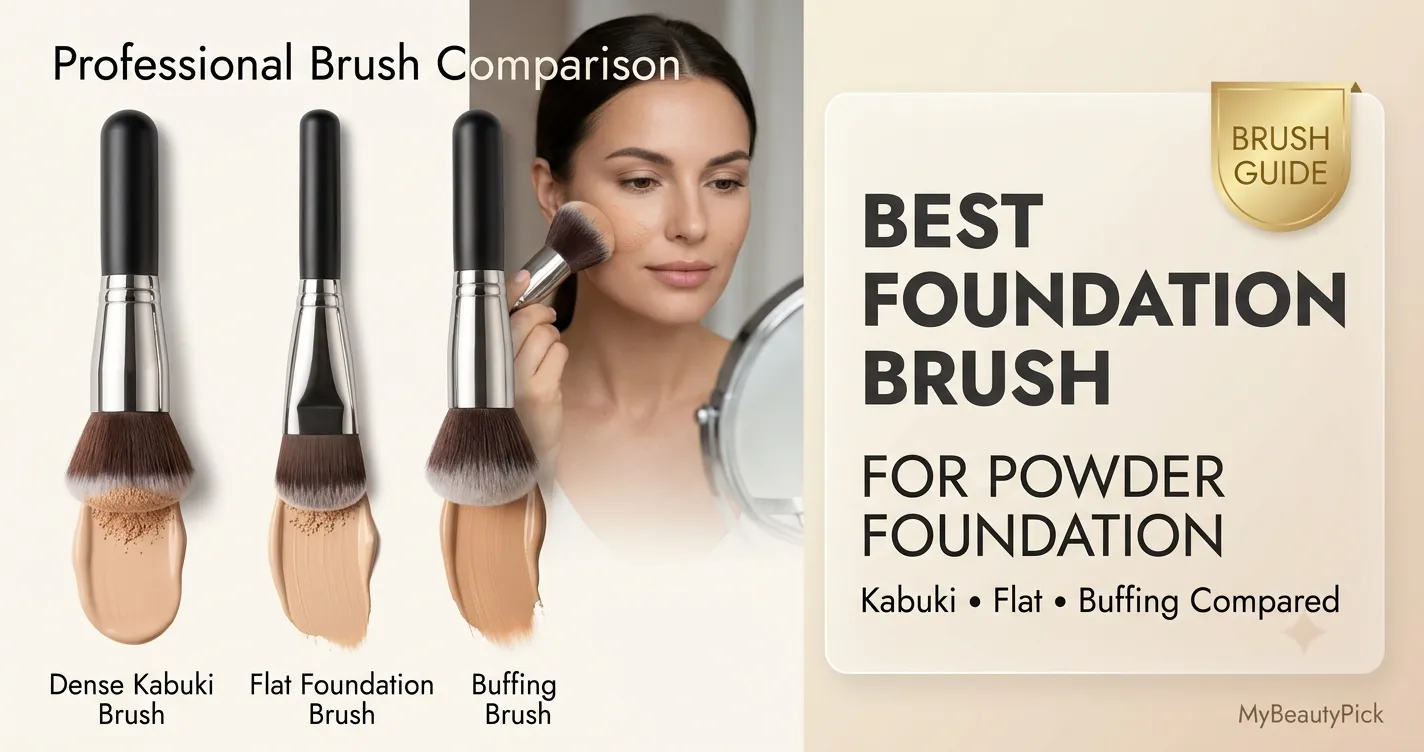
Powder foundation is not the same as loose powder — and that distinction matters when choosing a brush. Most brushes labelled “powder brush” are designed for loose setting powder: fluffy, loosely packed, and built for diffusion. Pressed powder foundation needs something different. It’s a coverage product that relies on consistent pressure and controlled deposit. Use the wrong brush and the powder sits unevenly on the skin rather than building a cohesive base.
- Powder foundation requires even pressure and controlled deposit — not loose diffusion.
- A flat-top kabuki is the most reliable brush for pressed powder foundation coverage.
- Very fluffy dome brushes designed for loose powder don’t deposit pressed powder foundation evenly.
- Buffing brush in circular motions gives a polished result but requires more product than pressing technique.
- The brush must be clean before every use — residual product from previous applications creates uneven deposit with powder.
Why Powder Foundation Needs a Different Brush Than Loose Powder
Loose powder relies on diffusion. You load a fluffy brush, tap off the excess, and sweep or press lightly over the skin to deposit a fine, even layer. The formula is so finely milled and the pigment so light that a very soft, open brush works well.
Pressed powder foundation is a different product with different demands. It’s pressed together for a reason — the compression creates a more pigment-dense product that needs consistent, even pressure to release and deposit correctly. A brush that’s too fluffy or too loosely packed can’t create the even pressure needed to pick up pressed powder foundation evenly. The result is a patchy, inconsistent deposit that looks uneven rather than like a smooth foundation base.
The best brush for powder foundation has three characteristics: a flat-topped or moderately domed head, moderate-to-dense bristle packing, and bristles that rebound clearly after pressure is applied — which tells you the brush will maintain consistent pressure contact with the skin throughout the application.
Kabuki Brush for Powder Foundation
Flat-Top Kabuki Brush
The flat-top kabuki is the most consistently recommended brush for pressed powder foundation. Its defining characteristics: extremely dense bristle packing, a flat cut at the top (rather than rounded or fluffy), and a short, compact head that allows you to apply consistent, even pressure across the skin surface.
When used with circular buffing motions, the kabuki presses powder foundation into the skin and buffs it for an even, polished result. The density of the bristles means the brush picks up a consistent amount of product with each load rather than the variable, patchy pickup that a loose brush produces with pressed powder.
The flat-top structure is what makes this brush specifically better for pressed powder foundation than for loose powder. Loose powder needs diffusion; the flat top creates pressure rather than diffusion. This is exactly what pressed powder foundation needs for even, buildable coverage.
How to use: swirl the kabuki gently in the compact to pick up product. Tap off excess on the back of the hand. Apply using small circular motions on the face, building coverage in thin layers. Finish with gentle pressing motions (no movement) on any areas where you want more coverage without adding thickness.
- Best examples: Flat Top Kabuki by KESHIMA, DUcare Flat Top Kabuki, sigma F80 (used with powder on dry skin)
- Best for: everyday powder foundation, building medium to full coverage with pressed powder
- Avoid if: you want a very sheer, diffused finish — the density is too high for truly light coverage
Flat Foundation Brush for Powder Foundation
Flat Foundation Brush (Dense)
A dense flat foundation brush — the same type used for liquid and cream foundation — can also work effectively with pressed powder foundation when used correctly. The flat bristle cut and dense packing create a stable surface for picking up pressed powder consistently, and the flat shape allows for precise placement in specific areas rather than all-over application.
Where the flat brush differs from the kabuki for powder: it’s better for targeted spot application — building coverage on a specific area of the face (over discolouration, around the nose, on blemishes) rather than building an all-over powder foundation base. For an even all-face powder foundation, the kabuki is more efficient. For targeted powder coverage in specific areas, a flat foundation brush gives more placement control.
Technique: pick up a small amount of powder by pressing the flat bristle surface gently into the compact — not swirling, which picks up too much. Tap off excess. Apply with light pressing strokes in the target area, then blend edges with a light back-and-forth motion.
- Best for: targeted powder foundation coverage, touch-ups, spot coverage building
- Not ideal for: all-over even powder foundation application — kabuki or buffing brush is more efficient for full-face coverage
Buffing Brush for Powder Foundation
Buffing Brush (Dome or Flat-Top, Dense)
A dense buffing brush — domed or flat-top with tightly packed bristles — works with pressed powder foundation in circular buffing motions to create a polished, blended result. The circular motion buffs the powder into the skin surface rather than depositing it on top, creating a more integrated finish than pressing alone.
The limitation of the buffing approach with powder foundation is that circular buffing uses more product per application than pressing. The motion kicks up some powder and distributes it across a wider area than where you’re actually applying, which reduces efficiency. For building coverage precisely over specific areas, pressing technique outperforms buffing.
Where the buffing brush with powder foundation excels: for the final pass after applying with a kabuki. After building coverage with pressing technique, a clean buffing brush used with light circular motions unifies the whole powder foundation finish and removes any visible edges between applied and unapplied areas.
- Best use case: finishing pass after kabuki application, or on skin where seamless blending is the priority over maximum coverage
- Not ideal for: first-pass coverage building with pressed powder — kabuki pressing technique is more efficient for this
Powder Foundation Brush Comparison Table
| Brush Type | Coverage Result | Best Technique | Best For | Limitation |
|---|---|---|---|---|
| Flat-top kabuki | Medium to full | Circular buffing + pressing | All-over pressed powder foundation | Not ideal for very sheer, diffused result |
| Dense flat brush | Medium, targeted | Pressing strokes | Spot coverage and precise placement | Less efficient for full-face application |
| Dense buffing (dome) | Light to medium | Circular buffing | Finishing pass, blending edges | Uses more product per application |
| Fluffy dome (loose powder brush) | Very light, sheer | Sweeping or pressing | Setting powder — NOT pressed powder foundation | Too loose for even pressed powder deposit |
| Kabuki (short, rounded) | Medium to full | Circular and pressing | Pressed powder on small-to-medium face areas | Shorter handle limits ease for larger faces |
Using a loose powder brush for pressed powder foundation. The fluffy, loosely packed bristles of a typical loose powder brush don’t pick up pressed powder foundation evenly — they create a variable, patchy deposit that leaves some areas lightly dusted and others with visible product. Always use a flat-top kabuki or dense dome brush for pressed powder foundation, and save the fluffy loose powder brush for finishing and setting spray-set looks.
How to Apply Pressed Powder Foundation for the Best Coverage
Application technique with a powder foundation brush is as important as brush selection. Even the right brush produces inconsistent results when loaded incorrectly or used with the wrong motion.
- Tap, don’t swirl, to load the brush. Press the brush bristles gently into the compact and tap lightly to load product. Swirling picks up too much product unevenly and causes fallout. Tapping creates a more controlled, consistent load.
- Tap off excess on the back of your hand. This removes any excess that would deposit unevenly in the first stroke. Any visible powder falling from the brush when you tap means there’s too much on it.
- Start at the centre of the face and work outward. This deposits the most product where coverage is typically most needed (around the nose, inner cheeks, chin) and naturally lightens toward the hairline and jawline where heavy coverage looks unnatural.
- Press first, buff second. Press the loaded brush onto the skin using gentle downward pressure for the first pass — no motion, just press. This deposits the product evenly. Then use light circular buffing motions to blend the deposit. Buffing first kicks up powder before it adheres and creates uneven results.
- Build in thin layers. Pressed powder foundation looks its best in two thin layers rather than one heavy application. After the first pass, assess coverage in natural light. Add a second thin pass only where more coverage is needed, using the same press-then-buff sequence.
When using pressed powder foundation on tan skin, always choose a banana powder or undertone-matched translucent powder for setting over the top — never white translucent. White translucent powder reads ashy and causes flashback in photos on tan and deeper skin tones. If you’re using pressed powder foundation as your base, the same undertone rule applies to the foundation itself: look for warm or neutral-warm shades in the tan range, not pink-biased formulas that oxidise orange against warm melanin-rich skin.
Frequently Asked Questions
What is the best foundation brush for powder foundation?
A flat-top kabuki brush is the best foundation brush for pressed powder foundation. Its extremely dense, flat-cut bristles create even pressure when pressed into a compact, pick up product consistently, and apply it with the circular buffing motion that polishes powder into the skin for even coverage. Very fluffy dome brushes — designed for loose setting powder — don’t pick up pressed powder foundation evenly and should not be used as a primary powder foundation brush.
Can I use a kabuki brush for powder foundation?
Yes — a kabuki brush is one of the best options for pressed powder foundation. The dense, short-bristled head creates the even pressure needed to pick up and deposit pressed powder consistently. Use the kabuki in gentle circular motions after an initial pressing deposit for the most polished, even result. For loose powder, a kabuki is slightly less ideal than a larger fluffy dome brush, but for pressed powder foundation specifically, the kabuki is one of the most reliable tools available.
Is a flat or buffing brush better for powder foundation?
For all-over pressed powder foundation coverage, a flat-top kabuki (which is a type of buffing brush) outperforms a standard flat brush. The density and circular motion of a kabuki creates more even, efficient coverage. A flat brush is better for targeted spot coverage with powder foundation — building opacity over a specific area. For a finishing pass to blend and polish after initial coverage is built, a clean buffing brush in circular motions produces the most seamless result.
How do I stop powder foundation from looking patchy?
Patchy powder foundation almost always comes from one of three causes: using the wrong brush (too fluffy for pressed powder), overloading the brush (too much product in one pass), or applying with sweeping motions rather than pressing. Fix: switch to a flat-top kabuki or dense dome brush. Tap the brush to load it and tap off excess before application. Apply with a pressing motion first, then a light circular buff. Build in two thin passes rather than one heavy application. Ensure skincare (moisturiser) is fully absorbed before powder foundation goes on — powder applied over unabsorbed moisturiser sits unevenly and looks patchy.
Can I use a powder foundation brush for liquid foundation?
A fluffy dome powder brush is not ideal for liquid foundation — the loose bristle packing doesn’t create the even pressure needed to apply liquid foundation consistently and the formula can spread unevenly into the loosely packed fibers. A flat-top kabuki or buffing brush designed for liquid and cream formulas can work for pressed powder foundation because the density is appropriate for both. The product type determines the brush requirement, not the other way round: dense brushes can handle both liquid and pressed powder; loose fluffy brushes are suited only to setting powder and loose powder products.