

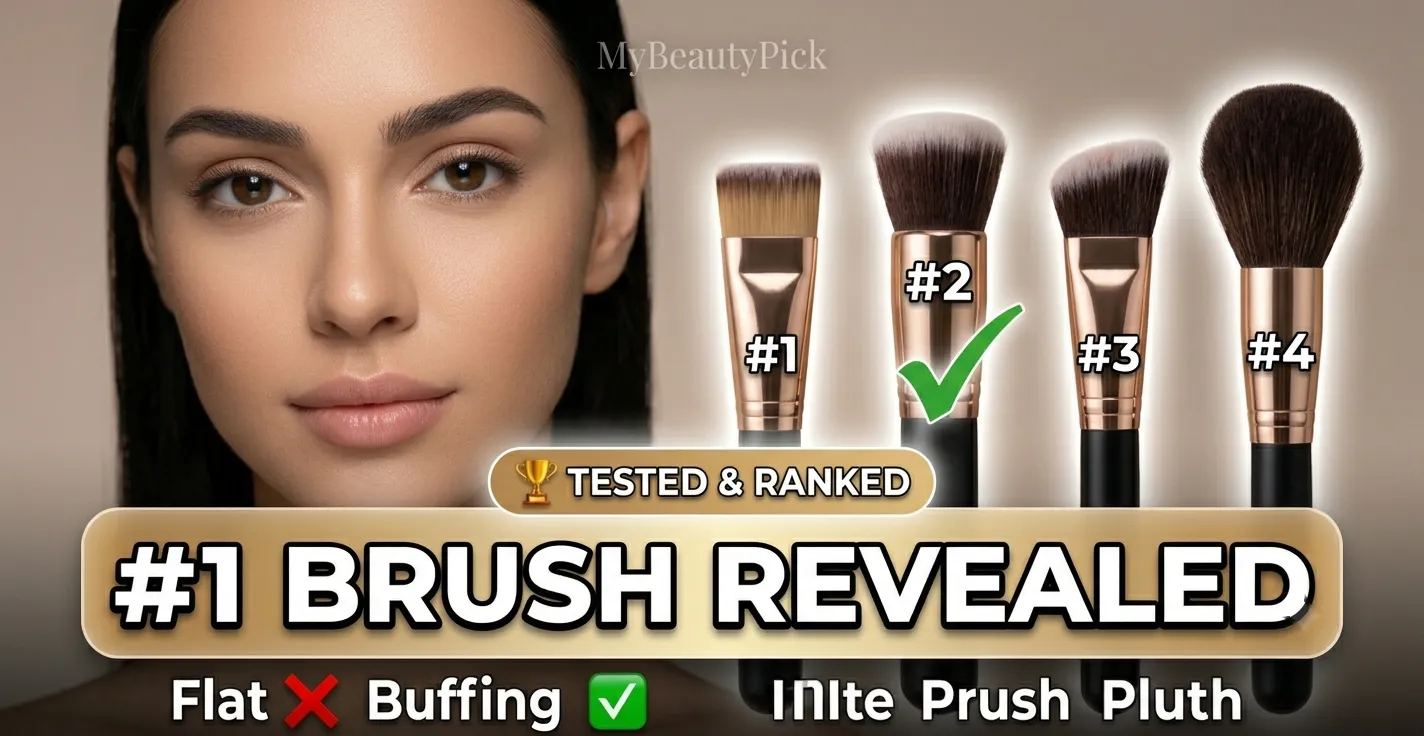
The brush you use to apply foundation changes the finish more than almost any other variable — including the formula itself. The same foundation applied with a flat brush, a buffing brush, an angled brush, and a powder brush produces four noticeably different results on the same skin. Understanding what each brush type actually does — and why — gives you control over your foundation finish rather than leaving it to chance.
- Flat brush: maximum coverage, most control, suited for liquid and cream formulas requiring precision.
- Buffing brush: airbrushed, polished result with less product than any other tool — best for buildable medium coverage.
- Angled brush: best for contoured application and hard-to-reach areas like the nose, jawline, and eye hollows.
- Powder brush: the only appropriate brush for powder foundation — fluffy, diffused deposit without patchiness.
- Brush type must match foundation formula — the wrong pairing consistently produces worse results regardless of brush quality.
How Foundation Brush Type Changes Your Finish
Every foundation brush type applies product through a different mechanism. A flat brush guides and presses. A buffing brush polishes in circular motions. An angled brush sculpts and reaches. A powder brush diffuses and deposits lightly. Each mechanism produces a different coverage level, finish quality, and skin texture interaction.
The question isn’t which brush is best — it’s which brush produces the result you’re trying to achieve with the specific foundation formula you’re using. A flat brush with a lightweight skin tint gives more coverage control than the same tint applied with a fluffy powder brush. A buffing brush on a full-coverage cream foundation gives a more polished, airbrushed result than applying the same formula with a stippling brush.
Flat Foundation Brush: Precision and Maximum Coverage
Flat Foundation Brush
A flat foundation brush has densely packed, straight bristles cut flat at the top. This shape allows the bristles to guide liquid or cream foundation in a clear, controllable direction — the flat edge creates a defined application stroke that deposits product precisely where you direct it.
The flat brush is the most effective tool for achieving maximum coverage with liquid foundation because it doesn’t sheer out the formula the way a sponge does or diffuse it the way a buffing brush does. What you pick up is what you apply. This also means less product waste — the bristles hold product without absorbing it into the tool itself.
Best for: full coverage, spot coverage building, liquid and cream foundations, anyone who wants precise placement with maximum payoff per application.
Technique: apply foundation to the back of your hand first, pick up a small amount on the brush, and apply using light pressing and sweeping motions from the centre of the face outward. For the highest coverage: press the brush bristles flat against the skin and use short back-and-forth strokes. Avoid long dragging strokes — these leave visible streaks.
- Best brush examples: BK Beauty 101 Contoured Foundation Brush, e.l.f. Smooth Swipe Foundation Brush, IT Cosmetics Airbrush Foundation Brush
- Avoid for: powder foundation (wrong bristle density), skin tints where sheer coverage is the goal
Buffing Foundation Brush: The Airbrushed Finish
Buffing (Flat-Top Kabuki) Brush
A buffing brush — also called a flat-top kabuki — has extremely dense, tightly packed bristles cut flat or domed at the top. When used in circular buffing motions, this brush polishes foundation into the skin rather than applying it on top, creating the airbrushed, pore-blurring effect that makes buffing brushes the professional standard for polished base application.
The circular buffing motion blends the boundary between covered and uncovered skin, eliminating visible application edges. The high density of the bristles also means you can build coverage gradually — one pass gives medium coverage, a second pass builds to full without the product sitting on top of itself the way a flat brush can produce with multiple layers.
The Sigma F80 Flat Kabuki is the most widely cited example of this brush type, recognised for producing an almost airbrushed skin finish when used correctly. The IT Cosmetics Heavenly Luxe #6 is the alternative most praised for flattering mature skin and contouring around facial curves.
Technique: pump foundation onto the back of the hand. Pick up a small amount with the brush tip. Apply to the face using small circular buffing motions starting at the centre and working outward. Add more product in a second pass only where more coverage is needed — never apply the full product in one pass.
- Best brush examples: Sigma F80, IT Cosmetics Heavenly Luxe #6, Real Techniques Expert Face Brush
- Avoid for: powder foundation — buffing circular motion with powder creates a thick, uneven deposit
Never pump foundation directly onto a buffing brush. Apply it to the back of your hand first, then pick up a small amount with the brush tip. This controls the amount of product on the brush and prevents over-loading — the most common reason buffing produces a heavy, cakey finish rather than the airbrushed result it’s capable of.
Angled Foundation Brush: Sculpted Application and Hard-to-Reach Areas
Angled Foundation Brush
An angled foundation brush has bristles cut at an angle — typically slanting upward from one side to the other. This diagonal cut allows the brush to hug the curves of the face and reach areas that flat and buffing brushes navigate less cleanly: the sides of the nose, the jawline, the area under the eye, the hollows around the mouth.
The angled shape also lends itself naturally to sculpted application — following the contours of the face precisely. For this reason, makeup artists use angled brushes not just for foundation but for cream contour and concealer, where placement precision is as important as coverage level.
The BK Beauty 101 Contoured Foundation Brush has a slight convex shape and angled cut designed specifically to follow facial curves — it’s particularly recommended by makeup artists working on mature skin because the shape allows foundation to be pressed into curves without dragging.
Technique: use short strokes following the natural direction of the skin surface. The angled tip is most useful for nose-area precision — use the narrow end to apply foundation along the nose bridge and nostrils without flooding. Use the wider face to apply across cheeks, forehead, and chin.
- Best brush examples: BK Beauty 101 Contoured Foundation Brush, KINGMAS Angled Kabuki, dual-ended angled/round brushes
- Best for: anyone who struggles with nose-area and jawline application, cream and liquid formulas
Powder Foundation Brush: Light Deposit, Even Coverage
Powder Foundation Brush
A powder foundation brush is larger, fuller, and more loosely packed than a liquid or cream foundation brush. The loosely packed bristles pick up powder without over-loading it and diffuse it across the skin in a soft, even layer that prevents the patchiness that denser brushes create when used with powder.
Powder foundation behaves differently from loose powder. It’s designed for coverage, not just setting — it relies on even pressure and controlled deposit rather than the light diffusion that loose powder requires. A flat-topped, moderately dense powder brush gives better results with pressed powder foundation than a very fluffy dome brush, which struggles to deposit enough product evenly for real coverage.
The kabuki brush — a short, dense, round brush — is frequently recommended for powder foundation precisely because its density creates the consistent pressure needed to deposit powder foundation evenly without dusting it loosely across the surface.
Technique: tap the brush into the pressed powder compact. Tap off excess on the back of the hand. Apply using light circular motions or pressing motions depending on desired coverage — pressing gives more coverage, circular motions give a lighter, more diffused result. Build in thin layers.
- Best brush examples: flat-top kabuki for powder, Real Techniques Setting Brush, any medium-density dome brush with flat cut top
- Avoid: using liquid or cream foundation brushes for powder — the density is wrong and deposits unevenly
Foundation Brush Comparison: Which Type for Which Situation
| Brush Type | Best Formula | Coverage Result | Finish | Best Technique |
|---|---|---|---|---|
| Flat brush | Liquid, cream | Full, buildable | Polished, precise | Short pressing and sweeping strokes |
| Buffing (flat kabuki) | Liquid, cream | Medium to full, airbrushed | Polished, pore-blurring | Small circular buffing motions |
| Angled brush | Liquid, cream | Medium to full, precise | Sculpted, contoured | Short strokes following facial curves |
| Powder brush (fluffy dome) | Powder foundation | Light to medium | Soft, diffused | Circular or pressing motions |
| Kabuki (dense) | Powder foundation, cream | Medium to full | Even, polished | Circular buffing, even pressure |
| Stippling brush | Liquid | Light, buildable | Soft, airbrushed, minimal | Stippling/dabbing motion only |
How to Choose the Right Foundation Brush for Your Skin Type
Oily and Combination Skin
A buffing brush or flat brush with a mattifying primer applied before foundation gives the most controlled, long-lasting result on oily skin. The pressing motion of a buffing brush ensures product adheres to the primed surface rather than sliding over oils. Avoid fluffy, loosely packed brushes on oily skin — they deposit product inconsistently and can distribute rather than adhere the formula.
Dry Skin
A flat brush used with pressing motions or a slightly damp sponge finishing pass after brush application gives the smoothest result on dry skin. The flat brush doesn’t drag on dry areas the way circular buffing motions can. After applying with a flat brush, a single pass with a damp sponge over the face softens any dry-patch emphasis.
Mature or Textured Skin
An angled brush or a contoured buffing brush with soft bristles that hug facial curves. The BK Beauty 101 is specifically recommended for mature skin by makeup artists — the angled, slightly convex shape allows the bristles to follow skin curves and deposit foundation without dragging, which is the primary issue with flat brushes on mature or textured skin.
Foundation Brush Care: What Most Guides Skip
Foundation brush performance degrades significantly when bristles hold residual product. A dirty buffing brush produces a muddy, uneven result on fresh application. A dirty flat brush streaks. Clean brushes produce the results described above; dirty ones don’t.
How often to clean: liquid and cream foundation brushes should be cleaned after every use if possible, or at minimum every 2–3 uses. Unwashed foundation brushes are also a meaningful cause of breakouts on acne-prone skin — the product residue combined with bacteria from daily use creates exactly the conditions that trigger breakouts.
How to clean: liquid brush cleaner applied to a tissue for a quick clean between uses. Dedicated brush shampoo or mild shampoo with warm water once a week for a thorough clean. Squeeze excess water from the base outward toward the tip — never soak the ferrule (the metal band connecting bristles to handle) as this loosens the glue over time and causes shedding.
Frequently Asked Questions
What is the best foundation brush for a flawless finish?
A buffing brush (flat-top kabuki) applied in circular motions with a liquid or cream foundation consistently produces the most polished, airbrushed finish of any brush type. The high bristle density and buffing motion polish foundation into the skin rather than applying it on top, blurring pores and eliminating application edges. The Sigma F80 and IT Cosmetics Heavenly Luxe #6 are the most widely recommended examples at their respective price points.
What is the difference between a flat foundation brush and a buffing brush?
A flat brush has bristles cut straight and flat at the top, used with sweeping and pressing strokes for precise, full coverage application. A buffing brush (flat-top kabuki) has extremely dense bristles used in circular buffing motions to polish foundation into the skin for an airbrushed effect. The flat brush gives more placement control; the buffing brush gives a more polished, diffused result with less effort. For the most coverage: flat brush. For the most polished skin finish: buffing brush.
What is a powder foundation brush and how does it differ from a liquid brush?
A powder foundation brush is larger, fuller, and more loosely packed than a liquid or cream foundation brush. The loose bristle packing allows it to pick up powder without overloading it and diffuse it evenly across the skin without patchiness. A liquid foundation brush has denser, more tightly packed bristles that grip and press product rather than diffusing it. Using a liquid brush with powder foundation creates uneven, patchy deposit — always use a brush appropriate for the formula type.
How do I prevent brush streaks when applying foundation?
Brush streaks when applying liquid foundation come from three causes: too much product on the brush, too-long application strokes, or dragging the brush rather than pressing. Fix: apply foundation to the back of your hand and pick up small amounts from there rather than loading directly from the pump. Use short strokes rather than long sweeping motions. Follow with a clean damp sponge to press and smooth any visible brush marks. Switching to a buffing brush with circular motions eliminates streaks entirely for most people.
How often should I clean my foundation brush?
Foundation brushes used with liquid or cream product should be cleaned at minimum every 2–3 uses. The product residue in unwashed bristles degrades the quality of subsequent applications and is a meaningful cause of breakouts on acne-prone skin. A quick clean with liquid brush cleaner on a tissue takes 30 seconds and is sufficient for daily maintenance. Do a thorough clean with brush shampoo or mild shampoo once per week, reshape the bristles, and let them dry flat rather than upright to prevent water from loosening the ferrule glue.