

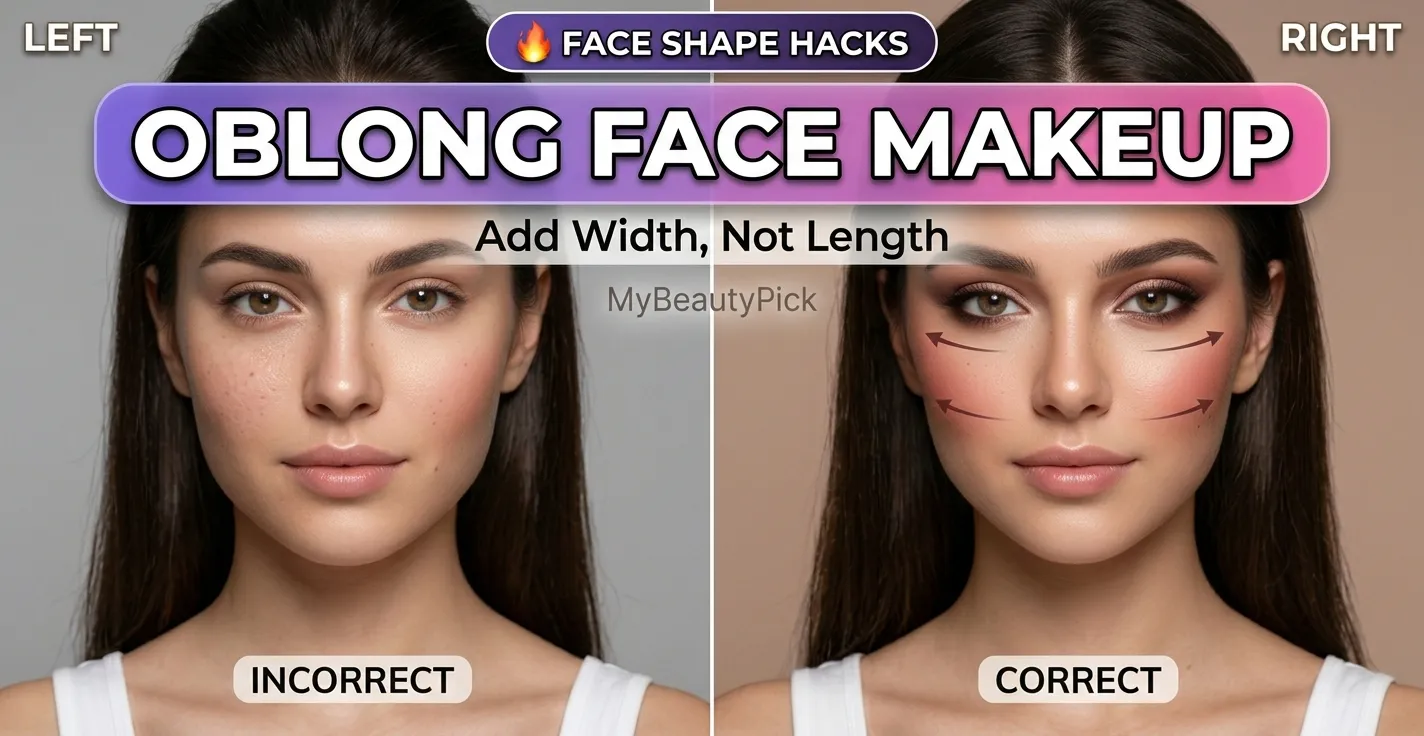
An oblong face is noticeably longer than it is wide, with similar width at the forehead, cheekbones, and jaw. The face reads as elegant and refined, but makeup that ignores the length — or actively emphasises it — can make the face look drawn or overly narrow. The goal is adding visual width and reducing the perception of length through horizontal emphasis in placement, direction, and technique.
- An oblong face is longer than it is wide with roughly equal widths at forehead, cheekbones, and jaw.
- The makeup goal is creating the illusion of width and reducing visual length through horizontal techniques.
- Blush swept horizontally across the cheekbone — not upward — adds the most visible width.
- Flatter brows without high arches are more flattering than the arched brows recommended for other face shapes.
- Avoid all vertical lines and elongating techniques — they increase the perception of face length.
How to Identify an Oblong Face Shape
Pull your hair back and look straight into a mirror in natural light. An oblong face shows: the face is clearly longer than it is wide; width is roughly equal across the forehead, cheekbones, and jaw (unlike heart, which is wider at the top, or diamond, which is wider at the cheekbones). The jaw is rounded rather than sharply angular. The overall face length is the dominant characteristic.
Oblong is sometimes confused with oval. The distinction: oval faces are slightly longer than wide but have balanced proportions. Oblong faces are noticeably longer than wide — the length is clearly the dominant feature.
Contour Placement for Oblong Face
Contouring an oblong face is about shortening and widening — creating shadows that reduce the perception of length rather than adding definition to any individual feature.
Chin Contour
Apply contour below the chin — on the very underside of the jawline — blending downward. This visually shortens the lower face and reduces the chin’s perceived length. It is one of the most effective contour placements for oblong faces and is unique to this face shape.
Hairline Contour
Apply contour along the top of the forehead at the hairline, blending into the hairline. This reduces the perceived height of the forehead and shortens the upper face. Keep it soft and well-blended — the goal is reducing length, not creating a visible stripe of darkness.
Contour down the sides of the face. Side-of-face contouring is designed to narrow wide faces — on an oblong face it elongates an already-long face and makes it appear even narrower. Also avoid a long vertical nose contour line that adds more central length. Any vertical contouring works against oblong face balance.
Blush Placement for Oblong Face
Blush is one of the most powerful tools for oblong faces because the direction of blush application directly determines whether the face reads as wider or longer.
The correct approach: apply blush horizontally across the cheekbone — sweeping from the nose side outward toward the ear. The blush band should read as wide and horizontal rather than narrow and vertical or steeply upward. This adds visual width to the face at the cheekbone level.
What to avoid: blush applied too close to the nose (which reads as a narrow vertical accent and adds to the perception of length); blush swept steeply upward toward the temple (which adds vertical movement and length); and blush concentrated only at the apple (which doesn’t add horizontal breadth).
The visual principle: a horizontal band of colour across the widest point of the face adds perceived width. Practise seeing blush as a horizontal line across the cheekbone rather than a curved brush stroke.
Eye Makeup Techniques for Oblong Face
Eye techniques that add width rather than height are most flattering for oblong faces. The distinction matters: some eye techniques lift and elongate vertically; others extend horizontally. For oblong faces, horizontal is always the preferred direction.
Liner Angle
A liner wing that extends outward rather than steeply upward adds horizontal length to the eye area. Keep the wing angle relatively flat and outward — the extension should go sideways rather than climbing vertically at the outer corner. This adds horizontal visual weight to the upper face without adding height.
Eyeshadow Blending
Eyeshadow blended to extend outward at the outer corner — horizontally rather than upward into the crease — adds width rather than height to the eye area. Avoid very dramatic high-blended eyeshadow that sweeps steeply up into the crease and beyond, which adds vertical emphasis.
Inner Corner Highlight
Warm highlight in the inner corner adds horizontal breadth to the eye area and opens the eye width-wise rather than height-wise.
Brow Shape for Oblong Face
Brow shape has a direct impact on how long a face reads — and for oblong faces, flatter brows are significantly more flattering than arched ones.
A flatter brow with a gentle, low arch is the most flattering for oblong faces. A flat brow reads as horizontal — it adds a horizontal line across the upper face at the brow level. A high arch pulls the brow upward and adds vertical height — the opposite of what an oblong face needs.
Brow fullness: a fuller brow that covers more horizontal distance on the brow bone is more effective than a thin, precisely defined brow. The horizontal coverage of a full, flat brow adds visual width to the forehead level.
What to avoid: high arched brows (add vertical height); very short brows that end before the outer eye (reduce horizontal scope); and thin, precisely pencilled brows that lack horizontal presence.
Highlight Placement for Oblong Face
| Area | Technique | Effect on Oblong Face |
|---|---|---|
| Hairline / top of forehead | Contour — blended into hairline | Visually shortens upper face length |
| Cheekbones | Blush in wide horizontal band | Adds width at the widest natural point |
| Cheekbone tip | Small highlight | Adds warmth — keep horizontal, not upward-directed |
| Chin underside | Contour | Visually shortens lower face |
| Centre of face (nose bridge) | Minimal highlight only | Avoid strong vertical highlight that increases perceived face length |
Lip Shape for Oblong Face
A fuller, wider lip adds horizontal visual weight to the lower face. A defined, generous cupid’s bow and a full lower lip read as width-adding. Gloss applied to the centre of the lower lip adds roundness and dimension.
Avoid very thin or minimally defined lips — they add to the perception of a long, narrow lower face. A wider lip shape, or a lip slightly overdrawn at the outer corners, reads as horizontal and adds breadth.
Bold lip colours on oblong faces work well — they draw the eye to the lower face and the width of the lip reads as a strong horizontal element.
Complete Look Guide: Oblong Face
Everyday Look
- Natural or satin-finish foundation
- Hairline contour blended up into hairline
- Wide horizontal blush across cheekbone
- Flat brow with low, gentle arch
- Mascara with outward-extending liner wing
- Fuller lip in warm nude or satin
Event Look
- Full-coverage long-wear foundation
- Hairline and chin contour
- Wide horizontal blush in warm terracotta or coral
- Eye technique extending outward rather than upward
- Full lashes for width at eye level
- Bold or well-defined lip
Mistakes to Avoid with Oblong Face Makeup
-
✗Blush swept upward toward the templeUpward blush adds vertical movement and length. On an oblong face, blush must sweep outward horizontally to add width. The direction is the technique — get this right and the effect is immediate.
-
✗High arched browsA high arch pulls the brow upward and adds vertical height to the face. Oblong faces benefit from flatter, more horizontal brows that add width without adding height.
-
✗Vertical contour down the sides of the faceSide-of-face contouring narrows faces. Oblong faces don’t need narrowing — they need widening. Side contour elongates rather than balances an oblong face.
-
✗Liner wing angled steeply upwardA steeply upward liner wing adds vertical height to the eye area. Keep the wing outward and relatively flat for a horizontal extension that adds width rather than height.
Frequently Asked Questions
What makeup techniques flatter an oblong face?
The most effective techniques: wide, horizontal blush across the cheekbones (not swept upward); hairline contour blended into the hairline to reduce forehead height; chin contour blended downward to reduce lower face length; flat or gently arched full brows rather than high-arched ones; liner extending outward rather than steeply upward; and a fuller, wider lip with a defined cupid’s bow. All techniques aim to add horizontal visual weight and reduce the perception of face length.
What brow shape suits an oblong face?
A flatter brow with a low, gentle arch is most flattering for an oblong face. A flat brow reads as a horizontal line across the upper face, adding width rather than height. A high arch pulls the brow upward and adds vertical height — the opposite of what an oblong face needs. Fuller brows that cover more horizontal distance on the brow bone are also more effective than thin, short styles that reduce the brow’s width-adding contribution.
Where should blush go on an oblong face?
Horizontally across the cheekbone — swept outward toward the ear rather than upward toward the temple. The blush should read as a horizontal band across the face at the cheekbone level. Blush swept upward adds vertical movement and length; blush placed horizontally adds width. Keep blush away from the nose (which reads as a narrow vertical accent) and avoid concentrating it only at the apple without the outward sweep.