

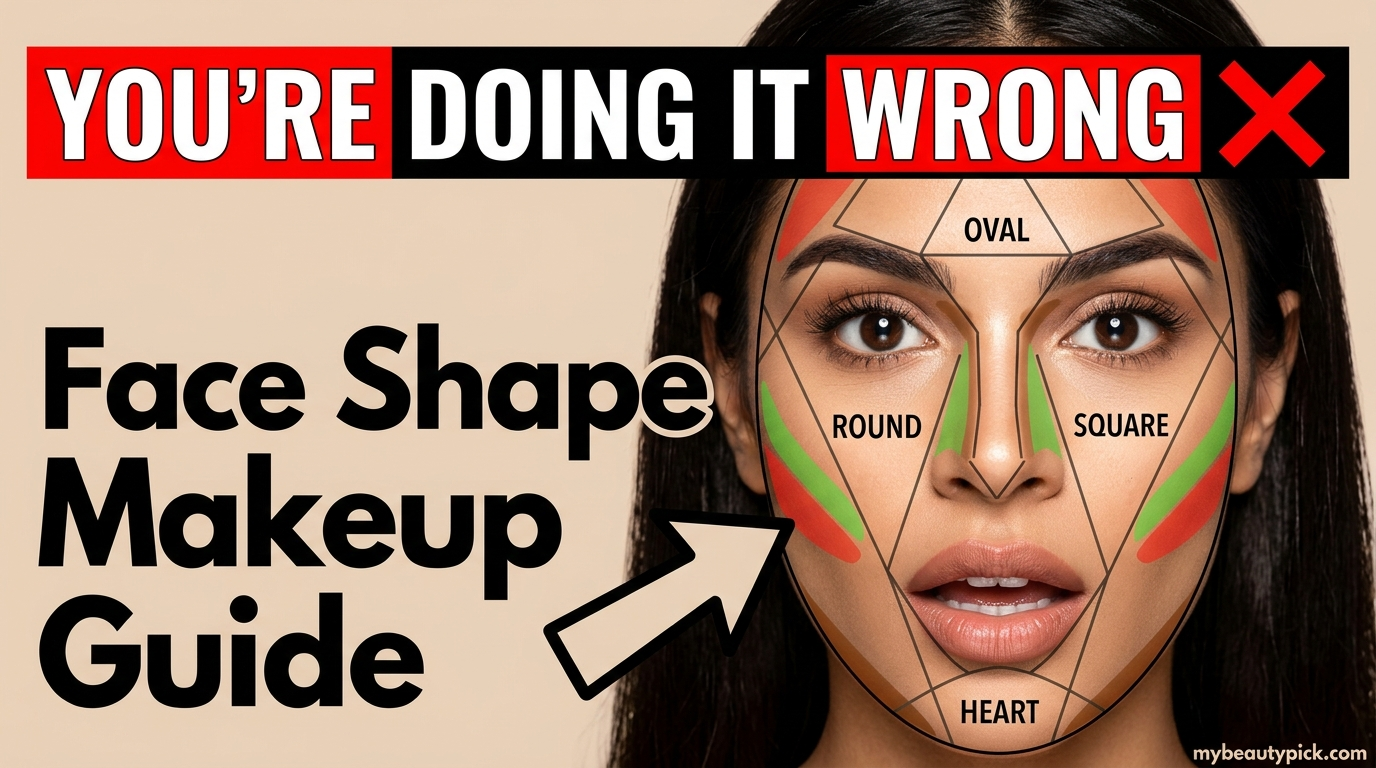
You can have the right contour shade, the right blush, the right highlighter — and still have them in the wrong place. Face shape is the variable that determines where every product goes. Contour placed correctly on a round face creates length. The same placement on an oblong face makes it look longer. Blush swept upward flatters an oval face and widens a face that is already wide. The product is the same. The shape changes everything.
This guide walks through how to determine your face shape in minutes using three methods — no apps required — then gives you the exact contour, highlight, blush, eyebrow, and lip placement for each of the six main face shapes: oval, round, square, heart, diamond, and oblong. Includes specific notes for tan and warm skin tones where the standard grey-contour advice consistently produces the wrong result.
Why Your Face Shape Changes How Makeup Works
Face shape is the overall outline formed by your forehead width, cheekbone width, jawline width, and face length together. It determines where shadows naturally fall on your face, which is what contour mimics — and where light naturally hits, which is what highlight enhances. Getting the shape right makes every other placement decision significantly more accurate.
Contour works by creating shadow. Shadow only reads as slimming or defining when it sits where natural shadow would fall based on your bone structure. On a round face, shadow placed along the sides of the face creates the illusion of a slimmer, longer shape. On a square face, the same placement does not help — the shadow needs to go at the corners of the jaw specifically to soften the angular line there.
Blush placement changes the perceived width and length of the face. A wide horizontal sweep of blush across the cheeks adds visual width — excellent for an oblong face, counterproductive for a round one. Highlight placed down the center of the face adds length — exactly what an oblong face does not need. These are not small differences. The wrong placement actively works against the face rather than with it.
How to Find Your Face Shape: 3 Methods
Method 1: The Measurement Method (Most Accurate)
This is the most reliable method because it removes guesswork from the process. You need a flexible measuring tape or ruler and about five minutes.
Tie hair back tightly so the hairline is fully visible. Stand in even daylight — not bathroom overhead lighting, which casts downward shadow and distorts proportions. No sunglasses, no jewelry on the face.
Place the tape measure from the peak of your left eyebrow arch to the peak of the right eyebrow arch. This is the standard forehead measurement point — not the full hairline width, which includes the temples. Write the number down.
Measure across your upper cheeks from the outer corner of one eye to the outer corner of the other — you are measuring from the sharp bump just below the outer eye corner to the same point on the other side. This is your cheekbone width. Write it down.
Measure from the widest point of your jaw — approximately one inch below each ear — across the face. Alternatively, measure from your chin to the point where the jaw angles upward below one ear, multiply by two. Write it down.
Measure from the center of your hairline at the top of the forehead straight down to the tip of the chin. This is your face length — the most important measurement for distinguishing oval from round, and oblong from square. Write it down.
You now have four measurements: forehead, cheekbones, jawline, and face length. The relationship between these four numbers — which is largest, which is smallest, and how they compare to each other — tells you your face shape.
| Shape | Face Length | Widest Point | Forehead vs Jaw | Jaw Type |
|---|---|---|---|---|
| Oval | Longest measurement | Cheekbones | Forehead slightly wider than jaw | Gently rounded |
| Round | Similar to cheekbone width | Cheekbones | Forehead and jaw similar | Very rounded, soft |
| Square | Similar to face width | All roughly equal | Forehead equals jaw | Sharp, angular |
| Heart | Any length | Forehead | Forehead widest, jaw narrowest | Narrow, pointed chin |
| Diamond | Longest measurement | Cheekbones (dramatically) | Forehead narrow, jaw narrow | Narrow, pointed chin |
| Oblong | Longest measurement, clearly | All roughly equal | Forehead, cheekbones, jaw similar | Rounded or lightly squared |
Method 2: The Mirror Tracing Method
Tie your hair back and stand directly in front of a mirror at arm’s length. Use a dry-erase marker, washable lip liner, or a bar of soap to trace the outline of your face directly onto the mirror surface — hairline to chin, ear to ear. Step back and look at the shape on the mirror rather than at your face. The outline on the glass makes the overall shape significantly easier to identify than looking at your face directly, where individual features draw the eye away from the overall proportion.
Method 3: The Straight-On Selfie Method
Take a straight-on selfie with hair completely pulled back. No tilting the head, no angled camera, no smiling that changes the cheek width. Hold the camera at face level rather than below it, which would distort the forehead and chin proportions. Compare the proportions in the photo to the shape descriptions. Less precise than measuring but useful for a quick first pass before confirming with measurements.
Most people’s faces are not a textbook example of any single shape. Use the measurement method to find your closest shape, then use the section below on falling between two shapes if your measurements put you between categories. The goal is finding the techniques that address your face’s specific proportions — not fitting a perfect label.
The 6 Face Shapes: Definition and Makeup Techniques
Oval Face Shape
Face length is the longest measurement. Cheekbones are the widest point. Forehead is slightly wider than the jaw. The jawline is gently rounded with no sharp angles. The face is elongated and proportionally balanced — often described as the closest to a classical “ideal” proportion because it requires the least correction.
Oval faces are the most versatile for makeup because the proportions are already balanced. The goal is not to change the shape but to enhance the features within it. Almost all contouring and blush techniques work on oval faces — the main risk is overdoing it and creating artificial structure where natural balance already exists.
- Follow natural bone structure — temples and cheek hollows
- Light application — oval does not need heavy sculpting
- Under cheekbones in a soft C-shape
- Keep it subtle — heavy contour overcorrects a balanced face
- Cheekbone tips — the high point of the cheekbone
- Center of forehead
- Bridge of nose
- Cupid’s bow
- Can highlight more broadly than other shapes
- Most placements work — apples swept upward is classic
- Sweep from cheek apples toward temples
- Avoid blush so high it reads as only temple color
- Brows: soft medium arch suits oval best
- Avoid very flat or very high arched brows
- Lips: almost all shapes work — oval is the most flexible
- Avoid competing a bold eye with a bold lip simultaneously
Oval faces on tan skin look best with warm taupe or golden-brown contour rather than cool grey. Cool-toned contour on warm golden or olive undertones reads flat and disconnected rather than as a natural shadow. Use a bronzer shade one to two steps deeper than your skin for the most natural sculpt.
Round Face Shape
Face length and cheekbone width are very similar measurements. Cheekbones are the widest point, with forehead and jawline also similar in width. The hairline is rounded rather than straight, the jaw is very soft and rounded with no angular points, and the cheeks are fuller. The face appears as wide as it is long.
The goal with a round face shape in makeup is to create the illusion of length and define the jawline — not to make the face appear smaller, but to add the vertical dimension that balances the horizontal fullness. The key mistakes to avoid are those that add more width: wide blush, side-swept highlight, and circular blush application.
- Temples — draws eye upward, adds length
- Along the sides of the face from temples to jaw
- Under cheekbones in a C-shape pulling toward the ear
- Lightly under the jawline to define it
- Avoid contouring the chin — shortens the face further
- Center of forehead vertically — adds perceived length
- Down the bridge of the nose — elongates
- Center of the chin — adds length to the lower face
- Avoid highlight placed too wide on the cheeks — adds width
- Sweep from cheekbones toward temples — upward direction
- Not on the apple of the cheek — widens the face
- Avoid circular blush application — amplifies roundness
- A diagonal line upward is the most slimming placement
- Brows: high arch creates the illusion of more length
- Avoid flat or very rounded brows — echoes face roundness
- Lips: slight overline on the cupid’s bow for definition
- Matte lip finish over high-gloss to avoid adding visual width
Warm bronzer placed below the cheekbones and blended upward toward temples is one of the most effective slimming techniques for round tan skin faces — it reads as natural warmth rather than obvious contouring. Avoid blending downward or across; the upward direction is what creates the length perception.
- Placing blush directly on the apple of the cheek — emphasizes roundness
- Wide highlighter sweeps across the cheekbones — adds width
- Flat brows that create a horizontal line across the forehead
- Heavy lip gloss in the center of the lip only — draws attention to the width of the mouth
Square Face Shape
All four measurements are roughly similar in width — forehead, cheekbones, and jaw are close to equal. The jawline is wide and angular with minimal curve. The face is approximately as wide as it is long. The defining feature is the strong, horizontal jawline and sharp jaw corners rather than the overall width.
The goal with a square face is to soften the angular jaw corners and add some length perception — not to slim the face, but to reduce the hard horizontal line at the jawline that makes the face appear very structured. The most important contouring placement for square faces is the jaw corners specifically.
- Corners of the jawline — the most important zone
- Corners of the forehead to soften the angular edge
- Add a slight curve at the jaw rather than a straight line
- Light under cheekbones in a soft sweep
- Center of forehead — adds length perception
- Under-eye area and tops of cheekbones
- Tip of the chin — softens the lower face
- Avoid angular or sharp highlight placement at the jaw
- Oval placement centered on cheeks — not wide, not high
- Avoid sweeping wide toward temples — adds to width perception
- A softer, rounder blush shape is ideal
- Brows: soft rounded arch rather than flat or angular
- A gentle arch breaks the horizontal forehead line
- Lips: rounded cupid’s bow — avoid sharp defined peaks
- Fuller lip rather than thin liner
Grey-based contour at the jaw corners on warm tan skin looks harsh and disconnected from the skin’s natural tone — the shadow reads as product rather than bone structure. Use a warm taupe or medium brown contour shade matched to your undertone. The effect is more natural and the jaw softening reads as genuine structure rather than makeup.
- Contouring the sides of the face in a straight vertical line — creates a box effect
- Shimmer highlight directly on the angular jawline — draws attention to the angle
- Very angular or flat eyebrows — echoes the horizontal jaw line
- Over-contouring the cheeks without addressing the jaw corners
Heart Face Shape
Forehead is the widest measurement. Cheekbones are high and prominent. Jawline narrows significantly to a pointed or narrow chin. The face is wider at the top than at the bottom, tapering downward. The hairline may have a widow’s peak. The upper face is strong and wide, the lower face is delicate and narrow.
The goal with a heart face shape is to balance the width of the forehead with the lower face — adding visual width at the jaw and chin area while reducing the perceived width of the forehead. The forehead is the primary contouring zone, and the chin and jaw area are where highlight goes to add dimension to the narrowest part.
- Temples and sides of the forehead — the primary zone
- Along the hairline at the forehead sides to reduce width
- Very light under the chin to add perceived width
- Avoid heavy cheekbone contouring — already prominent
- Jawline and chin area — visually widens the lower face
- Bridge of the nose — centers and balances
- Under-eye area
- Avoid wide forehead highlight — draws more attention to widest point
- Horizontal placement across the apples of the cheeks
- Lower placement than other shapes — draws eye toward lower face
- Avoid very high blush close to the temples — adds to forehead prominence
- Brows: lower arch position — high arch exaggerates forehead width
- Slightly fuller brow tail adds visual width at temples
- Lips: fuller lower lip emphasis adds perceived width to narrowest part
- Overline slightly at the corners of the lower lip
Forehead contouring on tan skin must be blended into the hairline completely — on warm or golden skin, any unblended line at the forehead edge shows as a stripe rather than a shadow. Use a fluffy brush and blend in light circular motions upward into the hairline. A warm-toned bronzer is better than a cool contour shade for this placement.
Diamond Face Shape
Cheekbones are dramatically the widest point — wider than both the forehead and the jaw. Forehead is narrow, jaw is narrow, and the chin is often pointed. Face length is the longest measurement. The overall shape is widest in the middle of the face, tapering to both a narrower top and bottom — the inverse of a typical oval.
Diamond faces are often mistaken for oval or heart because of the prominent cheekbones, but the key distinction is the narrow forehead combined with the narrow jaw — both top and bottom are narrow while the middle is very wide. Makeup goals are to add width to the forehead and chin while minimizing emphasis on the already-prominent cheekbones.
- Minimal contouring — cheekbones are already the strongest feature
- Light along the sides of cheekbones rather than underneath
- Avoid hollow cheekbone contouring — further emphasizes the width
- Forehead center — adds visual width to narrow top
- Chin — adds width to narrow lower face
- Temples — balances against cheekbone width
- Subtle cheekbone highlight only — they do not need emphasis
- Horizontal sweep across the nose bridge and cheeks
- Softer, more diffused placement rather than sculpted upward sweep
- Avoid highly dramatic upward cheekbone sweep — exaggerates cheekbone drama
- Brows: straight or gently curved — adds horizontal width to narrow forehead
- Avoid a very high arch — draws eye to narrow top
- Lips: full shape with emphasis on the corners
- A wider lip shape balances the narrow chin
Diamond face shape on tan skin benefits most from a warm luminous highlight on the forehead center and chin — this adds dimension to the narrower zones without the chalky quality that stark white highlighters produce on tan skin. Choose champagne or warm gold rather than silver or icy tones for the most skin-appropriate result.
Oblong Face Shape
Face length is clearly the longest measurement — significantly longer than the face is wide. Forehead, cheekbones, and jawline are all similar in width. The sides of the face are relatively straight rather than curved inward at the cheeks. Similar to oval in proportion but with straighter sides and greater length-to-width difference. Sometimes called rectangular or long face shape.
The goal with an oblong face shape is the opposite of a round face — add perceived width and reduce the visual length. This is the one face shape where wide blush placement, wide highlight, and horizontal techniques actively help. Any vertical placement worsens the length perception.
- Along the hairline at the top of the forehead — visually shortens face
- Under the chin — shortens the bottom
- Avoid any vertical contouring along the sides of the face
- No nose contouring down the bridge — adds more length
- Wide horizontal placement on cheekbones — adds width perception
- Avoid center-forehead vertical highlight — adds length
- Avoid chin highlight — adds more length to the bottom
- Wide cheekbone highlight is the priority placement
- Wide horizontal sweep across the cheeks — the most helpful technique for oblong faces
- Do not sweep upward toward temples — creates more vertical line
- Wider placement than any other shape is ideal here
- Brows: flat or minimal arch — high arch creates more vertical line
- Straighter, more horizontal brow shape is ideal
- Lips: full wide shape — emphasize the horizontal width
- Avoid very tall cupid’s bow that adds vertical height at center
Wide warm bronzer sweeping across the cheeks horizontally is one of the most naturally flattering techniques for oblong tan skin faces — it adds warmth and width without looking like obvious contouring. A terracotta or warm peach blush placed wide across the cheeks photographs particularly well on tan skin and adds the horizontal dimension the face shape benefits from.
- Blush swept upward toward temples — increases the vertical direction
- Highlighter placed down the center of the face only — creates a vertical stripe
- High arched brows — adds perceived height above the face
- Thin lip liner that makes the mouth look smaller
What If You Fall Between Two Face Shapes?
The majority of faces do not fit cleanly into one category. Measurements that are close but not definitive, or features that match one shape in some areas and another in others, are entirely normal. Here is how to handle the most common combinations:
Face length is slightly longer than cheekbone width but not dramatically. Use round face techniques but apply them lightly — blush swept toward temples rather than aggressively upward, light contouring at temples, center highlight on a narrow strip. You do not need the full round correction, just the direction.
Wide forehead with an angular jaw rather than a tapered one. Focus primarily on forehead width reduction — contour the temples and sides of the forehead. Also soften the jaw corners as you would for square. The jaw is the distinguishing feature here: if it is angular, treat it like square; if it is narrower than the forehead, treat it like heart.
Face is longer than wide but not dramatically so, and the sides are relatively straight. Use more horizontal blush placement than standard oval technique, widen the highlight on the cheekbones, and keep center-face vertical highlight minimal. The adjustments are toward width rather than toward dramatic length reduction.
Full cheeks with a more angular jaw than a typical round face. Apply round face techniques to the cheeks and temple area, and add jaw corner contouring from the square technique. The two corrections work in the same direction — both aim to define the jawline and add length perception — so combining them is straightforward.
Identify the single feature that you most want to change the perception of — a wide jaw, a very long face, a prominent forehead — and choose the techniques from whichever shape most specifically addresses that feature. You do not need to apply every technique for every shape. One well-placed correction is more effective than six partial ones.
Quick Reference: Contour, Highlight, Blush and Brow by Face Shape
| Face Shape | Contour Priority Zone | Highlight Priority Zone | Blush Direction | Eyebrow Shape |
|---|---|---|---|---|
| Oval | Temples, cheek hollows (light) | Cheekbone tips, nose bridge, cupid’s bow | Apples swept upward | Soft medium arch |
| Round | Temples, jaw sides, cheek hollows | Forehead center, nose bridge, chin | Sweep toward temples, diagonal upward | High arch |
| Square | Jaw corners, forehead corners | Forehead center, cheekbone tops, chin tip | Oval centered on cheeks | Soft rounded arch |
| Heart | Temples, forehead sides, hairline | Jaw and chin, nose bridge, under-eye | Lower horizontal across apple | Lower arch, fuller tail |
| Diamond | Cheekbone sides (minimal) | Forehead center, chin, temples | Horizontal across nose and cheek | Straight or gentle curve |
| Oblong | Hairline top, under chin | Wide horizontal cheekbones | Wide horizontal sweep | Flat or minimal arch |
Frequently Asked Questions
Oval is often cited as the most common face shape, followed closely by round and square. However, most people have a combination of features from multiple shapes rather than a textbook single shape. Oval and round together account for the majority of face shapes across all ethnicities.
Pull your hair back and take a straight-on selfie at face level. Compare the photo to the shape descriptions — focus on where your face is widest (forehead, cheekbones, or jaw), whether your face appears as long as it is wide or clearly longer, and whether your jaw is angular or rounded. The mirror tracing method is the fastest non-measurement approach: trace your face outline on the mirror and compare the shape.
The underlying bone structure — which determines face shape — does not change significantly after adulthood. However, changes in facial fat distribution with age, weight fluctuation, and skin laxity can alter how the shape appears. Someone with a naturally oval face may develop a rounder or squarer appearance over time as fat redistributes, but the bone measurements themselves remain consistent.
Both oval and oblong faces are longer than they are wide. The difference is in the sides of the face: oval faces curve gently inward at the cheeks, giving a slightly tapered appearance. Oblong faces have straighter sides with less inward curve — the face looks more like a rectangle with rounded corners than an egg shape. If the sides of your face look relatively straight when you look at a selfie, you are likely oblong rather than oval.
The key difference is the length-to-width ratio. An oval face is clearly longer than it is wide. A round face has very similar length and width measurements. If you measure your face length and cheekbone width and they are within half an inch of each other, you have a round face. If the length is notably longer, you have an oval face.
The technique and placement are the same as for any skin tone. The key difference for tan skin is the contour shade — avoid cool grey-based contour shades, which read as ashy or disconnected on warm tan undertones. Use a warm taupe, soft brown, or bronzer shade one to two steps deeper than your foundation shade. The shadow will read as natural bone structure rather than obvious product. Our guide to blush, bronzer, and highlight for tan skin covers specific shade recommendations.
A high arch suits round faces best because it creates a vertical line above the eye that adds perceived length to the face. Flat or very rounded brows echo the roundness of the face shape and make it appear rounder. The arch should peak toward the outer two-thirds of the brow rather than at the center, which keeps the shape from looking overly theatrical while still providing the length-adding effect.
Face shape does not affect foundation shade selection — that is determined by skin tone and undertone. However, face shape does affect where you apply concealer and corrector, since under-eye brightness should follow the natural depth of each specific face shape rather than a universal triangle. Our concealer guide for tan skin covers placement for different face structures.
Once you know your face shape, the next step is matching your contour, blush, and highlight to your specific undertone. On tan skin in particular, the shade choices for contouring and highlighting change significantly compared to fair skin guides. Our guide to blush, bronzer, and highlight for tan skin covers the exact shades for each product category, and our makeup routine for tan skin shows how to put the full face together once placement is dialed in.