

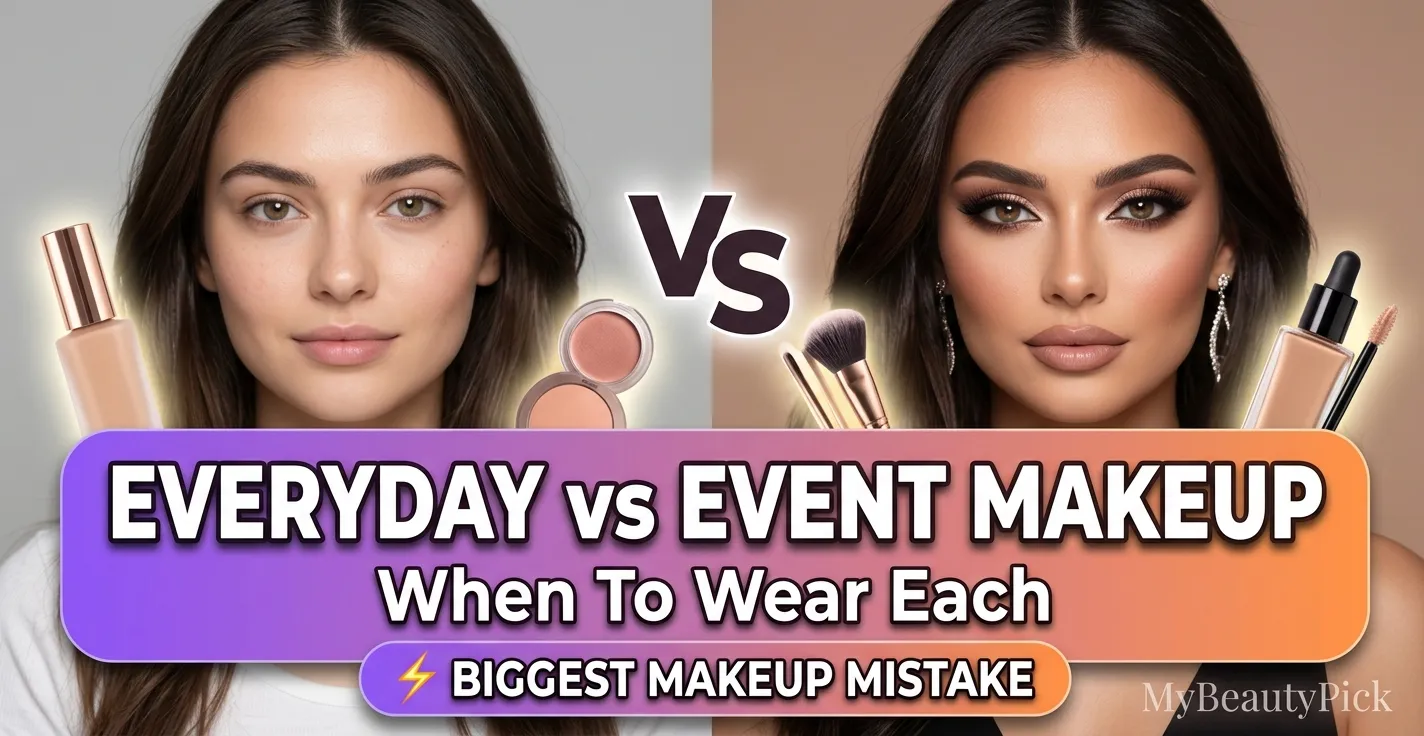
The difference between everyday makeup and event makeup is not just product intensity — it’s purpose, duration, and the visual environment the look needs to work in. Everyday makeup needs to look natural in office lighting, be comfortable for 8–10 hours, and survive an unpredictable day. Event makeup needs to hold through heat, photographs, and close-up scrutiny for 4–6 hours in conditions that would destroy an everyday look. The approaches are genuinely different, and understanding what changes between them gives you a framework for any occasion.
- Everyday makeup: natural finish, light-to-medium coverage, comfortable for 8+ hours, survives an unpredictable day.
- Event makeup: full coverage, long-wear formula, photograph-ready, built to hold through heat and movement for 4–6 hours.
- The three biggest differences: foundation formula, eye intensity, and lip longevity approach.
- Flash photography changes everything about event makeup — SPF formula, setting powder choice, and highlight placement all need adjustment.
- You can adapt any look from everyday to event by adding one layer of intensity — heavier lashes, a bolder lip, a more defined liner.
Everyday Makeup: What It Needs to Do
Everyday makeup has a different job description than event makeup. It needs to look appropriate and polished across a wide range of unpredictable environments — indoor office lighting, outdoor daylight, fluorescent supermarket lighting — without looking overdone in any of them. It needs to survive a commute, a full workday, lunch, coffee, phone calls, and whatever else happens, without requiring active maintenance.
This means the priorities for everyday makeup are: comfort, longevity under normal conditions, and visual appropriateness across contexts. Not maximum intensity, not photographic perfection.
Everyday Makeup Product Approach
Base
- Skin tint or light-to-medium coverage foundation
- Satin or natural finish
- Chemical SPF in skincare — not physical SPF in base products
- Concealer only where needed
- Light powder on T-zone if oily
- Setting spray to finish
Eyes, Cheek, Lip
- One or two eyeshadow shades maximum
- Mascara or light liner — nothing heavily set
- Defined but not sculpted brows
- Cream blush or light powder blush
- Tinted lip balm or satin lipstick for touch-up ease
- No false lashes
For everyday makeup that lasts without touch-ups, the single highest-impact change is primer. A matched primer (mattifying for oily zones, hydrating for dry) applied under foundation extends wear by 3–4 hours even on budget foundations. More effective than switching to a more expensive formula.
Event Makeup: What It Needs to Do
Event makeup is built for a specific environment that’s more demanding than everyday. It needs to look intentional and polished under harsher scrutiny — flash photography, direct event lighting, people looking at you closely during conversations and photographs. It needs to hold through heat, dancing, eating, drinking, and emotional moments. And it needs to look consistent from the beginning of the event to the end.
These demands require different products and application techniques from everyday makeup. The margin for formula imprecision is smaller — breakdown in event makeup shows more clearly and is harder to fix mid-event.
Event Makeup Product Approach
Base
- Full-coverage, long-wear foundation — silicone or polymer-based
- Primer before, targeted concealer, set with banana powder
- NO physical/mineral SPF in any product — causes flash photography white cast on tan skin
- Setting spray after everything
- Have a pressed powder and blotting papers in your bag
Eyes, Cheek, Lip
- Eye primer before any eyeshadow — non-negotiable for longevity
- Full eye look with liner and lashes
- Waterproof mascara
- Bold or more defined lip with liner underneath
- Matte lipstick for photography — gloss reflects flash and reads lighter
- More precise highlight placement — only on the tip of the cheekbone
The Three Biggest Differences Between Everyday and Event Makeup
1. Foundation Formula
Everyday foundation prioritises comfort and natural finish. Event foundation prioritises longevity and coverage integrity under demanding conditions. The formula change is the most important adaptation:
- Everyday: skin tint, BB cream, or medium-coverage foundation in satin or natural finish
- Event: full-coverage, long-wear formula — silicone or polymer-rich — with natural matte or satin finish
For tan skin specifically: event foundation needs to be chosen with oxidation in mind. The higher the heat and the longer the wear, the more iron oxide pigments shift. Choose a shade with a slightly cooler or more neutral undertone than your exact match for event makeup — the warm oxidation shift will bring it to your true tone over 4–6 hours.
2. Eye Intensity and Longevity
Everyday eye makeup is minimal — mascara, possibly a light shadow or liner. Event eye makeup is a complete, finished look that needs to hold for hours without visible fading or creasing.
The critical technique difference: eye primer. Eyeshadow without primer on tan skin with any oiliness creases and fades within 2–3 hours. With primer, the same eyeshadow holds for 8–10 hours. This single step transforms event eye makeup longevity and is non-negotiable for any event look.
For lashes: everyday usually means mascara only. Event usually means false lashes — either individual clusters at the outer corners for a modern approach, or a full strip lash for maximum drama. Lashes are one of the highest-impact visual changes between an everyday and event look.
3. Lip Approach
Everyday lips can use comfortable, touchable formulas — tinted balms, satin lipstick that you reapply when needed. Event lips need to hold through eating and drinking with minimum visible degradation.
The professional approach for event lips: apply lip liner in the same shade as the lipstick and fill the entire lip with liner as a base. Apply lipstick over the top. Blot with a single-ply tissue. Apply a second coat without blotting. This sets the lipstick for maximum longevity — the colour stays significantly longer through eating and drinking than a single application over bare lips.
Adapting a Look From Everyday to Event
You don’t need to start from scratch to convert an everyday look to event-ready. These targeted additions shift any look up one level in intensity without requiring a full redo:
- Add liner: a thin liner wing or tightlined upper waterline shifts the eye from casual to defined without adding eyeshadow complexity
- Add lashes: individual clusters at the outer corners takes 5 minutes and adds the most visual impact per product of any event upgrade
- Switch the lip: replace tinted balm with a satin lipstick and liner; this alone shifts a natural look toward soft glam event-ready
- Set more thoroughly: pressed banana powder on the T-zone and a mist of setting spray locks an everyday base for event-length wear
- Add precise highlight: a small amount of champagne or gold highlight on the tip of the cheekbone elevates a natural base into a polished, photography-ready finish
Makeup for Specific Event Types
Work Events and Professional Occasions
- Polished base: medium-to-full coverage, satin finish
- Defined brows, mascara, thin liner or tightline
- Blush: warm and natural
- Lip: satin or warm nude — no bold colour in most professional settings
- The goal: clearly dressed up without distracting
Weddings and Formal Events
- Full coverage base set with banana powder
- Soft glam or classic glam eye — the occasion determines which
- Full lashes
- Waterproof mascara and liner
- Statement lip or soft glam satin lip — both appropriate
- No physical SPF products — flash photography all day
Evening Events
- Full-coverage, long-wear base
- Smoky eye or classic glam — the most appropriate choices
- Full or cluster lashes
- Bold or deep satin lip
- Warm bronzer and precise highlight
- Setting spray finish
Casual Events (Brunch, Low-Key Parties)
- Soft glam or elevated natural
- Medium coverage, satin finish base
- Soft shimmer eye, cream blush
- Individual lash clusters — more modern than full strip
- Warm satin lip
- Effortless-looking but polished
Photography Considerations for Event Makeup on Tan Skin
Event makeup on tan skin faces specific photographic challenges that don’t apply to everyday wear:
No physical/mineral SPF. Titanium dioxide and zinc oxide reflect camera flash and appear as a white or grey cast in photos on tan skin. This affects any product containing these ingredients: foundation with SPF, BB creams, setting sprays with SPF, primer with SPF. Use chemical SPF only, in skincare, before makeup.
Banana powder over white translucent. White translucent setting powder causes the same flash reflection problem as physical SPF on tan skin. Yellow-toned banana powder absorbs flash rather than reflecting it and maintains the warm undertone of the foundation.
Highlight placement. Keep highlight to the very tip of the cheekbone only. Over-highlighting creates blown-out spots in flash photography on tan and deeper skin.
Matte lip for high-photography events. Gloss reflects flash and reads lighter in photos than it appears in person. For events where many photos will be taken, matte or satin lipstick reads more consistently and accurately in photographs.
Frequently Asked Questions
What is the difference between everyday and event makeup?
Everyday makeup prioritises comfort, natural finish, and versatility across multiple unpredictable environments over 8–10 hours. Event makeup prioritises longevity under demanding conditions, photographic performance, and visual impact over 4–6 hours in a specific environment. The practical differences: event makeup uses full-coverage long-wear foundation with primer and setting powder; a complete eye look with eye primer and false lashes; a lined, set lip that holds through eating and drinking; and no physical SPF products that cause flash photography issues.
How do I make my everyday makeup last longer for an event?
The highest-impact changes: add a primer matched to your skin type before foundation; set the T-zone with banana powder immediately after foundation; apply eye primer before any eyeshadow; finish with a setting spray. These four additions extend any foundation’s wear significantly — often by 3–4 hours — without requiring you to switch to a different formula or change your look substantially.
How do I stop foundation from showing flashback in event photos?
Flash photography flashback is caused by physical SPF ingredients (titanium dioxide, zinc oxide) in foundation, primer, or setting powder reflecting the camera flash as a white or grey cast. The fix: use chemical SPF only in your skincare routine before makeup; choose a foundation without added SPF; use banana powder or a pigmented pressed powder for setting (not white translucent); and avoid SPF-containing setting sprays. This applies to all skin tones but is particularly visible on tan and deeper complexions where the contrast with pale flashback is more pronounced.