

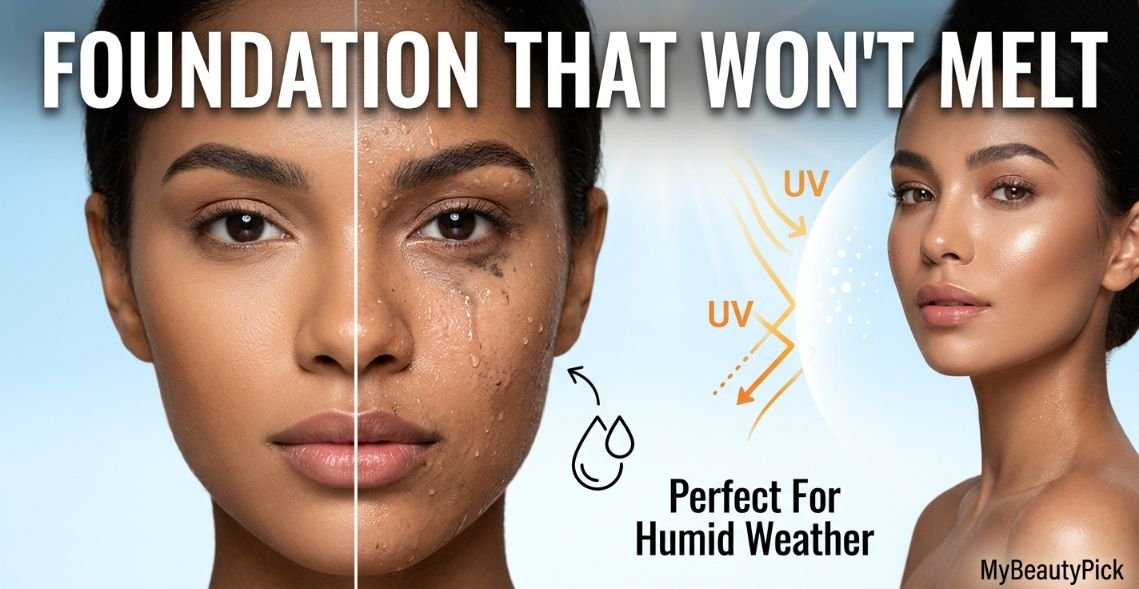
A wedding is one of the few occasions where foundation genuinely needs to perform at every level simultaneously: hold through hours of wear, survive any emotional moments, look natural in person, photograph cleanly under flash and natural light, and not transfer onto a white dress or partner’s face. That’s a longer and more specific list of requirements than most foundations are actually designed to meet. The formulas that work for weddings are specific, and the preparation around them matters just as much as which product you choose.
- No physical SPF (titanium dioxide, zinc oxide) in any product — foundation, primer, setting powder, setting spray. Flash photography flashback is visible on tan and deeper skin.
- Trial the complete bridal makeup routine 4–6 weeks before the wedding. Wear it for a full day. Photograph yourself in flash lighting. There should be no surprises on the day.
- Satin or natural-matte finish reads better in mixed lighting than flat matte (which looks heavy in candlelight) or very dewy (which overexposes in flash).
- Set in layers: banana powder on T-zone immediately, setting spray after, touch-up only with blotting papers during the event.
- For tan skin: choose one shade cooler than your exact match. Event lighting, emotion, and hours of wear all accelerate oxidation.
What Wedding Foundation Actually Needs to Do
The demands on bridal foundation are different from everyday wear in specific ways that change which formulas are appropriate:
- 12+ hour wear without touch-ups — ceremonies, portraits, reception, dancing
- Transfer resistance — no foundation on the white dress, partner’s face, or photographer’s hands
- Photography performance — no flashback from physical SPF, no oxidation visible in photos, consistent colour in both natural and artificial light
- Emotional resilience — many people cry at weddings, and while the tears are worth it, a foundation that migrates under the eyes within the first hour of the ceremony is a problem
- Looks natural in person — full coverage that looks like coverage rather than skin doesn’t suit every aesthetic, particularly in candlelit receptions or natural outdoor ceremonies
These demands pull in slightly different directions. Maximum transfer resistance and 12-hour wear push toward heavier, more coating formulas. Natural-looking skin finish pulls toward lighter, more luminous ones. The right balance depends on your skin type, the wedding environment, and your personal aesthetic.
Best Wedding Foundation Picks
Estée Lauder Double Wear Stay-in-Place Foundation
Double Wear is probably the most recommended bridal foundation by professional makeup artists, and the reason is straightforward: it does what it says. The formula holds through a 12-hour wedding day — ceremony, portraits in varying light, hours of reception — without significant breakdown. The transfer resistance is genuine; it doesn’t mark clothing or transfer onto a partner’s face the way lighter formulas do.
The natural matte finish reads consistently in natural light, artificial event lighting, and flash photography — the finish doesn’t shift between environments the way very dewy formulas can. For tan skin, the W shade range holds undertone better than most wedding foundations, which matters for the hours of portrait photography that will be examined in detail afterward.
The limitation for a wedding specifically: it reads as a polished, made-up look rather than skin. For brides who want the natural-skin aesthetic rather than a clearly made-up finish, Double Wear is not the right formula. It suits classic, full-glam, and formal aesthetics well; it suits natural, soft, or clean aesthetics less.
- 12-hour wear through a full wedding day
- Genuine transfer resistance
- Consistent in all lighting
- Holds undertone over long wear
- Looks polished rather than natural-skin
- Not for natural or soft bridal aesthetics
- Sets quickly — needs practiced blending
- Needs oil cleanser to remove
Giorgio Armani Luminous Silk Foundation
For the natural-skin bridal aesthetic — the “I look like myself but better” version of bridal makeup — Luminous Silk is the most frequently reaching-for formula in a professional bridal kit. The finish in wedding photographs is consistently beautiful: the micro-fil technology creates the kind of even, warm luminosity that flatters in natural outdoor light, candlelit receptions, and flash photography without overexposing.
The coverage is medium and builds to medium-full, which suits most bridal needs. For significant hyperpigmentation or redness, a targeted concealer over the top gives the coverage without making the whole face feel covered. On tan skin, the warm shade options photograph with genuine warmth rather than the orange shift that some warm formulas produce under lighting.
The limitation: it’s not a 12-hour transfer-proof formula. It holds well through a wedding day — better than most foundations in its finish category — but it’s not in the same category as Double Wear for transfer resistance or extreme longevity. Set properly with banana powder on the T-zone and finishing spray, it lasts reliably. Without that preparation, it may need a touch-up in the evening.
- Most beautiful finish in photography of any formula
- Natural-skin rather than made-up look
- Warm luminosity flatters tan skin in portraits
- Comfortable to wear for a full day
- Medium coverage — not enough alone for significant coverage needs
- Less transfer-resistant than Double Wear
- Needs proper setting for 12-hour hold
Charlotte Tilbury Airbrush Flawless Foundation
The Airbrush Flawless sits between Luminous Silk’s natural luminosity and Double Wear’s full coverage hold. It gives a soft-radiant finish with medium-to-full coverage that holds well through a wedding day when set properly. The finish reads consistently in person and in photographs across different lighting — neither as flat as Double Wear nor as luminous as Armani.
For bridal aesthetics that sit between natural-skin and full-glam, this covers the most ground. It suits a wide range of wedding aesthetics without looking too heavy or too minimal. The limitation: the shade range thins at the deeper tan and deep end, with fewer precise warm-undertone options than the category leaders.
- Versatile finish — suits multiple bridal aesthetics
- Holds well when set properly
- Consistent across different lighting
- Medium-full coverage without coating feel
- Shade range thins at deeper depths
- Less transfer-resistant than Double Wear
- Less photographically luminous than Luminous Silk
Dermablend Cover Creme Foundation SPF 30
For brides with significant hyperpigmentation, melasma, redness, or skin concerns that require genuine full coverage, Dermablend is the most reliable option. The formula’s high pigment concentration achieves maximum coverage in a thin layer, which holds better through a day of events than attempting full coverage with a lighter-pigmented formula applied heavily.
It’s not a natural-skin formula. The finish is clearly covered, which is what it’s designed for and what makes it appropriate for specific bridal needs. The SPF 30 should be checked — if it contains titanium dioxide or zinc oxide, that needs to be removed from the bridal makeup chain for photography performance on tan skin.
- Genuine full coverage for significant skin concerns
- High pigment — thin layer holds better than thick lighter formula
- Fragrance-free, dermatologist-tested
- Clearly covered finish — not for natural-skin aesthetics
- Check SPF type for photography on tan skin
- Smaller shade range
The Bridal Foundation Routine: Step by Step
- 1
No physical SPF in any product
Check every product — foundation, primer, setting powder, setting spray. Titanium dioxide and zinc oxide cause flash photography flashback. Use chemical SPF only, in skincare, applied and fully absorbed before makeup begins.
- 2
Long-wear primer, skin-type matched
Mattifying primer on the T-zone for combination or oily skin. A light smoothing primer on dry or normal skin. Wait 60 seconds for the primer to set before foundation.
- 3
Foundation in one thin layer with a damp sponge
Apply to the back of your hand, pick up with the sponge, press onto the skin using stippling motions. Start at the centre of the face. Build where needed with a second targeted pass — not a uniform second layer all over.
- 4
Concealer after foundation, not before
Applying foundation first reduces how much concealer you need. Use a small amount precisely where needed. For under-eye: colour-correct with a peach corrector before a matched concealer for maximum longevity.
- 5
Banana powder on T-zone immediately
Set within 60 seconds of foundation on the forehead, nose, and chin. Pressed technique (puff or sponge), not swept. On tan skin only: banana powder, not white translucent.
- 6
Blush, bronzer, highlight
Cream formulas under powder for layered longevity. Keep highlight subtle — particularly in high-photography environments, less highlight reads better in flash than more.
- 7
Long-wear setting spray as the final step
Two sprays at arm’s length. Let it dry naturally. Don’t press, fan, or blot. This step seals all layers together and extends wear through what follows.
Not doing a full trial. Choosing a foundation the week of the wedding, applying it for the first time on the day, and discovering at hour four that it oxidises orange, reads ashy under venue lighting, or transfers onto the dress. A proper trial — the full routine, worn for a full day, photographed under flash — surfaces every problem early enough to fix it. It’s not optional for bridal makeup.
Choosing a Bridal Foundation by Wedding Style
| Wedding Aesthetic | Foundation Finish | Formula Recommendation |
|---|---|---|
| Natural / Soft | Natural luminous or satin | Armani Luminous Silk, Charlotte Tilbury Airbrush Flawless |
| Classic Glam | Natural matte or satin | Double Wear, Charlotte Tilbury, MUFE HD Skin |
| Full Glam | Natural matte or full matte | Double Wear, Dermablend for full coverage needs |
| Outdoor / Garden | Natural luminous | Armani Luminous Silk — reads beautifully in natural light |
| Evening / Candlelit | Satin or natural luminous | Luminous Silk, Charlotte Tilbury — warm light flatters both |
| High Coverage Needs | Full matte | Dermablend — check SPF type if photography is priority |
For tan and warm skin in bridal photographs: a warm-luminous finish reads more naturally than a flat matte finish, which can strip the natural depth and warmth of melanin-rich skin even in beautiful photographs. If you’re choosing between Armani Luminous Silk and Double Wear for a wedding, the Armani typically looks more like your actual skin in the final photographs — which is what most brides want when they look back at their wedding photos years later.
Frequently Asked Questions
What is the best foundation for a wedding?
The best wedding foundation balances long wear, photography performance, and a finish that reads well in person and on camera. Estée Lauder Double Wear is the most reliable for all-day wear and transfer resistance. Giorgio Armani Luminous Silk gives the most beautiful natural-skin finish in photography. The right choice depends on your skin type, the formality of the wedding, and whether you need full coverage or a natural-skin look — and there is no single correct answer for everyone.
How do I make my wedding makeup last all day?
Use a long-wear primer matched to your skin type. Apply foundation in a thin layer with a damp sponge. Set the T-zone with banana powder immediately. Use waterproof mascara and liner. Finish with a long-wear setting spray. Carry blotting papers for touch-ups rather than re-powdering during the event. Test the full routine at your hair and makeup trial 4–6 weeks before the wedding to identify any issues before the day.
Should I avoid SPF in foundation for wedding photos?
Yes — physical SPF (titanium dioxide, zinc oxide) in any makeup product causes flash photography flashback, appearing as a white or grey cast in photos. This is particularly visible on tan and deeper skin tones. Use chemical SPF only in your skincare routine. Check every product in your wedding makeup — foundation, primer, setting powder, and setting spray — for physical SPF ingredients and eliminate all of them from your bridal routine.
How do I test my wedding foundation before the day?
Do a full wedding makeup trial 4–6 weeks before the date. Apply the complete routine exactly as planned and wear it for a full day. Photograph yourself in the same lighting conditions as the venue — flash photography and natural light. Check for oxidation at 4 and 8 hours. The trial surfaces problems early enough to change formula or technique before the wedding day. This is the step that prevents most bridal makeup disasters.
What is transfer-proof foundation?
Transfer-proof foundation uses strong polymer film formers that bond the formula to the skin, resisting transfer onto clothing, a partner’s cheek, and fabrics during hugging. No foundation is completely transfer-proof — some colour transfer is always possible. Formulas like Double Wear resist it significantly more than standard foundations. Proper setting with powder and setting spray further reduces transfer after application.